Human Values for UPSC GS4: How Values Are Learned, Family and Education, Great Lives, and Every Quotation Question 2021-2025
What Values Are and How They Are Learned
🎯 Exam priority: High-yield (Mains GS4). Every paper from 2021 to 2025 carried a full question of three quotations (about 30 marks), and the syllabus asks how family, society and education instil values. This article gives the psychology of how values are learned, then a meaning for every quotation UPSC has set.
What values are
Values are lasting beliefs about what is good, right or worth pursuing: honesty, compassion, justice, courage, duty. They sit behind attitudes and behaviour (article 03). They are not born with us; they are learned, and psychology explains how.
How values are learned
Observational learning (Albert Bandura): we learn by watching others and then imitating, or modelling, what they do or say. Bandura named four steps: attention, retention, reproduction and motivation. Motivation depends on what happened to the model: seeing the model rewarded (vicarious reinforcement) makes us copy; seeing the model punished (vicarious punishment) makes us hold back.
The Bobo doll experiment (1961): children watched an adult hit a five-foot inflatable doll. When the adult was punished, children were less aggressive; when the adult was praised or ignored, children copied the aggression. Lesson for administrators: if a corrupt official prospers, colleagues learn that corruption pays; if he is punished, they learn the opposite.
Moral development (Lawrence Kohlberg): using dilemmas such as the Heinz dilemma (should a man steal an overpriced drug to save his dying wife?), Kohlberg traced three levels of moral reasoning.
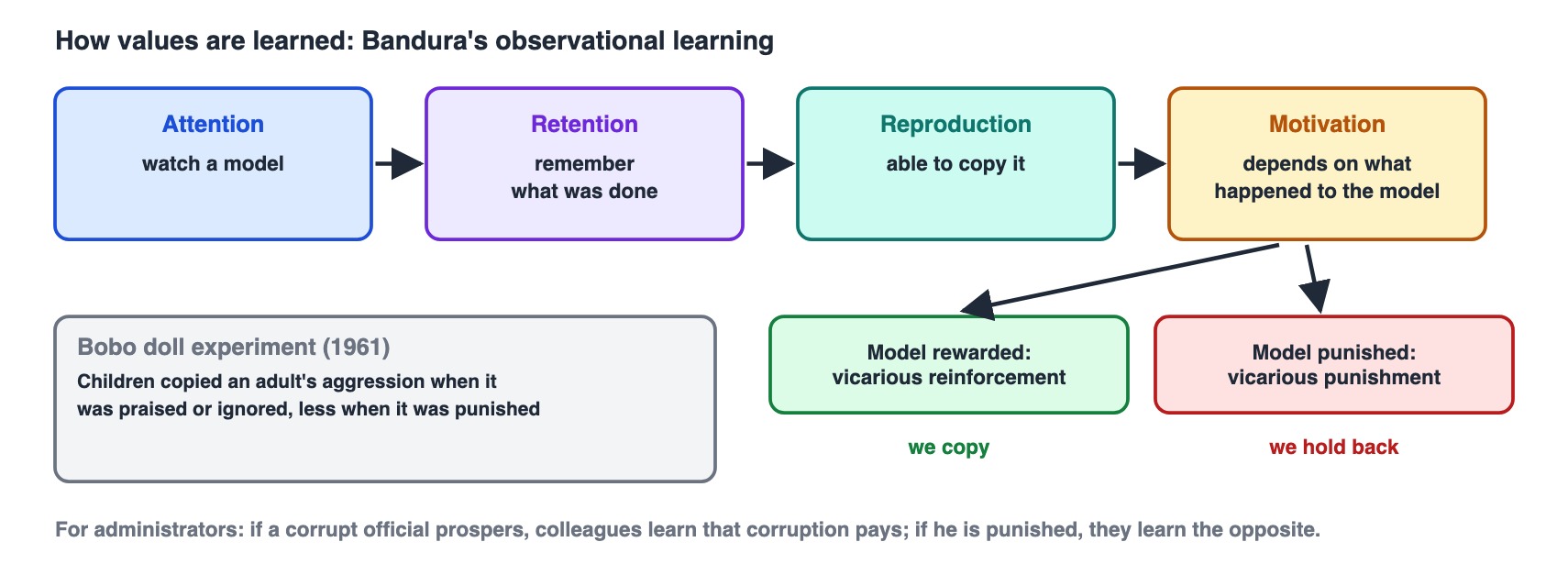
How values are learned by watching others, and why rewarding or punishing a model matters in an office.
Kohlberg's level | When | Basis of 'right' | In an office |
Pre-conventional | Before about age 9 | Avoiding punishment, getting rewards | 'I won't take the bribe because I might be caught' |
Conventional | Early adolescence onwards | Approval of others; obeying rules and law | 'I won't, because the conduct rules forbid it' |
Post-conventional | Only a few fully reach it | Universal principles of justice and human dignity | 'I won't, because it would cheat the poor of what is theirs' |
Two cautions from the same source make good answer material. Moral reasoning differs from moral behaviour: people may "talk the talk" and not "walk the walk". And Carol Gilligan (1982) criticised Kohlberg for studying only upper-class white men and boys; she argued that women often reason through care and relationships, an "ethics of care" that is not inferior but different.
Family, Society, Education and Great Lives
Family, society and educational institutions
Agent | How it instils values | Where it goes wrong |
Family | First and strongest models; children copy what parents do more than what they say (if you want children to read, read to them) | Double standards: parents who preach honesty but evade tax teach evasion |
Society (community, religion, media, peers) | Norms, rituals, role models, public praise and shame | Social approval of dowry, caste prejudice or 'getting things done' through contacts |
Educational institutions | Teachers as models, a fair and transparent school culture, civic and value education, sports and group work | Rote learning, cheating tolerated, marks above character |
Workplace and state | Codes, training, rewards and punishments, the example of seniors | Honest officers penalised; dishonest ones rewarded |
A.P.J. Abdul Kalam's line, set in 2022, names the key trio: to make a country corruption-free and "a nation of beautiful minds", the father, mother and teacher can make the difference. Use Bandura to explain why: children model the adults closest to them. The ARC applies the same logic to government. It wants Public Service Values stipulated by law, with a mechanism to make civil servants keep aspiring to them, because values that are modelled and rewarded spread, while values that are only preached fade.
Lessons from great leaders and reformers
Mahatma Gandhi's Seven Social Sins (Young India, 1925), which the ARC reproduces: politics without principles, wealth without work, leisure without conscience, knowledge without character, commerce without morality, science without humanity, worship without sacrifice. Each pairs a pursuit with the value that must govern it, a ready-made framework for answers on politics, business, technology and religion.
Swami Vivekananda (quoted by the ARC): unselfishness is the foundation of morality and "the quintessence of all ethics", whatever the language, religion or prophet. Four UPSC quotations from 2021 to 2025 are his.
Others in this playlist: Gandhi's trusteeship, Ambedkar's constitutional morality, Guru Nanak and Mahavira (article 07); Kant, Aristotle and Mill (article 06).
Every Quotation Question and How to Answer It
Every quotation question, 2021-2025
Each paper sets three quotations, 10 marks each, 150 words. The core idea of each is below; build the answer around it.
Year | Quotation (author) | Core idea to develop |
2021 | Every work must pass through hundreds of difficulties; those who persevere will see the light (Vivekananda) | Perseverance and resilience: reforms face resistance; the officer who persists delivers |
2021 | No peace in the outer world until we obtain peace within ourselves (Dalai Lama) | Inner calm and self-regulation (emotional intelligence) before resolving others' conflicts |
2021 | Life makes no sense without interdependence; we need each other (Erik Erikson) | Cooperation, community, global commons; administration as teamwork |
2022 | Ethics is knowing the difference between what you have the right to do and what is right to do (Potter Stewart) | Legal vs ethical: discretion used rightly, not merely lawfully |
2022 | Father, mother and teacher can make a nation corruption-free (A.P.J. Abdul Kalam) | Value formation in family and school |
2022 | Judge your success by what you had to give up to get it (Dalai Lama) | Means matter as much as ends; success bought with integrity is failure |
2023 | Simple acts of kindness are more powerful than a thousand heads bowing in prayer (Gandhi) | Compassion in action over ritual; service delivery as kindness |
2023 | To awaken the people, it is the women who must be awakened (Nehru) | Women's empowerment as a multiplier for family, village and nation |
2023 | Do not hate anybody; hatred and love come back to you (Vivekananda) | Reciprocity, tolerance, non-violence |
2024 | Learn what is good from others, but absorb it in your own way; do not become others (Vivekananda) | Open-mindedness with rootedness; adapt global best practice to Indian conditions |
2024 | Faith is of no avail without strength; both are needed for great work (Sardar Patel) | Conviction must be backed by capacity and resolve |
2024 | In law a man is guilty when he violates others' rights; in ethics, if he only thinks of doing so (Kant) | Ethics governs intention and character, law only acts |
2025 | Those who in trouble untroubled are, will trouble trouble itself (Thiruvalluvar) | Equanimity and resilience defeat adversity |
2025 | A human being can alter his life by altering his attitudes (William James) | Attitude change as the root of personal and administrative change |
2025 | The strength of a society is not in its laws, but in the morality of its people (Vivekananda) | Laws need a moral citizenry; the ARC's values-and-institutions balance |
A method for quotation answers
Meaning (2-3 lines): state the idea in your own words; name the value involved (perseverance, compassion, integrity).
Present context: one personal or social example and one from administration (a District Collector persisting with a land-records reform; an officer choosing kindness in a grievance hearing).
Link a thinker or a framework: Kant on intention, Bandura on modelling, the ARC on values and institutions, Gandhi's Seven Social Sins.
Close with relevance for a civil servant: what the quotation asks of you in office.
Common errors: retelling the author's biography, giving only abstract meaning with no example, and ignoring the words "in the present context", which UPSC adds every year.
Further Reading
PIB press releases, ministry websites and annual reports, the Gazette of India, MEA and UN documents and the official sources named in each note — the primary sources behind every fact above.
Test Yourself: Practice Questions & PYQs
12 practice questions, then the GS4 quotation questions of 2021-2025.
Practice Questions
Q1. Bandura's four steps in observational learning are
(a) stimulus, response, reward, habit
(b) perception, memory, judgment, action
(c) imitation, practice, feedback, mastery
(d) attention, retention, reproduction, motivation
Show answer
Answer: (d) — Motivation depends on whether the model was rewarded or punished.
Q2. Copying a behaviour because you saw a colleague rewarded for it is called
(a) vicarious reinforcement
(b) vicarious punishment
(c) cognitive dissonance
(d) operant extinction
Show answer
Answer: (a) — Seeing the model punished, vicarious punishment, reduces copying.
Q3. In the Bobo doll experiment, children imitated the adult's aggression most when the adult was
(a) silent
(b) praised or not punished
(c) punished
(d) absent
Show answer
Answer: (b) — When the adult was punished, children reduced their aggression.
Q4. Kohlberg's theory is about
(a) stages of moral reasoning
(b) group conformity
(c) emotional intelligence
(d) attitude change
Show answer
Answer: (a) — He used dilemmas such as the Heinz dilemma and studied the reasoning behind answers.
Q5. An officer who refuses a bribe only for fear of being caught reasons at Kohlberg's
(a) universal level
(b) conventional level
(c) pre-conventional level
(d) post-conventional level
Show answer
Answer: (c) — Avoiding punishment is the basis of pre-conventional morality.
Q6. According to Kohlberg, post-conventional moral reasoning is
(a) reached by everyone in adolescence
(b) typical before age 9
(c) based on obeying the law
(d) attained fully by only a few
Show answer
Answer: (d) — Conventional morality rests on approval and rules; post-conventional on universal principles.
Q7. Carol Gilligan criticised Kohlberg because his theory
(a) was based only on upper-class white men and boys
(b) rejected stages
(c) was not based on dilemmas
(d) ignored children
Show answer
Answer: (a) — She argued that women often reason through care and relationships.
Q8. Gandhi's 'Seven Social Sins' appeared in
(a) Hind Swaraj, 1909
(b) Young India, 1925
(c) Indian Opinion, 1904
(d) Harijan, 1946
Show answer
Answer: (b) — The 2nd ARC reproduces them in its 'Ethics in Governance' report.
Q9. Consider the following statements:
1. 'Wealth without work' is one of Gandhi's Seven Social Sins.
2. 'Science without humanity' is one of them.
3. 'Law without punishment' is one of them.
Which of the statements given above are correct?
(a) 1 and 2 only
(b) 2 and 3 only
(c) 1 and 3 only
(d) 1, 2 and 3
Show answer
Answer: (a) — 1 and 2 are correct. The seven: politics without principles, wealth without work, leisure without conscience, knowledge without character, commerce without morality, science without humanity, worship without sacrifice.
Q10. The quotation 'In law, a man is guilty when he violates the rights of others. In ethics, he is guilty if he only thinks of doing so' (GS4 2024) is by
(a) Sardar Patel
(b) Swami Vivekananda
(c) Immanuel Kant
(d) John Stuart Mill
Show answer
Answer: (c) — It contrasts law, which governs acts, with ethics, which governs intention.
Q11. Whom did A.P.J. Abdul Kalam name as the three societal members who can make a nation corruption-free?
(a) Priest, teacher and doctor
(b) Father, mother and teacher
(c) Judge, police and press
(d) Leader, officer and citizen
Show answer
Answer: (b) — UPSC set this quotation in 2022.
Q12. The 2nd ARC recommends that Public Service Values should be
(a) set by each State separately without law
(b) stipulated by law
(c) left to each officer's conscience
(d) replaced by codes of conduct
Show answer
Answer: (b) — It cites Australia's Public Service Act of 1999 as a model.
Mains Practice Questions
Use these to frame full-length answers. You don't have to answer one exactly — they show the angles UPSC tests, so let them guide which points you cover.
What is the role of family, society and educational institutions in inculcating values? Illustrate.
Using Kohlberg's stages, explain why fear of punishment is not enough to keep public servants honest.
Pick any one of Gandhi's Seven Social Sins and explain its relevance to governance today.
UPSC Mains — Previous Years’ Questions on this topic (last 10 years)
These are the actual GS Mains questions UPSC has asked on this theme — real proof of how, and when, it is tested. Try to write a full answer to each.
2021 (GS-IV): What does each of the following quotations mean to you? Vivekananda (perseverance), Dalai Lama (peace within), Erik Erikson (interdependence).
2022 (GS-IV): Potter Stewart (right to do vs right to do), A.P.J. Abdul Kalam (father, mother and teacher), Dalai Lama (what you gave up).
2023 (GS-IV): Gandhi (acts of kindness), Nehru (awaken the women), Vivekananda (do not hate anybody).
2024 (GS-IV): Vivekananda (learn from others), Sardar Patel (faith and strength), Immanuel Kant (law and ethics).
2025 (GS-IV): Thiruvalluvar (untroubled in trouble), William James (altering attitudes), Vivekananda (morality of the people).