Female Genital Tract for NEET PG Pathology: Cervical Cancer and CIN, Endometrial Cancer, Fibroids, Endometriosis, Ovarian Tumours, Molar Pregnancy
Start Here
🎯 Exam priority: High. Expect: HPV types and the transformation zone, CIN grades and Bethesda terms, type I vs II endometrial cancer, fibroid degeneration, endometriosis sites and chocolate cyst, PCOS criteria, ovarian tumour classes, Meigs syndrome, dermoid cyst, and complete vs partial mole.
CBME mapping: PA 29.1–29.10. Breast is article 25; tumour markers in general are in article 4.
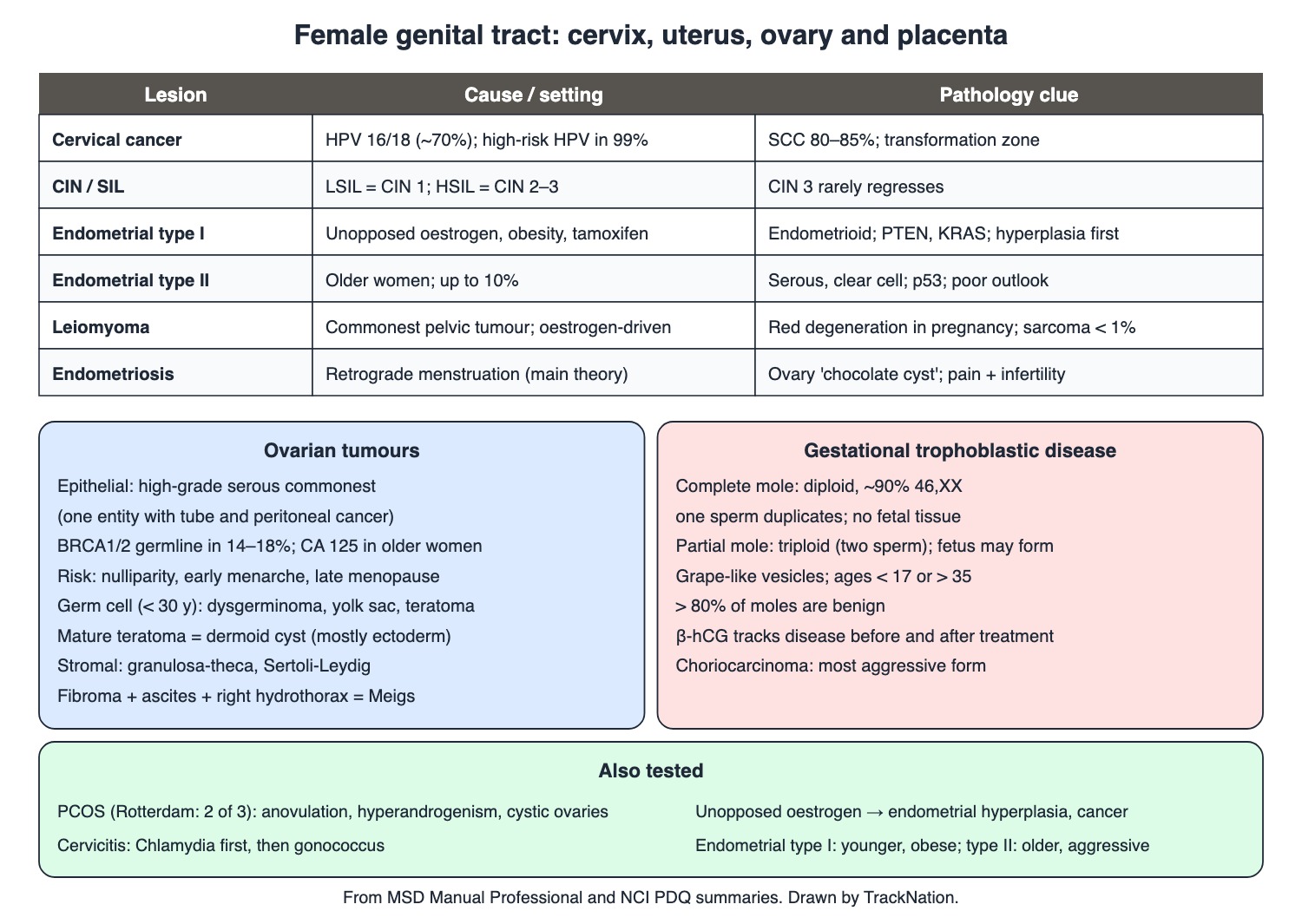
Cervix, uterus, ovary and placenta. Drawn by TrackNation.
Cervix
Cervicitis: usually sexually transmitted — Chlamydia trachomatis first, then N. gonorrhoeae; also HSV, Trichomonas, Mycoplasma genitalium.
HPV: types 16 and 18 cause about 70% of precancer and cancer; DNA of a high-risk type is found in 99% of cervical cancers. Smoking and immunodeficiency add risk.
Nearly all carcinomas start in the transformation zone (squamous metaplasia around the external os). The precursor is CIN: 1 mild, 2 moderate, 3 severe dysplasia/carcinoma in situ. CIN 3 rarely regresses. Bethesda cytology: LSIL = HPV change (koilocytosis) or CIN 1; HSIL = CIN 2–3.
Cervical cancer: squamous cell carcinoma 80–85%; most of the rest adenocarcinoma.
Uterus
Endometrial carcinoma presents with postmenopausal bleeding and is usually preceded by endometrial hyperplasia. Risk factors: unopposed oestrogen, age over 45, obesity, tamoxifen over 2 years, Lynch syndrome, pelvic radiation, PCOS.
Type I (commoner, non-aggressive): oestrogen-responsive, younger obese women, endometrioid (75–80% of all endometrial cancers), mutations in PTEN, PIK3CA, KRAS, CTNNB1. Type II (up to 10%, aggressive): older women, high-grade, serous or clear cell; p53 mutations in 10–30%.
Leiomyoma (fibroid): benign smooth muscle tumour of the myometrium and the commonest pelvic tumour. Subserosal, intramural or submucosal; grows in the reproductive years and shrinks after menopause (oestrogen). Degeneration: hyaline, myxomatous, calcific, cystic, fatty, red (in pregnancy). Sarcomatous change in < 1%.
Endometriosis: endometrial tissue implanted outside the uterus — ovaries, broad and uterosacral ligaments, pouch of Douglas, peritoneum. Retrograde menstruation is the leading theory. Triad: dysmenorrhoea, dyspareunia, infertility. Ovarian endometrioma = chocolate cyst.
PCOS (Rotterdam, 2 of 3): oligo/anovulation, hyperandrogenism, polycystic ovaries; insulin resistance and obesity are common. Unopposed oestrogen raises the risk of endometrial hyperplasia and cancer.
Ovary
Epithelial tumours dominate; stromal and germ cell tumours are under 10%. High-grade serous carcinoma is the commonest and is treated as one entity with fallopian tube and primary peritoneal cancer. Germline BRCA1/2 in 14–18%. Risk: nulliparity, delayed childbearing, early menarche, late menopause, family history; oral contraceptives lower risk. CA 125 is the marker in older women.
Germ cell tumours: under 30 years; dysgerminoma, yolk sac (endodermal sinus) tumour, embryonal carcinoma, choriocarcinoma, immature teratoma; XY gonadal dysgenesis predisposes. Mature cystic teratoma (dermoid) is benign and mostly ectodermal.
Sex cord-stromal: granulosa-theca and Sertoli-Leydig cell tumours. Meigs syndrome = benign ovarian fibroma + ascites + right hydrothorax. Metastases to the ovary come from breast and GI cancers.
Any adnexal mass over about 4 cm can twist (torsion).
Gestational Trophoblastic Disease
Hydatidiform moles: grape-like vesicles; commonest under 17 or over 35 years. Most (> 80%) are benign, but β-hCG is followed to detect persistent disease. Theca lutein cysts over 6 cm mark higher risk.
Choriocarcinoma is the most aggressive form of GTD.
Feature | Complete mole | Partial mole |
Karyotype | Diploid; about 90% 46,XX | Triploid |
Origin | One sperm duplicates; ovum nucleus absent or inactive | Two sperm (or a diploid sperm) + ovum |
Fetal tissue | Does not form | A fetus may develop but does not survive |
Behaviour | Most moles (> 80%) are benign; β-hCG monitors disease | As for complete |
Traps the Examiner Sets
Complete mole = diploid, all paternal, no fetus; partial = triploid, fetal parts.
Meigs = fibroma + ascites + RIGHT hydrothorax.
Type I endometrial = oestrogen + PTEN; type II = serous + p53.
Red degeneration of a fibroid = pregnancy.
LSIL = CIN 1; HSIL = CIN 2 and 3.
Memory Hooks & Shortcuts
Shortcuts to lock in this article's numbers and lists. Each one only re-packages facts proven above.
🧠 Complete = Copy of dad (46,XX paternal), no baby — complete mole
🧠 Partial = Plus one set (triploid), Part of a fetus — partial mole
🧠 Meigs: Mass (fibroma) + Moist belly (ascites) + Right lung water — Meigs syndrome
🧠 Type I = I'm oestrogen fed; Type II = Too aggressive (p53) — endometrial cancer
🧠 Red degeneration = Ready to deliver (pregnancy) — fibroid
🧠 LSIL = Little (CIN 1); HSIL = Heavy (CIN 2–3) — Bethesda
Rapid-Revision Cards
Cervicitis
Chlamydia > gonococcus.
HPV in cervical cancer
16/18 ~70%; high-risk HPV 99%.
Site of cervical cancer
Transformation zone.
Cervical cancer type
SCC 80–85%; rest adenocarcinoma.
Bethesda
LSIL = CIN 1; HSIL = CIN 2–3.
CIN 3
Rarely regresses.
Endometrial type I
Oestrogen, obesity; endometrioid; PTEN, KRAS.
Endometrial type II
Older; serous/clear cell; p53; ≤ 10%.
Endometrial risks
Unopposed oestrogen, obesity, tamoxifen, Lynch, PCOS.
Fibroid
Commonest pelvic tumour; oestrogen-driven.
Red degeneration
Fibroid in pregnancy.
Fibroid → sarcoma
< 1%.
Endometriosis triad
Dysmenorrhoea, dyspareunia, infertility.
Chocolate cyst
Ovarian endometrioma.
PCOS (Rotterdam)
2 of 3: anovulation, androgens, cystic ovaries.
Ovarian cancer type
High-grade serous (with tube, peritoneum).
Ovarian BRCA
Germline 14–18% of HGSC.
OCP and ovary
Lowers risk.
Ovarian germ cell
< 30 years; dysgerminoma, yolk sac, teratoma.
Dermoid
Mature teratoma, mostly ectoderm.
Meigs
Fibroma + ascites + right hydrothorax.
Complete mole
Diploid 46,XX; no fetus.
Partial mole
Triploid; fetal parts.
GTD marker
β-hCG.
Sources
Facts in this article were checked against these documents.
MSD Manual Professional: Cervical Cancer; Endometrial Cancer; Ovarian, Fallopian Tube and Peritoneal Cancer; Gestational Trophoblastic Disease — Merck & Co. (MSD Manuals), reviewed 2023–26 (link)
MSD Manual Professional: Uterine Fibroids; Endometriosis; Benign Adnexal Masses; Cervicitis; Polycystic Ovary Syndrome — Merck & Co. (MSD Manuals), reviewed 2025–26 (link)
PDQ Ovarian Epithelial, Ovarian Germ Cell and Gestational Trophoblastic Disease Treatment (Health Professional Version) — US National Cancer Institute, 2025–26 (link)
Competency Based Undergraduate Curriculum, Pathology (PA 29) — National Medical Commission, 2024
Test Yourself: Practice Questions
Thirty-two questions in NEET PG style, most of them clinical vignettes.
Practice Questions (NEET PG pattern)
Original questions written in the style of the exam: +4 for a correct answer, −1 for a wrong one. Every answer was checked against the sources listed above. NEET PG papers are not published by NBEMS, so these are not past-paper questions.
Q1. A sexually active woman has mucopurulent cervical discharge. The commonest infectious cause is
(a) Chlamydia trachomatis
(b) Candida albicans
(c) Gardnerella
(d) Neisseria gonorrhoeae
Show answer
Answer: (a) — Gonococcus is second.
Q2. Most precancerous and invasive cervical lesions are attributable to HPV types
(a) 6 and 11
(b) 31 and 33 only
(c) 16 and 18
(d) 1 and 2
Show answer
Answer: (c) — About 70%; high-risk HPV DNA is found in 99% of cancers.
Q3. Nearly all cervical carcinomas arise in the
(a) isthmus
(b) vaginal fornix
(c) endocervical glands deep in the canal
(d) transformation zone
Show answer
Answer: (d) — The zone of squamous metaplasia around the external os.
Q4. The commonest histological type of cervical cancer is
(a) sarcoma
(b) squamous cell carcinoma
(c) adenocarcinoma
(d) small cell neuroendocrine carcinoma
Show answer
Answer: (b) — 80–85%.
Q5. A Pap smear shows changes of HPV infection (koilocytosis) or mild dysplasia. In the Bethesda system this is reported as
(a) HSIL
(b) AGC
(c) ASC-H
(d) LSIL
Show answer
Answer: (d) — HSIL covers CIN 2 and CIN 3.
Q6. Which cervical lesion is least likely to regress on its own?
(a) koilocytosis alone
(b) CIN 1
(c) squamous metaplasia
(d) CIN 3
Show answer
Answer: (d) — Untreated, it may invade over months or years.
Q7. An obese perimenopausal woman has abnormal uterine bleeding; biopsy shows a low-grade endometrioid adenocarcinoma. The tumour type and a typical mutation are
(a) type II — BRCA1
(b) type II — p53 in all
(c) type I — HER2 amplification
(d) type I — PTEN
Show answer
Answer: (d) — Type I is oestrogen-responsive and commoner.
Q8. The usual precursor of endometrioid endometrial carcinoma is
(a) endometrial hyperplasia
(b) leiomyoma
(c) endometrial polyp always
(d) adenomyosis
Show answer
Answer: (a) — Driven by unopposed oestrogen.
Q9. A breast cancer survivor on tamoxifen for 4 years develops abnormal uterine bleeding. Tamoxifen raises the risk of
(a) ovarian dysgerminoma
(b) cervical carcinoma
(c) leiomyoma regression
(d) endometrial carcinoma
Show answer
Answer: (d) — Tamoxifen use over 2 years is a listed risk factor.
Q10. Which endometrial carcinoma is aggressive, occurs in older women and often carries p53 mutations?
(a) serous carcinoma (type II)
(b) grade 1 endometrioid carcinoma
(c) endometrial hyperplasia
(d) adenomyosis
Show answer
Answer: (a) — Type II is up to 10% of cases.
Q11. An inherited syndrome raising the risk of endometrial cancer is
(a) Turner syndrome
(b) Marfan syndrome
(c) Lynch syndrome
(d) Peutz-Jeghers only
Show answer
Answer: (c) — Also obesity, unopposed oestrogen, tamoxifen.
Q12. The commonest pelvic tumour in women is
(a) leiomyoma (fibroid)
(b) ovarian serous carcinoma
(c) endometrial carcinoma
(d) dermoid cyst
Show answer
Answer: (a) — A benign smooth muscle tumour of the myometrium.
Q13. The type of fibroid degeneration seen usually only in pregnancy is
(a) calcific degeneration
(b) sarcomatous change
(c) red degeneration
(d) hyaline degeneration
Show answer
Answer: (c) — Red degeneration occurs usually only during pregnancy.
Q14. Malignant (sarcomatous) change in a uterine fibroid occurs in
(a) less than 1%
(b) about 25%
(c) most cases after menopause
(d) about 10%
Show answer
Answer: (a) — Leiomyosarcoma is rare.
Q15. Fibroids enlarge during the reproductive years and shrink after menopause because they are
(a) androgen-driven
(b) insulin-driven
(c) independent of hormones
(d) oestrogen-responsive
Show answer
Answer: (d) — Hence treatment with GnRH analogues.
Q16. A woman with dysmenorrhoea, dyspareunia and infertility has an ovarian cyst full of old blood. The cyst is
(a) an endometrioma (chocolate cyst)
(b) a dermoid cyst
(c) a serous cystadenoma
(d) a corpus luteum cyst
Show answer
Answer: (a) — The classic triad of endometriosis.
Q17. The leading theory of how endometriosis begins is
(a) adenomyosis spreading through the wall only
(b) BRCA mutation
(c) retrograde menstruation through the fallopian tubes
(d) HPV infection
Show answer
Answer: (c) — Commonest sites: ovaries, ligaments, pouch of Douglas, peritoneum.
Q18. A woman has irregular cycles, hirsutism and polycystic ovaries on ultrasound. Long-term she is at increased risk of
(a) dysgerminoma
(b) choriocarcinoma
(c) cervical carcinoma
(d) endometrial hyperplasia and carcinoma
Show answer
Answer: (d) — Unopposed oestrogen from anovulation.
Q19. The Rotterdam criteria for PCOS require
(a) a positive pregnancy test
(b) all 3 plus obesity
(c) 2 of 3: anovulation, hyperandrogenism, polycystic ovaries
(d) raised prolactin
Show answer
Answer: (c) — Insulin resistance is common but not a criterion.
Q20. The commonest histological type of ovarian cancer is
(a) granulosa cell tumour
(b) Krukenberg tumour
(c) dysgerminoma
(d) high-grade serous carcinoma
Show answer
Answer: (d) — Treated as one entity with tubal and peritoneal cancer.
Q21. A woman with high-grade serous ovarian cancer is tested for germline mutations. The genes found in about 14–18% are
(a) APC
(b) VHL
(c) RB1
(d) BRCA1 and BRCA2
Show answer
Answer: (d) — Another 3% have somatic BRCA mutations.
Q22. Which factor lowers the risk of epithelial ovarian cancer?
(a) oral contraceptive use
(b) early menarche
(c) late menopause
(d) nulliparity
Show answer
Answer: (a) — Fewer ovulations.
Q23. A 19-year-old has an aggressive ovarian tumour. The tumour class most likely at her age is
(a) germ cell tumour
(b) Brenner tumour
(c) high-grade serous carcinoma
(d) metastatic breast cancer
Show answer
Answer: (a) — Germ cell cancers usually occur under 30.
Q24. A benign ovarian cyst contains tissue from all three germ layers, mostly ectoderm. It is
(a) a mature cystic teratoma (dermoid)
(b) an endometrioma
(c) a mucinous cystadenoma
(d) a dysgerminoma
Show answer
Answer: (a) — A germ cell tumour that rarely becomes malignant.
Q25. A woman with a benign ovarian tumour has ascites and a right pleural effusion. This is
(a) pseudomyxoma peritonei
(b) Krukenberg tumour
(c) Meigs syndrome with an ovarian fibroma
(d) ovarian hyperstimulation
Show answer
Answer: (c) — Fibroma + ascites + right hydrothorax.
Q26. Which of these is a sex cord-stromal tumour of the ovary?
(a) granulosa-theca cell tumour
(b) dysgerminoma
(c) serous cystadenocarcinoma
(d) yolk sac tumour
Show answer
Answer: (a) — Sertoli-Leydig cell tumour is another.
Q27. A patient with XY gonadal dysgenesis is at increased risk of
(a) serous carcinoma
(b) endometriosis
(c) leiomyoma
(d) ovarian germ cell tumours
Show answer
Answer: (d) — Germ cell cancers usually occur under 30.
Q28. Evacuated uterine contents show grape-like vesicles with no fetal tissue; the karyotype is 46,XX. This is
(a) a partial mole
(b) a complete hydatidiform mole
(c) choriocarcinoma
(d) a normal abortion
Show answer
Answer: (b) — One sperm duplicates; the ovum nucleus is absent or inactive.
Q29. A molar pregnancy with some fetal parts and a triploid karyotype is
(a) a placental site trophoblastic tumour
(b) a partial mole
(c) an invasive mole always
(d) a complete mole
Show answer
Answer: (b) — Fertilisation by two sperm or a diploid sperm.
Q30. After evacuation of a molar pregnancy, the test used to detect persistent trophoblastic disease is
(a) CEA
(b) serum beta-hCG
(c) CA 125
(d) AFP
Show answer
Answer: (b) — A sensitive marker before, during and after treatment.
Q31. The most aggressive form of gestational trophoblastic disease is
(a) theca lutein cyst
(b) partial mole
(c) choriocarcinoma
(d) complete mole
Show answer
Answer: (c) — Most moles (> 80%) are benign.
Q32. Hydatidiform mole is most common in women who are
(a) nulliparous at 25
(b) postmenopausal
(c) aged 20–30
(d) younger than 17 or older than 35
Show answer
Answer: (d) — Prior GTD is another risk.
Active Recall
From memory: name the causes of cervicitis; explain HPV, the transformation zone, CIN grades and Bethesda terms; contrast type I and type II endometrial cancer and list risk factors; describe fibroids, endometriosis and PCOS; classify ovarian tumours and define Meigs syndrome and the dermoid cyst; and compare complete and partial moles.