Capitalism, Socialism and Communism for UPSC GS1: Adam Smith, Marx, Social Democracy, Anarchism, the Russian Revolution and Stalin's USSR
Capitalism and the Varieties of Socialism
🎯 Exam priority: Important (Mains GS1). The GS1 syllabus names "political philosophies like communism, capitalism, socialism etc., their forms and effect on the society". This article explains each ideology, how it arose from industrial society, and the first communist state it produced in Russia.
Capitalism
From mercantilism to laissez-faire: mercantilists sought national wealth by hoarding precious metals and exporting more than importing. Adam Smith's The Wealth of Nations (1776) argued that trade can benefit all nations; laissez-faire held that market forces alone should drive the economy, with little government intervention.
Forms and effects: private ownership, profit and markets drove industrialisation and created vast wealth, but at a high cost to workers: long hours, dangerous work and loss of control over working conditions (article 04). Later forms added regulation and welfare: laws against child labour, worker insurance, safe housing and pollution control.
Socialism and its varieties
Strand | Idea | Example |
Utopian socialism | Model communities built on cooperation | Robert Owen's New Lanark (Britain) and New Harmony (USA): shorter hours, schooling, decent housing |
Marxism | History is class struggle; the bourgeoisie owns the means of production and exploits labour; capitalism will collapse and workers will take control | The Communist Manifesto (Marx and Engels, 1848) |
Social democracy | Achieve socialist goals peacefully, through unions, elections and laws | Social democratic parties in Europe; welfare legislation |
Revolutionary socialism and communism | Overthrow capitalism by revolution; public ownership of the means of production | The Bolsheviks in Russia |
Anarchism | Abolish government itself | Mikhail Bakunin, who clashed with Marx |
Socialists of all kinds met in the International Workingmen's Association, founded in London in 1864, but split between those favouring violence and those favouring peaceful, democratic means (the social democrats).
The Russian Revolution and Stalin
The Russian Revolution
Date | Event |
1905 | 'Bloody Sunday': troops fire on peaceful marchers; the Revolution of 1905 forces Tsar Nicholas II to accept an elected legislature, the Duma (first met 1906), though his appointees dominated it |
February (March) 1917 | Strikes in Petrograd during the First World War; the tsar abdicates; a provisional government under Alexander Kerensky keeps Russia in the war |
October (November) 1917 | Lenin's Bolsheviks seize power promising 'Peace, Land, Bread' |
3 March 1918 | Treaty of Brest-Litovsk: Russia leaves the war, ceding Poland, Ukraine, Finland and the Baltic states |
1918-1921 | Civil war; 'war communism' leaves the economy essentially bankrupt |
1921 | New Economic Policy (NEP): state control of key sectors but private trade, peasants free to sell produce |
1922 | The Union of Soviet Socialist Republics (USSR) established |
After Lenin's death | Joseph Stalin takes power |
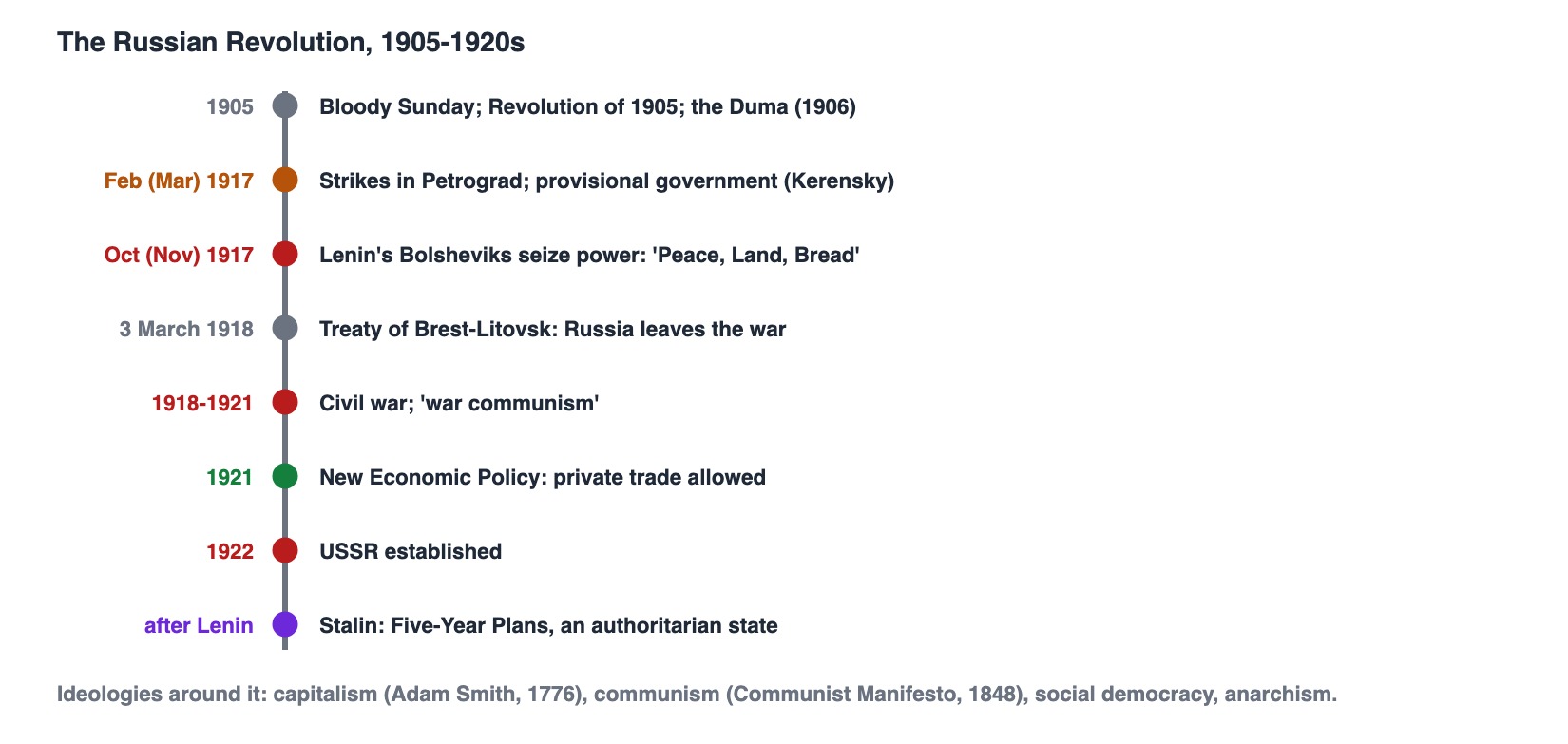
The Russian Revolution from 1905 to Stalin.
Stalin's USSR
Five-Year Plans: centralised economic control and rapid industrialisation, with a more authoritarian state that compelled obedience whatever the cost.
Collectivisation: peasants forced into collective farms; better-off peasants (kulaks) became scapegoats; in the Ukrainian famine known as the Holodomor, about 3.9 million people died.
Terror: after the assassination of Sergei Kirov in 1934, anyone suspected of disloyalty faced prison or death.
Comparing the Ideologies; Fascism; India's Path
Forms and effects on society: a comparison
Capitalism | Socialism / social democracy | Communism (Soviet model) | |
Ownership | Private | Mixed; public ownership of key sectors | State ownership of the means of production |
Coordination | Markets | Markets with planning and welfare | Central planning |
Gains | Innovation, growth, consumer goods | Welfare, labour rights, worker protection | Rapid, state-driven industrialisation |
Costs | Inequality, insecurity, exploitation in early phases | Fiscal burden, slower growth if over-regulated | Loss of freedom, famine, terror, inefficiency |
Fascism: the ideology of the right
Born of the First World War and economic crisis, fascism sought to turn citizens into committed nationalists striving for unity and racial purity, glorified violence, and abandoned democratic norms and the rule of law. Mussolini's Italy and Hitler's Germany are covered in article 08.
India's path
India's Constitution and planning blended these traditions: a democratic state, a mixed economy with a large public sector and Five-Year Plans, but without the Soviet model's coercion, and Directive Principles aimed at welfare. The Post-independence India playlist covers planning and the 1991 reforms.
Further Reading
PIB press releases, ministry websites and annual reports, the Gazette of India, MEA and UN documents and the official sources named in each note — the primary sources behind every fact above.
Test Yourself: Practice Questions & PYQs
12 practice questions on ideologies and the Russian Revolution.
Practice Questions
Q1. Adam Smith's The Wealth of Nations was published in
(a) 1776
(b) 1848
(c) 1867
(d) 1690
Show answer
Answer: (a) — He argued that trade can benefit all nations.
Q2. Laissez-faire economics holds that
(a) trade should be banned
(b) market forces alone should drive the economy
(c) nations should hoard gold
(d) the state should own all industry
Show answer
Answer: (b) — Governments should refrain from intervening.
Q3. The Communist Manifesto (1848) was written by
(a) Marx and Engels
(b) Bakunin and Proudhon
(c) Lenin and Trotsky
(d) Owen and Fourier
Show answer
Answer: (a) — It opens with history as class struggle.
Q4. Robert Owen's New Lanark was an example of
(a) fascism
(b) anarchism
(c) laissez-faire
(d) utopian socialism
Show answer
Answer: (d) — He also founded New Harmony in the USA.
Q5. Socialists who favoured peaceful, democratic means are called
(a) Bolsheviks
(b) anarchists
(c) social democrats
(d) fascists
Show answer
Answer: (c) — The split occurred within the International Workingmen's Association (1864).
Q6. Anarchism, associated with Mikhail Bakunin, advocates
(a) state ownership
(b) monarchy
(c) free markets only
(d) abolition of government
Show answer
Answer: (d) — Bakunin clashed with Marx.
Q7. Russia's first elected legislature after 1905 was the
(a) Soviet
(b) Duma
(c) Politburo
(d) Zemstvo
Show answer
Answer: (b) — It first met in 1906.
Q8. Lenin's slogan in 1917 was
(a) Blood and Iron
(b) Liberty, Equality, Fraternity
(c) Workers of the World, Unite
(d) Peace, Land, Bread
Show answer
Answer: (d) — The Bolsheviks seized power in October 1917.
Q9. By the Treaty of Brest-Litovsk (1918), Russia
(a) left the First World War, ceding large territories
(b) gained Poland
(c) became a monarchy again
(d) joined the Allies
Show answer
Answer: (a) — It gave up Poland, Ukraine, Finland and the Baltic states.
Q10. The New Economic Policy of 1921
(a) allowed some private trade under overall state control
(b) collectivised all farms
(c) abolished all markets
(d) restored the tsar
Show answer
Answer: (a) — It replaced war communism.
Q11. Consider the following statements:
1. The USSR was established in 1922.
2. Stalin's collectivisation led to the Holodomor famine in Ukraine.
3. Stalin abolished central planning.
Which of the statements given above are correct?
(a) 1 and 2 only
(b) 2 and 3 only
(c) 1 and 3 only
(d) 1, 2 and 3
Show answer
Answer: (a) — 1 and 2 are correct. Stalin's Five-Year Plans centralised planning.
Q12. Peasants who prospered under the NEP and became scapegoats under Stalin were called
(a) zamindars
(b) Junkers
(c) boyars
(d) kulaks
Show answer
Answer: (d) — They were targeted during collectivisation.
Mains Practice Questions
Use these to frame full-length answers. You don't have to answer one exactly — they show the angles UPSC tests, so let them guide which points you cover.
Compare capitalism, socialism and communism in their forms and effects on society.
Why did the Russian Revolution of 1917 succeed?
How did Indian planning combine socialist and democratic traditions?
UPSC Mains — Previous Years’ Questions on this topic (last 10 years)
These are the actual GS Mains questions UPSC has asked on this theme — real proof of how, and when, it is tested. Try to write a full answer to each.
No GS1 question of 2019 or 2021-2026 asked directly about these ideologies; the syllabus names them, and 2026 asked about India's planned economy (Post-independence India playlist).