The First World War for UPSC GS1: Alliances and the Balance of Power, Sarajevo, Total War, Versailles and the Fourteen Points
Causes and the Trigger
🎯 Exam priority: High-yield (Mains GS1). "World wars" are named in the GS1 syllabus, and 2024 asked: "How far is it correct to say that the First World War was fought essentially for the preservation of balance of power?" Know the long-term causes, the trigger, the course, and the settlement.
Long-term causes
Cause | Detail |
Alliances and the balance of power | Europe was organised into alliances meant to stop any one power becoming too strong: the Triple Entente (France, Russia and Britain, 1907) against the Triple Alliance of Germany, Austria-Hungary and Italy; in the war the Central powers were Germany, Austria-Hungary and the Ottoman Empire |
Imperial and naval rivalry | Germany's quest for colonies and a bigger navy put it in direct competition with Britain; the HMS Dreadnought (1906) set off a naval arms race |
Militarism | Mass armies: Germany had close to four million active soldiers; others expanded in response; war plans such as the Schlieffen Plan |
Nationalism | Subject peoples of Austria-Hungary and the Ottoman Empire wanted their own states; the Balkans became Europe's most explosive region |
Ottoman decline | Defeats and nationalist revolts left a power vacuum in the Balkans that Austria-Hungary and Russia contested |
The trigger: Sarajevo, June 1914
On 28 June 1914 Gavrilo Princip, a Bosnian Serb, shot Archduke Franz Ferdinand, heir to Austria-Hungary, and his wife Sophie in Sarajevo. Austria-Hungary declared war on Serbia; Russia backed Serbia; Germany backed Austria-Hungary; alliance obligations pulled in France and then Britain, which declared war on 4 August after Germany invaded neutral Belgium under the Schlieffen Plan.
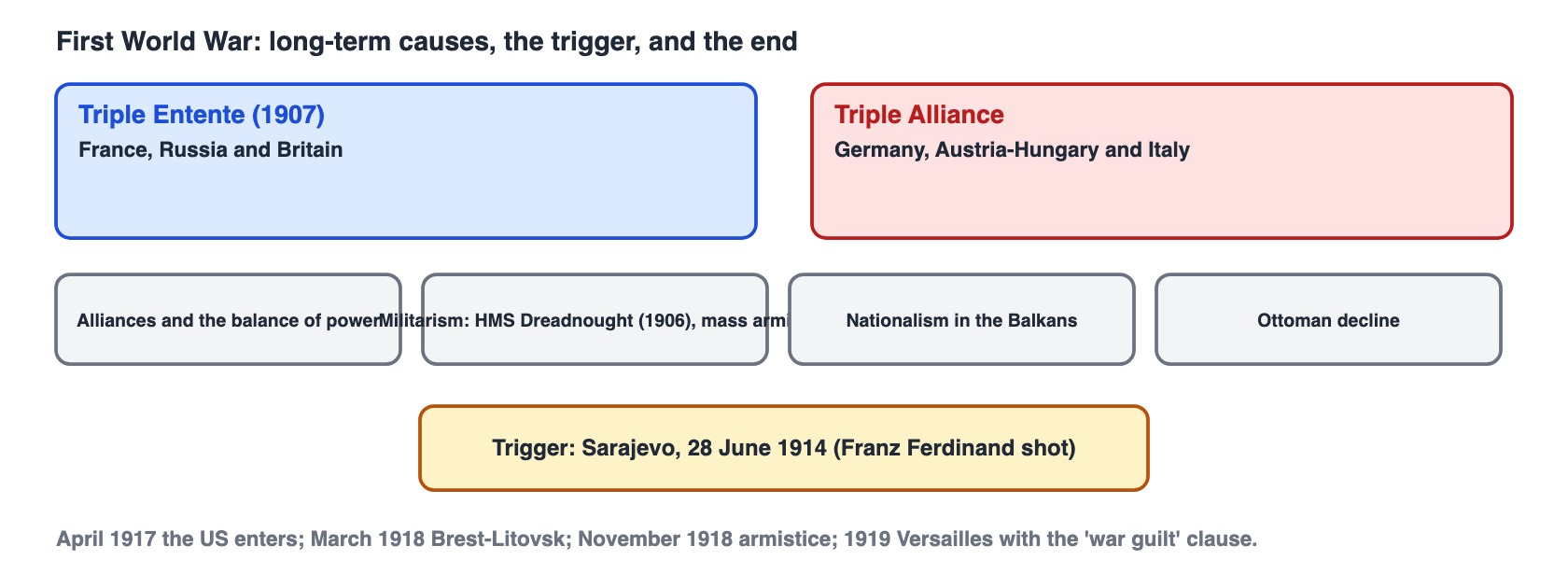
Alliances, long-term causes and the trigger of the First World War.
Course of the War and Total War
Course of the war
Date | Event |
September 1914 | Battle of the Marne halts the German advance on Paris; trench stalemate on the western front for years |
1915 | Gallipoli: a failed Allied landing against the Ottomans; the liner Lusitania sunk by a German submarine (May) |
1916 | Battle of Verdun (from February), meant to 'bleed France'; Britain readies its first tanks for the Somme |
March 1917 | Zimmermann Telegram (German offer to Mexico) published; Russian Revolution |
April 1917 | The United States enters on the Allied side |
March 1918 | Treaty of Brest-Litovsk: Russia leaves the war |
November 1918 | Armistice; Germany's offensive had failed against fresh Allied armies, amid a deadly influenza pandemic |
Total war
New technology: tanks, machine guns, long-range artillery, airplanes and submarines made killing industrial.
A world war: empires brought troops from colonies and dominions, including India; fighting spread to Asia and Africa; racial discrimination marked the treatment of colonial soldiers.
Home front: governments controlled industry by new laws, women entered new jobs, and votes for women followed: Britain (property-owning women over thirty) and Germany in 1918, the United States in 1920.
The Peace Settlement and the 2024 Question
The peace settlement
Wilson's Fourteen Points (January 1918): freedom of the seas, rights of neutrals, breaking up the empires blamed for the war, self-determination (each ethnic group with its own government), and a League of Nations for collective security.
Treaty of Versailles (1919): a "war guilt" clause blamed Germany; reparations of more than $33 billion; Germany lost territory. New states such as Czechoslovakia and Yugoslavia appeared, with borders drawn by diplomats in Paris that left ethnic issues unsolved; Yugoslavia, "simply a diplomatic creation", did not survive the century.
Empires redistributed: the Ottoman and German colonies became "mandates" of Britain and France, not independent states.
Was it fought to preserve the balance of power? (2024)
Yes, in large part: the alliance system existed precisely to prevent any one power dominating Europe. Britain went to war when Germany's invasion of Belgium and France threatened German domination of the continent; Russia and Germany each feared the other's gains in the Balkans; Britain feared Germany's navy.
But not essentially: other drivers were as powerful: nationalism (Serbian, Balkan and subject peoples), imperial and economic rivalry over colonies and markets, militarism and rigid war plans that turned a local crisis into a general war, the collapse of the Ottoman Empire, and miscalculation by leaders who expected a short war. And the peace was not about balance: Versailles punished Germany, which ultimately destroyed the balance it claimed to restore.
Conclusion: balance-of-power politics provided the framework, but nationalism, imperialism and militarism supplied the fuel; the war was fought as much to win empire and security as to preserve equilibrium.
Further Reading
PIB press releases, ministry websites and annual reports, the Gazette of India, MEA and UN documents and the official sources named in each note — the primary sources behind every fact above.
Test Yourself: Practice Questions & PYQs
12 practice questions, then the GS1 question on the First World War.
Practice Questions
Q1. The Triple Entente of 1907 consisted of
(a) France, Russia and Britain
(b) Britain, Germany and Russia
(c) France, Italy and Serbia
(d) Germany, Austria-Hungary and Italy
Show answer
Answer: (a) — The Triple Alliance was Germany, Austria-Hungary and Italy.
Q2. HMS Dreadnought (1906) symbolised
(a) the Schlieffen Plan
(b) the League of Nations
(c) the Balkan Wars
(d) the Anglo-German naval arms race
Show answer
Answer: (d) — Germany's naval ambitions challenged Britain.
Q3. Archduke Franz Ferdinand was assassinated in June 1914 in
(a) Vienna
(b) Sarajevo
(c) Belgrade
(d) Berlin
Show answer
Answer: (b) — By Gavrilo Princip, a Bosnian Serb.
Q4. The Schlieffen Plan aimed to
(a) invade Britain
(b) occupy the Balkans
(c) defeat France quickly via Belgium before turning on Russia
(d) attack Russia first
Show answer
Answer: (c) — The invasion of Belgium brought Britain into the war.
Q5. The Battle of the Marne (September 1914) led to
(a) German capture of Paris
(b) trench stalemate on the western front
(c) Russia's exit from the war
(d) the armistice
Show answer
Answer: (b) — Stalemate lasted several years.
Q6. The United States entered the war in
(a) August 1914
(b) January 1916
(c) November 1918
(d) April 1917
Show answer
Answer: (d) — After the Lusitania sinking and the Zimmermann Telegram.
Q7. The Zimmermann Telegram was a German offer to
(a) Japan
(b) Italy
(c) Mexico
(d) the Ottoman Empire
Show answer
Answer: (c) — Its publication on 1 March 1917 angered Americans.
Q8. The Treaty of Versailles assessed German reparations of more than
(a) $100 billion
(b) $33 billion
(c) $1 billion
(d) $3 billion
Show answer
Answer: (b) — It also blamed Germany for the war.
Q9. Consider the following statements:
1. Wilson's Fourteen Points included self-determination.
2. They proposed a League of Nations.
3. They proposed strengthening the old empires.
Which of the statements given above are correct?
(a) 1 and 2 only
(b) 2 and 3 only
(c) 1 and 3 only
(d) 1, 2 and 3
Show answer
Answer: (a) — 1 and 2 are correct. They called for breaking up the empires blamed for the war.
Q10. Which new state created after the war has been described as 'simply a diplomatic creation'?
(a) Poland
(b) Yugoslavia
(c) Finland
(d) Austria
Show answer
Answer: (b) — It did not survive the century.
Q11. Former Ottoman and German territories were placed under
(a) the mandate system of Britain and France
(b) independent rule
(c) the League's direct rule
(d) US administration
Show answer
Answer: (a) — Mandates kept European control over resource-rich regions.
Q12. Which of these weapons did the First World War introduce?
(a) The tank
(b) The atomic bomb
(c) The ballistic missile
(d) The jet aircraft
Show answer
Answer: (a) — It also introduced machine guns, long-range artillery and airplanes.
Mains Practice Questions
Use these to frame full-length answers. You don't have to answer one exactly — they show the angles UPSC tests, so let them guide which points you cover.
How far was the First World War fought essentially to preserve the balance of power?
Explain the long-term causes and the immediate trigger of the First World War.
Why is the Treaty of Versailles said to have sown the seeds of the Second World War?
UPSC Mains — Previous Years’ Questions on this topic (last 10 years)
These are the actual GS Mains questions UPSC has asked on this theme — real proof of how, and when, it is tested. Try to write a full answer to each.
2024 (GS-I): How far is it correct to say that the First World War was fought essentially for the preservation of balance of power?