Imperialism and Colonialism for UPSC GS1: Motives and Means, the Scramble for Africa, China and Japan, Indentured Labour and Colonial Legacies
Motives and Means of Imperialism
🎯 Exam priority: Important (Mains GS1). "Colonisation" is in the GS1 syllabus, and the theme runs through questions on railways (2023), the Industrial Revolution and Indian handicrafts (2024), and the First World War (2024). This article covers the "new imperialism" of 1870-1914; article 11 covers decolonisation.
Why empires expanded: motives
Motive | Explanation |
Economic | Industrial nations wanted cheap raw materials, markets and harbours for steamships; the Corn Laws' repeal in Britain made it cheaper to import food from colonies and settler lands |
Political and strategic | Prestige, national pride and military dominance over rivals |
Ideological | The 'civilising mission' (the French term); Social Darwinism, Herbert Spencer's pseudoscientific claim that some peoples were fitter to survive; claims that colonies benefited the conquered, despite clear evidence of harm |
How they did it: means
Medicine: quinine against malaria (grown by the Dutch in Indonesia by the 1870s) opened Africa's interior.
Transport and communication: steamships, railways, the telegraph.
Weapons: machine guns such as the Maxim gun (eleven bullets a second), which only industrial nations could mass-produce.
The Scramble for Africa and Asia
The Scramble for Africa
Europeans controlled about 10% of Africa when the Second Industrial Revolution began and 90% by 1900, mostly Britain, France, Belgium and Germany.
At the Berlin Conference (1884-1885), European nations divided the continent among themselves without any African input, drawing borders that later became sources of conflict.
King Leopold II of Belgium ran the Congo Free State as his private colony, where Africans were brutally exploited for ivory and rubber.
Resistance: Ethiopia defeated Italy at the Battle of Adwa (1896), keeping its independence. Rivalry among colonisers nearly led to war, as when British and French forces faced each other at Fashoda in Sudan.
Ecological shock: rinderpest (cattle plague), carried by cattle imported to feed Italian soldiers in Eritrea, swept Africa in the 1890s, reaching the Atlantic coast in 1892 and killing 90% of cattle; destroying livelihoods forced Africans into wage labour for planters and mines.
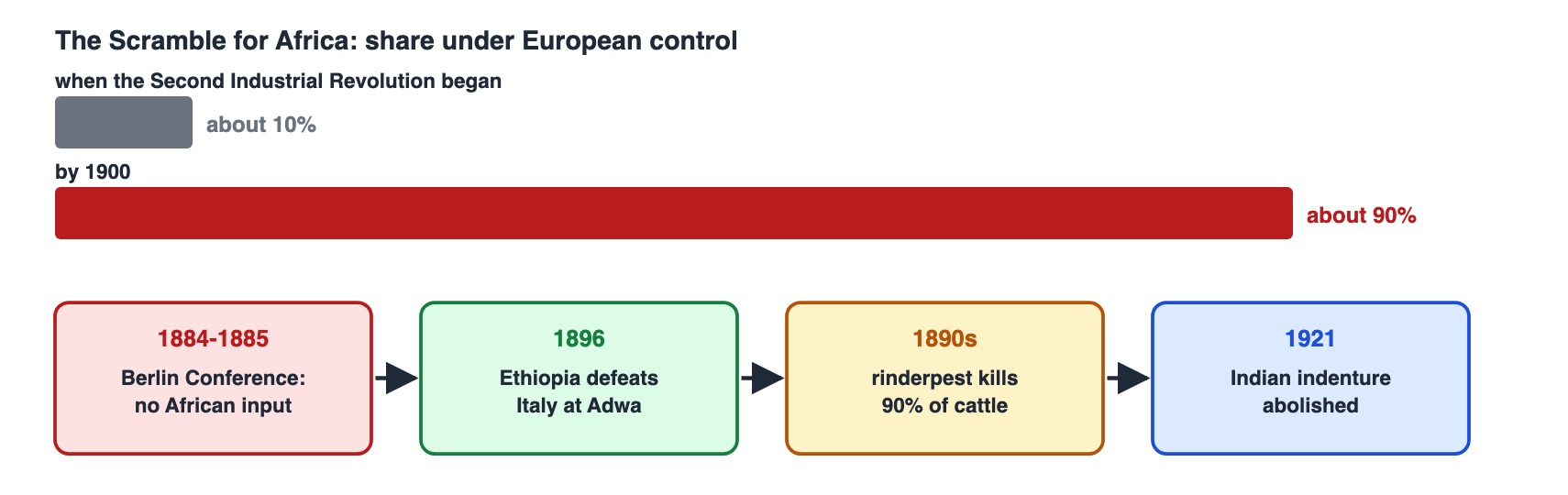
The Scramble for Africa in two numbers, with the events to remember.
Asia and the Pacific
Region | What happened |
China | After the First Opium War, the Treaty of Nanjing (1842) forced China to cede Hong Kong and open five ports; powers carved 'spheres of influence'; the anti-foreign Boxer Uprising began in 1899 |
Korea and Manchuria | Japan defeated Russia (1904-1905); the Treaty of Portsmouth (1905) recognised its claim to Korea, annexed in 1910 |
Indochina | France built an empire in present-day Vietnam, Laos and Cambodia |
Pacific | Islands seized as imperial possessions; the United States took Hawaii and Guam |
Indentured Labour and the Balance Sheet
Labour on the move: indentured migration from India
Indian labourers signed contracts promising return passage after five years on a plantation. Main destinations: the Caribbean (Trinidad, Guyana, Surinam), Mauritius and Fiji; Tamils went to Ceylon and Malaya; others to Assam's tea gardens.
Most came from eastern Uttar Pradesh, Bihar, central India and dry districts of Tamil Nadu, regions hit by declining cottage industries and rising rents.
Conditions were harsh and rights few: it has been called a "new system of slavery". Nationalist opposition from the 1900s led to its abolition in 1921. Cultures blended: Trinidad's Muharram became the carnival "Hosay".
The balance sheet of colonialism
Colonisers claimed | The reality for the colonised |
Roads, railways, telegraphs, water systems | Built mainly to extract resources and move troops |
Law, order and 'civilisation' | Racism, forced labour, loss of land and political rights |
Integration into world trade | Export economies tied to raw materials, de-industrialisation (article 04) |
Modern education and administration | Created elites who later led nationalist movements against the colonisers |
Colonial rivalry also fed the tensions that exploded in the First World War (article 07), and the borders drawn by colonisers shaped the conflicts of decolonisation (article 11).
Further Reading
PIB press releases, ministry websites and annual reports, the Gazette of India, MEA and UN documents and the official sources named in each note — the primary sources behind every fact above.
Test Yourself: Practice Questions & PYQs
12 practice questions on imperialism and colonialism.
Practice Questions
Q1. By 1900, roughly what share of Africa was under European control?
(a) 90%
(b) 10%
(c) 50%
(d) 30%
Show answer
Answer: (a) — It was about 10% at the start of the Second Industrial Revolution.
Q2. The Berlin Conference of 1884-1885
(a) created the League of Nations
(b) granted independence to Ethiopia
(c) divided Africa among European powers without African input
(d) ended the slave trade
Show answer
Answer: (c) — Its borders later fuelled conflict.
Q3. The Congo Free State was ruled as the private colony of
(a) Queen Victoria
(b) King Leopold II of Belgium
(c) Napoleon III
(d) Kaiser William II
Show answer
Answer: (b) — Africans were brutally exploited for ivory and rubber.
Q4. Which African country defeated Italy at the Battle of Adwa in 1896?
(a) Sudan
(b) Ethiopia
(c) Egypt
(d) Morocco
Show answer
Answer: (b) — It kept its independence.
Q5. Which medical development helped Europeans penetrate Africa's interior?
(a) Insulin
(b) Smallpox vaccination
(c) Quinine against malaria
(d) Penicillin
Show answer
Answer: (c) — The Dutch grew cinchona in Indonesia by the 1870s.
Q6. The French term for the claimed moral purpose of empire was
(a) manifest destiny
(b) realpolitik
(c) white man's peace
(d) the civilising mission
Show answer
Answer: (d) — Social Darwinism gave a pseudoscientific justification.
Q7. The Treaty of Nanjing (1842) forced China to
(a) accept Japanese rule
(b) join the British Empire
(c) cede Hong Kong and open five ports
(d) give up Manchuria
Show answer
Answer: (c) — It followed the First Opium War.
Q8. Japan formally annexed Korea in
(a) 1895
(b) 1905
(c) 1931
(d) 1910
Show answer
Answer: (d) — The 1905 Treaty of Portsmouth recognised its claim.
Q9. Rinderpest in 1890s Africa was
(a) a crop disease
(b) a famine in Egypt
(c) a human epidemic
(d) a cattle plague that killed about 90% of cattle
Show answer
Answer: (d) — It forced Africans into wage labour.
Q10. Consider the following statements:
1. Indian indentured migrants went mainly to the Caribbean, Mauritius and Fiji.
2. Indenture contracts promised return travel after five years.
3. Indentured labour from India continued until 1947.
Which of the statements given above are correct?
(a) 1 and 2 only
(b) 2 and 3 only
(c) 1 and 3 only
(d) 1, 2 and 3
Show answer
Answer: (a) — 1 and 2 are correct. It was abolished in 1921.
Q11. Nineteenth-century indenture has been described as
(a) a cooperative movement
(b) a 'new system of slavery'
(c) a civilising mission
(d) a free labour market
Show answer
Answer: (b) — Conditions were harsh and legal rights few.
Q12. Herbert Spencer is associated with
(a) Social Darwinism
(b) the Maxim gun
(c) the civilising mission
(d) the Berlin Conference
Show answer
Answer: (a) — A pseudoscientific belief used to justify empire.
Mains Practice Questions
Use these to frame full-length answers. You don't have to answer one exactly — they show the angles UPSC tests, so let them guide which points you cover.
What were the motives and means of the new imperialism of 1870-1914?
How did colonialism transform African societies and economies?
Was indentured labour a 'new system of slavery'?
UPSC Mains — Previous Years’ Questions on this topic (last 10 years)
These are the actual GS Mains questions UPSC has asked on this theme — real proof of how, and when, it is tested. Try to write a full answer to each.
Colonialism underlies the GS1 questions of 2023 (railways in different countries) and 2024 (the Industrial Revolution and Indian handicrafts); see articles 04 and 07.