Child Health Programmes for NEET PG PSM: SSBSK 2026 Home Visits, RBSK 2.0, Facility Newborn Care and IMNCI
Start Here
🎯 Exam priority: Medium–high. Two programmes changed in 2026. HBNC and HBYC are now one programme, SSBSK, with a new visit schedule, and RBSK was revised as RBSK 2.0. Older notes on HBNC visit days describe the schedule that has been replaced. An exam may still ask the old days, so learn both and read the question carefully.
CBME mapping: CM 10.
The Big Picture
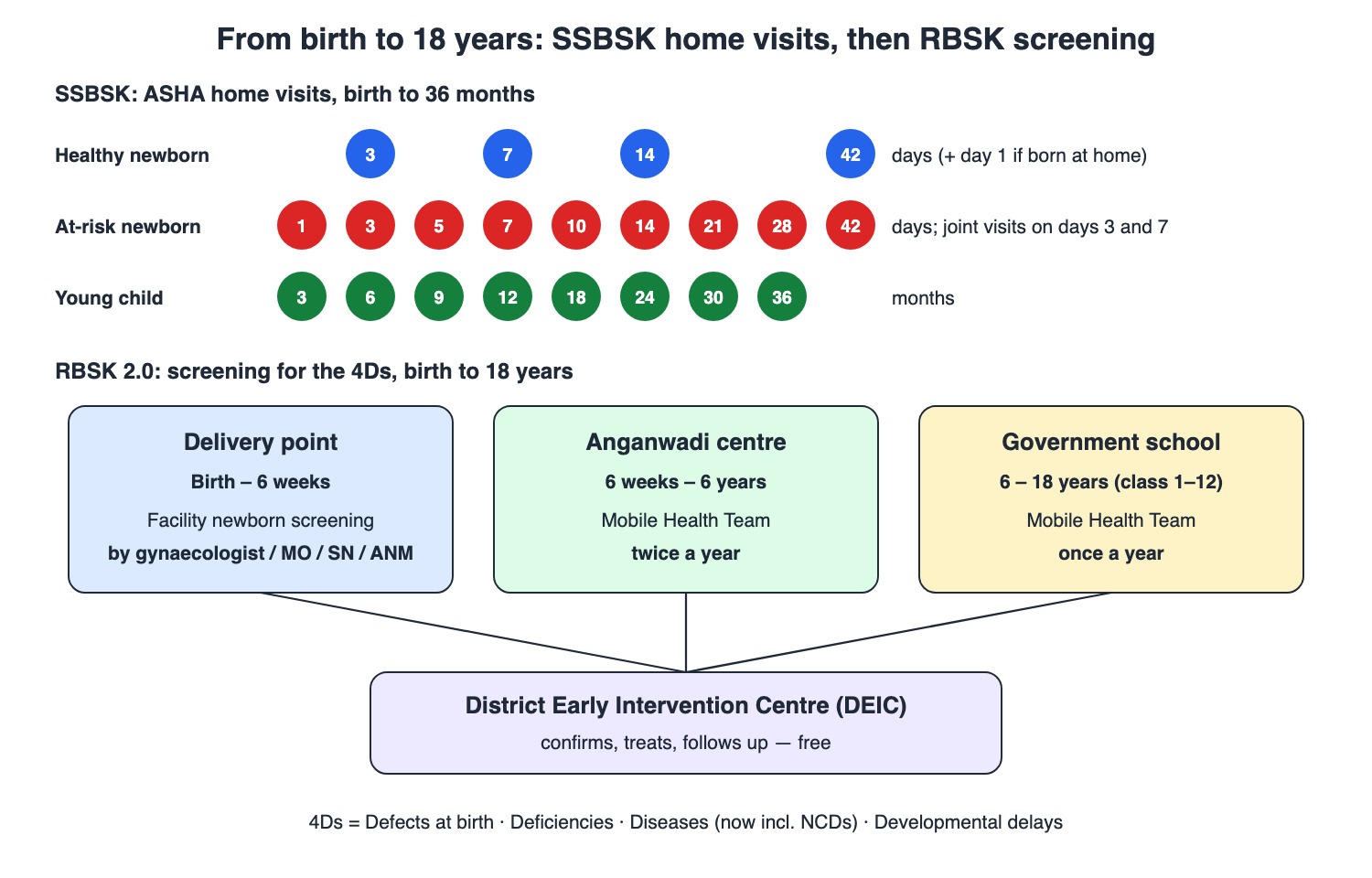
From birth to 18 years: SSBSK home visits up to 36 months, RBSK screening at delivery points, Anganwadi centres and schools, with the DEIC as the referral hub.
Under-five mortality fell 41% and neonatal mortality 37% in India in 2014–2024 (global: 18% and 15%). Nearly 40% of newborn deaths happen in the first 24 hours, which is why care begins at birth. The SDG targets are neonatal mortality of 12 or less and under-five mortality of 25 or less by 2030. About 18.2% of newborns are low birth weight.
SSBSK: Home-Based Care from Birth to 36 Months
Samagra Shishu Bal Swasthya Karyakram (SSBSK), in its 2026 guidelines, merges Home Based Newborn Care and Home Based Care for Young Child into one programme.
Who | Home visits | Joint visit by |
Healthy newborn | Days 3, 7, 14, 42 (4 visits); add day 1 for home birth (5 visits) | — |
At-risk newborn | Day 1 or discharge, then days 3, 5, 7, 10, 14, 21, 28, 42 (9 visits) | Days 3 and 7: ASHA with ANM and CHO (ANM and MO in urban areas) |
Young child | 3, 6, 9, 12, 18, 24, 30, 36 months | — |
At-risk young child | Same schedule | 3rd and 6th months |
Between day 42 and 3 months, children are also seen at village health days and immunization contacts at 1.5 and 2.5 months.
Who is 'at risk'?
At-risk newborn | At-risk young child |
Birth weight under 2,500 g, or preterm (under 37 weeks) | Moderately underweight or MAM (yellow) |
Needed hospital care, or discharged from SNCU | Severely underweight or SAM (red) |
Not started on breast milk, or unable to breastfeed | Discharged from a Nutrition Rehabilitation Centre |
Visible congenital malformation that threatens life or feeding, such as cleft lip or palate | Recurrent illness: at least two episodes within a year |
Low weight for age | Delay in a developmental milestone on the MCP card |
New in SSBSK: maternal mental health screening with simple tools such as PHQ-2, with linkage to Tele-MANAS; maternal nutrition counselling; nurturing care for early childhood development; and climate-sensitive advice on heat and air pollution. Families of at-risk newborns get a financial incentive for a facility follow-up visit within 8 days of life or discharge.
What changed
Before | SSBSK 2026 | |
Programmes | HBNC (2011, revised 2014) and HBYC (2018), separate | One continuum |
Age covered | 0–42 days, then 3–15 months | 0–36 months |
Newborn visits | 6 (days 3, 7, 14, 21, 28, 42); 7 if home birth | 4 for healthy; 9 for at-risk; +1 if home birth |
Young child visits | 3, 6, 9, 12, 15 months | 3, 6, 9, 12, 18, 24, 30, 36 months |
New | — | Risk stratification; maternal mental health; climate-sensitive counselling |
Facility Based Newborn Care
Level | Unit | Where | What it does |
Birth | Newborn Care Corner (NBCC) | Labour room and obstetric OT | Essential newborn care and resuscitation at birth |
First | Newborn Stabilization Unit (NBSU) | Sub-district: CHC or FRU; 4–6 beds | Basic care for sick and small newborns |
Second | Special Newborn Care Unit (SNCU) | District hospital; at least 12 beds | 24×7 secondary care, without surgery or mechanical ventilation |
Second | Mother Newborn Care Unit (MNCU) | With the SNCU | 'No separation': mother's bed beside the baby's warmer |
Tertiary | Newborn Intensive Care Unit | Medical colleges | Tertiary care |
Essential newborn care includes delayed cord clamping, skin-to-skin contact, maintaining the airway, support for breathing and early exclusive breastfeeding. Kangaroo Mother Care should begin before discharge.
IMNCI and Campaigns
IMNCI is India's adaptation of the WHO strategy: a standard, evidence-based syndromic approach to sick newborns and children.
Three components: health worker skills, health systems, family and community practices.
Indian adaptations: covers the entire 0–5 years including the first week of life; 50% of training time goes to young infants (0–2 months); training begins with young infants; training lasts 8 days.
SAANS (Social Awareness and Action to Neutralize Pneumonia Successfully), since 2019: childhood pneumonia. STOP Diarrhoea: a 2-month campaign, giving 2 ORS packets and 14 zinc tablets to under-fives.
RBSK 2.0: Who, Where, How Often
Covers children 0–18 years for the 4Ds: Defects at birth, Deficiencies, Diseases, Developmental delays.
Delivery points (birth–6 weeks): facility newborn screening by gynaecologists, MOs, staff nurses and ANMs; ASHAs screen babies during home visits up to 6 weeks.
Anganwadi centres (6 weeks–6 years): Mobile Health Team, twice a year.
Government and government-aided schools (6–18 years, classes 1–12): Mobile Health Team, once a year.
Mobile Health Team: 2 medical officers (MBBS/BDS/AYUSH), 1 ANM/MPW/staff nurse, 1 pharmacist (data management).
DEIC (district): a multidisciplinary team — paediatrician, MO, psychologist, speech therapist, audiologist, optometrist, physiotherapist, occupational therapist, dentist, social worker — confirms, treats and follows up, free of cost.
The Conditions List (RBSK 2.0)
Group | Conditions |
Defects at birth (1–10) | Neural tube defects, Down syndrome, cleft lip/palate, club foot, developmental dysplasia of the hip, congenital cataract, congenital deafness, congenital heart disease, retinopathy of prematurity, CAKUT (kidney and urinary tract anomalies) |
Deficiencies (11–15) | Vitamin A deficiency, vitamin D deficiency (rickets), severe acute malnutrition, goitre, anaemia |
Diseases incl. NCDs (16–26) | Skin conditions, rheumatic heart disease, reactive airway disease, dental caries, convulsive disorders, diabetes (type 1 and 2), hypertension, kidney disease, otitis media, tuberculosis, leprosy |
Developmental delays (27–35) | Vision and hearing impairment, neuro-motor, motor, cognitive and language delay, behavioural disorders (anxiety, ADHD, sleep), autism spectrum disorder, specific learning disorders, global developmental delay |
Also | Congenital hypothyroidism (optional), adolescent health concerns, red flags for referral |
Diabetes screen: the Mobile Health Team asks about the 4Ts — Toilet, Thirsty, Tired, Thinner, checks random blood sugar on a glucometer when suspicious, and refers to the district NCD clinic (NP-NCD) to classify type 1 or type 2.
What Changed from RBSK to RBSK 2.0
RBSK (2013) | RBSK 2.0 (2026) | |
Scope | 4Ds | Expanded 4Ds + NCDs, mental health, behaviour, lifestyle risks, kidney disorders, digital exposure |
Mobile Health Team | Fixed, mainly AYUSH, 4 persons | 2 MOs (MBBS/BDS/AYUSH) + 1 ANM/MPW/SN + 1 pharmacist, with flexible support staff |
Records | Basic RBSK portal reporting | Longitudinal Health Card; linked with JANANI (RCH 2.0), U-WIN and POSHAN |
Cochlear implant support | 0–2 years | Expanded to 0–6 years |
Convergence | ICDS and schools | Inter-ministerial: MoHFW, MoWCD, MoE, MoSJE |
Traps the Examiner Sets
SSBSK: healthy newborn 4 visits, at-risk 9; both end at day 42. The old HBNC schedule was 6 visits.
HBYC stopped at 15 months; SSBSK runs to 36.
NBSU is at sub-district level; SNCU is at district level.
RBSK: Anganwadi twice a year, schools once a year.
The 4Ds are Defects, Deficiencies, Diseases, Developmental delays — "disabilities" is a common wrong option.
Club foot = talipes (a defect at birth); goitre and anaemia are deficiencies; RHD and dental caries are diseases.
RBSK 2.0 adds diabetes, hypertension and kidney disorders; congenital hypothyroidism is optional.
Memory Hooks & Shortcuts
Shortcuts to lock in this article's numbers and lists. Each one only re-packages facts proven above.
🧠 3-7-14-42 — healthy newborn SSBSK days; at-risk babies add 1, 5, 10, 21 and 28
🧠 Sub-district 4-6, District 12 — NBSU and SNCU beds
🧠 Twice at the Anganwadi, once at school — RBSK screening frequency
🧠 The 4Ds: Defect, Deficient, Diseased, Delayed — the RBSK screening frame
🧠 2 + 1 + 1 — Mobile Health Team: 2 MOs, 1 nurse/ANM, 1 pharmacist
🧠 4Ts: Toilet, Thirsty, Tired, Thinner — the RBSK 2.0 diabetes screen
🧠 Cochlear 2 → 6 — implant support widened from 0–2 to 0–6 years in RBSK 2.0
Rapid-Revision Cards
SSBSK
Samagra Shishu Bal Swasthya Karyakram, 2026: merges HBNC and HBYC; birth to 36 months.
Healthy newborn visits
Days 3, 7, 14, 42 (4); add day 1 for home birth (5).
At-risk newborn visits
Day 1/discharge, 3, 5, 7, 10, 14, 21, 28, 42 (9).
Joint visits
At-risk newborn: days 3 and 7. At-risk young child: months 3 and 6.
Young child visits
3, 6, 9, 12, 18, 24, 30, 36 months.
At-risk newborn criteria
<2500 g or preterm; hospitalised or SNCU; not breastfeeding; serious malformation; low weight for age.
Old HBNC schedule
Days 3, 7, 14, 21, 28, 42; home birth added day 1.
Deaths on day 1
Nearly 40% of newborn deaths are in the first 24 hours.
NBCC
In the labour room and OT; essential newborn care and resuscitation.
NBSU
4–6 beds, sub-district; first level.
SNCU
At least 12 beds, district; second level; no surgery or ventilation.
MNCU
'No separation' of mother and newborn.
IMNCI
Syndromic; covers 0–5 years including week 1; 50% of training on 0–2 months.
SAANS
Pneumonia campaign, since 2019.
STOP Diarrhoea
2 ORS packets + 14 zinc tablets; 2-month campaign.
RBSK 4Ds
Defects at birth, Deficiencies, Diseases, Developmental delays.
RBSK age range
0–18 years.
RBSK platforms
Delivery point (0–6 wk) · Anganwadi (6 wk–6 y, twice a year) · schools (6–18 y, once a year).
Mobile Health Team
2 MOs (MBBS/BDS/AYUSH) + 1 ANM/MPW/SN + 1 pharmacist.
DEIC
District hub: confirm, treat, follow up — free; multidisciplinary team.
RBSK defects examples
NTD, Down syndrome, cleft, club foot, DDH, congenital cataract/deafness, CHD, ROP, CAKUT.
RBSK deficiencies
Vitamin A, vitamin D (rickets), SAM, goitre, anaemia.
RBSK 2.0 new NCDs
Diabetes (T1/T2), hypertension, kidney disorders.
4Ts
Toilet, Thirsty, Tired, Thinner → RBS → NP-NCD clinic.
Cochlear implant support
0–2 years → 0–6 years under RBSK 2.0.
RBSK 2.0 digital
Health Card; linked to JANANI (RCH 2.0), U-WIN, POSHAN.
Sources
Facts in this article were checked against these documents.
Samagra Shishu Bal Swasthya Karyakram (SSBSK): Operational Guidelines 2026 — Child Health Division, MoHFW, 2026 (link)
Facility Based Newborn Care Operational Guidelines — MoHFW, 2025 (link)
Home Based Newborn Care: Operational Guidelines (Revised 2014) — MoHFW, 2014 (link)
Adaptation of the IMNCI Strategy for India — Government Medical College and Hospital, Chandigarh, n.d. (link)
SAANS Campaign; STOP Diarrhoea Campaign — National Health Mission, accessed November 2026 (link)
Rashtriya Bal Swasthya Karyakram (RBSK 2.0): Operational Guidelines 2026 — Child Health Division, MoHFW, 2026 (link)
Test Yourself: Practice Questions
Twenty-five questions in NEET PG style.
Practice Questions (NEET PG pattern)
Original questions written in the style of the exam: +4 for a correct answer, −1 for a wrong one. Every answer was checked against the sources listed above. NEET PG papers are not published by NBEMS, so these are not past-paper questions.
Q1. Under SSBSK 2026, a healthy baby born in hospital receives ASHA home visits on days
(a) 3, 7, 14 and 42
(b) 1, 3, 7, 14 and 42
(c) 3, 5, 7, 10, 14, 21, 28 and 42
(d) 3, 7, 14, 21, 28 and 42
Show answer
Answer: (a) — Healthy newborn: 4 visits on days 3, 7, 14, 42, with day 1 added for a home birth. Six visits was the older HBNC schedule.
Q2. A baby is born at home at 35 weeks weighing 2.1 kg. Under SSBSK this newborn gets
(a) 9 home visits with joint visits on days 3 and 7
(b) 4 home visits
(c) no home visits until 3 months
(d) 5 home visits
Show answer
Answer: (a) — Preterm and low birth weight make the newborn at-risk: 9 visits, with joint visits on days 3 and 7.
Q3. SSBSK replaced which two programmes?
(a) HBNC and HBYC
(b) RBSK and IMNCI
(c) NSSK and FBNC
(d) JSY and JSSK
Show answer
Answer: (a) — SSBSK consolidates Home Based Newborn Care and Home Based Care for Young Child.
Q4. SSBSK home-based care for young children continues until the age of
(a) 15 months
(b) 6 years
(c) 12 months
(d) 36 months
Show answer
Answer: (d) — Visits at 3, 6, 9, 12, 18, 24, 30 and 36 months; HBYC used to stop at 15 months.
Q5. The 4Ds of RBSK are
(a) Defects at birth, Deficiencies, Diseases, Developmental delays
(b) Defects, Disabilities, Deficiencies, Deaths
(c) Diarrhoea, Dehydration, Deficiency, Disability
(d) Diagnosis, Drugs, Diet, Development
Show answer
Answer: (a) — Defects at birth, Deficiencies, Diseases and Developmental delays.
Q6. Under RBSK 2.0, Mobile Health Teams screen children at Anganwadi centres
(a) once every 2 years
(b) twice a year
(c) every month
(d) once a year
Show answer
Answer: (b) — Biannually at each AWC; annually in government and government-aided schools.
Q7. Children aged 6–18 years are screened under RBSK at
(a) Anganwadi centres, twice a year
(b) PHCs, every quarter
(c) government and government-aided schools, once a year
(d) private schools only
Show answer
Answer: (c) — Classes 1–12 in government and government-aided schools, annually.
Q8. The core RBSK 2.0 Mobile Health Team consists of
(a) 1 MO, 1 ASHA and 1 Anganwadi worker
(b) 2 medical officers, 1 ANM/MPW/staff nurse and 1 pharmacist
(c) 4 AYUSH doctors
(d) 1 paediatrician and 2 nurses
Show answer
Answer: (b) — 2 MOs (MBBS/BDS/AYUSH) + 1 ANM/MPW/SN + 1 pharmacist with data skills.
Q9. Under RBSK, club foot (talipes) is classified as a
(a) deficiency
(b) disease
(c) developmental delay
(d) defect at birth
Show answer
Answer: (d) — Talipes is item 4 under defects at birth.
Q10. Which of the following is listed under 'Deficiencies' in RBSK 2.0?
(a) Down syndrome
(b) Goitre
(c) Autism spectrum disorder
(d) Rheumatic heart disease
Show answer
Answer: (b) — Deficiencies: vitamin A, vitamin D (rickets), SAM, goitre, anaemia.
Q11. A new NCD added to the RBSK 2.0 screening list is
(a) hypertension
(b) dental caries
(c) tuberculosis
(d) rheumatic heart disease
Show answer
Answer: (a) — RBSK 2.0 adds NCDs such as diabetes (type 1 and 2), hypertension and kidney disorders.
Q12. The '4Ts' used by RBSK Mobile Health Teams to screen for diabetes are
(a) Toilet, Thirsty, Tired, Thinner
(b) Tremor, Tachycardia, Tired, Thin
(c) Tall, Thin, Tired, Thirsty
(d) Temperature, Tone, Thirst, Toilet
Show answer
Answer: (a) — Symptom screen: Toilet, Thirsty, Tired, Thinner; then random blood sugar if suspected.
Q13. The facility at district level that confirms and treats children referred by RBSK teams is the
(a) Adolescent Friendly Health Clinic
(b) District Early Intervention Centre
(c) Special Newborn Care Unit
(d) Nutrition Rehabilitation Centre
Show answer
Answer: (b) — DEIC — a multidisciplinary team providing free confirmation, treatment and follow-up.
Q14. Under RBSK 2.0, state-supported cochlear implant coverage was expanded to children aged
(a) 0–6 years
(b) 0–2 years
(c) 6–12 years
(d) 0–18 years
Show answer
Answer: (a) — From 0–2 years under RBSK to 0–6 years under RBSK 2.0.
Q15. Who screens newborns at delivery points under RBSK?
(a) The Mobile Health Team
(b) Anganwadi workers
(c) Gynaecologists, medical officers, staff nurses and ANMs
(d) DEIC therapists only
Show answer
Answer: (c) — Facility-based newborn screening is by the delivery-point staff; MHTs work at AWCs and schools.
Q16. RBSK 2.0 links each child's longitudinal Health Card with
(a) the PM-JAY card
(b) JANANI (RCH 2.0), U-WIN and POSHAN
(c) the Ni-kshay portal
(d) the CoWIN portal only
Show answer
Answer: (b) — The RBSK 2.0 digital platform is integrated with JANANI (RCH 2.0), U-WIN and POSHAN.
Q17. According to the HBNC guidelines, what share of newborn deaths occur within the first 24 hours of life?
(a) About 75%
(b) Nearly 40%
(c) About 10%
(d) About 25%
Show answer
Answer: (b) — Nearly 40% of newborn deaths happen on the first day.
Q18. Which newborn is 'at risk' under SSBSK?
(a) A baby with a mild nappy rash
(b) A term baby of 2.8 kg feeding well
(c) A baby born by normal delivery at home, otherwise well
(d) A baby unable to breastfeed
Show answer
Answer: (d) — Not started on breast milk or unable to breastfeed is one of the criteria.
Q19. A 2-year-old with SAM was discharged from an NRC. Under SSBSK, this child is
(a) only for the DEIC
(b) an at-risk young child
(c) outside the programme
(d) only for RBSK
Show answer
Answer: (b) — NRC discharge and SAM both mark an at-risk young child.
Q20. A 'no separation' unit where the mother stays beside the baby's warmer is the
(a) Mother Newborn Care Unit
(b) Labour room
(c) Nutrition Rehabilitation Centre
(d) Newborn Care Corner
Show answer
Answer: (a) — The aim of the MNCU is no separation of mother and newborn during hospital care.
Q21. The Newborn Stabilization Unit is located at
(a) district hospitals, with 12 beds
(b) sub-district level, with 4–6 beds
(c) medical colleges
(d) sub-health centres
Show answer
Answer: (b) — An NBSU is a 4–6 bedded unit at CHC or FRU level. SNCU: at least 12 beds at district level.
Q22. A Special Newborn Care Unit provides care for sick neonates EXCEPT those needing
(a) mechanical ventilation
(b) intravenous fluids
(c) phototherapy
(d) oxygen
Show answer
Answer: (a) — SNCUs give secondary care to neonates not requiring surgical intervention and mechanical ventilation.
Q23. In India's adaptation of IMNCI, the share of training time given to young infants is
(a) 75%
(b) 10%
(c) 50%
(d) 25%
Show answer
Answer: (c) — 50% of training time goes to 0–2 months, and training begins with young infants.
Q24. The IMNCI approach to case management is
(a) aetiological, needing laboratory confirmation
(b) only preventive
(c) syndromic
(d) surgical
Show answer
Answer: (c) — Standardized case management using an evidence based syndromic approach.
Q25. The STOP Diarrhoea campaign distributes to under-fives
(a) 5 ORS packets and 7 zinc tablets
(b) 2 ORS packets and 14 zinc tablets
(c) IFA syrup
(d) vitamin A only
Show answer
Answer: (b) — A 2-month campaign co-packaging 2 ORS packets and 14 zinc tablets.
Active Recall
From memory: explain what SSBSK replaced and give its visit days for healthy and at-risk newborns and for young children, with the at-risk criteria; then explain RBSK 2.0: the 4Ds, who is screened where and how often, the Mobile Health Team, the DEIC and the 4Ts; then list the levels of facility newborn care and the main features of IMNCI.