Occupational Health for NEET PG PSM: Labour Codes 2025, ESI Benefits, Notifiable Diseases, Pneumoconiosis, Lead and Noise
Start Here
🎯 Exam priority: Medium. Expect a dust-to-disease vignette, the ESI benefit numbers, and a question on which diseases are notifiable. The law changed in November 2025, so older notes that cite the Factories Act and ESI Act as current are out of date.
CBME mapping: CM 11.1–11.5 (occupational illness including agriculture, ESI, specific hazards, ergonomics, disorders of health professionals).
The Law Changed in November 2025
Four Labour Codes came into effect on 21 November 2025, replacing 29 central labour laws. Two matter for PSM:
Old law | Replaced by | Where |
Factories Act 1948, Mines Act 1952 and other workplace laws | Occupational Safety, Health and Working Conditions Code 2020 | Section 143 |
Employees' State Insurance Act 1948, Employee's Compensation Act 1923, Maternity Benefit Act 1961 and other social security laws | Code on Social Security 2020 (ESI is in Chapter IV) | Section 164 |
The names you will still see in books, the Factories Act and the ESI Act, are now repealed. Rules, schemes and regulations made under them continue where the Codes allow, and ESIC's own website still cites the old section numbers, so an exam may use either name. Learn both.
Notifiable Occupational Diseases
The Third Schedule of the OSH Code lists 29 notifiable diseases. Grouped for memory:
Metals and chemicals: lead, tetra-ethyl lead, phosphorus, mercury, manganese, arsenic, beryllium, benzene, carbon bisulphide, nitrous fumes, halogenated hydrocarbons, carbon monoxide, phosgene, isocyanates; chrome ulceration.
Dust: silicosis, asbestosis, byssinosis, coal miners' pneumoconiosis.
Infection: anthrax.
Physical: radium, radioactive substances and X-rays; noise-induced hearing loss.
Skin, cancer and organ damage: primary epitheliomatous skin cancer, oil acne or dermatitis, contact dermatitis, occupational cancer, toxic anaemia, toxic jaundice, toxic nephritis.
Who must report (section 12):
The employer sends notice to the prescribed authorities.
Any qualified medical practitioner attending a person who has, or is believed to have, a listed disease must report in writing without delay to the Chief Inspector-cum-Facilitator. Failure carries a penalty of up to ₹10,000.
The employer must also provide prescribed annual health examinations free of cost, and may not charge workers for safety or for medical tests that detect occupational disease.
Welfare Thresholds
Facility or post | Required when |
Canteen | 100 or more workers, including contract labour |
Crèche (children under 6) | More than 50 workers |
Shelter, rest-room and lunch-room | More than 50 workers in a factory or mine |
Welfare officer | 250 or more workers in a factory, mine or plantation |
Ambulance room | More than 500 workers in a factory, mine or construction work |
Safety officer | 500 or more in a factory; 250 or more in a hazardous-process factory or in construction; 100 or more in a mine |
Working hours: no worker for more than eight hours in a day.
The ESI Scheme
ESI is a contributory social insurance scheme run by the Employees' State Insurance Corporation under Chapter IV of the Code on Social Security.
Coverage: non-seasonal factories employing 10 or more persons, extended to shops, hotels, private medical and educational institutions and others.
Wage limit: ₹21,000 a month (₹25,000 for persons with disability).
Contribution: employer 3.25%, employee 0.75% of wages. Employees earning up to ₹176 a day pay nothing, but the employer still pays its share.
Two contribution periods of six months, with two matching benefit periods.
Benefit | What it pays (ESIC) |
Sickness | 70% of average daily wages, up to 91 days in two consecutive benefit periods |
Maternity | 100% of average daily wages, up to 26 weeks for confinement, 6 weeks for miscarriage, 12 weeks for commissioning and adopting mothers |
Disablement | Monthly payment while the injury lasts (temporary); for life (permanent) |
Dependants' | Monthly payment shared among dependants after death from employment injury |
Medical | Treatment and attendance for insured persons; can extend to the family |
Funeral expenses | Paid to the eldest surviving family member, or whoever bears the cost |
Dust Diseases
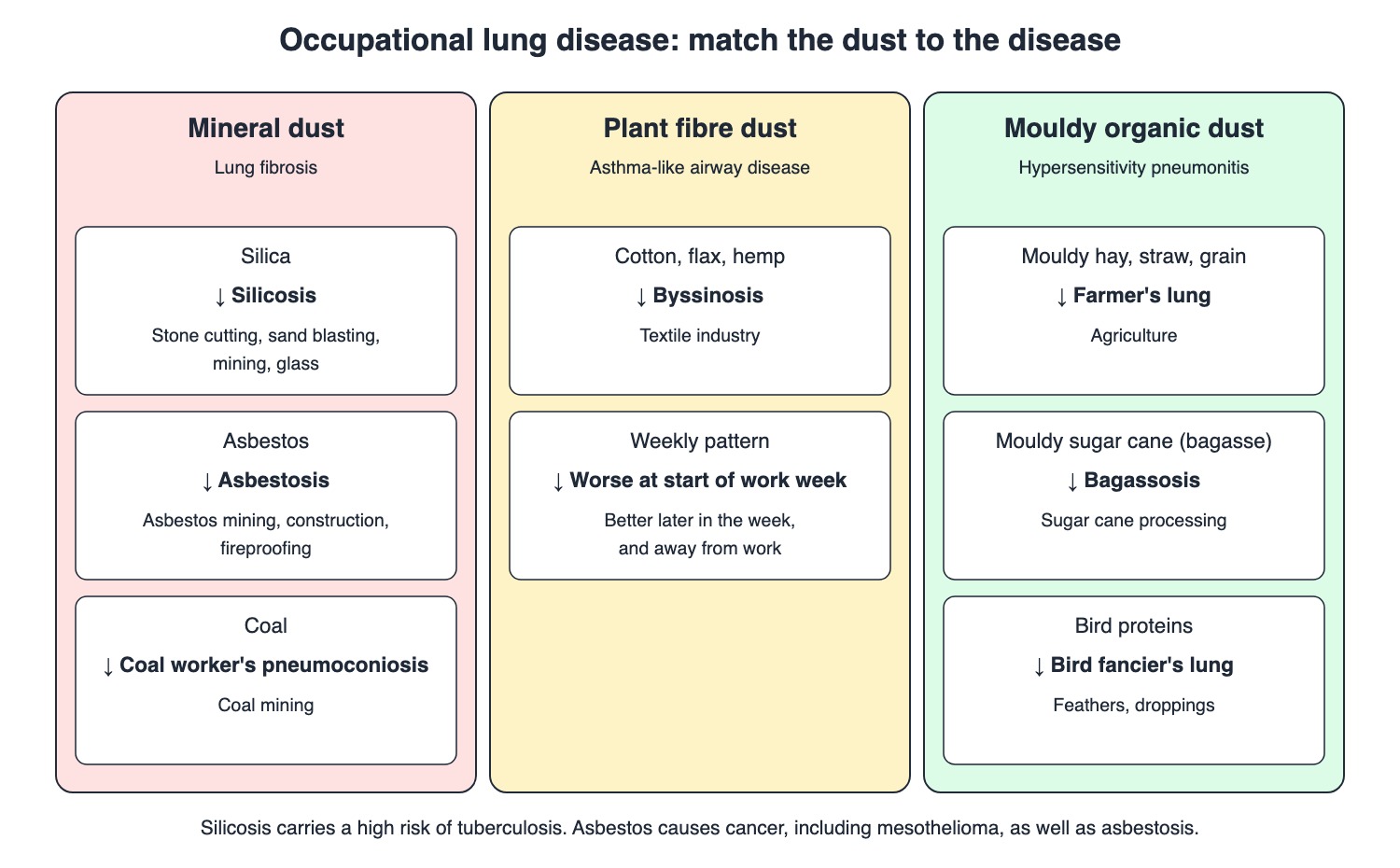
Sort the dust first: mineral dusts scar the lung, cotton dust gives an asthma-like illness, and mouldy organic dusts cause a hypersensitivity pneumonitis.
Disease | Exposure | Key points |
Silicosis | Stone cutting, sand blasting, mining, quarrying, glass, abrasives | Three forms below. No specific treatment. High TB risk; ILO lists silicotuberculosis |
Asbestosis | Asbestos mining and milling, construction, fireproofing | Symptoms often 20+ years later. Pleural plaques help diagnosis. Mesothelioma 20–40 years after exposure. Smoking raises the risk. Family exposed through work clothes |
Coal worker's pneumoconiosis | Coal dust | Simple or complicated (progressive massive fibrosis). Black sputum. With rheumatoid arthritis: Caplan syndrome |
Byssinosis | Raw cotton dust (flax, hemp, sisal too), textile workers | Chest tightness and wheeze, worse at the start of the work week, better later in the week |
Bagassosis | Mouldy sugar cane fibre (bagasse), used for paper, cardboard and rayon | A hypersensitivity pneumonitis linked to Thermoactinomyces sacchari. Not the same pattern as byssinosis, though the ILO lists the two dusts together |
Farmer's lung | Mouldy hay, straw, grain | A hypersensitivity pneumonitis: fever, chills, cough, breathlessness 4–8 hours after exposure |
Three forms of silicosis
Form | Exposure | Duration |
Chronic (most common) | Low | More than 20 years |
Accelerated | Larger amounts | 3 to 10 years |
Acute | Very large amounts | Short term; lungs fill with fluid, severe breathlessness, low oxygen |
Screen silicosis patients for tuberculosis, and treat a positive skin test with anti-TB medicines. Any change on the chest X-ray may mean TB.
Asbestos: WHO classes all forms, including chrysotile, as carcinogenic; asbestos accounts for more than 70% of deaths from work-related cancers.
Lead, Noise and Other Hazards
Lead
Most lead goes into lead-acid batteries; also smelting, recycling, paint and solder.
It travels to brain, liver, kidney and bones, and is stored in teeth and bones. Bone lead is released in pregnancy and reaches the fetus.
Exposure is measured by blood lead. No level is known to be safe; 3.5 µg/dL may lower intelligence in children.
WHO: at 5 µg/dL or above, find the source and stop the exposure.
Noise
Exposure over 85 decibels can damage hearing. In OSHA's rules, a hearing conservation programme starts at 85 dBA over 8 hours, and the legal limit is 90 dBA. These are US limits, not Indian law.
Noise-induced loss is permanent, affects high frequencies first, and neither surgery nor a hearing aid corrects it.
Control the source first. Earmuffs and plugs are acceptable but less desirable.
Occupational cancers: the ILO lists agents including asbestos, benzidine, beta-naphthylamine, vinyl chloride, benzene, coal tars, wood dust and hepatitis B and C viruses.
Occupational infections on the ILO list include brucellosis, anthrax, leptospirosis and tuberculosis, which is why farm and animal workers matter here.
Ergonomics and Health Workers
Ergonomics means fitting a job to a person. Poor fit causes musculoskeletal disorders: carpal tunnel syndrome, tendinitis, rotator cuff injury, epicondylitis, trigger finger, muscle strain and low back injury. The ILO links carpal tunnel to repetitive forceful work, vibration and extreme wrist postures, and prepatellar bursitis to prolonged kneeling.
Hazards of health workers (WHO):
Infections: tuberculosis, hepatitis B and C, HIV, respiratory infections. Needlesticks and sharps injuries are a route for blood-borne pathogens.
Patient handling: back injury from lifting and moving patients.
Chemicals: disinfectants, sterilants, mercury, toxic drugs, latex.
Radiation: X-rays, radionuclides, UV, lasers.
Psycho-social: time pressure, long hours and shift work lead to stress, burnout and fatigue. Violence and harassment are also listed.
Traps the Examiner Sets
"Factories Act" and "ESI Act" are repealed from 21 November 2025; the Codes took over.
ESI contribution: employer 3.25%, employee 0.75%. Do not swap them.
Sickness benefit is 70%, maternity benefit is 100%.
Silicosis goes with TB; asbestos goes with mesothelioma; coal with rheumatoid arthritis is Caplan.
Byssinosis is worst at the start of the week. Farmer's lung comes hours after exposure.
Reporting a notifiable disease is the doctor's duty too, not only the employer's.
Memory Hooks & Shortcuts
Shortcuts to lock in this article's numbers and lists. Each one only re-packages facts proven above.
🧠 3.25 boss, 0.75 worker — ESI contribution: the employer pays more
🧠 7-0 for 91 — ESI sickness: 70% for 91 days
🧠 26-12-6 — ESI maternity weeks: confinement, commissioning or adopting, miscarriage
🧠 Silica and TB are a pair — silicosis carries high TB risk
🧠 Monday cotton — byssinosis is worst at the start of the work week
🧠 Canteen 100, Crèche 50, Welfare 250, Ambulance 500 — the OSH Code thresholds
🧠 Coal + joints = Caplan — coal worker's pneumoconiosis with rheumatoid arthritis
Rapid-Revision Cards
Labour Codes in force from
21 November 2025; 4 Codes replace 29 central laws.
Factories Act 1948 replaced by
OSH and Working Conditions Code 2020 (section 143).
ESI Act 1948 replaced by
Code on Social Security 2020 (section 164; ESI in Chapter IV).
Notifiable diseases list
Third Schedule of the OSH Code: 29 diseases.
Doctor's duty for a notifiable disease
Written report without delay to the Chief Inspector-cum-Facilitator; penalty up to ₹10,000.
ESI contribution
Employer 3.25%, employee 0.75%.
ESI wage limit
₹21,000 a month; ₹25,000 for persons with disability.
ESI exemption from employee share
Daily average wage up to ₹176.
ESI six benefits
Sickness, maternity, disablement, dependants', medical, funeral.
ESI sickness benefit
70% of average daily wages, up to 91 days.
ESI maternity benefit
100% of average daily wages: 26 weeks, 6 for miscarriage, 12 for commissioning or adopting.
Canteen / crèche
100 or more workers / more than 50 workers.
Welfare officer / ambulance room
250 or more workers / more than 500 workers.
Three forms of silicosis
Chronic (>20 years), accelerated (3–10 years), acute (short, very heavy).
Silicosis and infection
High risk of tuberculosis.
Asbestos cancers
Mesothelioma 20–40 years after exposure; all forms are carcinogenic.
Caplan syndrome
Coal worker's pneumoconiosis with rheumatoid arthritis.
Complicated CWP
Progressive massive fibrosis.
Byssinosis
Raw cotton dust; worse at the start of the work week.
Bagassosis
Mouldy sugar cane fibre; hypersensitivity pneumonitis (Thermoactinomyces sacchari).
Farmer's lung
Mouldy hay; hypersensitivity pneumonitis, symptoms at 4–8 hours.
Lead storage
Teeth and bones; released in pregnancy.
WHO blood lead action level
5 µg/dL or above: find the source and stop exposure.
Noise thresholds (US OSHA)
85 dBA hearing programme; 90 dBA legal limit, 8 hours.
Noise-induced hearing loss
Permanent, high frequency, no surgical or hearing-aid correction.
Sources
Facts in this article were checked against these documents.
The Occupational Safety, Health and Working Conditions Code, 2020 (Act 37 of 2020) — Gazette of India, 2020 (link)
The Code on Social Security, 2020 (Act 36 of 2020) — Gazette of India, 2020 (link)
New labour codes implemented across the country effective 21 November 2025 (alert; used for the commencement date) — EY India, 21 November 2025 (link)
ESIC pages: Benefits, Contribution, Coverage — Employees' State Insurance Corporation, accessed November 2026 (link)
List of Occupational Diseases (revised 2010) — International Labour Organization, 2010
Lead poisoning; Asbestos fact sheets; Occupational hazards in the health sector — World Health Organization, accessed November 2026 (link)
Occupational Noise Exposure; Bloodborne Pathogens; Ergonomics — OSHA, US Department of Labor, accessed November 2026 (link)
Bagassosis (teaching notes) — NHL Municipal Medical College, 2020 (link)
Medical Encyclopedia: silicosis, asbestosis, coal worker's pneumoconiosis, byssinosis, hypersensitivity pneumonitis — MedlinePlus, US National Library of Medicine, accessed November 2026 (link)
Test Yourself: Practice Questions
Twenty-four questions in NEET PG style.
Practice Questions (NEET PG pattern)
Original questions written in the style of the exam: +4 for a correct answer, −1 for a wrong one. Every answer was checked against the sources listed above. NEET PG papers are not published by NBEMS, so these are not past-paper questions.
Q1. A 45-year-old stone cutter with 25 years of work has progressive breathlessness and weight loss. The complication most important to look for is
(a) tuberculosis
(b) mesothelioma
(c) Caplan syndrome
(d) bladder cancer
Show answer
Answer: (a) — This is chronic silicosis. People with silicosis are at high risk of TB, so test for it; the ILO even lists silicotuberculosis.
Q2. A sandblaster develops silicosis after 6 years of heavy exposure. This is the
(a) chronic form
(b) simple form
(c) acute form
(d) accelerated form
Show answer
Answer: (d) — Accelerated: larger amounts over 3 to 10 years. Chronic: low exposure for more than 20 years. Acute: very large short-term exposure.
Q3. A textile worker has chest tightness and wheeze that are worst when he returns to work after the weekend and ease later in the week. The likely diagnosis is
(a) byssinosis
(b) farmer's lung
(c) asbestosis
(d) silicosis
Show answer
Answer: (a) — Raw cotton dust causes byssinosis; symptoms are worse at the beginning of the work week and improve later.
Q4. A farmer has fever, chills, cough and breathlessness 6 hours after forking mouldy hay. The likely diagnosis is
(a) byssinosis
(b) hypersensitivity pneumonitis (farmer's lung)
(c) silicosis
(d) bagassosis
Show answer
Answer: (b) — Farmer's lung is a hypersensitivity pneumonitis from mouldy hay, straw or grain; symptoms often begin 4 to 8 hours after exposure.
Q5. A retired insulation worker has pleural plaques on CT and a pleural malignancy 30 years after exposure. The tumour is most likely
(a) mesothelioma
(b) lymphoma
(c) adenocarcinoma of the colon
(d) hepatocellular carcinoma
Show answer
Answer: (a) — Malignant mesothelioma of the pleura can develop 20 to 40 years after asbestos exposure; pleural plaques point to asbestos.
Q6. A coal miner with rheumatoid arthritis has pneumoconiosis. This combination is called
(a) Felty syndrome
(b) Löfgren syndrome
(c) Caplan syndrome
(d) Sjögren syndrome
Show answer
Answer: (c) — Coal worker's pneumoconiosis occurring with rheumatoid arthritis is Caplan syndrome.
Q7. Complicated coal worker's pneumoconiosis is also called
(a) progressive massive fibrosis
(b) bagassosis
(c) silicotuberculosis
(d) extrinsic allergic alveolitis
Show answer
Answer: (a) — CWP occurs in simple and complicated forms; the complicated form is progressive massive fibrosis.
Q8. Lung disease in workers exposed to sugar cane dust is called
(a) bagassosis
(b) anthracosis
(c) siderosis
(d) byssinosis
Show answer
Answer: (a) — Bagassosis comes from mouldy sugar cane fibre and is a hypersensitivity pneumonitis; byssinosis comes from cotton.
Q9. From 21 November 2025, the provisions on workplace safety that were in the Factories Act 1948 sit in the
(a) Occupational Safety, Health and Working Conditions Code 2020
(b) Code on Wages 2019
(c) Industrial Relations Code 2020
(d) Clinical Establishments Act 2010
Show answer
Answer: (a) — Section 143 of the OSH Code repeals the Factories Act 1948; the Codes took effect on 21 November 2025.
Q10. The Employees' State Insurance Act 1948 has been replaced by the
(a) OSH Code 2020
(b) Code on Wages 2019
(c) Code on Social Security 2020
(d) National Health Policy 2017
Show answer
Answer: (c) — Section 164 of the Code on Social Security repeals it; ESI now sits in Chapter IV of that Code.
Q11. Which of the following is NOT in the Third Schedule list of notifiable diseases of the OSH Code?
(a) Noise induced hearing loss
(b) Anthrax
(c) Byssinosis
(d) Carpal tunnel syndrome
Show answer
Answer: (d) — The 29 listed diseases include anthrax, byssinosis and noise-induced hearing loss. Carpal tunnel syndrome is on the ILO list but not on this one.
Q12. A doctor diagnoses silicosis in a factory worker. Under the OSH Code the doctor must
(a) send a written report without delay to the Chief Inspector-cum-Facilitator
(b) tell only the employer
(c) report only if the worker dies
(d) wait for the Medical Board
Show answer
Answer: (a) — Section 12(2): the medical practitioner must report in writing without delay. Failure carries a penalty of up to ten thousand rupees.
Q13. ESI contribution rates are
(a) employer 4.75%, employee 1.75%
(b) employer 0.75%, employee 3.25%
(c) employer 3.25%, employee 0.75%
(d) employer 12%, employee 12%
Show answer
Answer: (c) — Rates from 1 July 2019: employee 0.75%, employer 3.25% of wages.
Q14. The ESI sickness benefit pays
(a) 100% of wages for up to 26 weeks
(b) 50% of wages for up to 30 days
(c) 70% of average daily wages for up to 91 days
(d) 70% of wages for life
Show answer
Answer: (c) — 70% of average daily wages, up to 91 days in two consecutive benefit periods.
Q15. An insured woman under ESI has a miscarriage. Her maternity benefit is paid for up to
(a) 91 days
(b) 12 weeks
(c) 26 weeks
(d) 6 weeks
Show answer
Answer: (d) — 26 weeks for confinement, 6 weeks for miscarriage, 12 weeks for commissioning and adopting mothers, all at 100% of average daily wages.
Q16. An insured worker dies from an employment injury. The ESI benefit that pays his family a monthly amount is the
(a) disablement benefit
(b) sickness benefit
(c) funeral expenses
(d) dependants' benefit
Show answer
Answer: (d) — Dependants' benefit is a monthly payment apportioned among dependants after death due to employment injury.
Q17. The monthly wage limit for coverage under ESI, for a person without disability, is
(a) ₹30,000
(b) ₹15,000
(c) ₹25,000
(d) ₹21,000
Show answer
Answer: (d) — ₹21,000 a month; ₹25,000 for persons with disability.
Q18. Under the OSH Code, an establishment must provide a canteen when it has
(a) 250 or more workers
(b) 500 or more workers
(c) 50 or more workers
(d) 100 or more workers
Show answer
Answer: (d) — Canteen: 100 or more workers including contract labour. Crèche: more than 50. Welfare officer: 250 or more. Ambulance room: more than 500.
Q19. A factory has 300 workers and no hazardous process. Which is required under the OSH Code?
(a) A welfare officer
(b) A safety officer
(c) None of these
(d) An ambulance room
Show answer
Answer: (a) — Welfare officer at 250 or more. A safety officer needs 500 or more here, and an ambulance room more than 500.
Q20. Blood lead is 8 µg/dL in a battery recycler's child. WHO guidance is to
(a) repeat in 5 years
(b) identify the source and stop the exposure
(c) give only iron
(d) reassure, because the level is safe
Show answer
Answer: (b) — At 5 µg/dL or above WHO says to identify the source and act to end the exposure. No level is known to be safe.
Q21. Where is lead mainly stored in the body?
(a) Lungs
(b) Teeth and bones
(c) Skeletal muscle
(d) Fat
Show answer
Answer: (b) — Lead is stored in the teeth and bones and accumulates there; bone lead returns to the blood during pregnancy.
Q22. A weaving-shed worker has gradual, permanent hearing loss. The most accurate statement is
(a) high-frequency hearing is affected and it cannot be corrected by surgery
(b) it is always reversible within a week
(c) a hearing aid corrects it fully
(d) low-frequency hearing is lost first and surgery helps
Show answer
Answer: (a) — Noise-induced loss limits high-frequency hearing; neither surgery nor a hearing aid can correct it.
Q23. The most common occupational infections of concern in health workers, per WHO, include
(a) malaria and dengue
(b) cholera and typhoid
(c) tuberculosis, hepatitis B and C, HIV and respiratory infections
(d) leptospirosis and brucellosis
Show answer
Answer: (c) — WHO names TB, hepatitis B and C, HIV/AIDS and respiratory infections.
Q24. A clerk typing all day develops night-time tingling in the thumb and index finger. This disorder, linked by the ILO to repetitive forceful work, is
(a) carpal tunnel syndrome
(b) byssinosis
(c) miners' nystagmus
(d) prepatellar bursitis
Show answer
Answer: (a) — Carpal tunnel syndrome is on the ILO list for repetitive forceful work, vibration and extreme wrist postures.
Active Recall
From memory: say which Codes replaced the Factories Act and the ESI Act and when; who must report a notifiable disease; the six ESI benefits with their rates, the contribution and the wage limit; the OSH Code thresholds; then match each dust to its disease and key feature, and give the main points on lead, noise and hazards of health workers.