Adrenergic Drugs for NEET PG Pharmacology: Adrenaline, Noradrenaline, Dopamine Doses, Dobutamine, Alpha and Beta Blockers
Start Here
🎯 Exam priority: High. Expect vasopressor choices in shock, adrenaline in anaphylaxis, dopamine's dose ranges, beta-blocker selectivity and contraindications, and alpha-blocker side effects such as first-dose syncope and floppy iris.
CBME mapping: PH 2.2 (adrenergic and anti-adrenergic drugs).
Sympathetic Basics
Most postganglionic sympathetic fibres release noradrenaline. (Sweat glands are the cholinergic exception.)
Sympathetic activity raises heart rate and contractility, dilates the bronchi and releases glucose from the liver — the fight-or-flight response that beta and alpha drugs copy or block.
Agonists: Pressors, Inotropes and Bronchodilators
Drug | Receptors (label) | Main use (label) | Remember |
Adrenaline (epinephrine) | Non-selective alpha and beta | Anaphylaxis; hypotension in septic shock | Raises BP by inotropy, chronotropy and vasoconstriction |
Noradrenaline | Alpha (vasoconstriction) + beta (inotropy, coronary dilation) | Severe acute hypotension | Can cause reflex bradycardia; extravasation → phentolamine |
Dopamine | D1/D2, beta-1, alpha-1 by dose | Shock (distributive or low output) | See the dose diagram; extravasation causes necrosis |
Dobutamine | Cardiac beta receptors | Short-term inotropic support in cardiac decompensation | Does not release noradrenaline (dopamine does) |
Phenylephrine | Alpha-1 | Hypotension from vasodilation during anaesthesia | Pure vasoconstrictor |
Isoprenaline (isoproterenol) | Non-selective beta; very low alpha | Shock; bronchospasm during anaesthesia | Diastolic pressure falls |
Salbutamol (albuterol) | Beta-2 | Bronchospasm; exercise-induced bronchospasm | Hypokalaemia; paradoxical bronchospasm |
Adrenaline in anaphylaxis: intramuscular (or subcutaneous) into the anterolateral thigh, repeated every 5–10 minutes as needed: 0.3–0.5 mg for adults and children over 30 kg; 0.01 mg/kg for children under 30 kg.
Dopamine Depends on the Dose
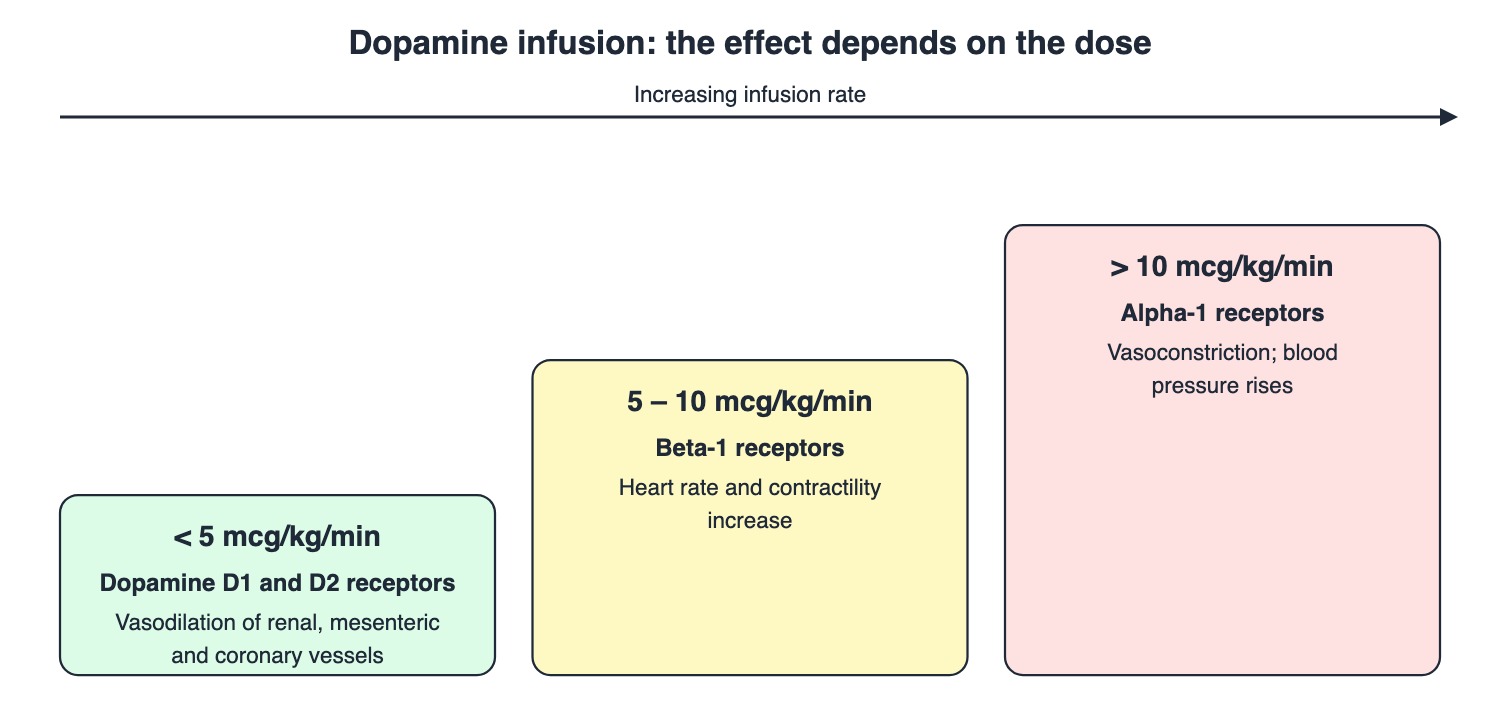
Dopamine infusion: D1/D2 vasodilation below 5 mcg/kg/min, beta-1 inotropy at 5–10, alpha-1 vasoconstriction above 10, as stated in the US dopamine label. Drawn by TrackNation.
Dopamine barely crosses the blood-brain barrier. Infuse into a large vein: extravasation can cause necrosis.
Central Alpha-2 Agonist and Alpha Blockers
Clonidine: a centrally acting alpha agonist that lowers blood pressure. Sudden stopping can cause nervousness, agitation, headache, tremor and a rapid rise in blood pressure; patients are told not to stop it without their doctor.
Prazosin (alpha-1 blocker, hypertension): can cause syncope with sudden loss of consciousness, usually from excessive postural hypotension.
Tamsulosin: for benign prostatic hyperplasia, not for hypertension. Alpha-1 blockers can cause intraoperative floppy iris syndrome in cataract and glaucoma surgery.
Phenoxybenzamine: long-acting alpha blocker ("chemical sympathectomy") for phaeochromocytoma, to control hypertension and sweating; a beta blocker may be added if tachycardia is excessive.
Beta Blockers
Beta blocker | Type (label) | Remember |
Propranolol | Non-selective beta | Hypertension, angina, AF rate control, post-MI, migraine prophylaxis, essential tremor, hypertrophic subaortic stenosis, phaeochromocytoma; avoid in asthma |
Metoprolol | Beta-1 selective (cardioselective) | Selectivity is not absolute: blocks beta-2 at high levels |
Atenolol | Beta-1 selective | Polar, hydrophilic |
Esmolol | Beta-1 selective, IV | Half-life about 9 minutes; broken down by red-cell esterases |
Labetalol | Alpha-1 + non-selective beta | Severe hypertension (IV) |
Carvedilol | Alpha + beta | Chronic heart failure; post-MI LV dysfunction; hypertension |
Abrupt withdrawal of propranolol has caused worsening angina and myocardial infarction: taper over at least a few weeks.
Beta blockade can mask the warning signs of hypoglycaemia (pulse and pressure changes), especially in insulin-treated diabetics.
Propranolol is contraindicated in bronchial asthma, sinus bradycardia and heart block greater than first degree.
Traps the Examiner Sets
Anaphylaxis: the label's route is IM (or SC) into the anterolateral thigh.
Dopamine: low dose D1/D2, middle beta-1, high alpha-1.
Dobutamine does not release noradrenaline; dopamine does.
Phenylephrine is pure alpha-1; isoprenaline is pure beta (diastolic pressure falls).
Cardioselective beta-1 blockers lose selectivity at high doses.
Tamsulosin is for BPH, not hypertension; watch for floppy iris at cataract surgery.
Phaeochromocytoma: alpha blockade (phenoxybenzamine) first; beta blocker only added for tachycardia.
Memory Hooks & Shortcuts
Shortcuts to lock in this article's numbers and lists. Each one only re-packages facts proven above.
🧠 Dopamine climbs D → β1 → α1 — below 5 dopamine receptors, 5–10 beta-1, above 10 alpha-1 (mcg/kg/min)
🧠 Thigh first, IM first — anaphylaxis: adrenaline IM into the anterolateral thigh
🧠 Pheo: Alpha before Beta — phenoxybenzamine first; beta blocker only for tachycardia
🧠 MAE are Mild on lungs — Metoprolol, Atenolol, Esmolol are beta-1 selective
🧠 Tam for the prostate, floppy for the iris — tamsulosin: BPH, and intraoperative floppy iris syndrome
🧠 Clonidine Climbs when Cut — sudden clonidine withdrawal raises blood pressure
Rapid-Revision Cards
Adrenaline receptors
Non-selective alpha and beta.
Adrenaline in anaphylaxis
IM thigh; 0.3–0.5 mg (>30 kg) or 0.01 mg/kg; repeat 5–10 min.
Noradrenaline
Alpha vasoconstriction + beta inotropy; reflex bradycardia.
Extravasation antidote
Phentolamine 5–10 mg infiltrated.
Dopamine < 5
D1/D2: renal, mesenteric, coronary vasodilation.
Dopamine 5–10
Beta-1: rate and contractility.
Dopamine > 10
Alpha-1: vasoconstriction.
Dobutamine
Cardiac beta; does not release noradrenaline.
Phenylephrine
Pure alpha-1; anaesthesia hypotension.
Isoprenaline
Pure beta; diastolic pressure falls.
Salbutamol ADRs
Hypokalaemia, glucose change, paradoxical bronchospasm.
Clonidine
Central alpha agonist; rebound hypertension if stopped suddenly.
Prazosin
Alpha-1 blocker; syncope (postural).
Tamsulosin
BPH, not hypertension; floppy iris at cataract surgery.
Phenoxybenzamine
Long-acting alpha blocker; phaeochromocytoma.
Propranolol
Non-selective; migraine prophylaxis, tremor, AF, post-MI; avoid in asthma.
Cardioselective
Metoprolol, atenolol, esmolol; selectivity lost at high doses.
Esmolol
IV; t½ ~9 min; red-cell esterases.
Labetalol
Alpha-1 + beta; severe hypertension.
Carvedilol
Alpha + beta; chronic heart failure.
Beta blocker + diabetes
Masks hypoglycaemia warning signs.
Beta blocker withdrawal
Angina, MI; taper over weeks.
Sources
Facts in this article were checked against these documents.
Prescribing labels: epinephrine injection; Levophed (norepinephrine); dopamine HCl injection; dobutamine in dextrose; phenylephrine HCl injection; isoproterenol HCl injection; albuterol HFA; Catapres-TTS (clonidine); prazosin; Flomax (tamsulosin); phenoxybenzamine; propranolol; metoprolol tartrate; Tenormin (atenolol); Brevibloc (esmolol); labetalol injection; Coreg (carvedilol) — DailyMed, US National Library of Medicine, current labels, accessed November 2026 (link)
MSD Manual Professional Edition: Overview of the Autonomic Nervous System — Merck & Co. (MSD Manuals), 2025 (link)
Competency Based Undergraduate Curriculum, Pharmacology (PH 2.2) — National Medical Commission, 2024
Test Yourself: Practice Questions
Twenty-three questions in NEET PG style.
Practice Questions (NEET PG pattern)
Original questions written in the style of the exam: +4 for a correct answer, −1 for a wrong one. Every answer was checked against the sources listed above. NEET PG papers are not published by NBEMS, so these are not past-paper questions.
Q1. For anaphylaxis in an adult, adrenaline (1 mg/mL) is given
(a) 0.01 mg/kg orally
(b) 5 mg subcutaneously once
(c) 1 mg IV bolus as first line
(d) 0.3–0.5 mg intramuscularly into the anterolateral thigh, repeated every 5–10 minutes as needed
Show answer
Answer: (d) — The label: IM or SC into the anterolateral thigh every 5–10 minutes; 0.3–0.5 mg for adults and children over 30 kg.
Q2. The anaphylaxis dose of adrenaline for a child weighing 20 kg is
(a) 0.5 mg
(b) 0.1 mg/kg (2 mg)
(c) 1 mg
(d) 0.01 mg/kg (0.2 mg)
Show answer
Answer: (d) — Children under 30 kg: 0.01 mg/kg; 20 × 0.01 = 0.2 mg.
Q3. Dopamine at 3 mcg/kg/min mainly causes
(a) renal, mesenteric and coronary vasodilation via D1 and D2 receptors
(b) alpha-1 vasoconstriction
(c) marked tachycardia
(d) beta-2 bronchodilation
Show answer
Answer: (a) — Below 5 mcg/kg/min dopamine activates D1/D2 receptors, causing vasodilation.
Q4. At 15 mcg/kg/min, dopamine raises blood pressure mainly through
(a) muscarinic receptors
(b) beta-2 receptors
(c) D1 receptors
(d) alpha-1 receptors
Show answer
Answer: (d) — Above 10 mcg/kg/min dopamine activates alpha-1 receptors, causing vasoconstriction.
Q5. Which inotrope does not release endogenous noradrenaline?
(a) Ephedrine
(b) Dopamine
(c) Dobutamine
(d) Tyramine
Show answer
Answer: (c) — Dobutamine acts directly on cardiac beta receptors and does not release noradrenaline, unlike dopamine.
Q6. Hypotension from vasodilation during anaesthesia is treated with a pure alpha-1 agonist such as
(a) phenylephrine
(b) dobutamine
(c) salbutamol
(d) isoprenaline
Show answer
Answer: (a) — Phenylephrine is an alpha-1 agonist indicated for hypotension from vasodilation during anaesthesia.
Q7. Isoprenaline infusion lowers diastolic pressure because it is
(a) a non-selective beta agonist with very low alpha affinity
(b) an alpha-1 agonist
(c) a D1 agonist
(d) a beta blocker
Show answer
Answer: (a) — Isoproterenol is a potent nonselective beta agonist; peripheral resistance falls and diastolic pressure falls.
Q8. A noradrenaline infusion extravasates. The label's antidote for local infiltration is
(a) propranolol
(b) phentolamine
(c) atropine
(d) hyaluronidase only
Show answer
Answer: (b) — Infiltrate 5–10 mg phentolamine in 10–15 mL saline.
Q9. Noradrenaline can slow the heart through
(a) direct beta blockade
(b) D2 activation
(c) reflex bradycardia from the rise in blood pressure
(d) muscarinic stimulation
Show answer
Answer: (c) — Overdosage may cause severe hypertension and reflex bradycardia.
Q10. An adverse effect listed for inhaled salbutamol (albuterol) is
(a) bradycardia
(b) miosis
(c) hypokalaemia
(d) hyperkalaemia
Show answer
Answer: (c) — Hypokalaemia and changes in blood glucose may occur; paradoxical bronchospasm is also possible.
Q11. Sudden stopping of clonidine can cause
(a) a rapid rise in blood pressure with agitation and tremor
(b) bradycardia and hypotension
(c) hypoglycaemia
(d) bronchospasm
Show answer
Answer: (a) — Clonidine withdrawal: nervousness, agitation, headache, tremor and a rapid rise in blood pressure.
Q12. Syncope with sudden loss of consciousness after starting an antihypertensive is a recognised effect of
(a) clonidine
(b) amlodipine
(c) prazosin
(d) hydrochlorothiazide
Show answer
Answer: (c) — Prazosin may cause syncope, usually from excessive postural hypotension.
Q13. A patient on tamsulosin is listed for cataract surgery. The surgeon should anticipate
(a) corneal oedema
(b) acute angle-closure glaucoma
(c) intraoperative floppy iris syndrome
(d) malignant hyperthermia
Show answer
Answer: (c) — IFIS has occurred in cataract and glaucoma surgery in patients on or previously on alpha-1 blockers.
Q14. Tamsulosin is indicated for
(a) hypertension
(b) phaeochromocytoma
(c) benign prostatic hyperplasia
(d) Raynaud phenomenon
Show answer
Answer: (c) — Flomax treats BPH symptoms and is not indicated for hypertension.
Q15. Hypertension and sweating in phaeochromocytoma are controlled with
(a) clonidine
(b) isoprenaline
(c) propranolol alone
(d) phenoxybenzamine
Show answer
Answer: (d) — Phenoxybenzamine, a long-acting alpha blocker; add a beta blocker only if tachycardia is excessive.
Q16. Propranolol is contraindicated in
(a) bronchial asthma
(b) essential tremor
(c) migraine prophylaxis
(d) hypertrophic subaortic stenosis
Show answer
Answer: (a) — Contraindications include bronchial asthma, sinus bradycardia and heart block beyond first degree.
Q17. Which is a labelled use of propranolol?
(a) Acute asthma
(b) Prophylaxis of migraine
(c) Treating an acute migraine attack
(d) Hypertensive emergency
Show answer
Answer: (b) — Propranolol prevents common migraine; it is not indicated for an attack in progress or for hypertensive emergencies.
Q18. Beta blockers are used cautiously in insulin-treated diabetics because they
(a) cause ketoacidosis
(b) cause hyperglycaemic coma
(c) increase insulin absorption
(d) mask premonitory signs of hypoglycaemia
Show answer
Answer: (d) — Beta blockade may prevent the pulse and pressure changes that warn of hypoglycaemia.
Q19. Stopping propranolol suddenly in a patient with angina can cause
(a) hypoglycaemia
(b) worsening angina and myocardial infarction
(c) asthma
(d) hypotension
Show answer
Answer: (b) — Taper over at least a few weeks.
Q20. Metoprolol at high doses may cause bronchospasm because
(a) it is an alpha blocker
(b) it is a muscarinic agonist
(c) its beta-1 selectivity is not absolute
(d) it has intrinsic sympathomimetic activity
Show answer
Answer: (c) — Metoprolol is cardioselective, but at higher concentrations it also blocks beta-2 receptors in bronchi.
Q21. Esmolol is suited to short-term IV control of heart rate because
(a) its half-life is about 9 minutes, as red-cell esterases break it down
(b) it blocks alpha receptors
(c) it is renally excreted unchanged
(d) it is a prodrug
Show answer
Answer: (a) — Elimination half-life about 9 minutes; metabolised by red blood cell esterases.
Q22. Labetalol differs from propranolol because it also blocks
(a) alpha-1 receptors
(b) muscarinic receptors
(c) beta-3 receptors only
(d) dopamine receptors
Show answer
Answer: (a) — Labetalol has selective alpha-1 and non-selective beta blocking actions in one molecule.
Q23. Which beta blocker with alpha-blocking action is indicated for chronic heart failure?
(a) Propranolol
(b) Carvedilol
(c) Atenolol
(d) Esmolol
Show answer
Answer: (b) — Carvedilol (an alpha/beta blocker) is indicated for mild-to-severe chronic heart failure.
Active Recall
From memory: give the receptors and main use of adrenaline, noradrenaline, dopamine (by dose), dobutamine, phenylephrine and isoprenaline; state the adrenaline dose in anaphylaxis; describe clonidine withdrawal; list the uses and side effects of prazosin, tamsulosin and phenoxybenzamine; and compare propranolol, the cardioselective blockers, labetalol and carvedilol.