Accountability and Ethical Governance for UPSC GS4: Social Audit, Systemic Reforms, Integrity Pacts, Mission Karmayogi, Social Capital and the BNS
Accountability and Social Audit
🎯 Exam priority: High-yield (Mains GS4). Asked in every recent paper: social audit (2021), social capital (2023), the Bharatiya Nyaya Sanhita, women in public service and Mission Karmayogi (2024), the civil servant as enabler rather than regulator (2025), and a professor using AI to write a PhD evaluation (2026, accountability and integrity).
What accountability means
Accountability is the duty to answer for one's decisions and actions, and to face consequences for them. It has two parts: answerability (explaining and justifying) and enforceability (sanctions or rewards). Its forms:
Type | To whom | Instruments |
Political | Legislature and voters | Questions, debates, committees, elections |
Administrative | Superiors in the hierarchy | Supervision, performance appraisal, discipline |
Legal | Courts and tribunals | Judicial review, writs, criminal and civil liability |
Financial | Auditors and the legislature | Audit, public accounts committees |
Social (to citizens directly) | The public | RTI, citizens' charters, social audit, report cards, Gram Sabhas |
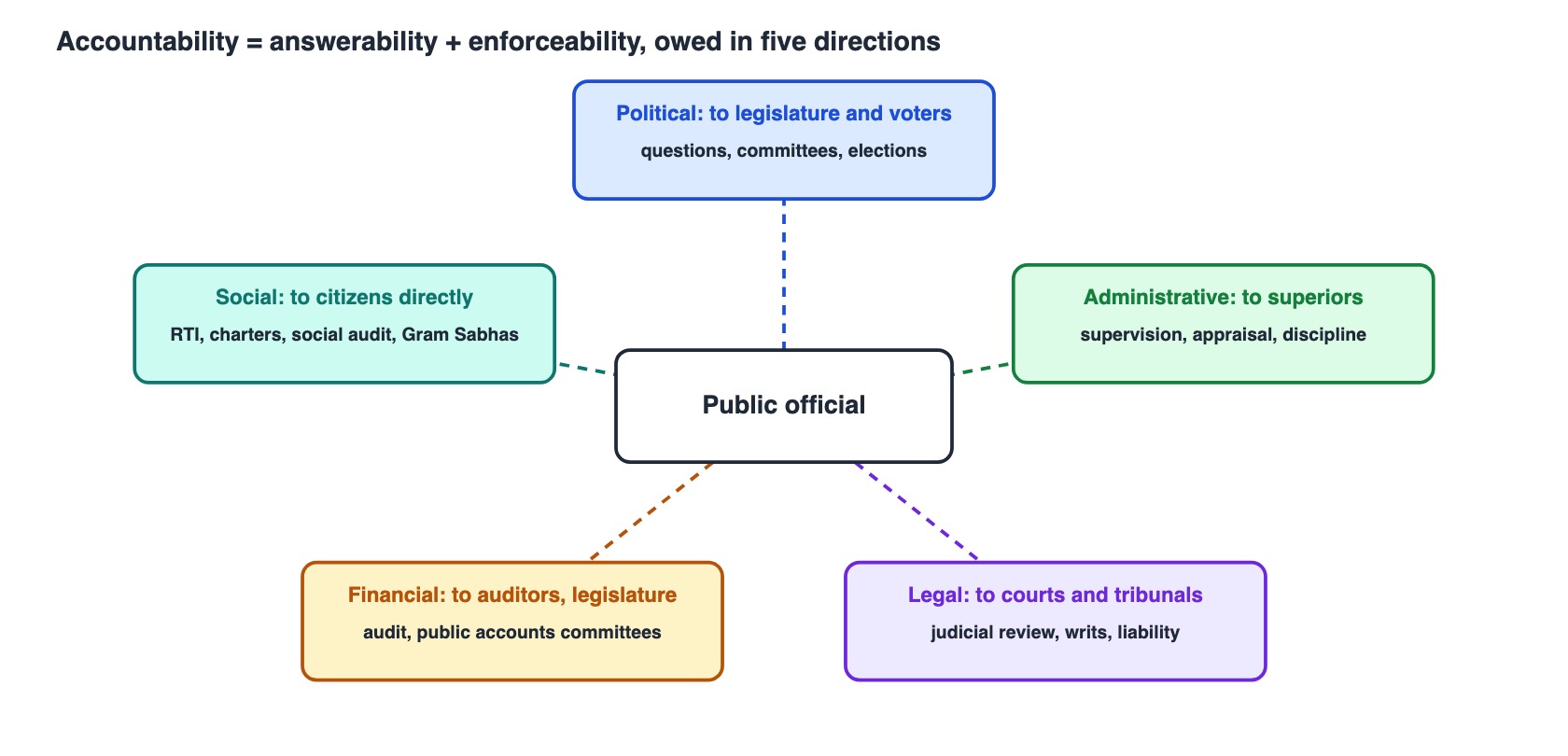
Five directions of accountability, each with its instruments.
The 2nd ARC stresses the last: every democracy needs empowered citizens to hold authority to account, and RTI, citizens' charters, stakeholder involvement, public consultation and social auditing have curbed corruption and improved decisions.
Social audit (2021)
A social audit is a review of a programme by the people it is meant to serve: records are read out in public, beneficiaries verify work and payments, and findings go to authorities for action. The ARC's 12th Report (2009) recommends that citizens be involved in all stages of development programmes and that social audit be mandatory for all developmental programmes, and it cites citizens' report cards on Bangalore's city services by the Public Affairs Centre (1994, 1999, 2003), which showed marked improvement in the utilities rated.
Should it extend to every sphere, including the judiciary? Its strengths: accountability to the user, early detection of leakage, and public trust. Its limits: capture by local elites, retaliation against those who speak, technical areas the public cannot judge, and judicial independence, which rules out audit of judgments themselves. A balanced answer supports social audit of services, spending and delays (case pendency, court facilities) in every sphere, while protecting adjudication from popular pressure.
Strengthening Ethics: Systemic Reforms and Mission Karmayogi
Strengthening ethical values in governance
The 2nd ARC prefers systemic reforms that reduce opportunities for corruption over appeals to virtue alone:
Reform | How it works | Example from the report |
Promote competition | Monopoly breeds corruption; choice reduces it | Telecom after private players entered |
Simplify transactions and use IT | Fewer steps and less contact with officials | e-Seva (Andhra Pradesh), FRIENDS (Kerala), e-Cops (Punjab) |
Promote transparency | Publish rules, criteria and decisions | Computerised land and property records |
Integrity pacts | Public agency and bidders agree that no bribes are paid, overseen by independent outside observers | Required in defence contracts above Rs 300 crore |
Reduce discretion | Clear criteria, time limits, objective tests | Transparent property valuation tables |
Supervision and complaint monitoring | Track complaints and act on them | Online complaint registration |
Values still matter: the ARC wants Public Service Values defined in law, codes of ethics (article 13), and protection for honest officers.
Mission Karmayogi (2024)
The National Programme for Civil Services Capacity Building, a Central Sector Scheme of DoPT, aims to move the civil service from a rule-based to a role-based approach driven by competencies, building the skills, mindset and accountability to deliver outcomes for citizens.
Institutions: the Capacity Building Commission (2021) is custodian of the framework; Karmayogi Bharat (a special purpose vehicle, 2022) runs the iGOT Karmayogi learning platform.
Scale (PIB, April 2026): over 1.5 crore learners, 8 crore course completions and 4,600 courses; over 130 capacity-building plans; learning outcomes integrated with performance appraisal.
Empowerment: continuous, self-paced learning; behavioural training (empathy, communication) alongside domain skills; recognition of competence. Limits: online courses can become box-ticking; ethics is learned by example as much as by modules.
From regulator to enabler (2025)
An enabling civil servant simplifies approvals (single windows, deemed approvals, self-certification for low-risk activities), gives time-bound decisions, listens to entrepreneurs, SHGs and farmers, and uses data to remove bottlenecks, while still enforcing rules on safety, environment and labour. The ethical point: enabling is not abandoning regulation; it is regulating with trust, speed and fairness.
Social Capital, the BNS, Women in Service and AI
Social capital and good governance (2023)
Pierre Bourdieu distinguished economic capital (assets and income), cultural capital (education and status) and social capital (networks of contacts and social associations). For governance, social capital means the trust, norms and networks that let people cooperate. It enhances good governance by raising participation (Gram Sabhas, SHGs, user groups), easing collective action (water users managing canals), lowering transaction costs (people trust institutions and each other), and enabling social accountability. Caution: closed networks of caste or kin can also breed exclusion and nepotism ("bonding" without "bridging").
The Bharatiya Nyaya Sanhita (2024)
The BNS, 2023 replaced the Indian Penal Code, 1860, and came into force on 1 July 2024; for the first time, terrorism and organised crime are defined in the general criminal law. The 2024 question asked how its soul, "Justice, Equality and Impartiality", marks a shift from a doctrine of punishment to one of justice. Arguments for: the very name (nyaya, justice); the government's stated aim of timely justice, with forensic capacity and technology to speed trials; and a code written in India's own idiom rather than a colonial one. Critics ask whether wider police powers and longer detentions sit easily with the shift. Answer both ways, ending with the ethical test: justice means fairness to the victim, the accused and society alike.
Women in public service (2024)
Gender-specific challenges: under-representation in senior and field posts, stereotyped postings, harassment and the burden of proof on the complainant, lack of childcare and family-friendly rules, safety in field postings, and the "double burden" of home and office. Remedies: effective internal committees on sexual harassment, childcare facilities and flexible leave, mentoring, and equal opportunity in postings. The ARC notes that the conduct rules now prohibit sexual harassment of women employees.
AI and integrity (2026)
A professor who has AI generate a PhD evaluation report and submits it with minor edits fails both tests. Accountability: the examiner, not the tool, is answerable for the judgment, and cannot vouch for what he has not assessed. Integrity: he presents machine output as his own expert opinion, and may breach confidentiality by uploading the thesis. Use of AI is ethical only if disclosed, permitted by the university, confined to support tasks, and if the final judgment is genuinely his.
Further Reading
PIB press releases, ministry websites and annual reports, the Gazette of India, MEA and UN documents and the official sources named in each note — the primary sources behind every fact above.
Test Yourself: Practice Questions & PYQs
12 practice questions, then the GS4 questions on accountability and ethical governance.
Practice Questions
Q1. Accountability has two essential parts:
(a) answerability and enforceability
(b) hierarchy and seniority
(c) efficiency and speed
(d) secrecy and loyalty
Show answer
Answer: (a) — Officials must explain their decisions and face consequences.
Q2. The 2nd ARC's 12th Report recommends that social audit be
(a) limited to the private sector
(b) mandatory for all developmental programmes
(c) abolished
(d) conducted only by the CAG
Show answer
Answer: (b) — It also wants citizens involved at all stages of programmes.
Q3. The citizens' report cards on Bangalore's city services cited by the 2nd ARC were conducted by
(a) NITI Aayog
(b) the Election Commission
(c) the CAG
(d) the Public Affairs Centre
Show answer
Answer: (d) — In 1994, 1999 and 2003.
Q4. An 'integrity pact' is an agreement between
(a) a public procuring agency and bidders that no bribes will be paid
(b) a citizen and a court
(c) a minister and his staff
(d) two governments on trade
Show answer
Answer: (a) — It is often overseen by independent outside observers.
Q5. According to the 2nd ARC, the Defence Procurement Procedure Manual, 2006 requires integrity pacts in contracts above
(a) Rs 300 crore
(b) Rs 50 crore
(c) Rs 100 crore
(d) Rs 1,000 crore
Show answer
Answer: (a) — The ARC wanted the practice extended.
Q6. Mission Karmayogi aims to move the civil service from
(a) merit to seniority
(b) online to offline training
(c) a rule-based to a role-based approach
(d) a role-based to a rule-based approach
Show answer
Answer: (c) — It is the National Programme for Civil Services Capacity Building.
Q7. Which body runs the iGOT Karmayogi platform?
(a) UPSC
(b) NITI Aayog
(c) the Capacity Building Commission
(d) Karmayogi Bharat
Show answer
Answer: (d) — The Capacity Building Commission (2021) is custodian of the framework; Karmayogi Bharat (2022) runs iGOT.
Q8. As of April 2026, learners registered on iGOT numbered over
(a) 1.5 lakh
(b) 15 crore
(c) 15 lakh
(d) 1.5 crore
Show answer
Answer: (d) — With over 8 crore course completions and 4,600 courses.
Q9. The Bharatiya Nyaya Sanhita, 2023 came into force on
(a) 1 July 2024
(b) 26 January 2024
(c) 1 April 2023
(d) 15 August 2024
Show answer
Answer: (a) — It replaced the Indian Penal Code, 1860.
Q10. In Bourdieu's scheme, educational qualifications are a form of
(a) social capital
(b) cultural capital
(c) economic capital
(d) political capital
Show answer
Answer: (b) — Social capital is networks of contacts and associations.
Q11. Consider the following statements:
1. Social capital can raise participation and trust.
2. Closed caste or kin networks can breed exclusion.
3. Social capital is the same as income.
Which of the statements given above are correct?
(a) 1 and 2 only
(b) 2 and 3 only
(c) 1 and 3 only
(d) 1, 2 and 3
Show answer
Answer: (a) — 1 and 2 are correct. Income is economic capital.
Q12. A professor who submits an AI-generated thesis evaluation with minor edits mainly violates
(a) only efficiency
(b) only copyright law
(c) nothing, if the AI is accurate
(d) accountability and integrity
Show answer
Answer: (d) — The examiner remains answerable for the judgment and must not present machine output as his own.
Mains Practice Questions
Use these to frame full-length answers. You don't have to answer one exactly — they show the angles UPSC tests, so let them guide which points you cover.
An independent social audit mechanism is a must in every sphere of public service. Elaborate.
Explain social capital and how it enhances good governance.
How can Mission Karmayogi strengthen ethics and efficiency in the civil service?
UPSC Mains — Previous Years’ Questions on this topic (last 10 years)
These are the actual GS Mains questions UPSC has asked on this theme — real proof of how, and when, it is tested. Try to write a full answer to each.
2021 (GS-IV): An independent and empowered social audit mechanism is an absolute must in every sphere of public service, including judiciary, to ensure performance, accountability and ethical conduct. Elaborate.
2023 (GS-IV): Explain the term social capital. How does it enhance good governance?
2024 (GS-IV): The soul of the new law, Bharatiya Nyaya Sanhita (BNS) is Justice, Equality and Impartiality based on Indian culture and ethos. Discuss this in the light of major shift from a doctrine of punishment to justice in the present judicial system.
2024 (GS-IV): "In Indian culture and value system, an equal opportunity has been provided irrespective of gender identity. The number of women in public service has been steadily increasing over the years." Examine the gender-specific challenges faced by female public servants and suggest suitable measures to increase their efficiency in discharging their duties.
2024 (GS-IV): Mission Karmayogi is aiming for maintaining a very high standard of conduct and behaviour to ensure efficiency for serving citizens and in turn developing oneself. How will this scheme empower the civil servants in enhancing productive efficiency and delivering the services?
2025 (GS-IV): To achieve holistic development goal, a civil servant acts as an enabler and active facilitator of growth rather than a regulator. What specific measures will you suggest to achieve this goal?
2026 (GS-IV): Owing to paucity of time, a university professor generates a Ph.D. evaluation report using Artificial Intelligence and submits it with some modifications. Discuss this from the perspective of accountability and integrity.