Ethics in International Relations for UPSC GS4: Realism vs Just War, Clausewitz, Arms and Peace, Security vs Human Rights, Refugees, Aid and Climate Justice
Realism, Just War and Clausewitz
🎯 Exam priority: High-yield (Mains GS4). The most consistent theme of recent papers: refugees (2021), the Russia-Ukraine war (2022), international aid (2023), the arms industry and peace, and climate change as greed (2024), Clausewitz on war and environmental clearances in border areas (2025), national security vs human rights, ethics vs strategic interest, and a weapons-export case study (2026).
Three views of ethics between states
View | Claim | Weakness |
Realism | States act on national interest and power; morality does not bind them in war | Licenses any cruelty that serves interest |
Pacifism | No war can be morally justified | May leave the innocent undefended against aggression |
Just war theory | The middle path: justify some wars, but also limit them | Its criteria are open to self-serving interpretation |
The 2026 question ("ethical considerations are often subordinated to the strategic interests of nation-states") asks you to weigh realism against these alternatives. A good answer accepts that states must protect their citizens, but argues that interest pursued without ethics is self-defeating: it destroys trust, invites retaliation and erodes the international order India depends on. India's own tradition (non-alignment, Panchsheel, "the world is one family") frames national interest within ethical limits.
Just war theory
Jus ad bellum: going to war | Jus in bello: conduct in war |
Just cause: averting the right kind of injury (self-defence against aggression) | Discrimination: always distinguish military targets from civilians |
Legitimate authority | Proportionality: foreseen harm proportionate to the military advantage |
Right intention: the just cause, not a pretext | Necessity: the least harmful means feasible |
Reasonable prospects of success | |
Proportionality of overall good and harm | |
Last resort (necessity) |
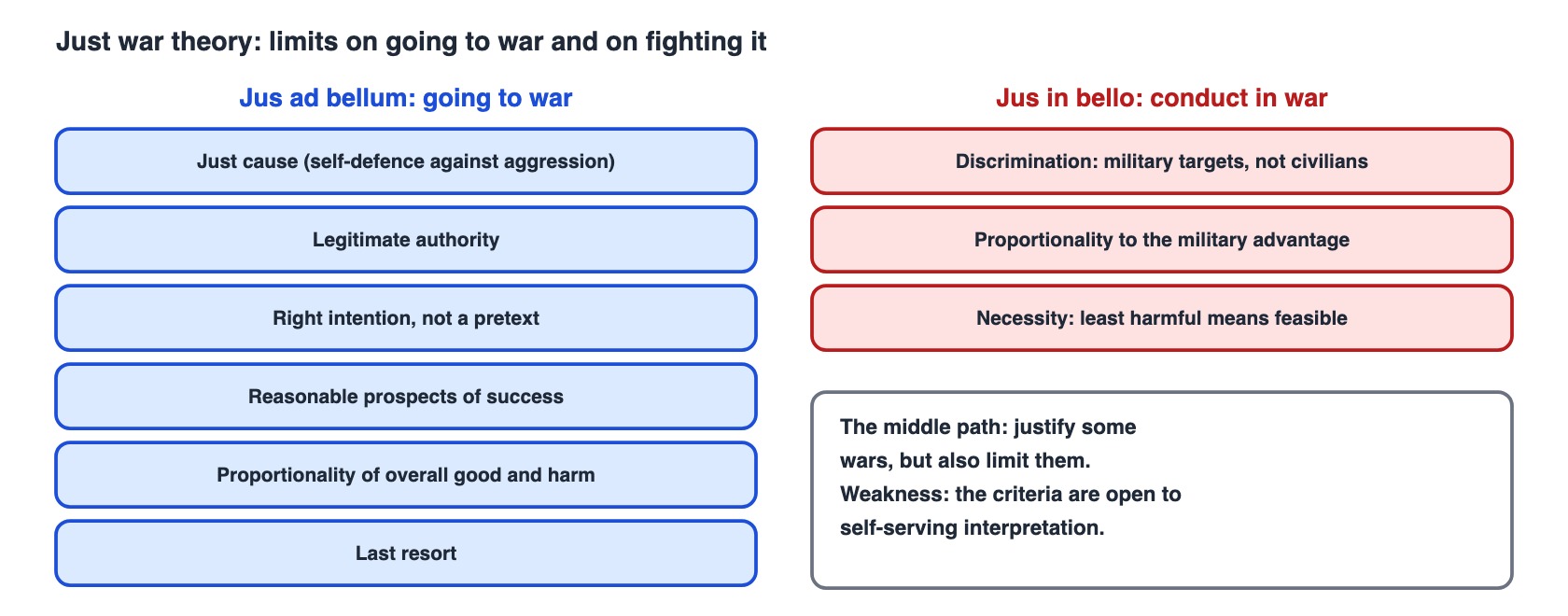
Just war criteria: when going to war can be justified, and how it must be fought.
Clausewitz (2025)
UPSC quoted Carl von Clausewitz as saying "War is a diplomacy by other means". His actual words in On War (Book I, chapter 1) are that war is "a mere continuation of policy by other means": war is a political instrument, not an end in itself. Critically: this is descriptively true of many modern conflicts (Ukraine, West Asia), but ethically incomplete. Treating war as just another policy tool lowers the threshold for violence; just war theory, international humanitarian law and the UN Charter exist to keep war a last resort and to protect civilians when it happens.
War, Arms, Security and Refugees
Peace, arms and war (2022, 2024, 2026)
The Russia-Ukraine war (2022): states took positions according to their interests. Ethical dimensions: sovereignty and territorial integrity; civilian deaths and refugees; food and energy shocks for poor countries; sanctions that hurt ordinary people; and the duty to pursue dialogue. The 2022 question asked what ethics should govern both launching a war and continuing it: the just war criteria below give the structure.
Arms industry (2024): "It is not enough to talk about peace, one must believe in it, and act upon it." When weapons industries profit from prolonging conflicts, the profit motive corrupts foreign policy. Ethical responses: arms export controls, end-use monitoring, transparency of transfers, and no sales to regimes committing atrocities.
The weapons-sales case (2026): the head of a department selling domestically made weapons abroad faces the tension between revenue, jobs and strategic ties on one side and the risk of fuelling atrocities on the other. The ethical course follows the law and India's export controls, insists on end-use assurances, refuses sales where weapons are likely to be used against civilians, and records reasons transparently.
National security and human rights (2025, 2026)
Security protects the most basic right, to life; human rights protect citizens from the state that provides security. Balance through: legality (measures must have a basis in law), necessity and proportionality (the least intrusive effective measure), oversight (judicial review, parliamentary scrutiny, human rights bodies), time limits and review, and accountability for abuse. In border areas, roads and installations in ecologically fragile zones pit defence needs against forests, glaciers and local communities: use rigorous but fast-tracked environmental assessment, the least damaging alignment, mitigation and community consultation, so that security does not become an excuse for avoidable harm.
Refugees (2021)
The principle that refugees should not be sent back to a country where they would face persecution is known as non-refoulement. The ethical case: equal human dignity (Kant's humanity formula), compassion, and a democracy's own professed values. The counter-pressures: security risks, strain on resources and local communities, and demographic anxieties. A democracy claiming to be an open society violates its own ethics if it returns people to persecution; it can still screen for security, share the burden internationally and integrate refugees in an orderly way.
Aid, Funding and Climate Ethics
Ethics in international aid and funding (2023)
Ethical issue | Example | Better practice |
Conditionality and political strings | Aid tied to votes, bases or policy changes | Aid aligned with the recipient's own priorities |
Tied aid | Aid that must be spent on the donor's firms | Untied, transparent procurement |
Debt burdens | Loans for unviable projects that leave countries in distress | Grants and concessional, sustainable financing |
Dependency and paternalism | Donors decide what poor countries need | Partnership and capacity building |
Leakage and corruption | Aid captured by elites | Transparency, audit and local accountability |
Foreign funding of civil society | Funding that shapes domestic agendas | Disclosure and regulation, without silencing legitimate NGOs |
India describes its own development cooperation (lines of credit, projects, debt relief and capacity building) as demand-driven, consultative and based on mutual benefit, non-interference and respect for sovereignty, which it contrasts with many traditional aid models (MEA Annual Report 2025). The ethical test for any donor: does aid serve the recipient's people or the donor's leverage?
Climate change as an ethical issue (2024)
Human-caused: anthropogenic climate change is change in Earth's climate caused or influenced by human activity, driven by fossil-fuel demand.
Justice: marginalised groups and poor countries are hit hardest though they emitted least, which is the basis of "common but differentiated responsibilities" in the climate regime built on the UNFCCC, the Kyoto Protocol (1997) and the Paris Agreement (2015).
Beyond anthropocentrism: traditional Western ethics is human-centred; environmental ethics asks whether nature has value of its own, a view close to Indian traditions of reverence for all life (Jainism's view that even water and stones have life).
Ending greed-driven harm: responsible consumption (India's LiFE, Lifestyle for Environment, idea), carbon pricing, honest corporate disclosure, climate finance from the rich to the poor, and intergenerational justice.
Further Reading
PIB press releases, ministry websites and annual reports, the Gazette of India, MEA and UN documents and the official sources named in each note — the primary sources behind every fact above.
Test Yourself: Practice Questions & PYQs
12 practice questions, then the GS4 questions on international ethics.
Practice Questions
Q1. Just war theory seeks a middle path between
(a) realism and pacifism
(b) nationalism and federalism
(c) capitalism and socialism
(d) utilitarianism and deontology
Show answer
Answer: (a) — It justifies some wars but also limits them.
Q2. Which principle belongs to jus in bello (conduct in war)?
(a) Discrimination between military targets and civilians
(b) Reasonable prospects of success
(c) Just cause
(d) Legitimate authority
Show answer
Answer: (a) — The others are jus ad bellum criteria for going to war.
Q3. 'Right intention' in just war theory means
(a) fighting to achieve the just cause, not as a pretext
(b) intending to expand territory
(c) declaring war formally
(d) intending to win at any cost
Show answer
Answer: (a) — It rules out using a just cause as an excuse for a wrongful end.
Q4. In On War, Clausewitz described war as
(a) the failure of all politics
(b) a natural state of man
(c) a purely economic act
(d) a mere continuation of policy by other means
Show answer
Answer: (d) — UPSC's 2025 question paraphrased it as 'diplomacy by other means'.
Q5. Not returning refugees to a country where they face persecution is the principle of
(a) non-refoulement
(b) non-alignment
(c) reciprocity
(d) sovereign immunity
Show answer
Answer: (a) — A 2021 GS4 question asked about its ethical dimension.
Q6. The UNFCCC laid the groundwork for the Kyoto Protocol and the Paris Agreement, adopted in
(a) 1992 and 2010
(b) 1997 and 2015
(c) 2005 and 2020
(d) 1987 and 2015
Show answer
Answer: (b) — More than 150 countries have signed the UNFCCC.
Q7. A human-centred view that assigns intrinsic value only to humans is called
(a) biocentrism
(b) ecocentrism
(c) relativism
(d) anthropocentrism
Show answer
Answer: (d) — Environmental ethics questions it.
Q8. Consider the following statements:
1. Tied aid requires spending on the donor's own firms.
2. Conditionality can attach political strings to aid.
3. Aid is ethically neutral in all cases.
Which of the statements given above are correct?
(a) 1 and 2 only
(b) 2 and 3 only
(c) 1 and 3 only
(d) 1, 2 and 3
Show answer
Answer: (a) — 1 and 2 are correct. Aid raises issues of strings, dependency, debt and leakage.
Q9. In balancing national security and human rights, the principle that a measure should be the least intrusive effective option is
(a) necessity and proportionality
(b) sovereignty
(c) reciprocity
(d) deterrence
Show answer
Answer: (a) — Along with legality, oversight and accountability.
Q10. Which view holds that states act on national interest and that morality does not bind them in war?
(a) Just war theory
(b) Cosmopolitanism
(c) Pacifism
(d) Realism
Show answer
Answer: (d) — Few philosophers find it compelling, though it has adherents.
Q11. Climate justice rests on the fact that
(a) climate change is natural only
(b) all countries emitted equally
(c) only rich countries are affected
(d) those who emitted least are often hit hardest
Show answer
Answer: (d) — Hence common but differentiated responsibilities.
Q12. In the 2026 weapons-sales case, the most ethical safeguard is
(a) end-use assurances and refusing sales likely to harm civilians
(b) selling to any buyer
(c) keeping all sales secret
(d) maximising revenue
Show answer
Answer: (a) — Lawful export controls and transparency guide the decision.
Mains Practice Questions
Use these to frame full-length answers. You don't have to answer one exactly — they show the angles UPSC tests, so let them guide which points you cover.
In international relations, ethics is often subordinated to strategic interest. Discuss from an ethical perspective.
How can national security be balanced with human rights?
Comment on the ethics of contemporary international aid with examples.
UPSC Mains — Previous Years’ Questions on this topic (last 10 years)
These are the actual GS Mains questions UPSC has asked on this theme — real proof of how, and when, it is tested. Try to write a full answer to each.
2021 (GS-IV): "Refugees should not be turned back to the country where they would face persecution or human right violation." Examine the statement with reference to ethical dimension being violated by the nation claiming to be democratic with open society.
2022 (GS-IV): Russia and Ukraine war has been going on for the last seven months. Different countries have taken independent stands and actions keeping in view their own national interests. We are all aware that war has its own impact on the different aspects of society, including human tragedy. What are those ethical issues that are crucial to be considered while launching the war and its continuation so far? Illustrate with justification the ethical issues involved.
2023 (GS-IV): 'International aid' is an accepted form of helping 'resource-challenged' nations. Comment on 'ethics in contemporary international aid'. Support your answer with suitable examples.
2024 (GS-IV): "It is not enough to talk about peace, one must believe in it; and it is not enough to believe in it, one must act upon it." In the present context, the major weapon industries of the developed nations are adversely influencing continuation of number of wars for their own self-interest, all around the world. What are the ethical considerations of the powerful nations in today's international arena to stop continuation of ongoing wars?
2024 (GS-IV): Global warming and climate change are the outcomes of human greed in the name of development, indicating the direction in which extinction of organisms including human beings is heading towards loss of life on Earth. How do you put an end to this to protect life and bring equilibrium between the society and the environment?
2025 (GS-IV): Carl von Clausewitz once said, "War is a diplomacy by other means." Critically analyse the statement in the present context of contemporary geo-political conflict.
2025 (GS-IV): Keeping the national security in mind, examine the ethical dilemmas related to controversies over environmental clearance of development projects in ecologically sensitive border areas.
2026 (GS-IV): Discuss how national security can be balanced with concerns of human rights.
2026 (GS-IV): In international relations, ethical considerations are often subjugated to the strategic interests of nation-states. Discuss this from an ethical perspective.