Paediatric Rheumatology and Immunodeficiency for NEET PG: JIA, IgA Vasculitis (HSP), XLA, DiGeorge, SCID, Wiskott–Aldrich, A-T and CGD
Start Here
🎯 Exam priority: Moderate–high. Expect: JIA definition and commonest type, who needs slit-lamp screening, systemic JIA and macrophage activation, IgA vasculitis tetrad, and matching each immunodeficiency to its arm, gene, clue and test.
Fact-checked against the MSD Manual. Rheumatic fever and Kawasaki disease are in article 17.
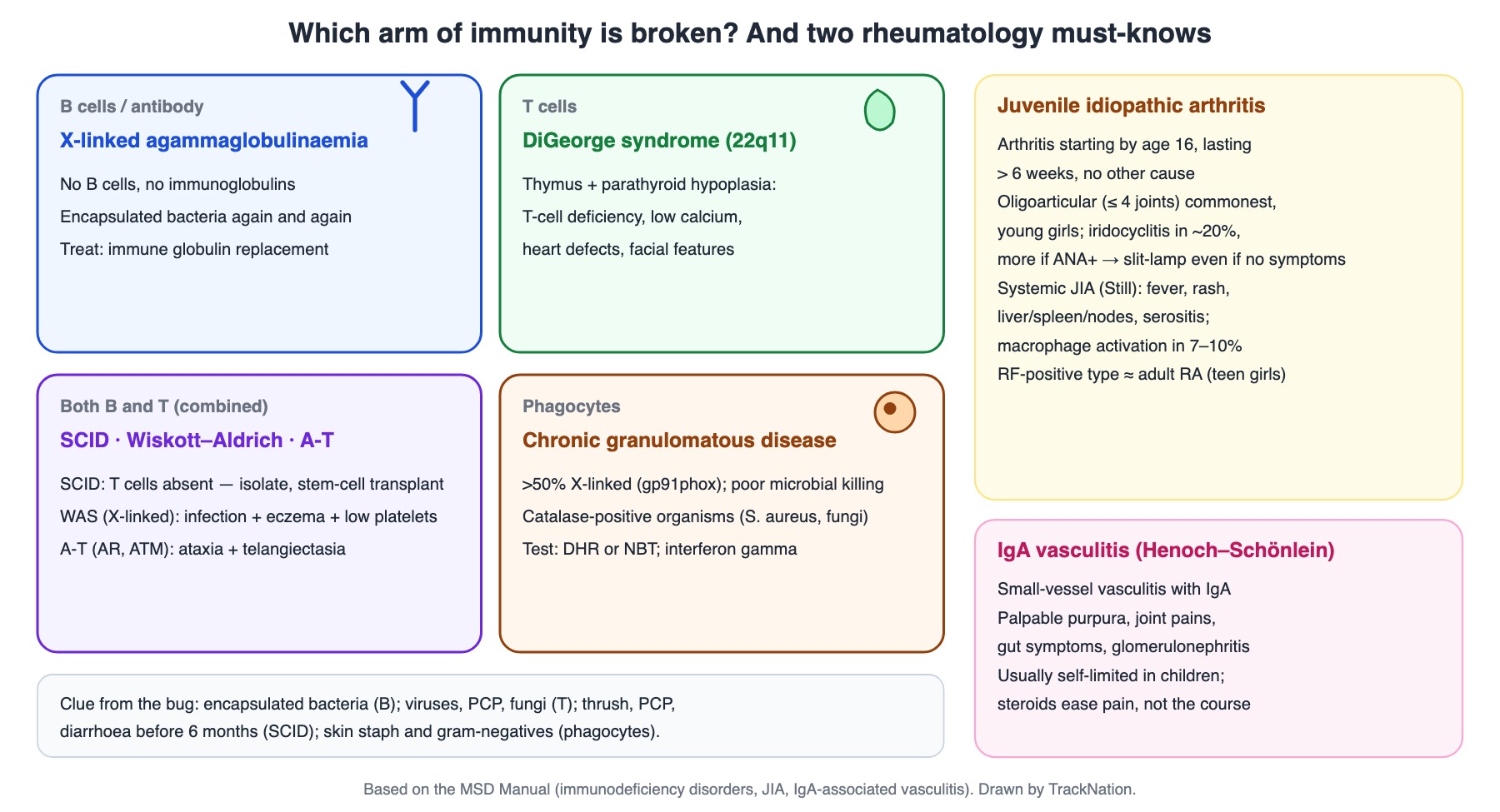
Primary immunodeficiency by arm of immunity, with JIA and IgA vasculitis. Drawn by TrackNation.
Juvenile Idiopathic Arthritis
JIA = arthritis beginning by age 16, lasting > 6 weeks, with no other cause.
Oligoarticular (≤ 4 joints; "extended" if ≥ 5 after 6 months) is the commonest, typically young girls. Iridocyclitis develops in nearly 20%, more if ANA-positive — so do slit-lamp examination even without eye symptoms; treat with steroid drops and mydriatics, methotrexate if needed.
RF-positive polyarticular: adolescent girls; behaves like adult RA.
Systemic JIA (Still disease): fever, rash, hepatosplenomegaly, lymphadenopathy, serositis with arthritis; macrophage activation syndrome (a cytokine storm) in 7–10%.
IgA Vasculitis (Henoch–Schönlein Purpura)
Small-vessel vasculitis with IgA immune-complex deposits.
Tetrad: palpable purpura, joint pains, gut symptoms, glomerulonephritis.
Usually self-limited in children; steroids ease joint and gut symptoms but do not change the course.
Primary Immunodeficiency by Arm
B cells — X-linked agammaglobulinaemia: no B cells, no immunoglobulins; repeated encapsulated bacterial infections; immune globulin replacement.
T cells — DiGeorge (22q11): thymic and parathyroid hypoplasia → T-cell deficiency and hypocalcaemia; congenital heart disease; low-set ears, small jaw, short philtrum. T-cell defects predispose to viruses, Pneumocystis and fungi.
Combined — SCID: T cells low or absent (e.g. JAK3 mutations); thrush, PCP, diarrhoea before 6 months, failure to thrive, absent thymic shadow; protected environment and stem-cell transplant. Wiskott–Aldrich (X-linked): infections + eczema + thrombocytopenia. Ataxia-telangiectasia (AR, ATM on 11q22, DNA repair): ataxia, telangiectasias, sinopulmonary infections.
Phagocytes — CGD: white cells cannot make activated oxygen, so killing fails; > 50% X-linked; infections with catalase-producing organisms (S. aureus, fungi); diagnose with DHR or NBT oxidative-burst test; antibiotics, antifungals, interferon gamma.
Traps the Examiner Sets
JIA uveitis is silent — screen with slit lamp even when the eyes look normal.
Steroids in HSP relieve pain but do not prevent kidney disease.
Eczema + low platelets + infections = Wiskott–Aldrich.
Low calcium + heart defect + infections = DiGeorge.
CGD: catalase-positive bugs; NBT/DHR test.
Memory Hooks & Shortcuts
Shortcuts to lock in this article's numbers and lists. Each one only re-packages facts proven above.
🧠 JIA uveitis: 'quiet eyes still need the lamp' — JIA
🧠 HSP 'PAGe': Purpura, Arthralgia, Gut, (glomerulo)nEphritis — IgA vasculitis
🧠 WAS 'TIE': Thrombocytopenia, Infections, Eczema — Wiskott–Aldrich
🧠 DiGeorge 'CATCH-22' — Cardiac, Abnormal face, Thymus, Cleft, Hypocalcaemia, 22q11 — DiGeorge
🧠 CGD 'catalase-positive cats' — Staph and fungi; NBT/DHR — CGD
Rapid-Revision Cards
JIA
By age 16; > 6 weeks; no other cause.
Oligoarticular
Commonest; ≤ 4 joints; young girls.
JIA uveitis
~20%; ANA+; slit lamp even if asymptomatic.
RF+ JIA
Teen girls; like adult RA.
Systemic JIA
Fever, rash, organomegaly, serositis.
MAS
7–10% of systemic JIA.
IgA vasculitis
Small vessels; IgA deposits.
IgAV tetrad
Purpura, arthralgia, gut, GN.
IgAV steroids
Ease pain; don't change course.
XLA
No B cells; encapsulated bacteria; IVIG.
DiGeorge
22q11; thymus + parathyroid; low Ca; heart.
T-cell defect bugs
Viruses, PCP, fungi.
SCID
T cells absent; thrush, PCP, diarrhoea < 6 mo.
SCID Rx
Protected; HSCT.
WAS
X-linked; infections + eczema + low platelets.
A-T
AR; ATM 11q22; ataxia + telangiectasia.
CGD defect
No activated oxygen; poor killing.
CGD bugs
Catalase-positive (S. aureus, fungi).
CGD test
DHR / NBT.
CGD Rx
Antibiotics, antifungals, interferon-γ.
CGD inheritance
> 50% X-linked.
Sources
Facts in this article were checked against these documents.
MSD Manual Professional: Juvenile Idiopathic Arthritis; IgA-Associated Vasculitis; Overview of Immunodeficiency Disorders; X-linked Agammaglobulinemia; DiGeorge Syndrome; SCID; Wiskott-Aldrich Syndrome; Ataxia-Telangiectasia; Chronic Granulomatous Disease — Merck & Co., 2025–2026 (link)
Test Yourself: Practice Questions
Thirty questions in NEET PG style, many of them clinic scenarios.
Practice Questions (NEET PG pattern)
Original questions written in the style of the exam: +4 for a correct answer, −1 for a wrong one. Every answer was checked against the sources listed above. NEET PG papers are not published by NBEMS, so these are not past-paper questions.
Q1. JIA is arthritis beginning by age
(a) 10
(b) 21
(c) 16
(d) 5
Show answer
Answer: (c) — Lasting > 6 weeks.
Q2. JIA requires arthritis lasting more than
(a) 1 year
(b) 1 week
(c) 6 months
(d) 6 weeks
Show answer
Answer: (d) — MSD.
Q3. The commonest type of JIA is
(a) RF-positive polyarticular
(b) oligoarticular
(c) systemic
(d) enthesitis-related
Show answer
Answer: (b) — Young girls.
Q4. Oligoarticular JIA is called 'extended' when, after 6 months, it involves at least
(a) 2 joints
(b) 1 joint
(c) 5 joints
(d) 10 joints
Show answer
Answer: (c) — Persistent ≤ 4.
Q5. Iridocyclitis in oligoarticular JIA occurs in nearly
(a) 20%
(b) 60%
(c) 90%
(d) 1%
Show answer
Answer: (a) — More if ANA+.
Q6. A 4-year-old girl with ANA-positive oligoarticular JIA and white quiet eyes should have
(a) MRI orbit
(b) only fundus photo
(c) no eye check
(d) slit-lamp examination
Show answer
Answer: (d) — Uveitis is silent.
Q7. The JIA type that resembles adult RA occurs in
(a) toddler boys
(b) systemic JIA
(c) infants
(d) RF-positive adolescent girls
Show answer
Answer: (d) — MSD.
Q8. Fever, rash, hepatosplenomegaly and serositis with arthritis suggest
(a) oligoarticular JIA
(b) rheumatic fever
(c) systemic JIA (Still disease)
(d) septic arthritis
Show answer
Answer: (c) — MSD.
Q9. A life-threatening complication of systemic JIA is
(a) macrophage activation syndrome
(b) uveitis
(c) growth spurt
(d) nephrotic syndrome
Show answer
Answer: (a) — 7–10%.
Q10. IgA vasculitis was formerly called
(a) Takayasu arteritis
(b) Kawasaki disease
(c) Henoch–Schönlein purpura
(d) Churg–Strauss
Show answer
Answer: (c) — MSD.
Q11. IgA vasculitis affects mainly
(a) large vessels
(b) veins only
(c) medium arteries only
(d) small vessels
Show answer
Answer: (d) — MSD.
Q12. Which is NOT part of the classic IgA vasculitis picture?
(a) palpable purpura
(b) glomerulonephritis
(c) thrombocytopenia
(d) arthralgia
Show answer
Answer: (c) — Tetrad: purpura, arthralgia, gut, GN.
Q13. Steroids in IgA vasculitis
(a) are contraindicated
(b) cure the disease
(c) prevent nephritis
(d) relieve joint and gut symptoms but do not alter the course
Show answer
Answer: (d) — MSD.
Q14. In children, IgA vasculitis is usually
(a) self-limited
(b) chronic
(c) fatal
(d) malignant
Show answer
Answer: (a) — MSD.
Q15. X-linked agammaglobulinaemia causes repeated infections with
(a) encapsulated bacteria
(b) Pneumocystis only
(c) fungi only
(d) catalase-positive organisms
Show answer
Answer: (a) — No B cells.
Q16. Treatment of X-linked agammaglobulinaemia is
(a) splenectomy
(b) immune globulin replacement
(c) interferon gamma
(d) thymus transplant
Show answer
Answer: (b) — MSD.
Q17. DiGeorge syndrome results from
(a) complement deficiency
(b) thymic and parathyroid hypoplasia (22q11)
(c) phagocyte defect
(d) B-cell absence
Show answer
Answer: (b) — MSD.
Q18. A newborn with a heart defect, low calcium and recurrent infections most likely has
(a) SCID
(b) DiGeorge syndrome
(c) XLA
(d) CGD
Show answer
Answer: (b) — T cells + parathyroid.
Q19. T-cell defects predispose especially to
(a) Neisseria only
(b) viruses, Pneumocystis and fungi
(c) encapsulated bacteria only
(d) catalase-positive bacteria only
Show answer
Answer: (b) — MSD.
Q20. Oral thrush, PCP, diarrhoea before 6 months and an absent thymic shadow suggest
(a) IgA vasculitis
(b) SCID
(c) XLA
(d) JIA
Show answer
Answer: (b) — Combined defect.
Q21. Definitive treatment of SCID is
(a) haematopoietic stem cell transplantation
(b) IVIG alone
(c) antibiotics alone
(d) steroids
Show answer
Answer: (a) — Protected environment till then.
Q22. Infections, eczema and thrombocytopenia in a boy suggest
(a) Wiskott–Aldrich syndrome
(b) DiGeorge
(c) ataxia-telangiectasia
(d) CGD
Show answer
Answer: (a) — X-linked.
Q23. Wiskott–Aldrich syndrome is inherited as
(a) mitochondrial
(b) autosomal recessive
(c) X-linked recessive
(d) autosomal dominant
Show answer
Answer: (c) — MSD.
Q24. Ataxia-telangiectasia is due to a defect in
(a) DNA repair (ATM gene)
(b) dystrophin
(c) NADPH oxidase
(d) BTK only
Show answer
Answer: (a) — AR; 11q22.
Q25. A child with progressive ataxia, telangiectasias on the eyes and sinus infections likely has
(a) ataxia-telangiectasia
(b) Wilson disease
(c) SCID
(d) Friedreich ataxia
Show answer
Answer: (a) — MSD.
Q26. In CGD, phagocytes fail because they cannot
(a) present antigen
(b) produce activated oxygen compounds
(c) make antibodies
(d) migrate to tissues
Show answer
Answer: (b) — Microbicidal defect.
Q27. Organisms typical of CGD are
(a) catalase-producing (S. aureus, fungi)
(b) viruses
(c) encapsulated bacteria
(d) Pneumocystis only
Show answer
Answer: (a) — MSD.
Q28. The diagnostic test for CGD is
(a) ESR
(b) flow cytometry for CD19 only
(c) DHR or NBT oxidative-burst assay
(d) sweat chloride
Show answer
Answer: (c) — MSD.
Q29. A drug used to prevent infections in CGD is
(a) interferon gamma
(b) rituximab
(c) methotrexate
(d) IVIG only
Show answer
Answer: (a) — Plus antibiotics, antifungals.
Q30. Most CGD is inherited as
(a) autosomal dominant
(b) mitochondrial
(c) Y-linked
(d) X-linked recessive
Show answer
Answer: (d) — > 50%.
Active Recall
From memory: define JIA and describe its types and eye screening, list the features of IgA vasculitis and the role of steroids, and match XLA, DiGeorge, SCID, Wiskott-Aldrich, ataxia-telangiectasia and CGD to their arm, inheritance, clues, tests and treatment.