Value Addition in UPSC Mains Answers: Articles, Judgments, Reports, Data, Examples and Quick Diagrams
Seven Kinds of Value Addition
🎯 Exam priority: High-yield. Two answers can make the same points; the one with evidence scores more. This article shows what counts as evidence and where to find it.
Seven kinds of value addition
Kind | What it shows the examiner | Verified example you could use |
Constitutional Article | You know the legal basis | Article 163(1): the Council of Ministers aids and advises the Governor, except where the Constitution requires him to act in his discretion |
Schedule or Act | Precision on the law | Tenth Schedule, paragraph 6: the Speaker or Chairman decides disqualification for defection, and the decision is final; paragraph 3 (split) was omitted by the 91st Amendment, 2003 |
Judgment | Awareness of how the law is read | Kihoto Hollohon v. Zachilhu (AIR 1993 SC 412) struck down paragraph 7 of the Tenth Schedule; in November 2025 the Supreme Court's Presidential Reference opinion held that courts cannot fix timelines for assent under Articles 200 and 201 and rejected 'deemed assent' |
Report or committee | Depth beyond the textbook | Second ARC, 4th Report, 'Ethics in Governance' (January 2007); the Rajya Sabha committee's 261st report on disaster management (2026), which recommends expanding Aapda Mitra and Yuva Aapda Mitra |
International framework | Global context | Sendai Framework 2015-2030, successor to the Hyogo Framework: four priorities, the first being 'understanding disaster risk', and an all-of-society approach |
Data | The scale of the issue | India became the 34th member of FATF in 2010 (FATF set up in 1989 at the G7 Paris summit) |
Example from a state or city | Real-world grounding | Ahmedabad made India's first city heat action plan in 2013 |
One or two of these in a 150-word answer and three or four in a 250-word answer is enough. More starts to crowd out the reasoning.
Using Evidence Well, and Where to Find It
Using evidence well
Attach it to a point. Evidence works when it supports an argument: "Preparedness saves lives: the Home Minister has contrasted the 1999 Odisha super cyclone (about 10,000 deaths) with Cyclone Fani in 2019 (one death, in his account)." A figure on its own is decoration.
Name the source when it matters: "according to the Economic Survey", "the Second ARC recommended", "the Supreme Court held". It shows the fact is not invented.
Round sensibly. "About 10,000" is as good as an exact number, and safer if you are unsure of the last digit.
Prefer official and recent. A 2025-26 figure beats a 2015 one; a ministry figure beats a newspaper estimate.
Never guess. A wrong number or a wrong year hurts more than no number. If unsure, describe the trend in words.
Where to find it
Paper | Best sources for value addition |
GS I | NCERT books, Census, Survey of India and IMD material, UNESCO lists, state examples |
GS II | The Constitution (bare text), Supreme Court judgments, Second ARC reports, Law Commission and parliamentary committee reports, MEA annual report |
GS III | Economic Survey, Union Budget, RBI reports, ministry annual reports, PIB releases, NDMA plans, Sendai and Paris frameworks |
GS IV | Second ARC 'Ethics in Governance', the conduct rules, thinkers' own words, real administrators' examples |
TrackNation's subject articles are built from these sources, and their For your Mains answer sections pick out the items worth carrying into an answer.
Quick Diagrams for Answers
Quick diagrams: five shapes that cover most answers
Shape | Use it for | Example question type |
Flowchart (boxes and arrows) | A process, a chain of causes, an institutional set-up | How a disaster response is coordinated from the national to the district level |
Cycle | Processes that repeat | The disaster management cycle: mitigation, preparedness, response, recovery |
Hub and spoke | Many factors around one issue | Causes of food inflation; stakeholders in a case study |
Two-column table | Compare or distinguish | Before and after a reform; FBR versus thermal reactor |
Rough sketch map | Location matters (GS I, IR, security) | Chokepoints, rivers, borders (draw schematically, without claiming exact boundaries) |
Rules for exam diagrams
Draw it in 30-45 seconds, with a pen, no ruler needed.
Five or six labels at most, each a few words.
Give it a title and refer to it in the text ("as the flowchart shows").
Use it instead of words, not in addition to the same words.
Practise each shape ten times before the exam, so it costs no thought on the day.
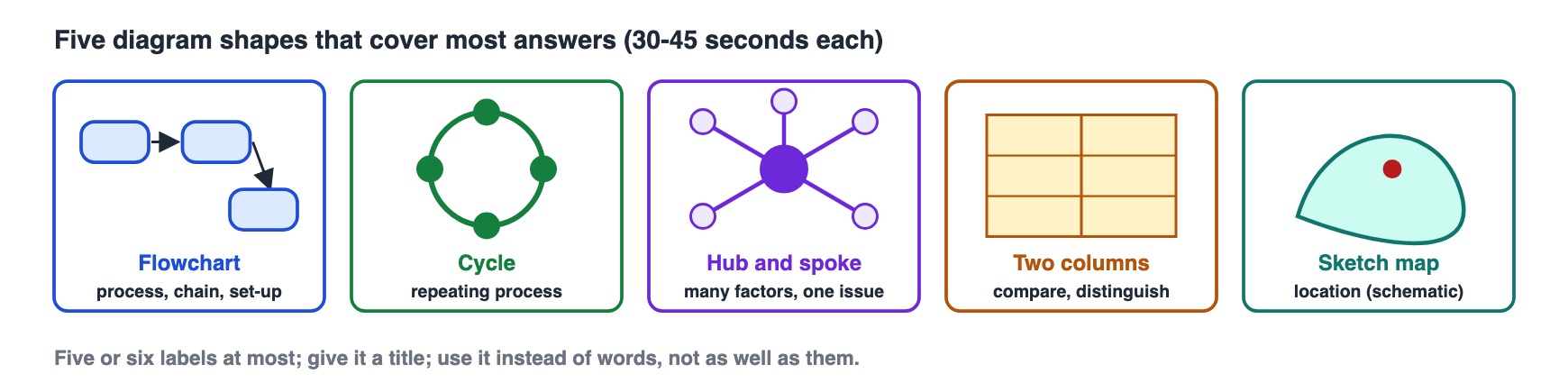
Five diagram shapes to practise until they cost no thought.
Two examples to practise
Anti-defection flowchart: Member elected on party ticket → leaves party or defies whip → petition to Speaker/Chairman → decision (final under paragraph 6, subject to judicial review after Kihoto Hollohon) → disqualified or not; exception: a merger backed under paragraph 4.
Sendai priorities as a ladder: understand risk → strengthen governance → invest in risk reduction → prepare for response and 'build back better'.
Further Reading
PIB press releases, ministry websites and annual reports, the Gazette of India, MEA and UN documents and the official sources named in each note — the primary sources behind every fact above.
Test Yourself: Practice Questions
12 questions on value addition.
Practice Questions
Q1. Under Article 163(1), the Governor acts on the aid and advice of the Council of Ministers
(a) except where the Constitution requires him to act in his discretion
(b) only on the advice of the President
(c) in every function without exception
(d) only in emergencies
Show answer
Answer: (a) — The discretion exception is in the Article itself.
Q2. Under paragraph 6 of the Tenth Schedule, disqualification for defection is decided by
(a) the President
(b) the Supreme Court
(c) the Election Commission
(d) the Speaker or Chairman of the House
Show answer
Answer: (d) — The decision is final, subject to judicial review as read in Kihoto Hollohon.
Q3. Which amendment omitted the 'split' exception (paragraph 3) from the Tenth Schedule?
(a) 91st Amendment, 2003
(b) 61st Amendment, 1988
(c) 73rd Amendment, 1992
(d) 52nd Amendment, 1985
Show answer
Answer: (a) — With effect from 1 January 2004.
Q4. In November 2025 the Supreme Court's Presidential Reference opinion held that
(a) deemed assent applies after three months
(b) the President cannot refer questions
(c) Governors must assent within one month
(d) courts cannot fix timelines for assent under Articles 200 and 201
Show answer
Answer: (d) — It also rejected deemed assent.
Q5. The Second ARC's 4th Report, 'Ethics in Governance', is dated
(a) March 2010
(b) June 2005
(c) December 2001
(d) January 2007
Show answer
Answer: (d) — A standard GS II and GS IV citation.
Q6. The Sendai Framework is the successor to
(a) the Paris Agreement
(b) Agenda 21
(c) the Hyogo Framework for Action
(d) the Kyoto Protocol
Show answer
Answer: (c) — Sendai runs 2015-2030.
Q7. India became a member of FATF in
(a) 1989
(b) 2006
(c) 2019
(d) 2010
Show answer
Answer: (d) — India was the 34th member; it was an observer from 2006.
Q8. Consider the following statements:
1. Evidence works best attached to a point.
2. A guessed figure is better than none.
3. Official and recent sources are preferred.
Which of the statements given above are correct?
(a) 1 and 2 only
(b) 2 and 3 only
(c) 1 and 3 only
(d) 1, 2 and 3
Show answer
Answer: (c) — 1 and 3 are correct. A wrong figure hurts; describe the trend instead.
Q9. Which diagram shape suits a 'distinguish between' question?
(a) Hub and spoke
(b) Cycle
(c) Two-column table
(d) Sketch map
Show answer
Answer: (c) — Compare on the same criteria.
Q10. India's first city heat action plan was made in
(a) Ahmedabad, 2013
(b) Hyderabad, 2010
(c) Delhi, 2015
(d) Nagpur, 2019
Show answer
Answer: (a) — A good state example for heat-wave questions.
Q11. How many labels should an exam diagram carry at most?
(a) Fifteen
(b) Five or six
(c) One
(d) Twenty
Show answer
Answer: (b) — It should take 30-45 seconds.
Q12. The Rajya Sabha committee's 261st report on disaster management recommended
(a) merging NDRF with the Army
(b) abolishing the NDMA
(c) expanding Aapda Mitra and Yuva Aapda Mitra
(d) ending the SDRF
Show answer
Answer: (c) — It also asked for village disaster management plans to be updated and integrated.
Mains Practice Questions
Use these to frame full-length answers. You don't have to answer one exactly — they show the angles UPSC tests, so let them guide which points you cover.
For one GS II question, list one Article, one judgment and one report you could use.
Draw the disaster management cycle in 30 seconds.
Why is a guessed figure worse than no figure?