Protozoa for NEET PG Microbiology: Malaria Life Cycle and India's Treatment, Amoebiasis, Giardia, Kala-azar, Toxoplasma and Cryptosporidium
Start Here
🎯 Exam priority: Very high. Expect: Plasmodium stages in mosquito vs human, which species relapse, Duffy and vivax, blackwater fever, India's first-line drugs and primaquine doses, E. histolytica vs E. dispar, flask ulcers and liver abscess, Giardia site, kala-azar vector, reservoir, case definition, elimination target and PKDL, Toxoplasma in HIV and pregnancy, and acid-fast Cryptosporidium.
CBME mapping: MI3.10–3.12 (with MI4.x). Fact-checked against the MSD Manual and NVBDCP malaria (2014, 2025) and kala-azar (2015, 2021) guidance.
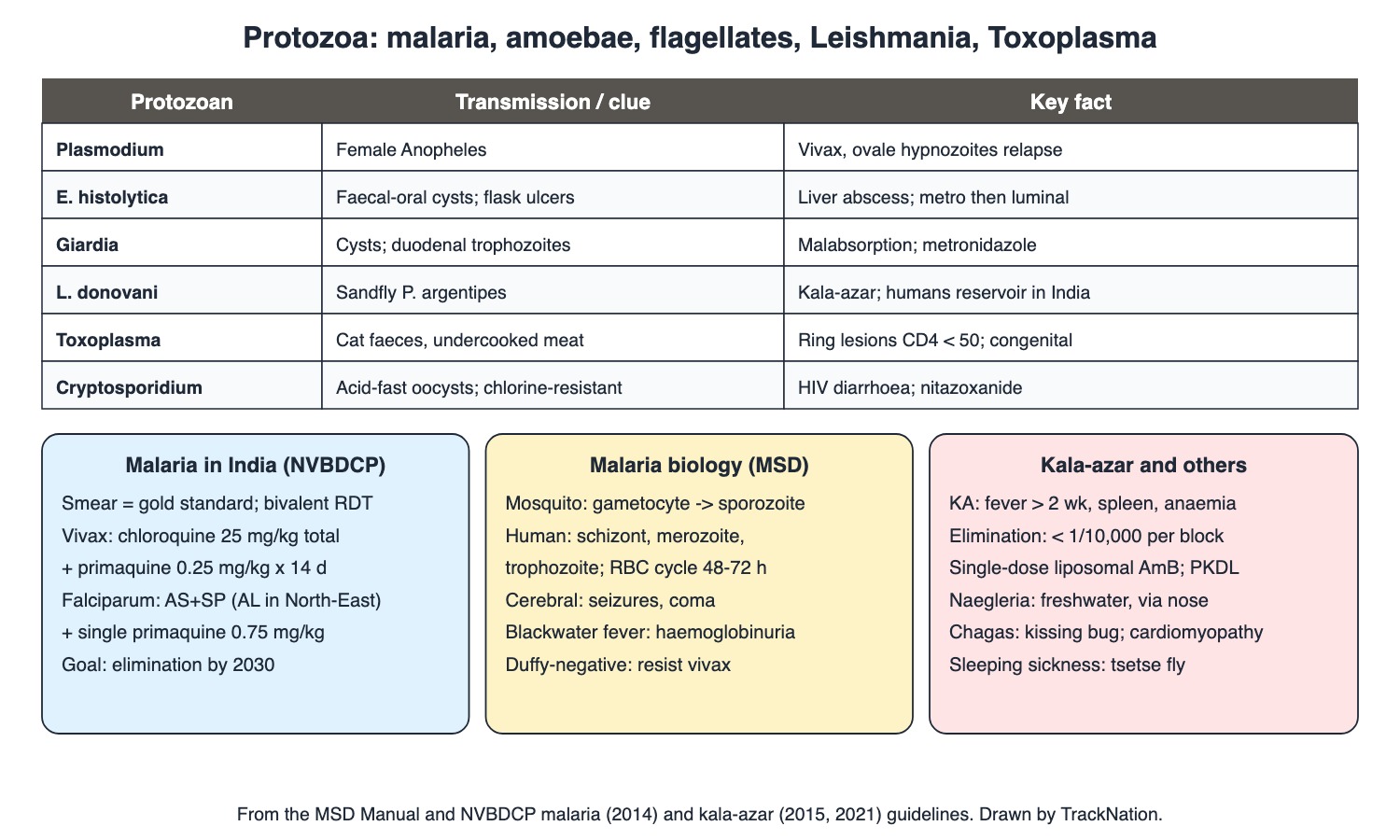
Protozoa, malaria and kala-azar. Drawn by TrackNation.
Malaria (MSD, NVBDCP)
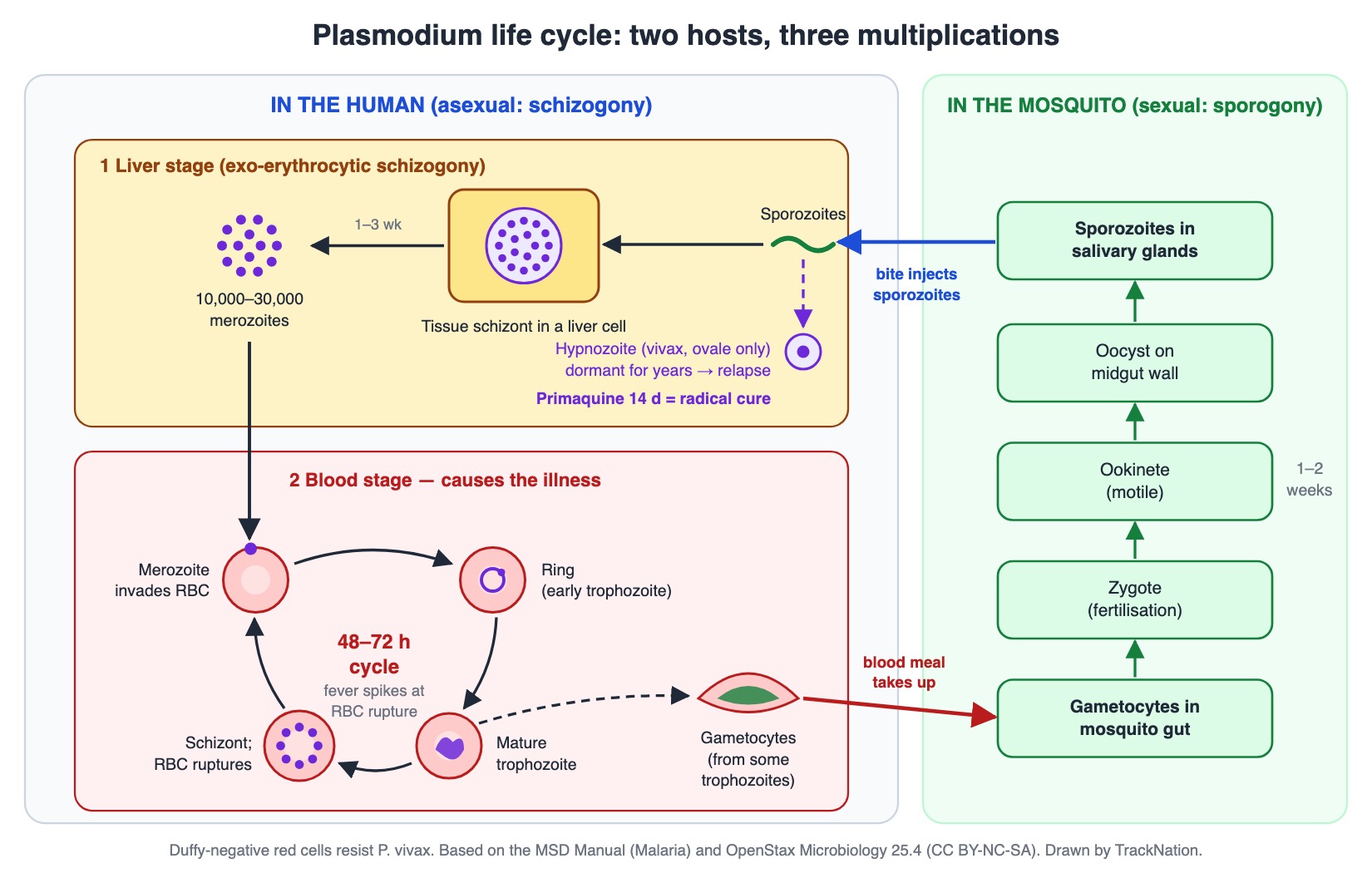
The Plasmodium life cycle: liver stage and hypnozoites, the 48–72 hour blood cycle, and sporogony in the mosquito. Drawn by TrackNation.
Spread by female Anopheles; species: P. falciparum, vivax, ovale, malariae, knowlesi (macaques, Malaysia). Rare spread by transfusion, needles, transplant or congenitally.
Life cycle: in the mosquito — gametocyte, oocyst, sporozoite; in humans — schizont, merozoite, trophozoite; RBCs rupture every 48–72 hours. Hypnozoites of vivax and ovale stay dormant in the liver and cause relapse (8–30% of vivax infections in India).
Severe disease: cerebral malaria (seizures, coma), haemolysis with blackwater fever (dark urine), hypoglycaemia. Duffy-negative people resist P. vivax.
India (NVBDCP 2014): thick and thin smear microscopy is the gold standard; bivalent RDTs detect vivax and falciparum. Vivax: chloroquine 25 mg/kg in total + primaquine 0.25 mg/kg daily for 14 days (not in pregnancy, infancy or G6PD deficiency). Falciparum: ACT — artesunate + sulfadoxine–pyrimethamine, but artemether–lumefantrine in the North-East — plus a single primaquine dose of 0.75 mg/kg on day 2. Goal: malaria elimination by 2030.
Intestinal Protozoa (MSD)
Entamoeba histolytica: faecal–oral; often asymptomatic, or dysentery with flask-shaped ulcers; spreads to cause liver abscess. E. dispar is a harmless, commoner look-alike. Treat with metronidazole/tinidazole followed by a luminal agent (paromomycin).
Giardia duodenalis (flagellate): trophozoites attach to duodenal and jejunal mucosa — flatulence to chronic malabsorption; metronidazole, tinidazole, secnidazole or nitazoxanide.
Cryptosporidium: acid-fast oocysts in stool; resists usual chlorine levels; severe diarrhoea in HIV (CD4 <100); nitazoxanide, plus ART in HIV.
Leishmania, Toxoplasma and Others (MSD, KA programme)
Leishmania donovani (kala-azar): spread by sandflies — Phlebotomus argentipes in India, where humans are the reservoir; amastigotes live in macrophages. Irregular fever, hepatosplenomegaly, pancytopenia, hypergammaglobulinaemia. PKDL may follow treatment (symmetric hypopigmented macules or nodules without sensory loss). rK39 rapid test; single-dose liposomal amphotericin B.
India's KA programme: endemic in Bihar, Jharkhand, West Bengal and UP (Bihar >60% of cases); clinical suspicion = fever over two weeks, splenomegaly, anaemia; elimination = <1 case per 10,000 per block.
Toxoplasma gondii: from undercooked meat or cat faeces. In HIV with CD4 <50: encephalitis with ring-enhancing lesions. Congenital: retinochoroiditis, cerebral calcifications, hydrocephalus. Treat with pyrimethamine + sulfadiazine (or clindamycin); spiramycin in early pregnancy does not cross the placenta.
Naegleria fowleri: freshwater; enters via the nose and cribriform plate → fatal meningoencephalitis (miltefosine). Chagas (T. cruzi): kissing bug; Romaña sign, cardiomyopathy, megaoesophagus/megacolon. Sleeping sickness: tsetse fly; Winterbottom sign (gambiense).
Traps the Examiner Sets
Vivax and ovale relapse from liver hypnozoites — primaquine prevents it.
Primaquine is avoided in pregnancy, infants and G6PD deficiency.
North-East India uses artemether–lumefantrine, not AS+SP, for falciparum.
E. dispar is harmless; only E. histolytica invades.
In the Indian subcontinent, humans are the reservoir of L. donovani.
Memory Hooks & Shortcuts
Shortcuts to lock in this article's numbers and lists. Each one only re-packages facts proven above.
🧠 'Vivax and Ovale Visit Often' — hypnozoite relapses — malaria
🧠 'Gametocyte Opens Sporozoite in the mosquito; Schizont Makes Trophozoites in man' — life cycle
🧠 'PQ: 0.25 for 14 (vivax), 0.75 once (falciparum)' — primaquine
🧠 'Bihar's Fever, Big Spleen, Bloodless (anaemia) = kala-azar' — kala-azar
🧠 Congenital toxo 'CHR': Calcifications, Hydrocephalus, Retinochoroiditis — toxoplasma
Rapid-Revision Cards
Malaria vector
Female Anopheles.
Mosquito stages
Gametocyte, oocyst, sporozoite.
Human stages
Schizont, merozoite, trophozoite.
Relapse
Vivax, ovale hypnozoites.
Duffy-negative
Resist vivax.
Blackwater fever
Haemoglobinuria.
India Dx
Smear gold standard; bivalent RDT.
Vivax Rx (India)
Chloroquine + PQ 0.25 mg/kg × 14 d.
PQ contraindications
Pregnancy, infants, G6PD.
Falciparum Rx (India)
AS+SP; AL in NE; PQ 0.75 mg/kg once.
Elimination
Malaria 2030; KA <1/10,000 per block.
E. histolytica
Flask ulcers; liver abscess; metro then paromomycin.
Giardia
Duodenum; malabsorption.
Cryptosporidium
Acid-fast oocysts; chlorine-resistant.
Kala-azar
L. donovani; P. argentipes; humans reservoir.
KA suspicion
Fever >2 wk, spleen, anaemia; rK39.
KA Rx
Single-dose liposomal AmB.
PKDL
Hypopigmented macules, no sensory loss.
Toxoplasma
Ring lesions CD4 <50; congenital triad.
Naegleria
Freshwater; cribriform plate.
Chagas / sleeping sickness
Kissing bug / tsetse.
Sources
Facts in this article were checked against these documents.
MSD Manual Professional: Malaria; Amebiasis; Giardiasis; Leishmaniasis; Toxoplasmosis; Cryptosporidiosis; Primary Amebic Meningoencephalitis; Chagas Disease; African Trypanosomiasis — Merck & Co. (MSD Manuals), 2024–26 (link)
Guidelines for Diagnosis and Treatment of Malaria in India (3rd ed.) — National Institute of Malaria Research and NVBDCP, 2014
Malaria training module for ASHA — National Center for Vector Borne Diseases Control, 2025
Operational Guidelines on Kala-azar Elimination; Kala-azar operational definitions — NVBDCP, MoHFW, 2015, 2021
Competency Based Undergraduate Curriculum, Vol I: Microbiology (MI3.10–3.12) — National Medical Commission, 2024
Test Yourself: Practice Questions
Thirty questions in NEET PG style, many of them clinical and programme scenarios.
Practice Questions (NEET PG pattern)
Original questions written in the style of the exam: +4 for a correct answer, −1 for a wrong one. Every answer was checked against the sources listed above. NEET PG papers are not published by NBEMS, so these are not past-paper questions.
Q1. Malaria is transmitted by
(a) sandflies
(b) female Anopheles mosquitoes
(c) Aedes
(d) Culex
Show answer
Answer: (b) — MSD.
Q2. The Plasmodium species found in macaques and Malaysia is
(a) P. knowlesi
(b) P. vivax
(c) P. malariae
(d) P. ovale
Show answer
Answer: (a) — MSD.
Q3. Stages that develop in the mosquito are
(a) gametocyte, oocyst and sporozoite
(b) schizont, merozoite, trophozoite
(c) hypnozoite only
(d) cyst and trophozoite
Show answer
Answer: (a) — Human: schizont, merozoite, trophozoite.
Q4. Relapse months after treated malaria is due to liver hypnozoites of
(a) P. knowlesi
(b) P. falciparum
(c) P. vivax and P. ovale
(d) P. malariae
Show answer
Answer: (c) — Primaquine/tafenoquine.
Q5. People lacking the Duffy blood group are resistant to
(a) P. falciparum
(b) P. vivax
(c) Toxoplasma
(d) P. malariae
Show answer
Answer: (b) — Duffy aids vivax attachment.
Q6. Dark urine from intravascular haemolysis in severe malaria is called
(a) cola urine of PSGN
(b) porphyria
(c) blackwater fever
(d) haemoglobin C disease
Show answer
Answer: (c) — MSD.
Q7. The gold standard for confirming malaria in India's programme is
(a) RDT
(b) PCR
(c) Widal
(d) thick and thin blood smear microscopy
Show answer
Answer: (d) — NVBDCP.
Q8. Radical cure of P. vivax in India uses primaquine at
(a) 15 mg weekly for 8 weeks
(b) 1 mg/kg for 3 days
(c) 0.75 mg/kg once
(d) 0.25 mg/kg daily for 14 days
Show answer
Answer: (d) — NVBDCP.
Q9. Primaquine is contraindicated in
(a) children over 5
(b) vivax malaria
(c) men
(d) pregnancy, infants and G6PD deficiency
Show answer
Answer: (d) — Haemolysis.
Q10. Outside the North-East, India's ACT for uncomplicated falciparum malaria is
(a) artesunate plus sulfadoxine–pyrimethamine
(b) quinine alone
(c) artemether–lumefantrine
(d) chloroquine
Show answer
Answer: (a) — AL in the North-East.
Q11. In falciparum malaria, India adds primaquine as
(a) nothing
(b) 14 days of 0.25 mg/kg
(c) a single dose of 0.75 mg/kg on day 2
(d) weekly doses
Show answer
Answer: (c) — Gametocytocidal.
Q12. India's malaria elimination target year is
(a) 2015
(b) 2030
(c) 2025
(d) 2040
Show answer
Answer: (b) — NVBDCP.
Q13. A protozoan that invades the colon causing flask-shaped ulcers is
(a) Giardia
(b) E. dispar
(c) Cryptosporidium
(d) Entamoeba histolytica
Show answer
Answer: (d) — E. dispar is harmless.
Q14. An extra-intestinal complication of amoebiasis is
(a) cerebral calcification
(b) PKDL
(c) megacolon from Chagas
(d) liver abscess
Show answer
Answer: (d) — Necrotic abscess.
Q15. Invasive amoebiasis is treated with
(a) albendazole
(b) metronidazole/tinidazole followed by a luminal agent such as paromomycin
(c) paromomycin alone
(d) chloroquine
Show answer
Answer: (b) — Eradicate cysts.
Q16. Giardia trophozoites attach to the
(a) colon
(b) duodenal and proximal jejunal mucosa
(c) stomach
(d) liver
Show answer
Answer: (b) — Malabsorption.
Q17. Chronic diarrhoea in an HIV patient with acid-fast oocysts in stool is due to
(a) E. histolytica
(b) Giardia
(c) Balantidium
(d) Cryptosporidium
Show answer
Answer: (d) — Nitazoxanide; ART.
Q18. Cryptosporidium outbreaks from swimming pools occur because oocysts resist
(a) standard chlorination
(b) boiling
(c) UV
(d) filtration
Show answer
Answer: (a) — MSD.
Q19. In India, the vector of kala-azar is
(a) Aedes
(b) Phlebotomus argentipes
(c) Culex
(d) Anopheles culicifacies
Show answer
Answer: (b) — Sandfly.
Q20. In the Indian subcontinent, the reservoir of L. donovani is
(a) rodents
(b) cattle
(c) humans
(d) dogs
Show answer
Answer: (c) — MSD.
Q21. Leishmania amastigotes are found inside
(a) neutrophils only
(b) hepatocytes only
(c) red cells
(d) macrophages
Show answer
Answer: (d) — MSD.
Q22. A patient from Bihar has fever for over two weeks, splenomegaly and anaemia. The suspected disease is
(a) kala-azar
(b) typhoid
(c) dengue
(d) brucellosis
Show answer
Answer: (a) — rK39 test.
Q23. The kala-azar elimination target in India is annual incidence of
(a) zero cases nationally
(b) < 1 case per 10,000 population at block level
(c) < 1 per 1000 per state
(d) < 10 per 100,000 per district
Show answer
Answer: (b) — Block PHC level.
Q24. After treatment of kala-azar, symmetric hypopigmented macules without sensory loss suggest
(a) post-kala-azar dermal leishmaniasis
(b) vitiligo
(c) leprosy
(d) tinea versicolor
Show answer
Answer: (a) — PKDL.
Q25. India's kala-azar programme uses
(a) chloroquine
(b) metronidazole
(c) albendazole
(d) single-dose liposomal amphotericin B
Show answer
Answer: (d) — Single day.
Q26. An HIV patient with CD4 < 50 has multiple ring-enhancing brain lesions. The likely cause is
(a) PML
(b) neurocysticercosis only
(c) cryptococcoma
(d) toxoplasmic encephalitis
Show answer
Answer: (d) — MSD.
Q27. Congenital toxoplasmosis classically causes
(a) cataract, PDA and deafness
(b) retinochoroiditis, cerebral calcifications and hydrocephalus
(c) limb hypoplasia
(d) Hutchinson teeth
Show answer
Answer: (b) — MSD.
Q28. Toxoplasmosis is treated with
(a) pyrimethamine plus sulfadiazine (or clindamycin)
(b) chloroquine
(c) albendazole
(d) metronidazole
Show answer
Answer: (a) — Spiramycin in early pregnancy.
Q29. A child develops fatal meningoencephalitis days after swimming in a warm freshwater pond. The amoeba entered via the
(a) skin
(b) olfactory neuroepithelium and cribriform plate
(c) gut
(d) bloodstream from a cut
Show answer
Answer: (b) — Naegleria fowleri.
Q30. Chagas disease is transmitted by
(a) triatomine (kissing) bugs
(b) ticks
(c) sandflies
(d) tsetse flies
Show answer
Answer: (a) — T. cruzi.
Active Recall
From memory: describe the malaria life cycle and relapse, severe malaria clues, India's diagnosis and drug policy with primaquine doses, amoebiasis and giardiasis, kala-azar biology and India's elimination programme, toxoplasmosis in HIV and pregnancy, Cryptosporidium, and the vectors of Chagas disease and sleeping sickness.