Ethics and the Human Interface for UPSC GS4: Essence, Determinants, Consequences and Dimensions of Ethics, Private and Public Relationships
What Ethics Is
🎯 Exam priority: High-yield (Mains GS4). This is the first line of the GS4 syllabus, and it is asked directly: "what does ethics seek to promote in human life?" (2022) and "explain the key dimensions of ethics" (2024). Every other GS4 answer borrows its vocabulary, so learn the terms here precisely.
What ethics is: the essence
The Second Administrative Reforms Commission (ARC), in its 4th Report Ethics in Governance (2007), gives the definition most useful for the exam: ethics is a set of standards that society places on itself and which helps guide behaviour, choices and actions. The word comes from the Greek ethikos, "arising from habit". The ARC adds a warning that shapes the whole paper: standards on paper do not by themselves make people ethical. That needs a culture of integrity, in which standards are actually practised, violations are punished quickly, and competent bodies investigate them.
Term | Meaning | Example |
Ethics | The study of right and wrong conduct, and the standards that follow from it | Deciding whether an officer may accept a gift from a contractor |
Morals / morality | The beliefs about right and wrong that a person or community actually holds | A family's belief that lying is wrong |
Law | Rules enforced by the state with penalties | The Prevention of Corruption Act punishes bribery |
Values | Lasting beliefs about what is good or worth pursuing | Honesty, compassion, fairness |
Ethics and law overlap but are not the same. Law sets a floor that the state can enforce; ethics asks for more. An act can be legal but unethical (using a legal loophole to deny a widow her pension), and occasionally illegal but ethically defensible (civil disobedience against an unjust law, a debate the 2026 paper raised through Ambedkar's warning). A useful line for answers: law asks "what am I allowed to do?", ethics asks "what ought I to do?".
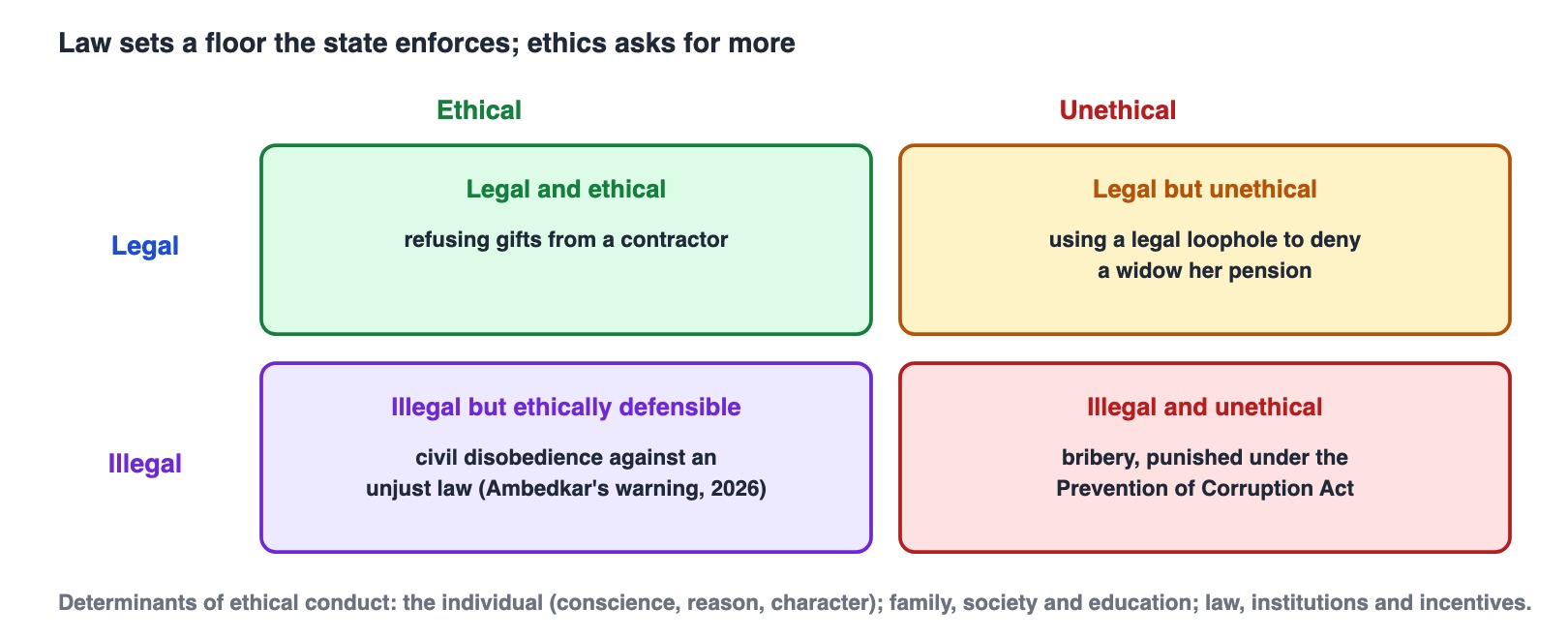
Legal is not the same as ethical: one example in each box, and what determines ethical conduct.
Facts and values
Philosophy separates descriptive claims (statements of fact: "40% of the district's children are anaemic") from evaluative claims (judgments of value: "the district must treat child anaemia as an emergency"). The Scottish philosopher David Hume (1711-1776) argued that you cannot derive an "ought" from an "is" alone: the is-ought problem. In administration this is a practical point. Data tells an officer what is happening; it takes values to decide what should be done, which is why GS4 says "data-driven" decisions still need an ethical frame (the 2021 and 2024 questions on digital technology and AI in decision-making).
Determinants and Consequences of Ethics
Why do people act ethically, or fail to? The syllabus calls these the determinants of ethics; their results are its consequences.
Determinants of ethical conduct
The individual: conscience, reason, emotions, character and the values learned early. A person who has internalised honesty feels guilt before any rule is broken.
Family, society and education: the first sources of values (article 02); religion, culture and peer groups shape what a community treats as normal.
Law, institutions and incentives: the ARC's central point. It contrasts two approaches: one stresses values and character and laments their decline; the other assumes most people are decent but a minority will put private gain above public good, so government must reward good conduct and punish bad. If good behaviour is consistently rewarded and bad behaviour consistently punished, most people stay on the straight path; if honesty is penalised and dishonesty rewarded, most people stray.
The ARC's synthesis: both values and institutions matter. Values are the guiding stars; but values without institutional support soon weaken and dissipate, and institutions provide the container that gives values shape. This balance is the best single line for a 2022- or 2024-type answer.
Structure of opportunity: the ARC notes that monopoly and discretion increase the propensity to corruption, while competition and transparency reduce it. When telephones, steel and cement became freely available after liberalisation, and when railway reservations and driving licences were computerised, much petty corruption disappeared. Ethics depends on the situation as well as on the person.
Consequences: what ethics seeks to promote (the 2022 question)
Level | What ethical conduct produces | What its absence produces |
Individual | Integrity, self-respect, peace of mind, trust from others | Guilt, fear of exposure, loss of reputation |
Organisation | Trust, cooperation, fair treatment, smooth functioning | Conflict, low morale, rule-bending, waste |
Society and state | Social trust (social capital), legitimacy of government, justice for the weak | Corruption, cynicism, injustice, falling faith in democracy |
The ARC calls corruption an important manifestation of the failure of ethics; "corrupt" comes from the Latin corruptus, "to break or destroy". Ethical values also help resolve conflicts, the second half of the 2022 question: shared standards (fairness, honesty, respect for persons) give rival parties a common ground for a solution that both can accept, where pure bargaining leaves the weaker side to lose.
Dimensions of Ethics; Private and Public Relationships
"Dimensions of ethics" (2024) can be answered two ways. Use both.
Dimension 1: the branches of ethics
Branch | Question it asks | Administrative example |
Metaethics | What is morality? Are moral claims true or false, or only feelings? | Is 'corruption is wrong' an objective truth or a cultural convention? |
Normative ethics | What should we do? It builds standards of conduct | Should an officer follow the rule, the best outcome, or what an honest person would do? |
Applied ethics | How do these norms apply to real controversies? | Bioethics, environmental ethics, business ethics, AI ethics |
Descriptive ethics | What do people actually believe and do? | A survey of how citizens view bribery |
Within normative ethics, the three main families are told apart by their test of right action: consequences (consequentialism, such as utilitarianism), duty (deontology, such as Kant) and character (virtue ethics, such as Aristotle). Article 06 covers them in depth.
Dimension 2: key distinctions about values
Intrinsic vs extrinsic value: something has intrinsic value if it is valuable for its own sake (human dignity, happiness); extrinsic or instrumental value if it is valuable for what it brings (money, efficiency).
Moral realism vs relativism: moral realists hold that some moral claims are objectively true ("murder is wrong"); moral relativism holds that there are many equally valid moral frameworks. Relativism encourages tolerance but cannot condemn practices such as untouchability, which is why constitutional values work as a common standard in public life.
Cognitivism vs non-cognitivism: whether moral judgments state facts, or (as emotivism says) only express emotion.
Personal, professional and social dimensions: the same person owes honesty to family, competence and impartiality to the job, and justice to society. Most dilemmas arise where these collide.
Ethics in private and public relationships
Private relationships | Public relationships | |
Who | Family, friends, neighbours | Citizens, colleagues, the state, the public at large |
Core values | Love, care, loyalty, partiality is natural | Impartiality, objectivity, accountability, rule of law |
Basis of trust | Personal bonds | Office held in trust for the public |
Typical failure | Betrayal, neglect | Nepotism, favouritism, conflict of interest, misuse of office |
The heart of this topic is the clash between the two: what is a virtue at home (loyalty to a relative) becomes a vice in office (nepotism). A public servant must keep private loyalties out of public decisions, which is why conduct rules require declaring conflicts of interest. Equally, public power must respect private life (privacy, dignity), the frame for the 2025 question on social media ethics: misinformation, hate speech, cyberbullying, privacy breaches, addictive design and the duty of officials not to misuse their own accounts.
Further Reading
PIB press releases, ministry websites and annual reports, the Gazette of India, MEA and UN documents and the official sources named in each note — the primary sources behind every fact above.
Test Yourself: Practice Questions & PYQs
12 practice questions, then the GS4 questions on ethics and the human interface.
Practice Questions
Q1. The 2nd ARC report 'Ethics in Governance' traces the word 'ethics' to the Greek 'ethikos', meaning
(a) arising from habit
(b) the good life
(c) duty to the state
(d) rule of the people
Show answer
Answer: (a) — It defines ethics as a set of standards that society places on itself to guide behaviour, choices and actions.
Q2. The 2nd ARC calls corruption
(a) an unavoidable cost of growth
(b) an important manifestation of the failure of ethics
(c) a purely legal problem
(d) a problem only of the private sector
Show answer
Answer: (b) — 'Corrupt' comes from the Latin 'corruptus', 'to break or destroy'.
Q3. According to the 2nd ARC, which of the following increase the propensity to corruption?
(a) Citizens' charters
(b) Computerisation and choice
(c) Monopoly and discretion
(d) Competition and transparency
Show answer
Answer: (c) — Competition and transparency reduce it, as liberalisation and computerised services showed.
Q4. The ARC's view on values and institutions is best summed up as
(a) both matter: values guide, institutions sustain them
(b) neither can curb corruption
(c) values alone are enough
(d) institutions alone are enough
Show answer
Answer: (a) — Values without institutional support soon weaken; institutions are the container that gives values shape.
Q5. Which branch of ethics asks whether moral statements can be objectively true?
(a) Applied ethics
(b) Metaethics
(c) Normative ethics
(d) Descriptive ethics
Show answer
Answer: (b) — Normative ethics sets standards of conduct; applied ethics applies them to issues such as bioethics.
Q6. Bioethics, environmental ethics and business ethics belong to
(a) applied ethics
(b) metaethics
(c) descriptive ethics
(d) aesthetics
Show answer
Answer: (a) — Applied ethics applies moral norms to controversial issues.
Q7. The 'is-ought problem', that you cannot derive what ought to be from what is, is associated with
(a) David Hume
(b) John Rawls
(c) Aristotle
(d) Immanuel Kant
Show answer
Answer: (a) — Hume (1711-1776) set it out in A Treatise of Human Nature.
Q8. 'Forty per cent of the children in this district are anaemic' is
(a) a categorical imperative
(b) a descriptive claim
(c) an evaluative claim
(d) a normative principle
Show answer
Answer: (b) — It states a fact; 'the district must treat anaemia as an emergency' would be evaluative.
Q9. Something valued for its own sake, not for what it brings, has
(a) market value
(b) intrinsic value
(c) instrumental value
(d) extrinsic value
Show answer
Answer: (b) — Money and efficiency are usually valued instrumentally; dignity and happiness intrinsically.
Q10. Emotivism holds that moral judgments
(a) follow from the law
(b) only express emotion
(c) are commands of God
(d) state objective facts
Show answer
Answer: (b) — It is a form of non-cognitivism.
Q11. Consider the following statements:
1. Consequentialism judges actions by their outcomes.
2. Deontology judges actions by duty or rules.
3. Virtue ethics judges actions mainly by legality.
Which of the statements given above are correct?
(a) 1 and 2 only
(b) 2 and 3 only
(c) 1 and 3 only
(d) 1, 2 and 3
Show answer
Answer: (a) — 1 and 2 are correct. Virtue ethics judges by character: what a person of good character would do.
Q12. Loyalty to a relative becomes an ethical failure in public office when it leads to
(a) nepotism
(b) transparency
(c) probity
(d) empathy
Show answer
Answer: (a) — Public relationships demand impartiality, so private loyalties must not shape official decisions.
Mains Practice Questions
Use these to frame full-length answers. You don't have to answer one exactly — they show the angles UPSC tests, so let them guide which points you cover.
What does ethics seek to promote in human life? How do ethical values help resolve conflicts?
Explain the key dimensions of ethics that influence human actions.
Ethics in private relationships and ethics in public relationships often conflict. Illustrate.
UPSC Mains — Previous Years’ Questions on this topic (last 10 years)
These are the actual GS Mains questions UPSC has asked on this theme — real proof of how, and when, it is tested. Try to write a full answer to each.
2022 (GS-IV): It is believed that adherence to ethics in human actions would ensure smooth functioning of an organization/system. If so, what does ethics seek to promote in human life? How do ethical values assist in the resolution of conflicts faced by him in his day-to-day functioning?
2024 (GS-IV): "Ethics encompasses several key dimensions that are crucial in guiding individuals and organizations towards morally responsible behaviour." Explain the key dimensions of ethics that influence human actions. Discuss how these dimensions shape ethical decision-making in a professional context.
2025 (GS-IV): In the present digital age, social media has revolutionised our way of communication and interaction. However, it has raised several ethical issues and challenges. Describe the key ethical dilemmas in this regard.