India's External Relations 1947-1999 for UPSC GS1: Non-alignment, Panchsheel, the 1962, 1965 and 1971 Wars, Kargil and Nuclear Policy
Non-alignment and China
🎯 Exam priority: Important (Mains GS1). The 2025 GS1 question on early consolidation includes "international relations" as one of its four strands. This article covers India's foreign policy and wars from 1947 to the nuclear tests; GS2 international relations builds on it.
Principles: non-alignment
Constitutional basis: Article 51, a Directive Principle, asks the state to promote international peace and security, maintain just and honourable relations between nations, foster respect for international law and treaties, and encourage settlement of international disputes by arbitration.
Non-alignment was India's innovative response to the Cold War: staying out of both military blocs while judging each issue on merit. India did not join the public condemnation of the Soviet invasion of Hungary (1956), yet took independent stands and drew aid from both blocs. Pakistan, by contrast, joined US-led alliances.
Afro-Asian unity: India championed decolonisation and firmly opposed racism, especially apartheid. The Bandung Conference (1955) marked the zenith of its engagement with new Asian and African nations and led to the Non-Aligned Movement.
China: from Panchsheel to war
Panchsheel, the Five Principles of Peaceful Coexistence, was announced by Nehru and Zhou Enlai on 29 April 1954; India accepted China's claim over Tibet.
Disputes: China claimed Aksai Chin in Ladakh and much of Arunachal Pradesh (then NEFA); between 1957 and 1959 it occupied Aksai Chin and built a strategic road.
War (October 1962): while the world watched the Cuban Missile Crisis, China invaded both regions, advancing nearly to the Assam plains before declaring a unilateral ceasefire.
Consequences: Defence Minister V.K. Krishna Menon left the cabinet; Nehru's stature suffered and he faced the first no-confidence motion against his government.
Wars with Pakistan and Nuclear Policy
Pakistan: 1965 and 1971
War | Course | Outcome |
1965 | Pakistan attacked in the Rann of Kutch (April), then in Jammu and Kashmir (August-September) | UN-brokered ceasefire; the Soviet-brokered Tashkent Agreement between Lal Bahadur Shastri and Ayub Khan (January 1966); added to India's economic strain |
1971 | Pakistan's 1970 election gave East Pakistan's Awami League (Sheikh Mujib-ur Rahman) a sweep; the army arrested Mujib and unleashed a reign of terror; India bore about 80 lakh refugees; India signed a 20-year Treaty of Peace and Friendship with the USSR (August 1971); war in December | About 90,000 Pakistani troops surrendered at Dhaka; Bangladesh became free; the Shimla Agreement (3 July 1972) between Indira Gandhi and Zulfikar Ali Bhutto |
1999 (Kargil) | Intruders, with suspected Pakistan Army involvement, occupied heights in Mashkoh, Dras, Kaksar and Batalik | India recovered control of many points by 26 July 1999 |
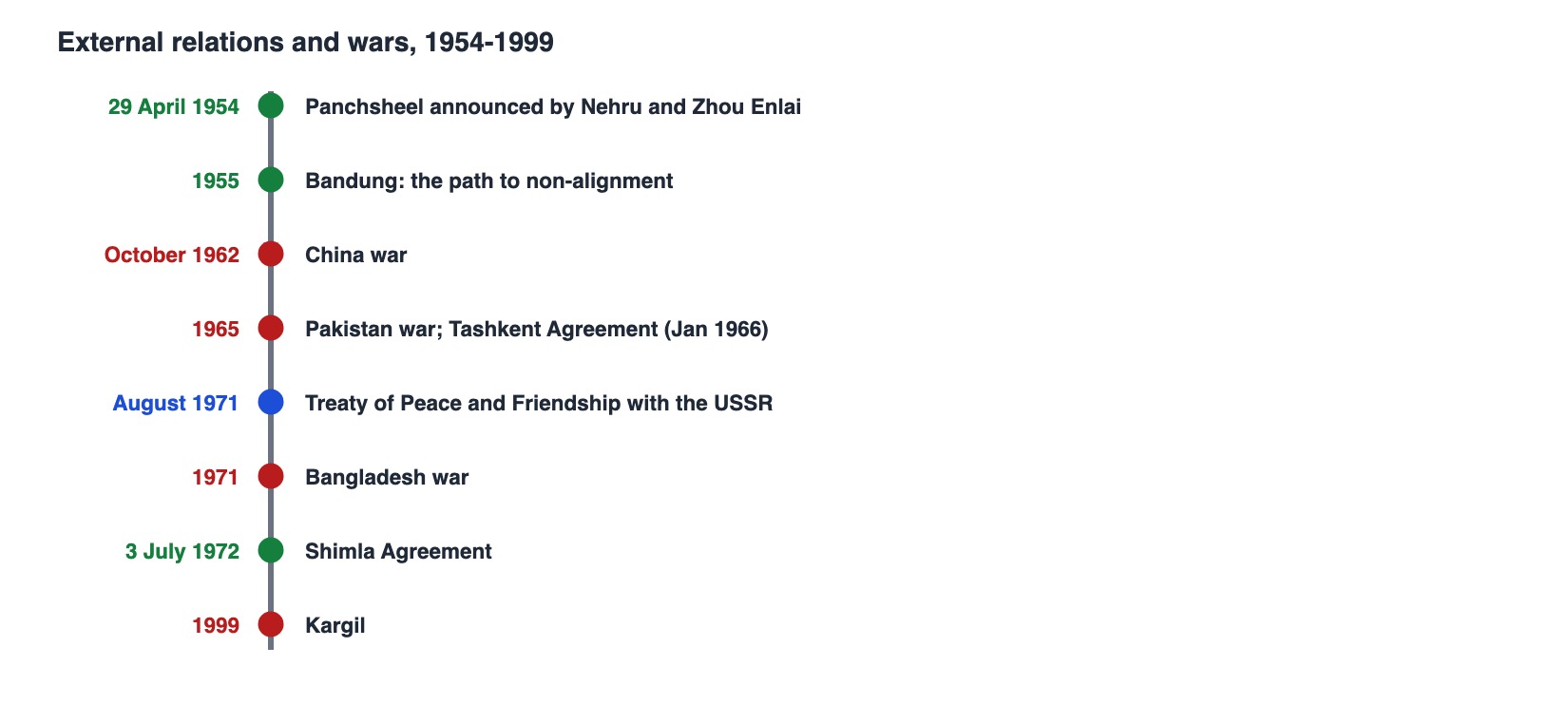
India's external relations and wars, 1954-1999.
Nuclear policy
Nehru launched a nuclear programme in the late 1940s under Homi J. Bhabha for peaceful purposes and opposed nuclear weapons.
India refused to sign the NPT (1968), which it considered discriminatory, and conducted its first nuclear test in May 1974, calling it a peaceful explosion.
It opposed the NPT's indefinite extension in 1995, refused to sign the CTBT, and conducted nuclear tests in May 1998; Pakistan followed.
Assessment and the 2025 Question
Assessing early foreign policy
Achievements | Limitations |
Independent voice through non-alignment; aid from both blocs | Misjudged China; unprepared in 1962 |
Leadership of Afro-Asian and anti-colonial causes | Critics argued non-alignment became unprincipled when India drew close to the USSR (the 1971 treaty) |
Decisive 1971 victory and the creation of Bangladesh | Wars added to economic strain |
Nuclear autonomy without signing discriminatory treaties | International criticism after 1998 and a nuclear-armed neighbourhood |
For the 2025 question (international relations strand)
In the first two decades India consolidated its international position by choosing non-alignment, championing decolonisation (Bandung), defining relations with China through Panchsheel, and defending its territory, though 1962 exposed limits that forced a rethink of defence and diplomacy. Link this to the domestic strands: wars affected the economy (article 04) and politics (article 06).
Further Reading
PIB press releases, ministry websites and annual reports, the Gazette of India, MEA and UN documents and the official sources named in each note — the primary sources behind every fact above.
Test Yourself: Practice Questions & PYQs
12 practice questions on India's external relations.
Practice Questions
Q1. Which article of the Constitution directs the state to promote international peace and security?
(a) Article 48
(b) Article 51
(c) Article 39
(d) Article 253
Show answer
Answer: (b) — It is a Directive Principle.
Q2. Panchsheel was announced by Nehru and Zhou Enlai on
(a) 15 August 1947
(b) 26 January 1950
(c) 29 April 1954
(d) 20 October 1962
Show answer
Answer: (c) — India accepted China's claim over Tibet.
Q3. Between 1957 and 1959, China occupied and built a strategic road in
(a) Tawang
(b) Siachen
(c) Aksai Chin
(d) Doklam
Show answer
Answer: (c) — It also claimed much of Arunachal Pradesh (then NEFA).
Q4. China's invasion of India came in
(a) April 1965
(b) May 1999
(c) December 1971
(d) October 1962
Show answer
Answer: (d) — While the world's attention was on the Cuban Missile Crisis.
Q5. After the 1962 war, which Defence Minister had to leave the cabinet?
(a) Y.B. Chavan
(b) V.K. Krishna Menon
(c) Jagjivan Ram
(d) Baldev Singh
Show answer
Answer: (b) — Nehru faced the first no-confidence motion against his government.
Q6. The Tashkent Agreement of January 1966 was brokered by
(a) the United States
(b) Britain
(c) the Soviet Union
(d) the UN
Show answer
Answer: (c) — Signed by Lal Bahadur Shastri and Ayub Khan.
Q7. In August 1971 India signed a 20-year Treaty of Peace and Friendship with
(a) the Soviet Union
(b) Bangladesh
(c) the United States
(d) China
Show answer
Answer: (a) — It countered the US-Pakistan-China axis.
Q8. About how many Pakistani troops surrendered at Dhaka in 1971?
(a) 30,000
(b) 90,000
(c) 9,000
(d) 900,000
Show answer
Answer: (b) — Bangladesh became free.
Q9. The Shimla Agreement was signed on 3 July 1972 by
(a) Nehru and Ayub Khan
(b) Indira Gandhi and Zulfikar Ali Bhutto
(c) Indira Gandhi and Yahya Khan
(d) Shastri and Bhutto
Show answer
Answer: (b) — It formalised the return of peace.
Q10. Consider the following statements:
1. India refused to sign the NPT, which it considered discriminatory.
2. India's first nuclear test was in May 1974.
3. India signed the CTBT in 1996.
Which of the statements given above are correct?
(a) 1 and 2 only
(b) 2 and 3 only
(c) 1 and 3 only
(d) 1, 2 and 3
Show answer
Answer: (a) — 1 and 2 are correct. India refused to sign the CTBT.
Q11. India's nuclear programme was initiated in the late 1940s under the guidance of
(a) A.P.J. Abdul Kalam
(b) C.V. Raman
(c) Homi J. Bhabha
(d) Vikram Sarabhai
Show answer
Answer: (c) — Nehru wanted atomic energy for peaceful purposes.
Q12. The Kargil conflict took place in
(a) May-July 1999
(b) 1965
(c) 1987
(d) 1971
Show answer
Answer: (a) — India recovered most points by 26 July 1999.
Mains Practice Questions
Use these to frame full-length answers. You don't have to answer one exactly — they show the angles UPSC tests, so let them guide which points you cover.
How did non-alignment serve India's interests in the Cold War?
What led to the 1962 war with China and what were its consequences?
Did the 1971 Indo-Soviet treaty compromise non-alignment?
UPSC Mains — Previous Years’ Questions on this topic (last 10 years)
These are the actual GS Mains questions UPSC has asked on this theme — real proof of how, and when, it is tested. Try to write a full answer to each.
2025 (international relations strand): Trace India's consolidation process during early phase of independence in terms of polity, economy, education and international relations.