Planned Development in India for UPSC GS1: The Bombay Plan, Planning Commission, First and Second Plans, Plan Holiday and Regional Imbalance
Why India Planned
🎯 Exam priority: High-yield (Mains GS1). 2026 asked you to comment: "The model of planned economy was adopted in India to address the regional imbalances left behind by colonial rule." Planning was also the economy strand of the 2025 question on early consolidation.
Why plan? A broad consensus
In the 1940s and 1950s planning had wide support worldwide, after the Great Depression, the interwar reconstruction of Japan and Germany, and above all the Soviet Union's rapid growth in the 1930s and 1940s.
Surprisingly, Indian big business backed it: in 1944 leading industrialists drafted the Bombay Plan, asking the state to take major initiatives in industrial and economic investment. "From left to right", planning was the obvious choice.
Its constitutional purpose came from the Directive Principles: livelihood for all, distribution of resources for the common good, and no concentration of wealth.
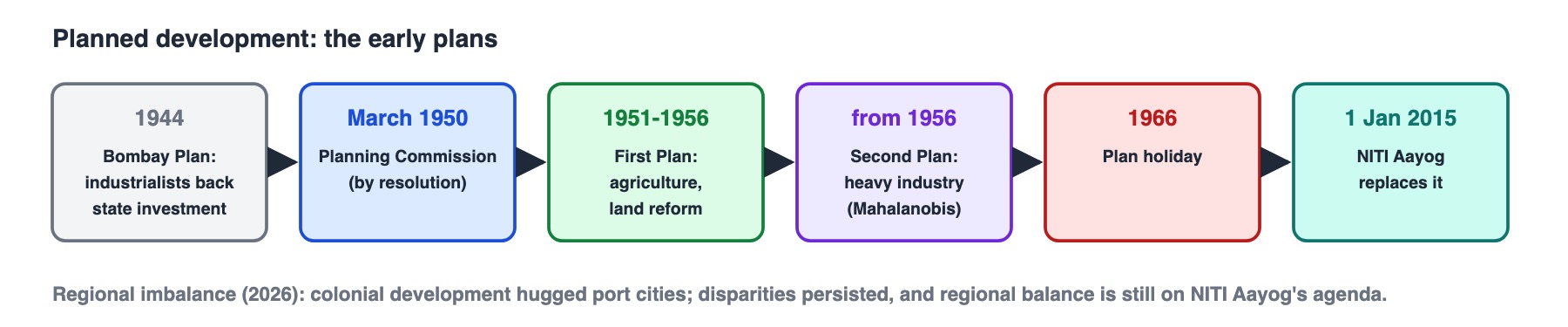
Planning in India from the Bombay Plan to NITI Aayog.
The Planning Commission
Set up in March 1950 by a simple government resolution, not by the Constitution, with an advisory role (its recommendations took effect only when the Cabinet approved them). It was replaced by NITI Aayog (National Institution for Transforming India) on 1 January 2015.
The Early Plans and Their Critics
The early plans
Plan | Focus | Key features |
First (1951-1956) | Agriculture | Get out of the cycle of poverty; K.N. Raj's advice to 'hasten slowly'; dams and irrigation such as Bhakra Nangal; land reform as the key to development |
Second (from 1956) | Heavy industry | P.C. Mahalanobis's plan for quick structural change; the Congress's Avadi session goal of a 'socialist pattern of society'; tariffs to protect domestic industry; electricity, railways, steel, machinery and communications in the public sector |
Third (from 1961) | Continuity with the Second | Not significantly different from the Second |
1966 | Plan holiday | Economic crisis; the Fourth Plan was postponed, though the foundations of development were in place |
Debates and criticisms
Industry vs agriculture: industry attracted more investment, risking food shortages; planners found the balance "really difficult".
Foreign exchange: technological backwardness meant spending scarce foreign exchange on imported technology.
Urban bias: critics saw an "unmistakable urban bias"; others wanted agriculture-related rather than heavy industries.
Development and displacement: NCERT's Orissa case shows the dilemma: rich iron ore lies in underdeveloped tribal districts, where industry promises capital and jobs but tribal people fear displacement and environmentalists fear pollution.
Planning and Regional Imbalance
Did planning address regional imbalances? (2026)
The aim: colonial rule left development concentrated in port cities and export enclaves, with vast backward interiors (World History article 04). Planning, grounded in the Directive Principles, sought balanced growth across classes and regions, using public investment where private capital would not go: dams, steel, power and railways.
But regional balance was one aim among several, and results were mixed:
The main drivers were growth, self-reliance and heavy industrialisation (the Mahalanobis strategy), not regional equity alone.
The Green Revolution was introduced only in areas with assured irrigation, and NCERT's sociology text notes it worsened regional inequalities.
Critics pointed to an urban bias, and to large projects in backward, often tribal, regions that displaced the poor while benefits flowed elsewhere.
Conclusion: planning was adopted to overcome colonial underdevelopment as a whole, including regional imbalance, and it laid the industrial and agricultural foundations of modern India; but regional disparities persisted and in places widened, and regional balance remains on the agenda of NITI Aayog, which replaced the Planning Commission in 2015.
Further Reading
PIB press releases, ministry websites and annual reports, the Gazette of India, MEA and UN documents and the official sources named in each note — the primary sources behind every fact above.
Test Yourself: Practice Questions & PYQs
12 practice questions, then the GS1 question on planning.
Practice Questions
Q1. The Bombay Plan of 1944 was drafted by
(a) a section of big industrialists
(b) the Communist Party
(c) the Planning Commission
(d) the British government
Show answer
Answer: (a) — It wanted the state to take major initiatives in industry.
Q2. The Planning Commission was set up in March 1950 by
(a) an Act of Parliament
(b) the Constitution
(c) a presidential ordinance
(d) a resolution of the Government of India
Show answer
Answer: (d) — It had an advisory role.
Q3. NITI Aayog replaced the Planning Commission on
(a) 1 January 2015
(b) 1 April 2014
(c) 15 August 2015
(d) 26 January 2016
Show answer
Answer: (a) — NITI stands for National Institution for Transforming India.
Q4. The main focus of the First Five Year Plan (1951-1956) was
(a) information technology
(b) defence
(c) agriculture, including dams and irrigation
(d) heavy industry
Show answer
Answer: (c) — It saw land reform as the key to development.
Q5. Which economist argued that India should 'hasten slowly'?
(a) Manmohan Singh
(b) K.N. Raj
(c) Amartya Sen
(d) P.C. Mahalanobis
Show answer
Answer: (b) — He helped draft the First Plan.
Q6. The Second Five Year Plan, stressing heavy industry, was led by
(a) Verghese Kurien
(b) P.C. Mahalanobis
(c) Charan Singh
(d) K.N. Raj
Show answer
Answer: (b) — He founded the Indian Statistical Institute.
Q7. The Congress declared a 'socialist pattern of society' as its goal at its session in
(a) Avadi
(b) Faizpur
(c) Karachi
(d) Lahore
Show answer
Answer: (a) — Avadi is near the then Madras city.
Q8. In 1966 the government decided on a 'plan holiday' because of
(a) an acute economic crisis
(b) the Emergency
(c) the 1991 reforms
(d) elections
Show answer
Answer: (a) — The Fourth Plan was postponed.
Q9. Consider the following statements:
1. Critics found an 'urban bias' in the plans.
2. Planners found it hard to balance industry and agriculture.
3. The Second Plan concentrated mainly on agriculture.
Which of the statements given above are correct?
(a) 1 and 2 only
(b) 2 and 3 only
(c) 1 and 3 only
(d) 1, 2 and 3
Show answer
Answer: (a) — 1 and 2 are correct. The Second Plan stressed heavy industry.
Q10. According to NCERT sociology, the Green Revolution
(a) was introduced everywhere equally
(b) worsened regional inequalities
(c) removed regional inequalities
(d) focused on rainfed areas
Show answer
Answer: (b) — It was introduced only in areas with assured irrigation.
Q11. Which large project did the First Plan fund?
(a) Bhilai steel plant
(b) Bhakra Nangal Dam
(c) Konkan Railway
(d) Tarapur atomic plant
Show answer
Answer: (b) — Agriculture needed urgent attention after Partition.
Q12. NCERT's Orissa iron ore case illustrates the tension between
(a) agriculture and services
(b) Centre and judiciary
(c) industrial investment and tribal displacement
(d) exports and imports
Show answer
Answer: (c) — Environmentalists also feared pollution.
Mains Practice Questions
Use these to frame full-length answers. You don't have to answer one exactly — they show the angles UPSC tests, so let them guide which points you cover.
The model of planned economy was adopted to address regional imbalances left by colonial rule. Comment.
How did the Second Plan differ from the First?
What were the main criticisms of India's early planning?
UPSC Mains — Previous Years’ Questions on this topic (last 10 years)
These are the actual GS Mains questions UPSC has asked on this theme — real proof of how, and when, it is tested. Try to write a full answer to each.
2026 (GS-I): The model of planned economy was adopted in India to address the regional imbalances left behind by colonial rule. Comment.
2025 (economy strand): Trace India's consolidation process during early phase of independence in terms of polity, economy, education and international relations.