Bacterial Skin Infections and Skin TB for NEET PG Dermatology: Impetigo, Cellulitis vs Erysipelas, Necrotising Fasciitis, SSSS, Cutaneous Tuberculosis
Start Here
🎯 Exam priority: High. Expect: honey-coloured crusts and the organisms of impetigo, bullous impetigo as S. aureus, post- streptococcal glomerulonephritis, ecthyma, carbuncle with diabetes, cellulitis vs erysipelas, ICMR severity grading, sepsis and necrotising fasciitis red flags, SSSS vs TEN, nasal carriage and mupirocin, MRSA drugs, and when to suspect cutaneous TB.
CBME mapping: DR 15.1–15.3. Streptococcal and staphylococcal biology is in Microbiology; TB treatment in Medicine and PSM.
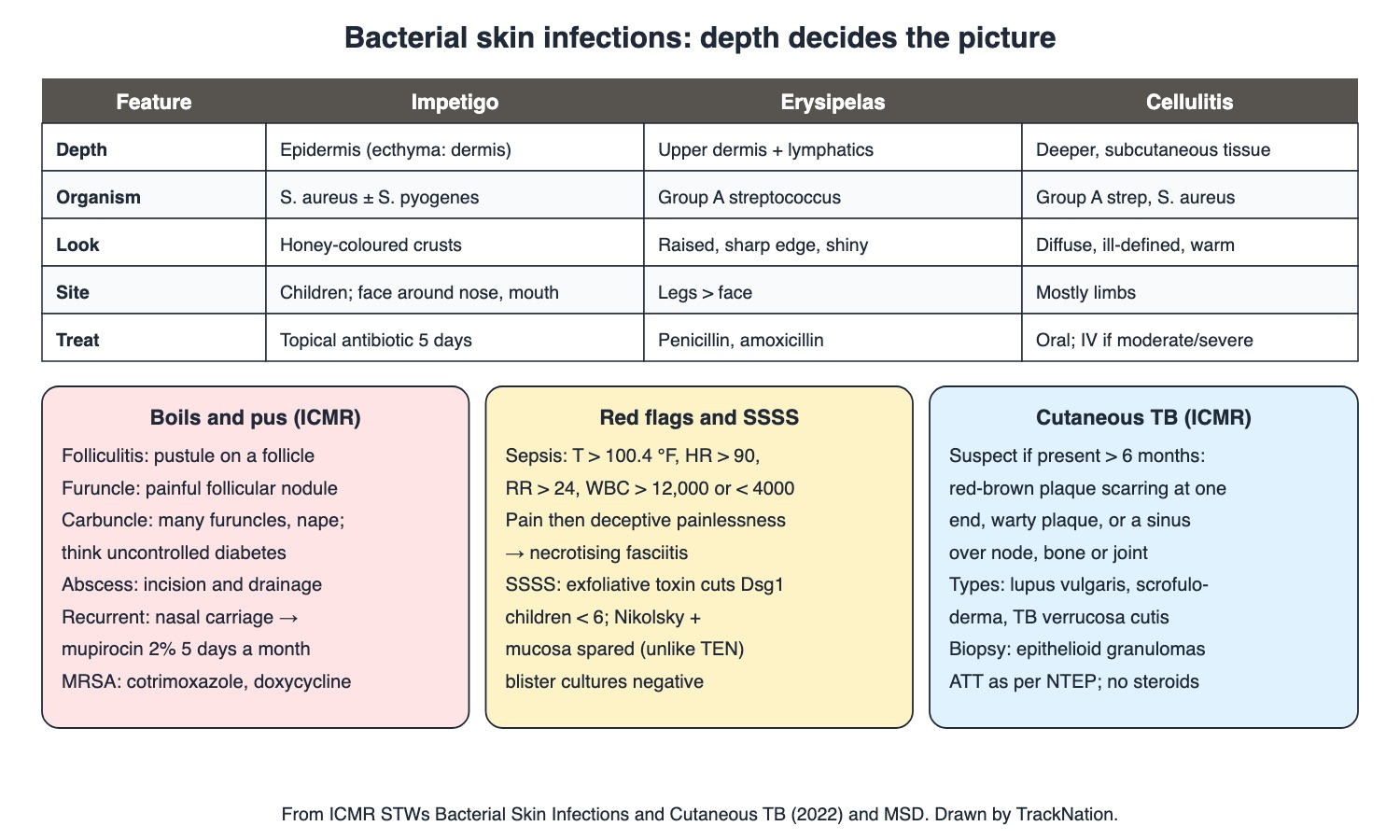
Impetigo, erysipelas and cellulitis compared; boils and abscesses; red flags and SSSS; cutaneous tuberculosis. Drawn by TrackNation.
Impetigo, Ecthyma and Follicular Infections
Impetigo: superficial epidermal infection by S. aureus and/or S. pyogenes; usually children; around the nose and mouth, then limbs; may complicate scabies or eczema. Vesicles or pustules rupture to leave honey-coloured (wet yellow-brown) crusts. Non-bullous is commoner; bullous impetigo is always S. aureus. Topical antibiotic (mupirocin, fusidic acid) for 5 days; oral for extensive disease, lymphadenopathy or outbreaks. Nephritogenic group A strep can cause post-streptococcal glomerulonephritis, which antibiotics probably do not prevent.
Ecthyma: deeper (into dermis), punched-out ulcers under thick brown-black crusts — oral antibiotics for 7 days.
Folliculitis: pustules centred on hair follicles (exclude oils, waxing, occlusion). Furuncle: painful follicular nodule. Carbuncle: several furuncles merging with pus from many openings — nape of neck, breasts, buttocks — think uncontrolled diabetes. Abscess: fluctuant painful swelling → incision and drainage.
Recurrent boils or family outbreaks suggest nasal S. aureus carriage — mupirocin 2% for 5 days a month; check diabetes, scabies, eczema. Suspect MRSA with poor immunity, severe systemic signs, MRSA elsewhere, penetrating trauma or no improvement in 48–72 hours — oral cotrimoxazole, doxycycline, minocycline or linezolid; IV vancomycin, linezolid or clindamycin.
Cellulitis, Erysipelas and Emergencies
Cellulitis: acute spreading infection of deeper dermis and subcutaneous tissue; red, hot, tender, oedematous (peau d'orange) with ill-defined edges; mostly limbs; group A streptococcus (spreads via streptokinase, DNase, hyaluronidase) or S. aureus. Entry through tinea pedis, ulcers or eczema. Tell it from DVT by warmth, redness, peau d'orange and nodes.
Erysipelas: superficial cellulitis with dermal lymphatic involvement — bright red, shiny, raised plaque with a sharply demarcated edge; legs more than face; often lymphangitis; mainly group A streptococcus → penicillin or amoxicillin.
Red flags: temperature > 100.4 °F, WBC > 12,000 or < 4,000, heart rate > 90, respiratory rate > 24 (sepsis); severe pain followed by deceptive painlessness and dark skin suggest necrotising fasciitis → surgery and broad IV cover.
Staphylococcal scalded skin syndrome: exfoliative toxins A and B cleave desmoglein 1 → superficial split at the granular layer; children under 6 (adults with kidney failure or immunosuppression); tender skin, Nikolsky positive, peeling in sheets, perioral peeling; mucosa spared (unlike SJS/TEN); blister fluid is culture-negative (organism at a distant site). Admit for antistaphylococcal antibiotics; remits within a week in children but adult mortality is high.
Severity (ICMR) | Picture | Treatment |
Mild | Typical cellulitis or erysipelas, no pus focus, no systemic signs | Oral antibiotics as outpatient; elevate the limb; treat the portal (e.g. tinea pedis); ibuprofen |
Moderate | Cellulitis/erysipelas with systemic signs of infection | Admit; IV ceftriaxone 2 g twice daily or amoxicillin–clavulanate 1.2 g thrice daily; clindamycin if penicillin-allergic |
Severe | Failed oral antibiotics, immunocompromised, bullae, sloughing, hypotension, organ dysfunction | Broad IV cover (vancomycin + piperacillin–tazobactam), surgical debridement, culture-guided change |
Cutaneous Tuberculosis (ICMR)
Suspect when there is an ulcer or discharging sinus over lymph node, bone or joint, a persistent asymptomatic red-brown plaque for more than 6 months that may scar at one end, or a persistent warty lesion for more than 6 months. Types include lupus vulgaris, scrofuloderma, tuberculosis verrucosa cutis, orificial and miliary TB; tuberculids (lichen scrofulosorum, papulonecrotic tuberculid, erythema nodosum) are also listed.
Investigate with skin biopsy (granulomas with epithelioid histiocytes and giant cells), culture of biopsy tissue (not a swab), chest X-ray and FNAC of nodes. IGRA and PCR are not recommended for diagnosis; Mantoux helps when histology is equivocal.
Treat like pulmonary TB as per NTEP; no oral or topical steroids. Review at 4–6 weeks; no response by 8 weeks → think of another diagnosis or drug-resistant TB and refer.
Traps the Examiner Sets
Bullous impetigo = S. aureus; erysipelas = streptococcus with a sharp edge.
SSSS spares the mucosa; TEN involves it.
Carbuncle → check blood sugar.
Pain out of proportion that then fades, with dusky skin → necrotising fasciitis, operate.
Memory Hooks & Shortcuts
Shortcuts to lock in this article's numbers and lists. Each one only re-packages facts proven above.
🧠 Impetigo 'Honey on the Hungry child's face' — impetigo
🧠 'Bullous = Bug S. aureus, always' — bullous impetigo
🧠 Erysipelas = 'Edge you can trace'; cellulitis = edge you can't — cellulitis vs erysipelas
🧠 SSSS 'Skin Sheds, Spares mouth' — SSSS vs TEN
🧠 Skin TB '6 months, no steroids, NTEP' — cutaneous TB
Rapid-Revision Cards
Impetigo
Honey crusts; children; nose and mouth.
Bullous impetigo
Always S. aureus.
Impetigo treatment
Topical 5 days.
Impetigo complication
Post-strep GN.
Ecthyma
Punched-out ulcer, black crust; oral 7 days.
Carbuncle
Nape; diabetes.
Abscess
Incision and drainage.
Recurrent boils
Nasal carriage → mupirocin 5 days/month.
Cellulitis
Ill-defined; deeper.
Erysipelas
Sharp edge; strep; legs > face.
Strep spread
Streptokinase, DNase, hyaluronidase.
Mild cellulitis
Oral; elevate.
Moderate
IV ceftriaxone or amox-clav.
Severe
Vanco + pip-taz; debride.
Necrotising fasciitis
Pain then painless, dusky skin.
MRSA oral
Cotrimoxazole, doxycycline, linezolid.
SSSS
Dsg1 toxin; < 6 y; mucosa spared.
SSSS culture
Blisters sterile.
Cutaneous TB
Lesion > 6 months; sinus over node.
TB biopsy
Epithelioid granulomas.
TB treatment
NTEP ATT; no steroids.
Sources
Facts in this article were checked against these documents.
Standard Treatment Workflows: Bacterial Skin Infections; Cutaneous Tuberculosis — Indian Council of Medical Research, DHR, 2022 (link)
MSD Manual Professional: Impetigo and Ecthyma; Cellulitis; Erysipelas; Staphylococcal Scalded Skin Syndrome — Merck & Co. (MSD Manuals), reviewed 2025–26 (link)
Competency Based Undergraduate Curriculum, Dermatology (DR 15) — National Medical Commission, 2024
Test Yourself: Practice Questions
Thirty questions in NEET PG style, most of them clinical vignettes.
Practice Questions (NEET PG pattern)
Original questions written in the style of the exam: +4 for a correct answer, −1 for a wrong one. Every answer was checked against the sources listed above. NEET PG papers are not published by NBEMS, so these are not past-paper questions.
Q1. A child has crusted lesions around the nose and mouth; the crusts are wet and yellow-brown. The diagnosis is
(a) herpes labialis
(b) seborrhoeic dermatitis
(c) tinea faciei
(d) impetigo
Show answer
Answer: (d) — Honey-coloured crusts.
Q2. Bullous impetigo is caused by
(a) Pseudomonas
(b) Streptococcus pyogenes alone
(c) Staphylococcus aureus
(d) Candida
Show answer
Answer: (c) — S. aureus causes all bullous impetigo.
Q3. Localised impetigo is treated (ICMR) with
(a) a topical antibiotic for 5 days
(b) antifungal cream
(c) oral steroids
(d) IV ceftriaxone
Show answer
Answer: (a) — Oral if extensive.
Q4. A child recovering from impetigo develops acute glomerulonephritis. The complication and its link are
(a) rheumatic fever from S. aureus
(b) IgA nephropathy
(c) SSSS from S. aureus
(d) post-streptococcal glomerulonephritis from nephritogenic group A strep
Show answer
Answer: (d) — Antibiotics probably do not prevent it.
Q5. Punched-out ulcers under thick brown-black crusts that extend into the dermis are
(a) furuncle
(b) impetigo
(c) ecthyma
(d) erysipelas
Show answer
Answer: (c) — Oral antibiotics for 7 days.
Q6. A man with poorly controlled diabetes has a large painful indurated swelling on the nape of the neck with pus draining from several openings. The diagnosis is
(a) carbuncle
(b) folliculitis
(c) furuncle
(d) lipoma
Show answer
Answer: (a) — Confluent furuncles.
Q7. Recurrent boils in several family members most likely indicate
(a) fungal infection
(b) diabetes in all
(c) nasal carriage of Staphylococcus aureus
(d) streptococcal pharyngitis
Show answer
Answer: (c) — Or human–pet transmission.
Q8. For staphylococcal nasal carriers, ICMR advises
(a) oral cloxacillin for 6 months
(b) nasal steroid spray
(c) no treatment
(d) mupirocin 2% ointment for 5 days a month
Show answer
Answer: (d) — Decolonisation.
Q9. The main treatment of a fluctuant cutaneous abscess is
(a) incision and drainage
(b) steroid injection
(c) topical antibiotic only
(d) antifungal
Show answer
Answer: (a) — Antibiotics are adjunctive.
Q10. A painful, bright red, shiny, raised plaque with a sharply demarcated edge appears on the lower leg. The diagnosis is
(a) contact dermatitis
(b) cellulitis
(c) DVT
(d) erysipelas
Show answer
Answer: (d) — Superficial; dermal lymphatics.
Q11. Erysipelas is most often caused by
(a) group A beta-haemolytic streptococci
(b) Pseudomonas
(c) S. epidermidis
(d) anaerobes
Show answer
Answer: (a) — Treat with penicillin.
Q12. Compared with erysipelas, the borders of cellulitis are
(a) violaceous
(b) sharply demarcated
(c) indistinct
(d) raised and shiny
Show answer
Answer: (c) — Deeper infection.
Q13. Streptococci spread rapidly in cellulitis because they produce
(a) exfoliative toxin
(b) streptokinase, DNase and hyaluronidase
(c) coagulase
(d) protein A only
Show answer
Answer: (b) — Enzymes break down tissue barriers.
Q14. A common portal of entry in recurrent leg cellulitis that should be treated is
(a) seborrhoeic dermatitis
(b) vitiligo
(c) tinea pedis
(d) acne
Show answer
Answer: (c) — Also onychomycosis, ulcers.
Q15. Mild cellulitis without systemic signs is managed (ICMR) with
(a) topical antibiotic only
(b) IV vancomycin
(c) surgical debridement
(d) oral antibiotics as an outpatient and limb elevation
Show answer
Answer: (d) — Treat predisposing factors.
Q16. Cellulitis with systemic signs of infection is treated (ICMR) with
(a) observation
(b) topical mupirocin
(c) oral amoxicillin at home
(d) admission and IV ceftriaxone 2 g twice daily or amoxicillin–clavulanate
Show answer
Answer: (d) — Clindamycin if penicillin-allergic.
Q17. A patient with a leg infection has severe pain that later becomes deceptively painless, with dark discoloured skin. The likely diagnosis is
(a) DVT
(b) erysipelas
(c) necrotising fasciitis
(d) simple cellulitis
Show answer
Answer: (c) — Needs surgery and broad IV antibiotics.
Q18. Which is an ICMR sepsis red flag in skin infection?
(a) heart rate > 90 and respiratory rate > 24
(b) itching
(c) honey crusts
(d) single pustule
Show answer
Answer: (a) — Also temperature > 100.4 °F, abnormal WBC.
Q19. Severe skin infection with bullae and hypotension needs empiric IV
(a) topical fusidic acid
(b) oral doxycycline
(c) oral cloxacillin
(d) vancomycin + piperacillin–tazobactam and debridement
Show answer
Answer: (d) — Broad cover.
Q20. MRSA should be suspected if a skin infection
(a) does not improve in 48–72 hours on beta-lactams
(b) improves in 1 day
(c) is in a child
(d) is honey-crusted
Show answer
Answer: (a) — Also poor immunity, MRSA elsewhere.
Q21. An oral option for suspected MRSA skin infection (ICMR) is
(a) penicillin V
(b) amoxicillin
(c) cotrimoxazole 2 DS tablets twice daily
(d) cephalexin
Show answer
Answer: (c) — Also doxycycline, linezolid.
Q22. A 2-year-old has fever, very tender red skin that peels in sheets with a positive Nikolsky sign; the mouth is spared. The diagnosis is
(a) staphylococcal scalded skin syndrome
(b) bullous impetigo only
(c) TEN
(d) pemphigus vulgaris
Show answer
Answer: (a) — Mucosa spared unlike TEN.
Q23. The exfoliative toxin in SSSS cleaves
(a) type VII collagen
(b) BP180
(c) desmoglein 1
(d) desmoglein 3
Show answer
Answer: (c) — Split at the granular layer.
Q24. In SSSS, culture of the blister fluid is usually
(a) negative — the organism is at a distant site
(b) positive for HSV
(c) always positive for S. aureus
(d) positive for streptococci
Show answer
Answer: (a) — Culture the original focus.
Q25. SSSS in an adult is uncommon unless the patient has
(a) hypertension
(b) psoriasis
(c) acne
(d) kidney failure or immunosuppression
Show answer
Answer: (d) — Adult mortality is high.
Q26. Cutaneous TB should be suspected in a patient with
(a) a discharging sinus over a lymph node, or an asymptomatic red-brown plaque present > 6 months
(b) a herald patch
(c) honey crusts
(d) an itchy wheal lasting hours
Show answer
Answer: (a) — Also warty plaques > 6 months.
Q27. Histopathology in cutaneous TB shows
(a) Munro microabscesses
(b) granulomas with epithelioid histiocytes and giant cells
(c) spongiosis
(d) acantholysis
Show answer
Answer: (b) — Culture from biopsy, not swab.
Q28. For diagnosing cutaneous TB, ICMR states IGRA and PCR are
(a) not recommended
(b) first-line
(c) the gold standard
(d) mandatory
Show answer
Answer: (a) — Biopsy with culture is preferred.
Q29. Cutaneous TB is treated with
(a) surgery alone
(b) dapsone
(c) ATT as for pulmonary TB under NTEP, without steroids
(d) topical steroids
Show answer
Answer: (c) — No oral or topical steroids.
Q30. A patient with cutaneous TB shows no response after 8 weeks of ATT. ICMR advises
(a) consider another diagnosis or drug-resistant TB and refer
(b) stop treatment
(c) add steroids
(d) double the dose
Show answer
Answer: (a) — First review at 4–6 weeks.
Active Recall
From memory: describe impetigo and its organisms and complication, the boil family, cellulitis versus erysipelas with ICMR severity treatment, the red flags of sepsis and necrotising fasciitis, SSSS versus TEN, and when and how to diagnose and treat cutaneous TB.