Maternal Health in India for NEET PG OBG: MMR, Perinatal Mortality, Maternal Near Miss, Robson Classification, JSY, JSSK, PMSMA and SUMAN
Start Here
🎯 Exam priority: High. Expect: the WHO definition of maternal death, MMR vs maternal mortality rate, India's latest MMR and the SDG target, perinatal mortality and stillbirth definitions, maternal near miss, MDSR steps, the Robson ten groups, and what JSY, JSSK, PMSMA, LaQshya, SUMAN and Anemia Mukt Bharat give, plus the 21-day registration rule.
CBME mapping: OG1.1–1.5 (vital statistics, perinatal audit, stillbirth and abortion, caesarean audit by Robson, national programmes). These numbers change: values here are from SRS bulletins (MMR 2022–24, May 2026; Statistical Report 2024).
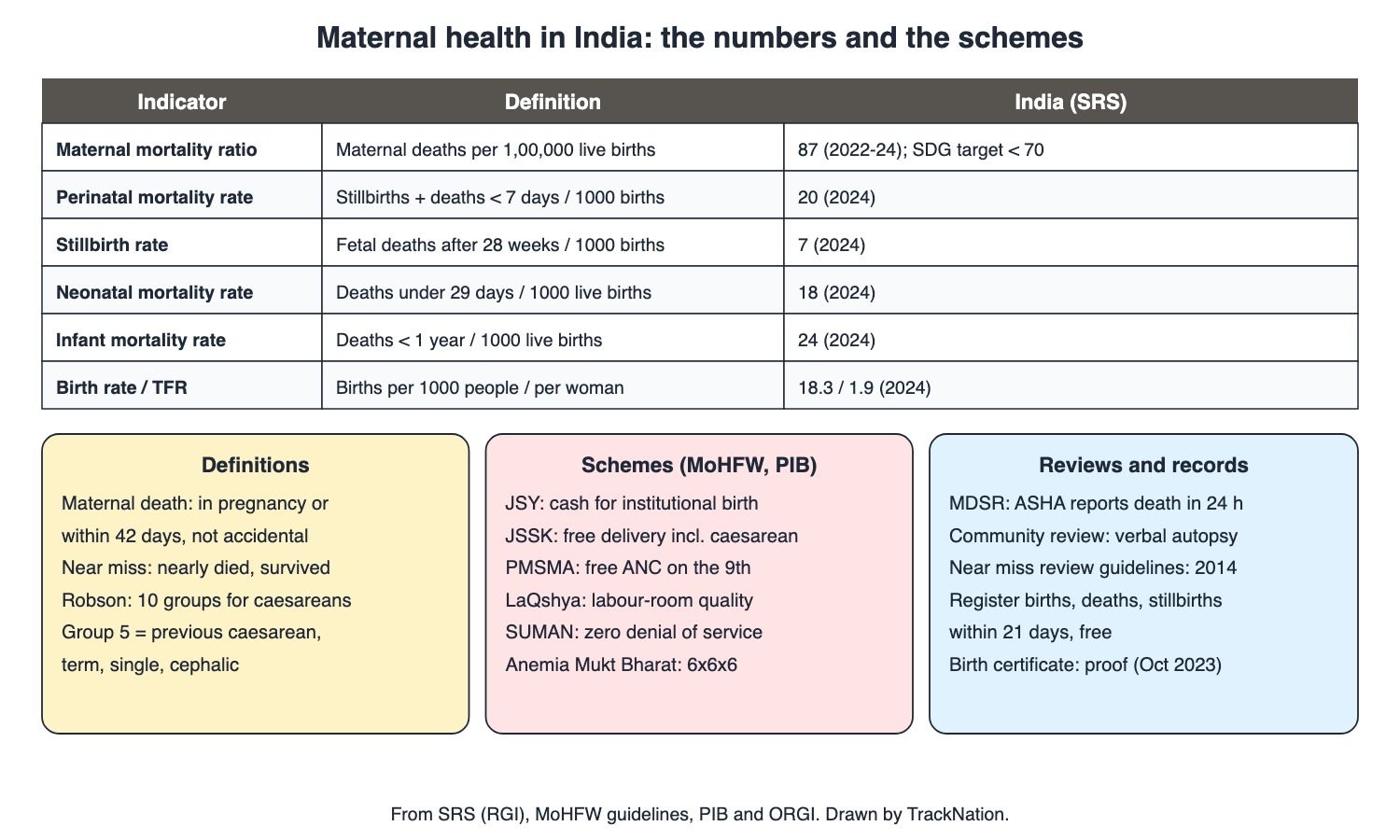
Maternal and perinatal indicators, schemes and review systems. Drawn by TrackNation.
Maternal Mortality (SRS, WHO)
Maternal death (WHO): death while pregnant or within 42 days of the end of pregnancy, from any cause related to or aggravated by the pregnancy or its management, but not accidental or incidental.
Maternal mortality ratio (MMR) = maternal deaths per 1,00,000 live births. Maternal mortality rate = maternal deaths per lakh women aged 15–49. Lifetime risk = chance a woman of reproductive age dies from childbirth or the puerperium.
India: MMR 87 (2022–24), down from 130 in 2014–16 and 88 in 2021–23. SDG 3.1 target: below 70. SRS groups states as EAG (Bihar, Jharkhand, MP, Chhattisgarh, Odisha, Rajasthan, UP, Uttarakhand) and Assam, Southern, and Other. State MMRs vary widely (2021–23: Kerala 30, MP 142).
Maternal near miss (WHO): a woman who nearly died but survived a complication in pregnancy, childbirth or within 42 days — an indirect marker of care quality; MoHFW issued MNM Review Operational Guidelines in 2014. Haemorrhage leads in Indian near-miss audits.
Perinatal Statistics (SRS 2024)
Stillbirth rate = fetal deaths after 28 weeks per 1000 live births + stillbirths — India 7.
Perinatal mortality rate = stillbirths + infant deaths under 7 days, per 1000 live births + stillbirths — India 20 (rural 22, urban 14).
Neonatal mortality (deaths under 29 days per 1000 live births) 18; early neonatal 13. IMR 24 (Kerala lowest, 8); under-5 mortality 28. About half (52.7%) of infant deaths occur in the first week.
Crude birth rate 18.3, TFR 1.9. About 72% of births were in government hospitals.
Reviews and Audits (MoHFW, WHO)
MDSR is a continuous cycle: identify, notify, review, act. The ASHA is the primary informant and reports the death of any woman aged 15–49 within 24 hours. Community-based review uses a verbal autopsy for every death in the area, wherever it happened; facilities do facility-based reviews.
Robson classification: every woman giving birth fits one of 10 groups by parity, previous caesarean, number of fetuses, presentation/lie, gestation and onset of labour. Group 1: nulliparous, single cephalic, ≥37 weeks, spontaneous labour. Group 5: multiparous with a previous caesarean, single cephalic, term — the largest contributor to caesareans in the WHO-manual study cited. Group 8: multiple pregnancies; group 10: single cephalic preterm.
National Programmes (MoHFW, PIB)
JSY: conditional cash transfer for institutional delivery. Low-performing states (LPS) cover all women; in high-performing states, BPL women aged 19+ and all SC/ST women. Rural LPS: mother ₹1400, ASHA ₹600.
JSSK (1 June 2011): completely free delivery in public facilities, including caesarean — drugs, consumables, diet, diagnostics, transport, blood; also for sick infants up to 1 year.
PMSMA: free specialist antenatal check-up on the 9th of every month; extended PMSMA tracks high-risk pregnancies (incentive for 3 extra visits). LaQshya: quality in labour rooms and maternity OTs. SUMAN: assured, respectful, free care with zero tolerance for denial of services. Also MCP card, VHSND, Birth Waiting Homes, obstetric HDUs/ICUs.
Anemia Mukt Bharat: 6×6×6 (6 beneficiary groups, 6 interventions, 6 institutional mechanisms); aims to cut anaemia by 3 percentage points a year. Pregnancy: Hb 10–10.9 mild, 7–9.9 moderate, <7 severe; IFA (60 mg iron + 500 µg folic acid) daily from the second trimester, at least 180 days, and 180 days after delivery.
Registration (RBD Act 1969, amended 2023): births, deaths and stillbirths reported within 21 days — free; later by delayed registration. In hospitals the medical officer in charge reports. For those born on or after 1 October 2023, the birth certificate is the required proof of date and place of birth.
Traps the Examiner Sets
MMR uses live births; maternal mortality rate uses women 15–49.
Perinatal and stillbirth rates use live births plus stillbirths as the denominator.
Accidental deaths in pregnancy are not maternal deaths.
JSY gives cash; JSSK gives free services.
Memory Hooks & Shortcuts
Shortcuts to lock in this article's numbers and lists. Each one only re-packages facts proven above.
🧠 'Ratio for babies (live births), Rate for ladies (women 15–49)' — MMR vs rate
🧠 Maternal death: '42 days, no accidents' — definition
🧠 'PMSMA on the 9th — nine months of pregnancy' — PMSMA
🧠 'JSY = Yojana = Yes, cash; JSSK = free Karyakram' — schemes
🧠 Robson 5: 'Five for the scarred uterus' — Robson
Rapid-Revision Cards
Maternal death
Pregnancy or ≤42 days; not accidental.
MMR
Per 1,00,000 live births.
Maternal mortality rate
Per lakh women 15–49.
India MMR
87 (2022–24).
SDG 3.1
MMR < 70.
Stillbirth
Fetal death after 28 wk.
PMR
SB + deaths <7 d / 1000 LB+SB.
India PMR / SBR
20 / 7 (2024).
IMR / NMR
24 / 18 (2024).
CBR / TFR
18.3 / 1.9.
Near miss
Nearly died, survived.
MNM guidelines
2014.
MDSR informant
ASHA, 24 hours.
CBMDR
Verbal autopsy.
Robson
10 groups.
Robson 5
Previous CS, term cephalic.
JSY
Cash for institutional birth.
JSSK
Free delivery incl. CS; infants <1 y.
PMSMA
9th of every month.
SUMAN
Zero denial of services.
Registration
21 days, free.
Sources
Facts in this article were checked against these documents.
Special Bulletin on Maternal Mortality in India 2022–24 — Office of the Registrar General, India (SRS), May 2026
Sample Registration System Statistical Report 2024 — Office of the Registrar General, India, 2026
Steps taken for Reducing Maternal Mortality (Lok Sabha reply) — Press Information Bureau, MoHFW, 13 Mar 2026 (link)
Maternal Death Surveillance & Response Operational Guidelines; Janani Suraksha Yojana Guidelines; Anemia Mukt Bharat Operational Guidelines (2018) — Ministry of Health & Family Welfare, 2006–2018
Civil Registration System — Frequently Asked Questions — Office of the Registrar General, India, 2024 (link)
Implementation of the WHO manual for Robson classification: an example from Sri Lanka (BMJ Open 9:e027317) — Senanayake H, Piccoli M, Valente EP, et al., 2019 (link)
Validating the maternal near miss review operational guidelines for teaching institutes in India: a retrospective five-year study (Indian J Med Res) — Chandra, Mishra, et al., 2025 (link)
Competency Based Undergraduate Curriculum, Vol III: Obstetrics & Gynaecology (OG1) — National Medical Commission, 2024
Test Yourself: Practice Questions
Thirty questions in NEET PG style, most of them clinical or data vignettes.
Practice Questions (NEET PG pattern)
Original questions written in the style of the exam: +4 for a correct answer, −1 for a wrong one. Every answer was checked against the sources listed above. NEET PG papers are not published by NBEMS, so these are not past-paper questions.
Q1. A woman dies in a road accident at 30 weeks of pregnancy. Under the WHO definition this is
(a) an indirect maternal death
(b) a direct maternal death
(c) a late maternal death
(d) not a maternal death (accidental cause)
Show answer
Answer: (d) — Excludes accidental/incidental causes.
Q2. Maternal death includes deaths up to how long after the end of pregnancy?
(a) 42 days
(b) 7 days
(c) 1 year
(d) 28 days
Show answer
Answer: (a) — WHO.
Q3. The denominator for the maternal mortality ratio is
(a) 1,00,000 women aged 15–49
(b) 1,00,000 live births
(c) 1,000 live births
(d) total pregnancies
Show answer
Answer: (b) — Rate uses women 15–49.
Q4. Maternal deaths per lakh women aged 15–49 is the
(a) maternal mortality rate
(b) maternal mortality ratio
(c) lifetime risk
(d) general fertility rate
Show answer
Answer: (a) — SRS.
Q5. India's MMR in the SRS 2022–24 bulletin is
(a) 97
(b) 87
(c) 70
(d) 130
Show answer
Answer: (b) — Down from 88.
Q6. The SDG 3.1 target for maternal mortality is an MMR below
(a) 30
(b) 70 per 1,00,000 live births
(c) 100
(d) 12
Show answer
Answer: (b) — Global target.
Q7. Which state is NOT in the SRS EAG group?
(a) Uttarakhand
(b) Kerala
(c) Odisha
(d) Bihar
Show answer
Answer: (b) — Kerala is Southern.
Q8. The SRS stillbirth rate counts fetal deaths after
(a) 28 weeks of gestation
(b) 12 weeks
(c) 20 weeks
(d) 37 weeks
Show answer
Answer: (a) — Per 1000 live births + stillbirths.
Q9. The perinatal mortality rate numerator is
(a) infant deaths under 28 days
(b) stillbirths only
(c) stillbirths plus infant deaths under 7 days
(d) deaths under 1 year
Show answer
Answer: (c) — Denominator: live births + stillbirths.
Q10. India's perinatal mortality rate in SRS 2024 was
(a) 20
(b) 7
(c) 24
(d) 38
Show answer
Answer: (a) — Stillbirth rate 7.
Q11. India's infant mortality rate in SRS 2024 was
(a) 24
(b) 30
(c) 18
(d) 8
Show answer
Answer: (a) — Kerala 8.
Q12. SRS counts neonatal deaths as infant deaths under
(a) 1 year
(b) 42 days
(c) 7 days
(d) 29 days
Show answer
Answer: (d) — NMR 18 in 2024.
Q13. India's total fertility rate in SRS 2024 was
(a) 2.1
(b) 2.7
(c) 1.5
(d) 1.9
Show answer
Answer: (d) — Rural 2.1, urban 1.5.
Q14. A woman with eclampsia needs ICU care, ventilation and recovers fully. In audit terms she is a
(a) perinatal death
(b) late maternal death
(c) maternal death
(d) maternal near miss
Show answer
Answer: (d) — Nearly died but survived.
Q15. MoHFW released Maternal Near Miss Review Operational Guidelines in
(a) 2014
(b) 2021
(c) 1992
(d) 2005
Show answer
Answer: (a) — Indirect quality marker.
Q16. Under MDSR, the primary informant who notifies the death of a woman aged 15–49 in a village is the
(a) Medical college, yearly
(b) District Magistrate, within 7 days
(c) ANM, within 30 days
(d) ASHA, within 24 hours
Show answer
Answer: (d) — MoHFW.
Q17. Community-based maternal death review collects information using
(a) verbal autopsy
(b) post-mortem examination
(c) hospital records only
(d) census data
Show answer
Answer: (a) — For all deaths in the area.
Q18. The Robson classification sorts women giving birth into
(a) 3 stages
(b) 4 risk grades
(c) 5 indications
(d) 10 mutually defined groups
Show answer
Answer: (d) — WHO caesarean audit.
Q19. A multiparous woman with one previous caesarean, single cephalic fetus at 39 weeks, belongs to Robson group
(a) 1
(b) 10
(c) 3
(d) 5
Show answer
Answer: (d) — Often the biggest caesarean contributor.
Q20. Robson group 1 is
(a) twins
(b) previous caesarean
(c) nulliparous, single cephalic, ≥37 weeks, spontaneous labour
(d) breech
Show answer
Answer: (c) — Group 2 = induced or prelabour CS.
Q21. All women with twin pregnancies fall in Robson group
(a) 8
(b) 10
(c) 9
(d) 6
Show answer
Answer: (a) — Including previous CS.
Q22. Janani Suraksha Yojana is
(a) a conditional cash transfer for institutional delivery
(b) free caesarean entitlement
(c) an anaemia programme
(d) a monthly ANC day
Show answer
Answer: (a) — JSSK gives free services.
Q23. In a high-performing state, JSY eligibility includes
(a) all women
(b) only primigravidas
(c) BPL women aged 19+ and all SC/ST women
(d) only private deliveries
Show answer
Answer: (c) — LPS: all women.
Q24. Under JSSK, a woman delivering by caesarean at a district hospital pays
(a) for drugs only
(b) nothing — drugs, diet, diagnostics, transport and blood are free
(c) for the operation only
(d) a subsidised fee
Show answer
Answer: (b) — Since 1 June 2011.
Q25. JSSK entitlements also extend to
(a) adolescent girls
(b) fathers
(c) children up to 5 years
(d) sick infants up to one year
Show answer
Answer: (d) — PIB.
Q26. PMSMA provides a free specialist antenatal check-up on
(a) every Monday
(b) the 1st of every month
(c) only in the third trimester
(d) the 9th of every month
Show answer
Answer: (d) — Extended PMSMA tracks high-risk cases.
Q27. The initiative promising zero tolerance for denial of services to pregnant women and newborns at public facilities is
(a) RBSK
(b) JSY
(c) SUMAN
(d) LaQshya
Show answer
Answer: (c) — Surakshit Matritva Aashwasan.
Q28. LaQshya aims to improve
(a) cash incentives
(b) school health
(c) contraceptive supply
(d) quality of care in labour rooms and maternity theatres
Show answer
Answer: (d) — PIB.
Q29. Under Anemia Mukt Bharat, a pregnant woman with Hb 8.5 g/dL has
(a) severe anaemia
(b) no anaemia
(c) mild anaemia
(d) moderate anaemia
Show answer
Answer: (d) — Moderate 7–9.9.
Q30. A stillbirth in a hospital must be registered within
(a) 1 year
(b) 7 days by the parents
(c) it need not be registered
(d) 21 days, free, reported by the medical officer in charge
Show answer
Answer: (d) — RBD Act 1969, amended 2023.
Active Recall
From memory: define maternal death, MMR and maternal mortality rate with India's latest figure, define stillbirth and perinatal mortality with current values, explain maternal near miss, MDSR and the Robson classification, and list what JSY, JSSK, PMSMA, LaQshya, SUMAN and Anemia Mukt Bharat provide, with the registration rule.