Twins, Rh Isoimmunisation, Liquor Disorders and Fetal Growth Restriction for NEET PG OBG: Anti-D, MCA Doppler, AFI and Stillbirth Work-up
Start Here
🎯 Exam priority: High. Expect: twin risk factors and complications, TTTS with a shared placenta, when twins deliver vaginally, why the first Rh-positive pregnancy is spared, ABO and Kell facts, antibody titre and MCA Doppler steps, anti-D timings, AFI/SDP cut-offs and causes of poly- and oligohydramnios, symmetric vs asymmetric FGR, and the stillbirth work-up.
CBME mapping: OG11 (multiple pregnancy) and part of OG12 (Rh isoimmunisation, fetal growth, liquor).
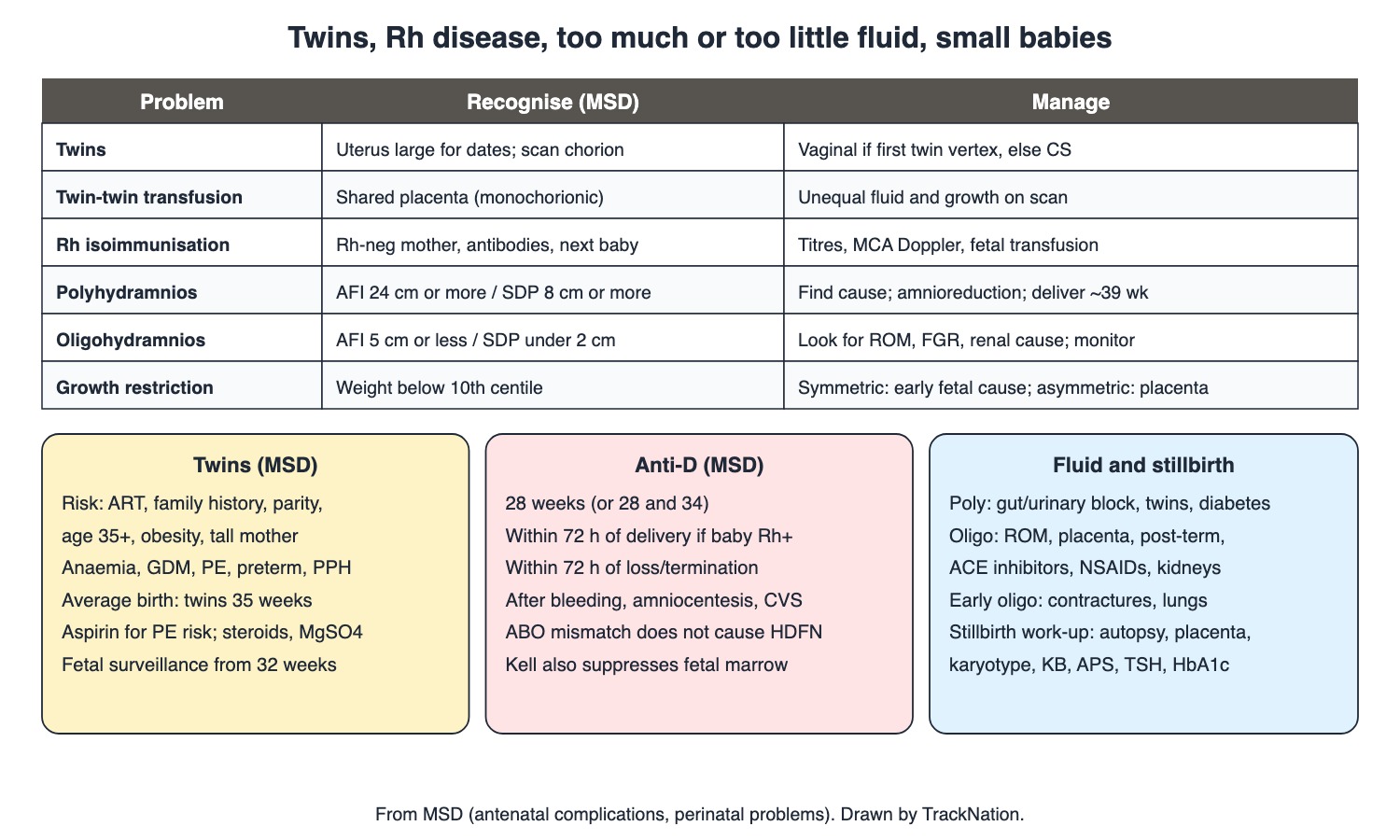
Twins, Rh disease, liquor problems and growth restriction. Drawn by TrackNation.
Multiple Pregnancy (MSD)
Risks: ART/IVF, personal or family history, higher parity, obesity, tall mothers, age ≥35. Suspect when the uterus is large for dates; confirm and assess chorionicity by ultrasound.
Complications: hyperemesis, anaemia, GDM, pre-eclampsia, FGR, preterm birth, PPH (overdistended uterus), caesarean, stillbirth. Average birth: twins 35 weeks, triplets 31. After the first twin, the uterus may contract and shear the placenta.
Twin-twin transfusion syndrome: twins sharing a placenta (monochorionic, or monoamniotic) → vascular connections → unequal fluid and growth.
Care: screen for GDM and pre-eclampsia as usual; cervical length scans; fetal surveillance from 32 weeks; aspirin for pre-eclampsia risk; cerclage, progesterone, tocolytics; steroids and magnesium for prematurity. Vaginal delivery if the first twin is vertex; caesarean if non-vertex first twin or triplets.
Rh Isoimmunisation (MSD)
An Rh-negative woman carrying an Rh-positive fetus makes antibodies after fetomaternal bleeding (mostly at delivery or termination). The first pregnancy is spared; in later pregnancies IgG crosses the placenta → fetal haemolysis, anaemia, high-output heart failure, death; neonatal jaundice and kernicterus. Kell, Duffy, Kidd and others can do the same (Kell also suppresses fetal marrow); ABO incompatibility does not cause HDFN.
Screening: blood group, Rh and antibody screen at the first visit. If antibodies: type the father — if he is Rh-negative, stop. Otherwise titres every 2–4 weeks after 20 weeks; above the critical titre (1:8–1:32) → fetal MCA Doppler every 1–2 weeks; raised flow → cordocentesis and intrauterine transfusion (every 1–2 weeks, till 32–35 weeks). Cell-free fetal DNA can show fetal RHD.
Prevention — anti-D to unsensitised Rh-negative women: 28 weeks (or 28 and 34), within 72 hours of delivery of an Rh-positive baby, within 72 h of miscarriage/termination, after bleeding, amniocentesis or CVS. One dose lasts >3 months. Kleihauer-Betke sizes extra doses for big bleeds.
Liquor, Growth and Stillbirth (MSD)
Normal AFI >5 to <24 cm; normal SDP 2 to <8 cm.
Polyhydramnios (AFI ≥24 or SDP ≥8): idiopathic, fetal GI or urinary obstruction, twins, diabetes, fetal anaemia (HDFN). Risks: preterm labour, PROM, malposition, cord prolapse, atony and PPH, fetal death. Treat the cause; amnioreduction if severe; deliver ~39 weeks.
Oligohydramnios (AFI ≤5 or SDP <2): rupture of membranes, uteroplacental insufficiency (pre-eclampsia, hypertension, abruption), post-term, ACE inhibitors and NSAIDs, aneuploidy, fetal renal malformations. Early onset → limb contractures and poor lung maturation. Look for causes; umbilical artery Doppler if FGR.
Small for gestational age: weight below the 10th centile. Symmetric (all parameters) = early fetal cause (genetic, infection); asymmetric (weight down, head spared) = later placental insufficiency (pre-eclampsia, hypertension, renal disease, APS, twins). Neonates: asphyxia, meconium aspiration, polycythaemia, hypoglycaemia.
Stillbirth: MSD/US ≥20 weeks; India's SRS uses fetal death after 28 weeks. Work-up: fetal autopsy, karyotype/microarray, placenta, CBC, Kleihauer-Betke, antiphospholipid antibodies, TSH, HbA1c, TORCH.
Traps the Examiner Sets
ABO incompatibility does not cause HDFN; Kell can, and suppresses marrow too.
If the father is Rh-negative, no further fetal testing is needed.
Monochorionic twins risk TTTS.
Asymmetric FGR spares the head — think placenta.
Memory Hooks & Shortcuts
Shortcuts to lock in this article's numbers and lists. Each one only re-packages facts proven above.
🧠 'First baby is the sensitiser, second baby the sufferer' — Rh
🧠 Anti-D: '28 and 72' — 28 weeks antenatal, 72 hours after — anti-D
🧠 AFI: '5 and 24 are the walls' — below 5 too little, 24+ too much — liquor
🧠 'Kell Kills the marrow' — Kell
🧠 Asymmetric FGR: 'Brain-sparing, Belly-shrinking' — growth
Rapid-Revision Cards
Twin risks
ART, family hx, parity, age ≥35.
Twin complications
PE, GDM, preterm, PPH.
Twins born
~35 weeks.
TTTS
Monochorionic.
Surveillance
From 32 weeks.
Twin delivery
Vaginal if twin 1 vertex.
First Rh+ pregnancy
Usually spared.
ABO
Does not cause HDFN.
Kell
Marrow suppression too.
Father Rh-neg
Stop testing.
Critical titre
1:8–1:32.
Fetal anaemia
MCA Doppler.
Treatment
Intrauterine transfusion.
Anti-D antenatal
28 (± 34) weeks.
Anti-D postnatal
Within 72 hours.
Normal AFI
>5 to <24 cm.
Poly causes
GI block, twins, diabetes.
Oligo causes
ROM, placenta, post-term, ACEI.
SGA
<10th centile.
Asymmetric FGR
Head spared; placenta.
Stillbirth work-up
Autopsy, placenta, karyotype.
Sources
Facts in this article were checked against these documents.
MSD Manual Professional: Multifetal Gestation; Hemolytic Disease of the Fetus and Neonate; Polyhydramnios; Oligohydramnios; Small-for-Gestational-Age Infant; Stillbirth — Merck & Co. (MSD Manuals), 2024–26 (link)
Competency Based Undergraduate Curriculum, Vol III: Obstetrics & Gynaecology (OG11, OG12) — National Medical Commission, 2024
Test Yourself: Practice Questions
Thirty questions in NEET PG style, most of them clinical vignettes.
Practice Questions (NEET PG pattern)
Original questions written in the style of the exam: +4 for a correct answer, −1 for a wrong one. Every answer was checked against the sources listed above. NEET PG papers are not published by NBEMS, so these are not past-paper questions.
Q1. A woman conceived by IVF has a uterus larger than dates at 14 weeks. The likeliest explanation to check by scan is
(a) oligohydramnios
(b) FGR
(c) multiple pregnancy
(d) previa
Show answer
Answer: (c) — ART is a major risk.
Q2. Which complication is increased in twin pregnancy?
(a) post-term pregnancy
(b) macrosomia
(c) pre-eclampsia, preterm birth and PPH
(d) oligohydramnios only
Show answer
Answer: (c) — Also GDM, anaemia.
Q3. The average gestation at birth for twins is about
(a) 28 weeks
(b) 31 weeks
(c) 40 weeks
(d) 35 weeks
Show answer
Answer: (d) — Triplets ~31.
Q4. Twin-twin transfusion syndrome occurs in twins that
(a) are dizygotic only
(b) share a placenta (monochorionic)
(c) are dichorionic
(d) are of different sexes
Show answer
Answer: (b) — Unequal fluid and growth.
Q5. Antenatal fetal surveillance in twins usually begins at
(a) 32 weeks
(b) 20 weeks
(c) 12 weeks
(d) 40 weeks
Show answer
Answer: (a) — NST, BPP.
Q6. At term, the first twin is vertex and the second breech. Preferred mode of delivery:
(a) elective caesarean always
(b) vaginal delivery
(c) induction at 32 weeks
(d) external version of twin 1
Show answer
Answer: (b) — First twin vertex.
Q7. Triplets are usually delivered by
(a) forceps
(b) induction at 41 weeks
(c) vaginal delivery
(d) caesarean section
Show answer
Answer: (d) — Higher-order multiples.
Q8. An Rh-negative primigravida carrying an Rh-positive fetus usually has
(a) no haemolytic disease in this first pregnancy
(b) fetal death
(c) ABO disease
(d) severe hydrops
Show answer
Answer: (a) — Sensitisation affects later pregnancies.
Q9. Which incompatibility does NOT cause haemolytic disease of the fetus?
(a) Rh(D)
(b) Kell
(c) ABO
(d) Duffy
Show answer
Answer: (c) — MSD.
Q10. Besides haemolysis, anti-Kell antibodies cause fetal anaemia by
(a) iron deficiency
(b) suppressing fetal marrow red cell production
(c) bleeding
(d) folate deficiency
Show answer
Answer: (b) — Direct marrow suppression.
Q11. A sensitised Rh-negative woman's husband is Rh-negative (paternity certain). Next step:
(a) amniocentesis
(b) MCA Doppler weekly
(c) intrauterine transfusion
(d) no further fetal testing is needed
Show answer
Answer: (d) — Fetus must be Rh-negative.
Q12. Maternal anti-D titres below the critical value are rechecked
(a) every 2–4 weeks after 20 weeks
(b) daily
(c) at delivery only
(d) once only
Show answer
Answer: (a) — Critical 1:8–1:32.
Q13. Once anti-D titres exceed the critical value, fetal anaemia is monitored by
(a) amniotic fluid index
(b) middle cerebral artery Doppler
(c) maternal Hb
(d) CTG only
Show answer
Answer: (b) — Then transfusion if raised.
Q14. Raised fetal MCA peak velocity at 28 weeks in an alloimmunised pregnancy calls for
(a) anti-D injection
(b) immediate delivery at 28 weeks always
(c) no action
(d) cordocentesis and intrauterine transfusion
Show answer
Answer: (d) — Specialist centre.
Q15. Fetal RhD status can be checked non-invasively by
(a) amniocentesis
(b) cell-free fetal DNA in maternal blood
(c) Kleihauer-Betke
(d) CVS
Show answer
Answer: (b) — RHD gene.
Q16. Routine antenatal anti-D prophylaxis for an unsensitised Rh-negative woman is given at
(a) 28 weeks (or 28 and 34 weeks)
(b) 40 weeks only
(c) 12 weeks
(d) never antenatally
Show answer
Answer: (a) — Plus after delivery.
Q17. After delivery of an Rh-positive baby to an unsensitised Rh-negative mother, anti-D should be given within
(a) 6 months
(b) 72 hours
(c) 7 days
(d) 24 days
Show answer
Answer: (b) — MSD.
Q18. An unsensitised Rh-negative woman needs anti-D after which event?
(a) amniocentesis at 16 weeks
(b) a urine test
(c) an antenatal BP check
(d) a normal 20-week scan
Show answer
Answer: (a) — Also bleeding, miscarriage.
Q19. Normal amniotic fluid index ranges from
(a) 1 to 3 cm
(b) more than 5 to less than 24 cm
(c) 10 to 15 cm only
(d) 25 to 40 cm
Show answer
Answer: (b) — SDP 2 to <8 cm.
Q20. An AFI of 28 cm is
(a) polyhydramnios
(b) anhydramnios
(c) normal
(d) oligohydramnios
Show answer
Answer: (a) — ≥24 cm.
Q21. A cause of polyhydramnios is
(a) renal agenesis
(b) ACE inhibitor use
(c) post-term pregnancy
(d) fetal gastrointestinal obstruction
Show answer
Answer: (d) — Fetus can't swallow fluid.
Q22. A diabetic woman with polyhydramnios has her membranes rupture. An immediate danger is
(a) oligohydramnios
(b) umbilical cord prolapse
(c) post-term labour
(d) macrosomia only
Show answer
Answer: (b) — Also PPH from atony.
Q23. An AFI of 4 cm at 34 weeks is
(a) polyhydramnios
(b) borderline high
(c) normal
(d) oligohydramnios
Show answer
Answer: (d) — ≤5 cm.
Q24. A hypertensive woman on an ACE inhibitor develops oligohydramnios. The drug is
(a) protective
(b) irrelevant
(c) replaced with NSAIDs
(d) recognised as a likely cause of the oligohydramnios
Show answer
Answer: (d) — ACE inhibitors and NSAIDs.
Q25. Oligohydramnios starting early in pregnancy can cause
(a) polycythaemia only
(b) limb contractures and poor lung maturation
(c) cord prolapse
(d) macrosomia
Show answer
Answer: (b) — MSD.
Q26. A newborn is small for gestational age if its weight is below the
(a) 25th centile
(b) 10th centile
(c) 50th centile
(d) 3rd centile only
Show answer
Answer: (b) — MSD.
Q27. Growth restriction with weight reduced but head circumference spared suggests
(a) asymmetric FGR from placental insufficiency
(b) macrosomia
(c) symmetric FGR from a chromosomal cause
(d) normal growth
Show answer
Answer: (a) — Late onset.
Q28. Symmetric growth restriction usually results from
(a) a fetal problem starting early (genetic, infection)
(b) late pre-eclampsia
(c) maternal smoking in the last month only
(d) post-maturity
Show answer
Answer: (a) — Fewer cells.
Q29. A growth-restricted newborn should be watched for
(a) hypoglycaemia and polycythaemia
(b) hypercalcaemia
(c) post-term changes only
(d) macrosomia
Show answer
Answer: (a) — Also meconium aspiration.
Q30. After a stillbirth, the most informative evaluations include
(a) fetal autopsy, placental examination and karyotype
(b) no tests
(c) maternal ECG only
(d) CA-125
Show answer
Answer: (a) — Plus KB, APS, TSH, HbA1c.
Active Recall
From memory: list twin risk factors, complications, TTTS and delivery rules, explain Rh isoimmunisation, its surveillance and anti-D prophylaxis, define and give causes of poly- and oligohydramnios, contrast symmetric and asymmetric growth restriction, and outline the stillbirth work-up.