Conception, Placenta and Maternal Changes for NEET PG OBG: Diagnosis of Pregnancy, hCG, Naegele Rule, Fundal Height and Physiology of Pregnancy
Start Here
🎯 Exam priority: Moderate–High. Expect: day of ovulation and implantation, when hCG appears, scan milestones (sac, cardiac activity), Naegele rule, fundal height landmarks, GTPAL counting, and the "normal" changes of pregnancy that look like disease — dilutional anaemia, low creatinine, raised ALP, supine hypotension, respiratory alkalosis.
CBME mapping: OG2–OG4, OG6–OG7 (anatomy, conception, fetus and placenta, diagnosis of pregnancy, maternal changes).
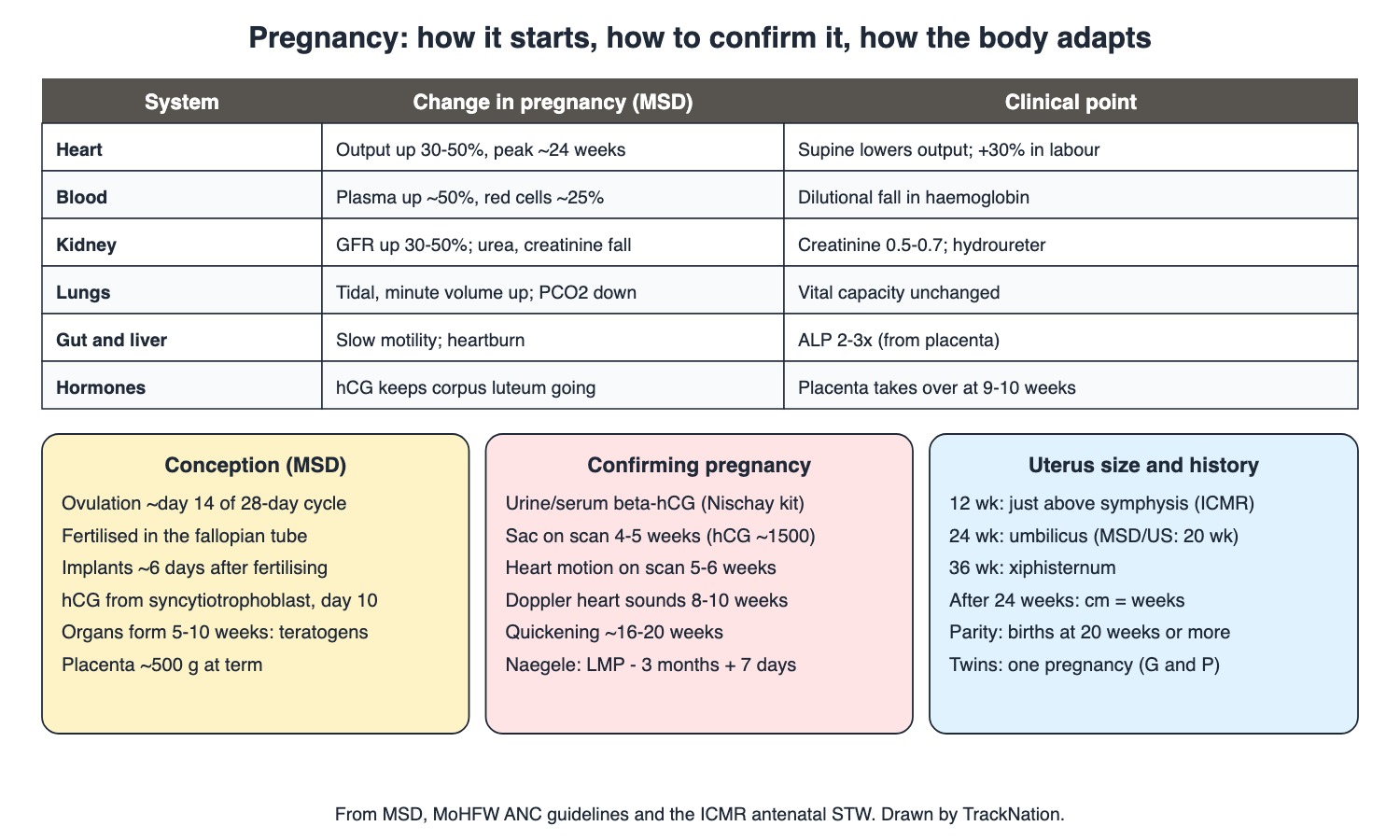
Maternal changes, conception, diagnosis of pregnancy and fundal height. Drawn by TrackNation.
Conception, Implantation and Placenta (MSD)
Cycle: in a 28-day cycle, ovulation is ~day 14. Rising oestradiol triggers the LH surge (positive feedback, 36–48 h). The luteal phase is the most constant (~14 days); the corpus luteum makes progesterone (thermogenic — basal body temperature rises). Inhibin suppresses FSH, not LH.
Fertilisation usually happens in the fallopian tube; sperm survive ~3 days. Two oocytes fertilised by two sperm = dizygotic twins.
The blastocyst implants about 6 days after fertilisation. The syncytiotrophoblast makes hCG by day 10; hCG keeps the corpus luteum making oestrogen and progesterone until the placenta takes over after 9–10 weeks. Amnion (inner) and chorion (outer) come from trophoblast.
Germ layers by day ~10; the heart pumps by ~day 20. Organs form 21–57 days after fertilisation (5–10 weeks' gestation) — the window of greatest teratogen risk. Placenta fully formed by 18–20 weeks, ~500 g at term.
Diagnosing and Dating Pregnancy (MSD, MoHFW)
Earliest sign: missed period. Confirm with urine or serum β-hCG — MoHFW's free Nischay kit (2 drops of urine, 5 minutes) is used by ANMs and ASHAs.
Ultrasound: gestational sac at 4–5 weeks (β-hCG ~1500 mIU/mL); yolk sac by 5 weeks; cardiac motion at 5–6 weeks. Handheld Doppler heart sounds from 8–10 weeks. Women feel movements (quickening) at 16–20 weeks (MoHFW: ~20).
Length: 280 days from LMP (266 from conception). Naegele: LMP − 3 months + 7 days; adjust by (cycle length − 28) for non-28-day cycles. Preterm <37 weeks, post-term >42.
Fundus — Indian landmarks (ICMR STW 2025): 12 weeks just above the symphysis, 16 weeks one-third of the way to the umbilicus, 24 weeks at the umbilicus, 36 weeks at the xiphisternum, and at 40 weeks it sinks back to the 32-week level with full flanks. (MSD, a US text, places the umbilicus at 20 weeks — answer Indian exam questions with the ICMR landmarks.) After 24 weeks, fundal height in cm ≈ weeks (MoHFW). Fibroids or twins make this unreliable.
History: gravidity = number of pregnancies; parity = deliveries at ≥20 weeks, recorded as term, preterm, abortions, living children. Twins count once (except living children).
Maternal Changes (MSD)
Heart: cardiac output +30–50% from 6 weeks, peaking ~24 weeks; another +30% in labour. BP falls in the second trimester (low SVR). Lying supine compresses the IVC and drops output — lie on the left. Flow murmurs and ectopics are normal.
Blood: plasma volume +~50% vs red cells +~25% → dilutional anaemia (Hb ~13.3 → 12.1). WBC 9,000–12,000; ≥20,000 in labour. Extra iron needed ~1 g over pregnancy.
Kidney: GFR +30–50%; urea <10 mg/dL, creatinine 0.5–0.7 mg/dL — a "normal" 1.0 may be abnormal. Hydroureter (progesterone + uterine pressure); may take up to 12 weeks postpartum to settle.
Lungs: progesterone drives tidal and minute volume up → low PCO₂, higher pH; O₂ use +20%; residual volume falls; vital capacity unchanged. Nasal stuffiness, mild exertional breathlessness.
Gut/liver: progesterone slows motility (constipation, heartburn); peptic ulcers improve; gallbladder disease rises; ALP 2–3× from the placenta.
Endocrine: total T4 rises (more TBG) but free hormones normal; cortisol and aldosterone up; insulin resistance (hPL, progesterone, cortisol); prolactin ×10. Skin: melasma, linea nigra, darker areolae, spider angiomas.
Traps the Examiner Sets
Creatinine 1.0 mg/dL in pregnancy is not reassuring.
Raised ALP late in pregnancy is placental, not liver disease.
Vital capacity does not change; PCO₂ falls.
Parity counts deliveries ≥20 weeks; twins count once.
Memory Hooks & Shortcuts
Shortcuts to lock in this article's numbers and lists. Each one only re-packages facts proven above.
🧠 Naegele: 'Minus three, plus seven' — EDD
🧠 Fundus (ICMR): '12 at the bone, 24 at the button, 36 at the breastbone' — fundal height
🧠 Scan: 'Sac at 5, beat at 6' (weeks) — ultrasound
🧠 Pregnancy dilutes: 'more water than wine' — plasma 50%, cells 25% — anaemia
🧠 'Progesterone relaxes everything' — gut, ureters, breathing drive up — progesterone
Rapid-Revision Cards
Ovulation
Day 14 of 28-day cycle.
Luteal phase
Constant ~14 days.
LH surge
Oestradiol positive feedback.
Fertilisation
Fallopian tube.
Implantation
~6 days after fertilisation.
hCG
Syncytiotrophoblast; day 10.
Luteo-placental shift
9–10 weeks.
Organogenesis
5–10 weeks' gestation.
Placenta
~500 g at term.
Sac on scan
4–5 wk; hCG ~1500.
Cardiac motion
5–6 weeks.
Doppler FHS
8–10 weeks.
Naegele
LMP − 3 mo + 7 d.
Fundus at umbilicus
24 wk (ICMR); 20 wk (MSD).
After 24 wk
Fundal cm ≈ weeks.
Parity
Deliveries ≥ 20 weeks.
Cardiac output
+30–50%, peak 24 wk.
Anaemia
Dilutional.
Creatinine
0.5–0.7 mg/dL.
Lungs
PCO₂ down; VC same.
ALP
2–3× (placental).
Sources
Facts in this article were checked against these documents.
MSD Manual Professional: Fertilization and Development of the Embryo; Female Reproductive Endocrinology; Evaluation of the Obstetric Patient; Physiology of Pregnancy — Merck & Co. (MSD Manuals), 2024–25 (link)
Guidelines for Antenatal Care and Skilled Attendance at Birth by ANMs/LHVs/SNs — Ministry of Health & Family Welfare, 2010
Competency Based Undergraduate Curriculum, Vol III: Obstetrics & Gynaecology (OG2–OG7) — National Medical Commission, 2024
Test Yourself: Practice Questions
Thirty questions in NEET PG style, most of them clinical vignettes.
Practice Questions (NEET PG pattern)
Original questions written in the style of the exam: +4 for a correct answer, −1 for a wrong one. Every answer was checked against the sources listed above. NEET PG papers are not published by NBEMS, so these are not past-paper questions.
Q1. In a regular 28-day cycle, ovulation occurs about
(a) day 21
(b) day 28
(c) day 1
(d) day 14
Show answer
Answer: (d) — Luteal phase ~14 days.
Q2. The most constant phase of the menstrual cycle is the
(a) follicular phase
(b) luteal phase (~14 days)
(c) menstrual phase
(d) proliferative phase
Show answer
Answer: (b) — Follicular phase varies.
Q3. The LH surge is triggered mainly by
(a) falling progesterone
(b) high oestradiol (positive feedback)
(c) inhibin
(d) hCG
Show answer
Answer: (b) — Lasts 36–48 h.
Q4. A rise in basal body temperature after ovulation is due to
(a) prolactin
(b) oestradiol
(c) FSH
(d) progesterone
Show answer
Answer: (d) — Thermogenic.
Q5. Fertilisation normally occurs in the
(a) ovary
(b) cervix
(c) uterine cavity
(d) fallopian tube
Show answer
Answer: (d) — Then implantation in uterus.
Q6. The blastocyst implants about how long after fertilisation?
(a) 14 days
(b) 1 day
(c) 6 days
(d) 28 days
Show answer
Answer: (c) — Near fundus or posterior wall.
Q7. hCG is produced by the
(a) corpus luteum
(b) syncytiotrophoblast, by day 10 after fertilisation
(c) amnion
(d) anterior pituitary
Show answer
Answer: (b) — Maintains corpus luteum.
Q8. The placenta takes over oestrogen and progesterone production from the corpus luteum after about
(a) 9–10 weeks
(b) 2 weeks
(c) 20 weeks
(d) 36 weeks
Show answer
Answer: (a) — hCG keeps corpus luteum until then.
Q9. A woman takes a known teratogen. Fetal risk of structural malformation is highest at
(a) 5–10 weeks' gestation
(b) term
(c) 30–34 weeks
(d) the first week after LMP
Show answer
Answer: (a) — Organogenesis.
Q10. The weight of the placenta at term is about
(a) 500 g
(b) 1500 g
(c) 100 g
(d) 50 g
Show answer
Answer: (a) — Fully formed 18–20 weeks.
Q11. An ASHA tests a woman with 6 weeks of amenorrhoea using the Nischay kit. It detects
(a) hCG in urine
(b) oestriol
(c) LH in blood
(d) progesterone in urine
Show answer
Answer: (a) — Two drops, five minutes.
Q12. On transvaginal ultrasound, an intrauterine gestational sac is usually first visible at about
(a) 4–5 weeks (β-hCG ~1500 mIU/mL)
(b) 12 weeks
(c) 2 weeks
(d) 8 weeks
Show answer
Answer: (a) — Yolk sac by 5 weeks.
Q13. Fetal cardiac motion can first be seen on ultrasound at about
(a) 5–6 weeks
(b) 3 weeks
(c) 10 weeks
(d) 16 weeks
Show answer
Answer: (a) — Doppler sounds 8–10 weeks.
Q14. Fetal heart sounds are first audible with a handheld Doppler at
(a) 8–10 weeks
(b) 4 weeks
(c) 20 weeks
(d) 28 weeks
Show answer
Answer: (a) — If uterus is accessible.
Q15. A woman's LMP was 10 January (regular 28-day cycles). By Naegele rule the EDD is
(a) 10 October
(b) 17 November
(c) 3 October
(d) 17 October
Show answer
Answer: (d) — LMP − 3 months + 7 days.
Q16. For a woman with regular 35-day cycles, the EDD should be
(a) LMP + 266 days
(b) unchanged
(c) LMP + 280 days − 7 days
(d) LMP + 280 days + 7 days
Show answer
Answer: (d) — Add (cycle length − 28).
Q17. Per the ICMR antenatal STW, the uterine fundus reaches the level of the umbilicus at
(a) 36 weeks
(b) 16 weeks
(c) 12 weeks
(d) 24 weeks
Show answer
Answer: (d) — Xiphisternum at 36 weeks (MSD, US: umbilicus at 20).
Q18. Per MoHFW, fundal height in cm approximately equals gestational age in weeks after
(a) 8 weeks
(b) 12 weeks
(c) 24 weeks
(d) 36 weeks only
Show answer
Answer: (c) — Legs straight while measuring.
Q19. A woman has had one term delivery, one twin delivery at 34 weeks and one miscarriage at 10 weeks; all three children live. Her parity is recorded as
(a) G3 P2-0-1-2
(b) G3 P1-1-1-2
(c) G4 P1-2-1-3
(d) G3 P1-1-1-3
Show answer
Answer: (d) — Twins count once except living children.
Q20. Maternal cardiac output in pregnancy peaks at about
(a) term
(b) it falls
(c) 8 weeks
(d) 24 weeks (+30–50%)
Show answer
Answer: (d) — +30% more in labour.
Q21. A woman at 34 weeks feels faint lying flat on her back. The cause is
(a) the uterus compressing the inferior vena cava
(b) pre-eclampsia
(c) anaemia
(d) hypoglycaemia
Show answer
Answer: (a) — Turn to left side.
Q22. The 'physiological anaemia' of pregnancy is due to
(a) haemolysis
(b) plasma volume rising (~50%) more than red cell mass (~25%)
(c) iron deficiency only
(d) marrow suppression
Show answer
Answer: (b) — Dilutional.
Q23. Total extra iron needed over a pregnancy is about
(a) 100 mg
(b) 1 g
(c) 5 g
(d) 10 mg
Show answer
Answer: (b) — Fetus/placenta ~300 mg.
Q24. A pregnant woman's serum creatinine of 1.0 mg/dL should be viewed as
(a) irrelevant
(b) normal
(c) possibly abnormal, since normal is 0.5–0.7
(d) low
Show answer
Answer: (c) — GFR rises 30–50%.
Q25. Dilated ureters on ultrasound at 30 weeks in an asymptomatic woman are due to
(a) infection
(b) stones always
(c) VUR
(d) progesterone and uterine pressure
Show answer
Answer: (d) — Physiological hydroureter.
Q26. The acid–base pattern of normal pregnancy is
(a) metabolic acidosis
(b) respiratory alkalosis with low PCO₂
(c) respiratory acidosis
(d) metabolic alkalosis
Show answer
Answer: (b) — Progesterone drives breathing.
Q27. Which lung measure is unchanged in pregnancy?
(a) tidal volume
(b) vital capacity
(c) residual volume
(d) minute ventilation
Show answer
Answer: (b) — Residual volume falls.
Q28. Alkaline phosphatase 2–3 times normal at 38 weeks in a well woman is most likely
(a) bone metastasis
(b) hepatitis
(c) cholestasis
(d) placental in origin
Show answer
Answer: (d) — Other LFTs normal.
Q29. In pregnancy, thyroid function shows
(a) raised total T4 but normal free hormones
(b) hypothyroidism
(c) raised free T4
(d) low TBG
Show answer
Answer: (a) — TBG rises.
Q30. Brownish blotchy facial pigmentation in pregnancy is
(a) melasma
(b) linea nigra
(c) chloasma of cirrhosis
(d) vitiligo
Show answer
Answer: (a) — Usually regresses within a year.
Active Recall
From memory: describe ovulation, fertilisation, implantation and the role of hCG and the placenta, outline how pregnancy is diagnosed and dated including scan milestones, Naegele rule and fundal height, explain gravidity and parity, and summarise the cardiovascular, haematological, renal, respiratory, hepatic and endocrine changes of pregnancy.