Antepartum Haemorrhage for NEET PG OBG: Placenta Previa, Placental Abruption, Vasa Previa, Placenta Accreta and Uterine Rupture
Start Here
🎯 Exam priority: High. Expect: painless (previa) vs painful (abruption) bleeding, no digital PV exam until previa is excluded by ultrasound, low-lying placenta, previa risks, accreta risk climbing with each caesarean, timing of delivery, concealed abruption, DIC tests, Kleihauer-Betke, vasa previa triad with fetal blood, and uterine rupture after a scar.
CBME mapping: OG10 (antepartum haemorrhage).
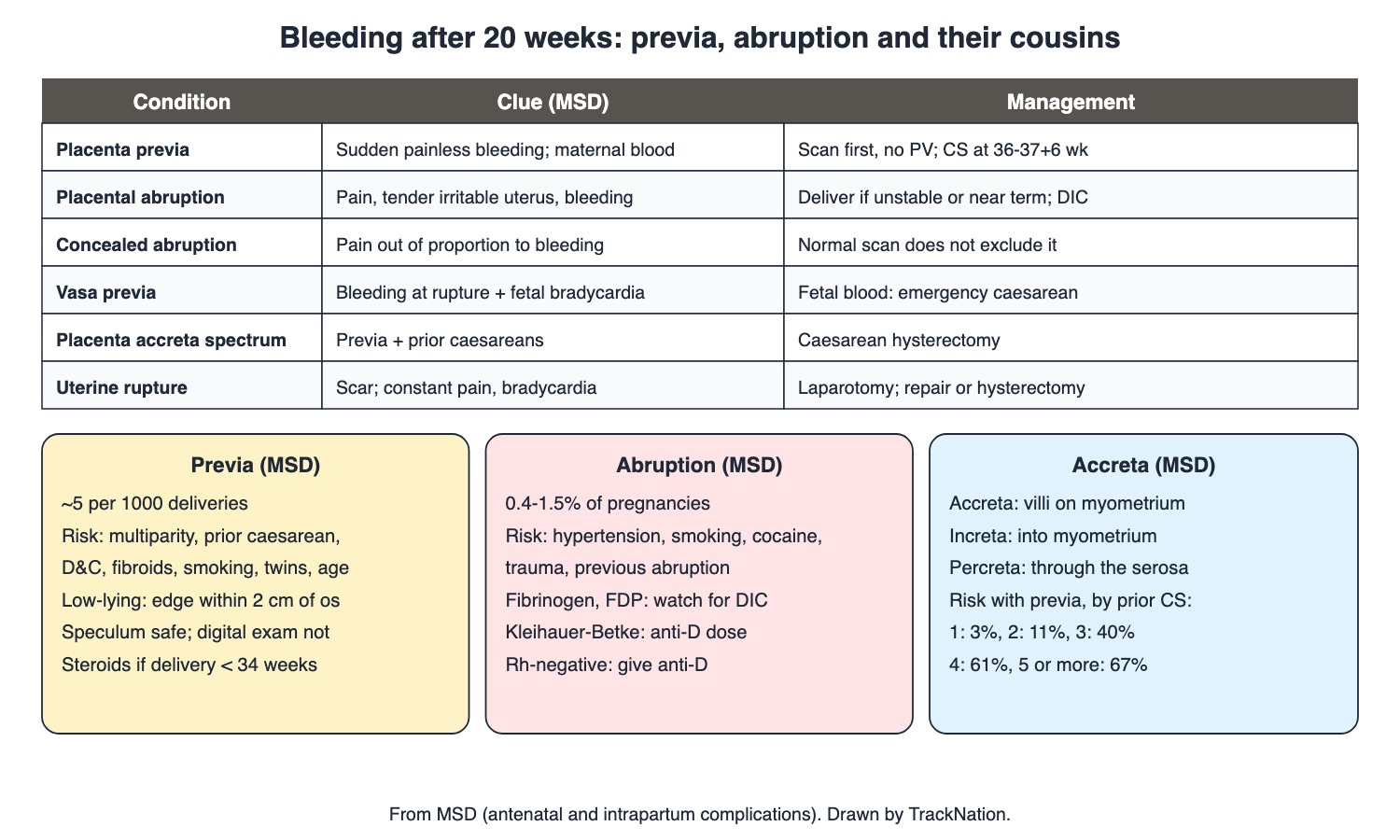
Placenta previa, abruption, vasa previa, accreta and rupture. Drawn by TrackNation.
Placenta Previa (MSD)
Placenta over (previa) or within 2 cm (low-lying) of the internal os; ~5 per 1000 deliveries. Early previa usually resolves by 28 weeks as the uterus grows.
Risks: multiparity, previous caesarean, fibroids, previous curettage or myomectomy, smoking, twins, older age. Linked to malpresentation, FGR, vasa previa and velamentous cord.
Sudden painless bleeding after 20 weeks (maternal blood), sometimes heavy; often found on the routine second-trimester scan.
Never do a digital vaginal examination until ultrasound excludes previa — it can provoke massive bleeding; a speculum exam is safe. Transvaginal ultrasound is accurate and safe. Monitor the fetal heart.
First (sentinel) bleed before 36 weeks: admit, modified activity, avoid intercourse; corticosteroids if delivery may be needed before 34 weeks. Stable: caesarean at 36 to 37+6 weeks; severe bleeding or fetal distress: immediate caesarean. Rh-negative: anti-D.
Placental Abruption (MSD)
Premature separation of a normally sited placenta, usually after 20 weeks; 0.4–1.5% of pregnancies. Risks: hypertension, smoking, cocaine, abdominal trauma, previous abruption, FGR, chorioamnionitis, thrombophilia, PROM with polyhydramnios.
Painful bleeding with a tender, irritable uterus. Blood may stay behind the placenta (concealed) — pain out of proportion to visible bleeding. Complications: shock, DIC, fetal distress or death; chronic abruption gives dark brown spotting.
Tests: fetal heart monitoring, CBC, group and Rh, PT/PTT, fibrinogen and fibrin split products (most sensitive), ultrasound — a normal scan does not exclude abruption. Rh-negative: Kleihauer-Betke to dose anti-D.
Unstable mother or fetus, or near term → prompt delivery with resuscitation; preterm and stable → observe in hospital.
Vasa Previa, Accreta and Rupture (MSD)
Vasa previa: fetal vessels in the membranes over or within 2 cm of the os (often with velamentous insertion). Classic triad: painless bleeding at membrane rupture with fetal bradycardia. The blood is fetal — fetal mortality ~60% if undiagnosed. Diagnose with transvaginal ultrasound and colour Doppler; planned caesarean around 34–37 weeks, emergency caesarean if membranes rupture, bleeding continues or the fetal status is worrying.
Placenta accreta spectrum: villi attach to (accreta), invade (increta) or penetrate through (percreta) the myometrium. Main risk: previous caesarean, especially with a current previa — 3%, 11%, 40%, 61%, 67% after 1 to ≥5 caesareans. Suspect if the placenta is not delivered within 30 minutes; treat with caesarean hysterectomy.
Uterine rupture: mostly along a previous caesarean scar; also overdistension, version, excess uterotonics, obstructed labour. Signs: fetal bradycardia, hypovolaemia, loss of fetal station, severe constant pain. Avoid prostaglandins in VBAC. Treatment: immediate laparotomy, delivery, repair or hysterectomy.
Traps the Examiner Sets
Bleeding after 20 weeks: scan before any finger goes in.
Previa and abruption bleed maternal blood; vasa previa bleeds fetal blood.
A normal ultrasound does not rule out abruption.
Previa + previous caesarean = think accreta.
Memory Hooks & Shortcuts
Shortcuts to lock in this article's numbers and lists. Each one only re-packages facts proven above.
🧠 'Previa is Painless, Abruption Aches' — pain
🧠 'No finger before the probe' in late bleeding — examination
🧠 'Vasa = Very fetal': blood from the baby — vasa previa
🧠 Accreta ladder: 'A-ttach, I-nvade, P-enetrate' — accreta
🧠 Accreta risk by caesareans: '3, 11, 40, 61, 67' — risk
Rapid-Revision Cards
Previa
Painless bright bleeding.
Abruption
Painful, tender uterus.
Before PV exam
Scan to exclude previa.
Previa test
Transvaginal ultrasound.
Low-lying
Within 2 cm of os.
Early low placenta
Resolves by 28 wk.
Previa risks
Multiparity, prior CS, curettage.
Previa delivery
CS at 36–37+6 wk.
Steroids
If delivery < 34 weeks.
Abruption risks
HTN, trauma, cocaine, smoking.
Concealed abruption
Pain > bleeding.
DIC marker
Fibrinogen, FDP.
Kleihauer-Betke
Anti-D dose.
Normal scan
Doesn't exclude abruption.
Vasa previa
Bleed at ROM + bradycardia.
Vasa blood
Fetal.
Velamentous
Vessels in membranes.
Accreta spectrum
Accreta, increta, percreta.
Accreta risk
Previa + prior CS.
Rupture signs
Bradycardia, loss of station.
VBAC
No prostaglandins.
Sources
Facts in this article were checked against these documents.
MSD Manual Professional: Placenta Previa; Placental Abruption; Vasa Previa; Placenta Accreta; Uterine Rupture — Merck & Co. (MSD Manuals), 2024–25 (link)
Competency Based Undergraduate Curriculum, Vol III: Obstetrics & Gynaecology (OG10) — National Medical Commission, 2024
Test Yourself: Practice Questions
Thirty questions in NEET PG style, most of them clinical vignettes.
Practice Questions (NEET PG pattern)
Original questions written in the style of the exam: +4 for a correct answer, −1 for a wrong one. Every answer was checked against the sources listed above. NEET PG papers are not published by NBEMS, so these are not past-paper questions.
Q1. A multipara at 32 weeks has sudden painless bright vaginal bleeding. Most likely:
(a) placental abruption
(b) uterine rupture
(c) placenta previa
(d) vasa previa
Show answer
Answer: (c) — Maternal blood.
Q2. In a woman bleeding at 30 weeks, the first thing to avoid until a scan is done is
(a) digital vaginal examination
(b) IV access
(c) speculum examination
(d) fetal heart monitoring
Show answer
Answer: (a) — May provoke massive bleeding.
Q3. The investigation of choice to diagnose placenta previa is
(a) transvaginal ultrasound
(b) digital examination
(c) Kleihauer-Betke
(d) MRI
Show answer
Answer: (a) — Accurate and safe.
Q4. A placenta whose edge lies 1.5 cm from the internal os without covering it is
(a) complete previa
(b) normal
(c) low-lying
(d) accreta
Show answer
Answer: (c) — Within 2 cm.
Q5. A low placenta at the 18-week scan
(a) always needs caesarean
(b) usually resolves by 28 weeks
(c) needs immediate delivery
(d) means accreta
Show answer
Answer: (b) — Rescan later.
Q6. A risk factor for placenta previa is
(a) previous caesarean section
(b) male fetus
(c) nulliparity
(d) low maternal age
Show answer
Answer: (a) — Also multiparity, curettage, smoking.
Q7. A stable woman with placenta previa and no further bleeding should be delivered by caesarean at
(a) 36 to 37+6 weeks
(b) 41 weeks
(c) 28 weeks
(d) vaginally at term
Show answer
Answer: (a) — Earlier if bleeding is severe.
Q8. A woman at 31 weeks with a first previa bleed that has stopped should receive
(a) tocolysis and vaginal delivery
(b) admission and corticosteroids for fetal lung maturity
(c) immediate caesarean
(d) discharge without follow-up
Show answer
Answer: (b) — Delivery may be needed <34 weeks.
Q9. Profuse previa bleeding with fetal distress at 34 weeks requires
(a) tocolytics
(b) expectant care
(c) immediate caesarean delivery
(d) vaginal delivery
Show answer
Answer: (c) — MSD.
Q10. A woman with preeclampsia at 34 weeks has painful vaginal bleeding and a tender, irritable uterus. Most likely:
(a) cervical polyp
(b) placenta previa
(c) placental abruption
(d) vasa previa
Show answer
Answer: (c) — Hypertension is a risk.
Q11. Severe abdominal pain and shock with only slight vaginal bleeding suggests
(a) placenta previa
(b) concealed placental abruption
(c) vasa previa
(d) threatened abortion
Show answer
Answer: (b) — Blood behind the placenta.
Q12. Placental abruption occurs in about
(a) 25%
(b) 0.4–1.5% of pregnancies
(c) 10% of pregnancies
(d) 0.01%
Show answer
Answer: (b) — Peaks 24–26 weeks.
Q13. A drug whose use carries up to a 10% risk of abruption is
(a) folic acid
(b) paracetamol
(c) insulin
(d) cocaine
Show answer
Answer: (d) — Also tobacco.
Q14. After a road accident at 30 weeks a woman has abdominal pain and spotting; ultrasound looks normal. Correct statement:
(a) abruption is excluded
(b) discharge home
(c) do a digital exam first
(d) a normal scan does not exclude abruption; monitor the fetus
Show answer
Answer: (d) — Trauma is a risk factor.
Q15. The most sensitive laboratory indicator of DIC in abruption is
(a) haemoglobin
(b) ALT
(c) platelet count alone
(d) fibrinogen and fibrin split products
Show answer
Answer: (d) — MSD.
Q16. In an Rh-negative woman with abruption, the Kleihauer-Betke test is used to
(a) calculate the dose of anti-D
(b) measure fibrinogen
(c) assess lung maturity
(d) diagnose previa
Show answer
Answer: (a) — Fetomaternal haemorrhage.
Q17. Abruption at 38 weeks with an unstable mother is managed by
(a) prompt delivery with resuscitation
(b) expectant care
(c) outpatient follow-up
(d) tocolysis
Show answer
Answer: (a) — MSD.
Q18. Chronic placental abruption may present as
(a) polyhydramnios always
(b) fetal tachycardia only
(c) intermittent dark brown spotting with growth restriction
(d) sudden painless bright bleeding
Show answer
Answer: (c) — MSD.
Q19. At membrane rupture, a woman has painless bleeding and the fetal heart drops abruptly. Diagnosis:
(a) placenta previa
(b) vasa previa
(c) abruption
(d) uterine rupture
Show answer
Answer: (b) — Fetal vessels torn.
Q20. In vasa previa, the blood lost is
(a) fetal
(b) maternal
(c) amniotic
(d) mixed always
Show answer
Answer: (a) — Rapid fetal compromise.
Q21. Undiagnosed vasa previa carries a fetal mortality of up to about
(a) 95%
(b) 60%
(c) 1%
(d) 5%
Show answer
Answer: (b) — Diagnose antenatally with Doppler.
Q22. Umbilical vessels running through the membranes before reaching the placenta is
(a) velamentous cord insertion
(b) succenturiate lobe
(c) battledore placenta
(d) circumvallate placenta
Show answer
Answer: (a) — Unprotected by Wharton jelly.
Q23. Placental villi that penetrate through the uterine serosa are
(a) placenta accreta
(b) placenta increta
(c) placenta percreta
(d) placenta previa
Show answer
Answer: (c) — Increta: into myometrium.
Q24. The main risk factor for placenta accreta spectrum is
(a) nulliparity
(b) previous caesarean delivery
(c) young age
(d) twin pregnancy
Show answer
Answer: (b) — Especially with current previa.
Q25. A woman with placenta previa and three previous caesareans has an accreta risk of about
(a) 40%
(b) 11%
(c) 3%
(d) 67%
Show answer
Answer: (a) — 3, 11, 40, 61, 67%.
Q26. Placenta accreta spectrum diagnosed antenatally is usually treated with
(a) D&C
(b) methotrexate alone
(c) caesarean hysterectomy
(d) manual removal after vaginal birth
Show answer
Answer: (c) — MSD.
Q27. Accreta should be suspected when the placenta is not delivered within
(a) 5 minutes
(b) 24 hours
(c) 30 minutes of the baby
(d) 2 hours
Show answer
Answer: (c) — Retained placenta.
Q28. During a trial of labour after caesarean, sudden fetal bradycardia, loss of fetal station and constant pain suggest
(a) normal descent
(b) cord prolapse only
(c) abruption
(d) uterine rupture
Show answer
Answer: (d) — Immediate laparotomy.
Q29. In a woman attempting vaginal birth after caesarean, which should NOT be used for induction?
(a) oxytocin at standard dose
(b) prostaglandins
(c) Foley balloon
(d) membrane sweep
Show answer
Answer: (b) — Raise rupture risk.
Q30. Uterine rupture is treated by
(a) tocolytics
(b) immediate laparotomy with delivery and repair or hysterectomy
(c) oxytocin
(d) bed rest
Show answer
Answer: (b) — MSD.
Active Recall
From memory: contrast placenta previa and abruption by presentation, risks, investigations and management, explain why digital examination is avoided, describe vasa previa and the placenta accreta spectrum with risk by number of caesareans, and outline uterine rupture.