Antenatal Care for NEET PG OBG: ICMR Visit Schedule, Tests, IFA, Calcium, Td Vaccine, High-Risk Pregnancy and Danger Signs
Start Here
🎯 Exam priority: High. Expect: folic acid dose and timing, ANC visit timings, first-visit tests, IFA and calcium regimens and why they are kept apart, Td-1/Td-2/booster, anomaly scan timing, when to give IV iron or refer, ICMR high-risk criteria and danger signs.
CBME mapping: OG5 (preconception counselling) and OG8 (antenatal care). Indian anchor: ICMR STW on antenatal management of normal pregnancy (December 2025).
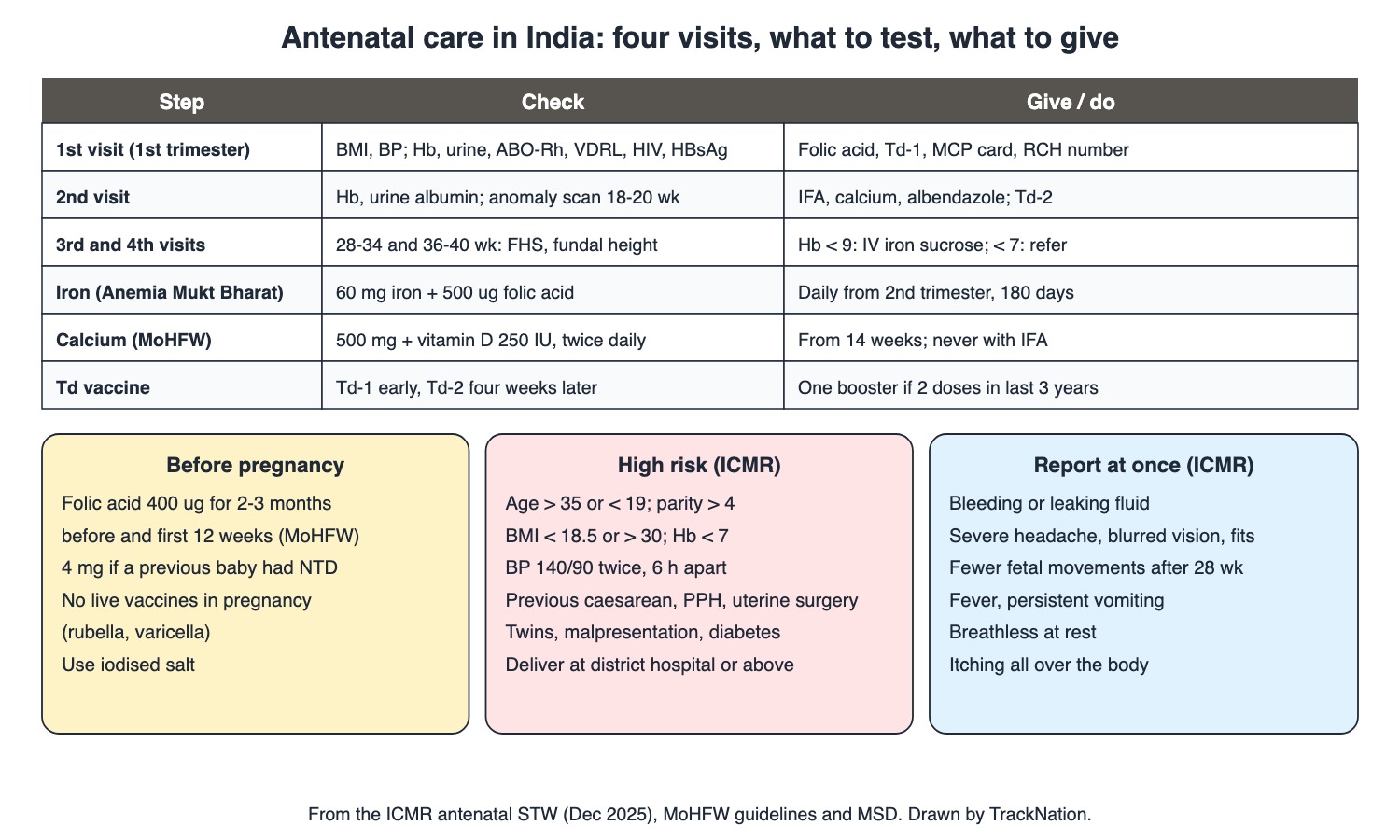
Antenatal visits, supplements, high-risk factors and danger signs. Drawn by TrackNation.
Preconception Care (MoHFW, MSD)
Folic acid 400 µg daily for 2–3 months before conception and through the first 12 weeks (MoHFW) cuts neural tube defects; 4 mg daily if a previous fetus or infant had an NTD (MSD).
Live vaccines (rubella, varicella) are not given in pregnancy — vaccinate before. Use iodised salt. Avoid cat litter (toxoplasmosis), hot tubs and sick contacts.
The Antenatal Visits (ICMR STW 2025, MoHFW)
MoHFW minimum: 4 visits — within 12 weeks (register), 14–26, 28–34 and 36 weeks to term; more if needed. Hb, urine sugar and protein, BP and weight at every visit. About 15% of pregnancies develop complications. PMSMA adds a specialist check on the 9th of each month.
First visit (preferably first trimester): history (medical, obstetric, consanguinity, tobacco), BMI, BP, pallor, breast, systemic and abdominal exam. Essential tests: Hb, urine, ABO and Rh; desirable: VDRL/RPR, HIV, HBsAg, DIPSI; TSH if high risk; optional aneuploidy screening. Do: EDD, MCP card, RCH number, folic acid, Td-1.
Second visit: Hb, urine albumin; level II scan at 18–20 weeks for major anomalies; repeat DIPSI after 24 weeks. IFA (one daily, two if Hb <11), calcium, albendazole 400 mg once, Td-2 ≥4 weeks after Td-1, birth preparedness.
Third (28–34) and fourth (36–40 weeks): FHS, fundal height, Hb, urine albumin, optional growth scan. Hb <9 or poor compliance → IV iron sucrose (≤200 mg a dose, ≤3 times a week); Hb <7 → refer; refer if no Hb rise after 4 weeks of oral iron or fundal height differs from dates by >4 weeks.
Supplements and Vaccine (MoHFW, AMB)
IFA (Anemia Mukt Bharat): 60 mg elemental iron + 500 µg folic acid daily from the second trimester, at least 180 days, and 180 days after delivery. (The 2010 guideline used 100 mg for 100 days — since replaced.) Anaemia in pregnancy: Hb <11; severe <7.
Calcium: universal, to prevent hypertensive disorders — 500 mg calcium + 250 IU vitamin D3 twice daily with meals from 14 weeks to 6 months postpartum. Never with IFA (calcium blocks iron absorption); not on an empty stomach.
Td: Td-1 early in pregnancy, Td-2 four weeks later; a single booster (Td-B) if she had 2 doses in a pregnancy within the last 3 years.
Diet: no extra calories in the first trimester; ~340 kcal/day in the second and ~450 kcal/day in the third (MSD).
High-Risk Pregnancy and Danger Signs (ICMR)
High risk: medical illness, previous caesarean or uterine surgery, past PPH or bad obstetric history, age >35 or <19, parity >4, BMI <18.5 or >30, Hb <7, BP >140/90 twice 6 hours apart, APH, GDM, twins, malpresentation at term. Deliver (and preferably follow) at a district hospital or medical college.
Danger signals to come in for: fever, persistent vomiting, abnormal discharge, breathlessness at rest, vaginal bleeding, leaking fluid, reduced fetal movements after 28 weeks, severe headache, blurred vision or fits, burning or scanty urine, generalised itching.
Birth preparedness: facility, support person and birth companion, emergency transport and number, blood donors, plans for early exclusive breastfeeding and postpartum contraception.
Traps the Examiner Sets
Calcium and IFA are taken at different times.
Folic acid must start before conception to prevent NTDs.
Rubella vaccine is never given in pregnancy.
Current IFA dose is 60 mg iron for 180 days (Anemia Mukt Bharat).
Memory Hooks & Shortcuts
Shortcuts to lock in this article's numbers and lists. Each one only re-packages facts proven above.
🧠 'Folate before the date' — start before conception — folic acid
🧠 'Iron and calcium are enemies at the table' — take apart — supplements
🧠 AMB IFA: '60-500-180' — IFA
🧠 High-risk extremes: 'under 19, over 35, over 4 babies' — high risk
🧠 ICMR iron ladder: 'Below 9 — vein; below 7 — refer' — anaemia
Rapid-Revision Cards
Folic acid
400 µg, 2–3 mo before to 12 wk.
Previous NTD
4 mg daily.
Live vaccines
Not in pregnancy.
ANC visits
≤12, 14–26, 28–34, 36–term.
Every visit
Hb, urine, BP, weight.
1st visit tests
Hb, urine, ABO-Rh; VDRL, HIV, HBsAg.
Anomaly scan
18–20 weeks.
IFA (AMB)
60 mg + 500 µg; 180 days.
IFA if Hb <11
Twice daily.
Hb <9 / poor compliance
IV iron sucrose.
Hb <7
Refer.
Calcium
500 mg + D3 BD from 14 wk.
Calcium + IFA
Never together.
Albendazole
400 mg once, 2nd trimester.
Td
Td-1, Td-2 at 4 wk; booster if <3 y.
High-risk age
>35 or <19; parity >4.
High-risk BMI
<18.5 or >30.
High-risk BP
>140/90 twice, 6 h apart.
Danger: headache
Blurred vision, fits.
Danger: movements
Reduced after 28 wk.
FH discrepancy
>4 weeks: refer.
Sources
Facts in this article were checked against these documents.
Standard Treatment Workflow: Ante-natal Management of Normal Pregnancy — ICMR / Department of Health Research, Dec 2025
Guidelines for Antenatal Care and Skilled Attendance at Birth by ANMs/LHVs/SNs — Ministry of Health & Family Welfare, 2010
National Guidelines for Calcium Supplementation during Pregnancy and Lactation; Td vaccine operational guidelines; Anemia Mukt Bharat Operational Guidelines — Ministry of Health & Family Welfare, 2014–2018
MSD Manual Professional: Evaluation of the Obstetric Patient — Merck & Co. (MSD Manuals), 2025 (link)
Competency Based Undergraduate Curriculum, Vol III: Obstetrics & Gynaecology (OG5, OG8) — National Medical Commission, 2024
Test Yourself: Practice Questions
Thirty questions in NEET PG style, most of them clinical vignettes.
Practice Questions (NEET PG pattern)
Original questions written in the style of the exam: +4 for a correct answer, −1 for a wrong one. Every answer was checked against the sources listed above. NEET PG papers are not published by NBEMS, so these are not past-paper questions.
Q1. A woman planning pregnancy should take folic acid
(a) 400 µg daily from 2–3 months before conception to 12 weeks
(b) only in the third trimester
(c) only after the anomaly scan
(d) 5 mg weekly
Show answer
Answer: (a) — MoHFW.
Q2. A woman whose previous baby had anencephaly plans another pregnancy. Folic acid dose:
(a) none
(b) 1 mg weekly
(c) 4 mg daily
(d) 400 µg daily
Show answer
Answer: (c) — High-risk dose.
Q3. Which vaccine must NOT be given during pregnancy?
(a) rubella
(b) hepatitis B
(c) influenza
(d) Td
Show answer
Answer: (a) — Live vaccine.
Q4. The MoHFW minimum ANC schedule's first visit should be
(a) within 12 weeks, as soon as pregnancy is suspected
(b) only when in labour
(c) at 28 weeks
(d) at 20 weeks
Show answer
Answer: (a) — Registration.
Q5. The third MoHFW antenatal visit is scheduled at
(a) 8–10 weeks
(b) 14–26 weeks
(c) 28–34 weeks
(d) 36 weeks to term
Show answer
Answer: (c) — Fourth: 36 to term.
Q6. Per MoHFW, at every antenatal visit the ANM must check
(a) HIV
(b) ultrasound
(c) TSH
(d) Hb, urine sugar and protein, BP and weight
Show answer
Answer: (d) — Every visit.
Q7. Among ICMR's essential first-visit tests is
(a) ABO and Rh grouping
(b) Doppler
(c) glucose challenge with 50 g
(d) quadruple test
Show answer
Answer: (a) — Also Hb, urine.
Q8. The ICMR STW times the level II anomaly scan at
(a) 11–13 weeks only
(b) 28 weeks
(c) 36 weeks
(d) 18–20 weeks
Show answer
Answer: (d) — Gross malformations.
Q9. Under Anemia Mukt Bharat, the prophylactic IFA tablet for a pregnant woman contains
(a) 60 mg elemental iron + 500 µg folic acid
(b) 200 mg iron
(c) 100 mg iron + 5 mg folic acid
(d) 20 mg iron + 100 µg folic acid
Show answer
Answer: (a) — Red tablet.
Q10. Prophylactic IFA in pregnancy should continue for at least
(a) 30 days
(b) 100 days only
(c) 180 days in pregnancy and 180 days postpartum
(d) until the first trimester ends
Show answer
Answer: (c) — Starts second trimester.
Q11. Per ICMR, a pregnant woman with Hb 10.2 g/dL should take IFA
(a) twice daily
(b) once daily
(c) not at all
(d) weekly
Show answer
Answer: (a) — One if Hb >11.
Q12. A woman at 30 weeks has Hb 8.5 g/dL and cannot tolerate oral iron. Per ICMR give
(a) nothing
(b) double oral dose
(c) blood transfusion routinely
(d) parenteral iron sucrose
Show answer
Answer: (d) — ≤200 mg a dose.
Q13. A pregnant woman with Hb 6.5 g/dL should be
(a) given calcium
(b) given oral IFA once daily
(c) referred to a higher centre
(d) reassured
Show answer
Answer: (c) — Severe anaemia.
Q14. MoHFW calcium supplementation in pregnancy is
(a) with IFA together
(b) 500 mg calcium + 250 IU vitamin D3 twice daily from 14 weeks
(c) 1 g once at night from conception
(d) only in the third trimester
Show answer
Answer: (b) — Until 6 months postpartum.
Q15. Calcium and IFA tablets should be taken at different times because
(a) iron inhibits calcium
(b) calcium inhibits iron absorption
(c) both cause vomiting together
(d) they react chemically
Show answer
Answer: (b) — MoHFW.
Q16. The main reason for universal calcium supplementation in Indian pregnancies is to prevent
(a) anaemia
(b) hypertensive disorders/pre-eclampsia
(c) osteoporosis
(d) neural tube defects
Show answer
Answer: (b) — MoHFW preventive strategy.
Q17. Albendazole in pregnancy per ICMR is given as
(a) a single 400 mg dose in the second trimester
(b) never
(c) monthly
(d) daily for 3 days in the first trimester
Show answer
Answer: (a) — After first trimester.
Q18. A primigravida receives Td-1 at registration. Td-2 is due
(a) at least 4 weeks later
(b) after delivery
(c) at 36 weeks only
(d) next pregnancy
Show answer
Answer: (a) — Td guidelines.
Q19. A woman had 2 Td doses in a pregnancy 2 years ago. Now pregnant again, she needs
(a) two Td doses
(b) three doses
(c) one Td booster
(d) no Td
Show answer
Answer: (c) — Within 3 years.
Q20. Per ICMR, which woman has a high-risk pregnancy?
(a) a 22-year-old with BMI 22
(b) a 37-year-old
(c) a 28-year-old with Hb 11.5
(d) a 25-year-old second gravida with normal history
Show answer
Answer: (b) — Age >35 or <19.
Q21. ICMR defines a high-risk BP as
(a) above 140/90 on two occasions 6 hours apart
(b) above 160/110 only
(c) diastolic above 80
(d) above 120/80 once
Show answer
Answer: (a) — Hypertensive disorder.
Q22. Per ICMR, a BMI that marks a high-risk pregnancy is
(a) below 18.5 or above 30
(b) 25–27
(c) only above 40
(d) 22–25
Show answer
Answer: (a) — Malnourished.
Q23. A woman with a previous caesarean section should deliver
(a) at home with an ASHA
(b) at a sub-centre
(c) anywhere
(d) at a district hospital or medical college
Show answer
Answer: (d) — High risk.
Q24. Which symptom should prompt a pregnant woman to report immediately?
(a) severe headache with blurred vision
(b) mild ankle swelling in the evening
(c) occasional heartburn
(d) increased appetite
Show answer
Answer: (a) — ICMR danger signal.
Q25. At 32 weeks a woman notices her baby moving much less. ICMR advice:
(a) report to a health facility at once
(b) wait a week
(c) take extra IFA
(d) drink cold water and ignore
Show answer
Answer: (a) — Danger signal.
Q26. Generalised itching in late pregnancy is listed by ICMR as
(a) a sign of good fetal health
(b) an allergy needing antihistamines only
(c) a danger signal to report
(d) normal
Show answer
Answer: (c) — Report to a facility.
Q27. A fundal height 5 weeks less than the gestational age by dates should be
(a) treated with calcium
(b) ignored
(c) referred to a higher centre
(d) rechecked next year
Show answer
Answer: (c) — Discrepancy >4 weeks.
Q28. Extra daily energy needed in the third trimester (normal BMI) is about
(a) 0 kcal
(b) 100 kcal
(c) 1000 kcal
(d) 450 kcal
Show answer
Answer: (d) — Second trimester ~340.
Q29. Birth preparedness counselling includes arranging
(a) formula feeds
(b) a home delivery kit only
(c) transport, a birth companion and blood donors
(d) elective caesarean
Show answer
Answer: (c) — ICMR.
Q30. Thyroid (TSH) testing at the first visit, per ICMR, is done in
(a) no woman
(b) every woman
(c) only after 36 weeks
(d) high-risk women (bad obstetric history, goitre, obesity, iodine-deficient areas)
Show answer
Answer: (d) — Targeted.
Active Recall
From memory: outline preconception folic acid and vaccine advice, list the antenatal visit schedule with tests at each ICMR visit, give the IFA, calcium, albendazole and Td regimens, state when to give IV iron or refer, and list ICMR high-risk criteria and danger signals.