Paediatric Heart Disease for NEET PG: Newborn Pulse-Oximetry Screen, VSD, ASD, PDA, TOF, TGA, Coarctation, Heart Failure, Rheumatic Fever and Kawasaki
Start Here
🎯 Exam priority: Very high. Expect: pulse-oximetry pass/fail values, murmur location by defect, fixed split S2, continuous murmur, TOF's four parts and X-ray, tet spell drugs, egg-on-a-string, femoral pulses in coarctation, PDA closure drugs, Jones criteria and prophylaxis durations, Kawasaki IVIG dose and timing.
CBME mapping: PE23. Fact-checked against ICMR Standard Treatment Workflows (Critical Heart Disease in the Newborn, Pediatric Heart Failure, Acute Rheumatic Fever, 2024) and the MSD Manual.
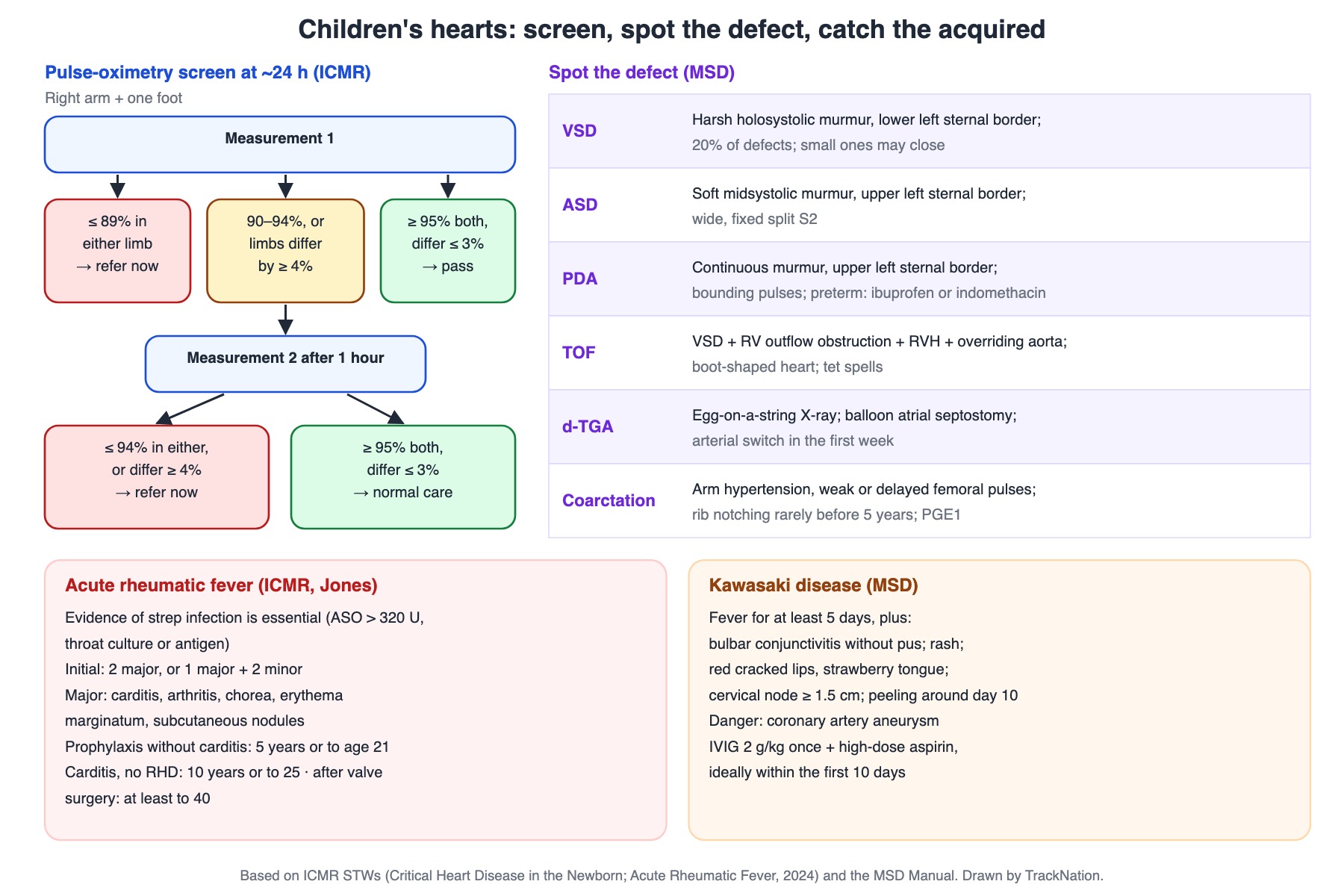
Pulse-oximetry screen, defect clues, rheumatic fever and Kawasaki disease. Drawn by TrackNation.
Newborn Screening and Critical CHD (ICMR)
Universal pulse-oximetry screening: right arm and one foot at about 24 hours. ≤ 89% in either → refer at once. 90–94% or a difference ≥ 4% → repeat after 1 hour; still ≤ 94% or ≥ 4% apart → refer. ≥ 95% in both and ≤ 3% apart → pass.
Duct-dependent lesions: systemic (critical AS, HLHS, interrupted arch, critical coarctation) present with shock; pulmonary (pulmonary atresia, critical PS, TOF with severe PS, Ebstein) with severe cyanosis. Normal newborn heart rate: 100–180 awake, 80–160 asleep.
Heart failure in infants: tachypnoea, tachycardia, tender hepatomegaly, sweating and breathlessness on feeds. ICMR classes I–IV (class II = mild tachypnoea/sweating on feeds without growth failure; IV = symptoms at rest with growth failure). Causes by age: duct-dependent lesions in week 1; large VSD/PDA at 3–12 months; RHD and myocarditis later. Most have a treatable cause.
Acyanotic Shunts: VSD, ASD, PDA (MSD)
VSD: the commonest defect after bicuspid aortic valve (20%), mostly perimembranous (70–80%); harsh holosystolic murmur at the lower left sternal border; many close in infancy.
ASD: soft midsystolic murmur at the upper left sternal border with wide, fixed splitting of S2; ostium primum and sinus venosus defects never close spontaneously.
PDA: continuous murmur at the upper left sternal border with bounding pulses. The duct closes as PaO₂ rises and prostaglandins fall; in preterms try ibuprofen or indomethacin (not effective at term).
Untreated large shunts can raise pulmonary resistance until the shunt reverses — Eisenmenger syndrome, which is irreversible and rules out repair of the original defect.
Cyanotic and Obstructive: TOF, TGA, Coarctation (MSD)
Tetralogy of Fallot: VSD + RV outflow obstruction/pulmonary stenosis + RV hypertrophy + overriding aorta. X-ray: boot-shaped heart with oligaemic lungs; ECG RVH with right axis. Tet spells (months to 2 years), triggered by crying or straining: treat with morphine, phenylephrine and beta-blockers.
d-TGA: aorta from the RV, pulmonary artery from the LV — parallel circulations; X-ray egg-on-a-string; balloon atrial septostomy to mix; arterial switch (Jatene) in the first week.
Coarctation: arm hypertension with weak, delayed femoral pulses; check BP in all four limbs; rib notching (3rd–8th ribs) seldom before 5 years; critical neonatal coarctation is stabilised with prostaglandin E1.
Rheumatic Fever (ICMR, 2024)
Essential: evidence of streptococcal infection (throat culture/antigen or ASO > 320 U). Initial ARF: 2 major or 1 major + 2 minor; recurrence in established RHD: 2 minor suffice.
Major: carditis (clinical or subclinical), arthritis (polyarthritis in low-risk; mono- or polyarthritis or polyarthralgia in moderate/high-risk populations), chorea, erythema marginatum, subcutaneous nodules. Minor: fever, raised ESR/CRP, prolonged PR, arthralgia.
Treatment: eradicate strep (benzathine penicillin 6 lakh U ≤ 27 kg, 12 lakh U > 27 kg); arthritis or mild carditis — aspirin 2–4 weeks; moderate/severe carditis — prednisolone 2 mg/kg/day for 8–12 weeks; chorea — carbamazepine, valproate or haloperidol.
Secondary prophylaxis: no carditis — 5 years or until 21; carditis without RHD — 10 years or until 25; after valve surgery — at least until 40, preferably lifelong (whichever is longer).
Kawasaki Disease (MSD)
Fever ≥ 5 days with bulbar conjunctivitis without pus, polymorphous rash, red cracked lips and strawberry tongue, a cervical node ≥ 1.5 cm, and peeling of fingertips around day 10.
The danger is coronary artery aneurysm (giant > 8 mm carries the highest risk). Treat with IVIG 2 g/kg once + high-dose aspirin, ideally within the first 10 days.
Traps the Examiner Sets
Pulse-ox pass needs ≥ 95% in both limbs and a gap ≤ 3%.
Fixed split S2 = ASD; continuous murmur = PDA; holosystolic LLSB = VSD.
Boot = TOF; egg on a string = TGA; rib notching = coarctation (rare under 5).
Indomethacin/ibuprofen close a PDA only in preterms; PGE1 keeps a duct open.
Jones: evidence of strep infection is essential; in moderate/high-risk populations monoarthritis can be a major criterion.
Memory Hooks & Shortcuts
Shortcuts to lock in this article's numbers and lists. Each one only re-packages facts proven above.
🧠 Pulse-ox '89 out, 95 in, gap 3' — screening
🧠 Murmur map: 'VSD Low and Long, ASD Split and Stuck, PDA Never Stops' — murmurs
🧠 X-ray shapes: Boot (TOF), Egg (TGA), Notches (coarctation, after 5) — X-rays
🧠 Prophylaxis '5-21, 10-25, 40+' — rheumatic fever
🧠 Kawasaki 'CRASH and burn': Conjunctivitis, Rash, Adenopathy, Strawberry tongue, Hands peel — with 5 days of fever — Kawasaki
Rapid-Revision Cards
Pulse-ox fail
≤ 89% either limb → refer.
Pulse-ox repeat
90–94% or gap ≥ 4% → recheck in 1 h.
Pulse-ox pass
≥ 95% both, gap ≤ 3%.
Infant HF
Tachypnoea, tachycardia, tender liver, feed sweating.
VSD
Holosystolic LLSB; 20%; may close.
ASD
Fixed split S2; primum never closes.
PDA
Continuous ULSB murmur; bounding pulses.
PDA closure
Ibuprofen/indomethacin in preterms.
Eisenmenger
Shunt reversal; irreversible.
TOF
VSD + PS/RVOTO + RVH + overriding aorta.
TOF X-ray
Boot-shaped, oligaemic.
Tet spell
Morphine, phenylephrine, beta-blocker.
d-TGA
Egg on a string; arterial switch week 1.
Coarctation
Arm HTN, weak femorals; notching > 5 y; PGE1.
Jones initial
2 major or 1 major + 2 minor + strep evidence.
Jones recurrence in RHD
2 minor.
ASO
> 320 U.
Carditis Rx
Prednisolone 2 mg/kg × 8–12 wk.
Prophylaxis
5 y/21 · 10 y/25 · ≥ 40 after surgery.
Kawasaki
Fever ≥ 5 d; node ≥ 1.5 cm; peeling day 10.
Kawasaki Rx
IVIG 2 g/kg + aspirin within 10 days.
Sources
Facts in this article were checked against these documents.
Standard Treatment Workflows: Critical Heart Disease in the Newborn; Pediatric Heart Failure; Acute Rheumatic Fever — ICMR / Department of Health Research, MoHFW, 2024
MSD Manual Professional: VSD; ASD; PDA; Tetralogy of Fallot; Transposition of the Great Arteries; Coarctation of the Aorta; Eisenmenger Syndrome; Kawasaki Disease — Merck & Co., 2025–2026 (link)
Test Yourself: Practice Questions
Thirty questions in NEET PG style, many of them bedside scenarios.
Practice Questions (NEET PG pattern)
Original questions written in the style of the exam: +4 for a correct answer, −1 for a wrong one. Every answer was checked against the sources listed above. NEET PG papers are not published by NBEMS, so these are not past-paper questions.
Q1. Newborn pulse-oximetry screening (ICMR) is done on
(a) the right arm and one foot at about 24 hours
(b) the left arm only at 6 hours
(c) the ear at discharge
(d) both feet at birth
Show answer
Answer: (a) — ICMR.
Q2. A screened newborn has 88% in the foot. Action?
(a) repeat at 1 week
(b) refer for immediate assessment
(c) repeat in 1 hour
(d) pass
Show answer
Answer: (b) — ≤ 89% = fail.
Q3. Right hand 97%, foot 92%. Action?
(a) start antibiotics
(b) repeat after 1 hour
(c) discharge
(d) pass
Show answer
Answer: (b) — 90–94% or ≥ 4% gap.
Q4. A screen is passed when SpO₂ is ≥ 95% in both limbs and the difference is
(a) any
(b) 10% or less
(c) 3% or less
(d) 5% or less
Show answer
Answer: (c) — ICMR.
Q5. A sign of heart failure in an infant is
(a) tender hepatomegaly with sweating on feeds
(b) splenomegaly
(c) polyuria
(d) bradycardia only
Show answer
Answer: (a) — ICMR.
Q6. Heart failure from a large VSD typically presents at
(a) 3–12 months
(b) adolescence
(c) the first day
(d) 5 years
Show answer
Answer: (a) — Post-tricuspid shunts.
Q7. VSD (MSD) is the commonest congenital heart anomaly after
(a) ASD
(b) PDA
(c) TOF
(d) bicuspid aortic valve
Show answer
Answer: (d) — 20% of defects.
Q8. The murmur of a VSD is
(a) midsystolic at the apex
(b) harsh holosystolic at the lower left sternal border
(c) diastolic rumble
(d) continuous at the upper left sternal border
Show answer
Answer: (b) — MSD.
Q9. Wide fixed splitting of S2 suggests
(a) atrial septal defect
(b) coarctation
(c) PDA
(d) VSD
Show answer
Answer: (a) — MSD.
Q10. Which ASD never closes spontaneously?
(a) stretched PFO
(b) ostium primum
(c) central 4 mm secundum
(d) small secundum < 3 mm
Show answer
Answer: (b) — Also sinus venosus.
Q11. A continuous murmur at the upper left sternal border with bounding pulses suggests
(a) PDA
(b) ASD
(c) TOF
(d) VSD
Show answer
Answer: (a) — MSD.
Q12. Drug used to close a significant PDA in a preterm is
(a) propranolol
(b) ibuprofen or indomethacin
(c) prostaglandin E1
(d) digoxin
Show answer
Answer: (b) — Not effective at term.
Q13. Which is NOT one of the four features of tetralogy of Fallot?
(a) VSD
(b) overriding aorta
(c) atrial septal defect
(d) RV outflow obstruction
Show answer
Answer: (c) — Fourth: RVH.
Q14. The chest X-ray in tetralogy shows
(a) rib notching
(b) snowman heart
(c) boot-shaped heart with oligaemic lungs
(d) egg on a string
Show answer
Answer: (c) — MSD.
Q15. A 1-year-old with TOF becomes deeply cyanosed while crying. Drugs used include
(a) atropine
(b) adenosine
(c) morphine, phenylephrine and beta-blockers
(d) digoxin and furosemide
Show answer
Answer: (c) — Tet spell.
Q16. The classic X-ray of d-TGA is
(a) water-bottle
(b) figure of 3
(c) egg on a string
(d) boot-shaped
Show answer
Answer: (c) — Narrow mediastinum.
Q17. Definitive repair of d-TGA is
(a) arterial switch in the first week
(b) balloon valvotomy
(c) Fontan at 3 years
(d) Blalock–Taussig shunt at 1 year
Show answer
Answer: (a) — Jatene.
Q18. A hypertensive child has weak, delayed femoral pulses. Most likely
(a) coarctation of the aorta
(b) ASD
(c) PDA
(d) renal artery stenosis
Show answer
Answer: (a) — Check 4-limb BP.
Q19. Rib notching in coarctation is seldom seen before age
(a) 6 months
(b) 1 month
(c) 15 years
(d) 5 years
Show answer
Answer: (d) — 3rd–8th ribs.
Q20. A newborn in shock with critical coarctation is stabilised with
(a) indomethacin
(b) prostaglandin E1 infusion
(c) IV fluids only
(d) propranolol
Show answer
Answer: (b) — Keeps duct open.
Q21. Once Eisenmenger syndrome develops, the original defect
(a) needs only medicines
(b) closes by itself
(c) cannot be primarily corrected
(d) is cured by oxygen
Show answer
Answer: (c) — Irreversible.
Q22. For an initial episode of ARF, the Jones criteria need
(a) 3 minor only
(b) 2 major or 1 major + 2 minor, with evidence of strep infection
(c) 1 major only
(d) positive ASO only
Show answer
Answer: (b) — ICMR.
Q23. In a patient with established RHD, recurrent ARF can be diagnosed with
(a) carditis alone
(b) 3 major
(c) 2 major only
(d) 2 minor criteria
Show answer
Answer: (d) — ICMR.
Q24. An ASO titre counted as elevated in the ICMR workflow is above
(a) 1000 U
(b) 200 U
(c) 100 U
(d) 320 U
Show answer
Answer: (d) — Essential criterion.
Q25. Moderate-to-severe rheumatic carditis is treated with
(a) aspirin for 2 weeks
(b) methotrexate
(c) prednisolone 2 mg/kg/day for 8–12 weeks
(d) IVIG
Show answer
Answer: (c) — ICMR.
Q26. Secondary prophylaxis after ARF without carditis lasts
(a) 5 years after the last episode or until 21, whichever is longer
(b) 1 year
(c) lifelong always
(d) 10 years or until 25
Show answer
Answer: (a) — ICMR.
Q27. A child with rheumatic carditis but no residual RHD needs prophylaxis for
(a) 10 years or until 25, whichever is longer
(b) 5 years
(c) 6 months
(d) until 40
Show answer
Answer: (a) — ICMR.
Q28. Kawasaki disease requires fever lasting at least
(a) 14 days
(b) 1 day
(c) 5 days
(d) 2 days
Show answer
Answer: (c) — MSD.
Q29. The most feared complication of Kawasaki disease is
(a) mitral stenosis
(b) renal failure
(c) pericardial calcification
(d) coronary artery aneurysm
Show answer
Answer: (d) — MSD.
Q30. Kawasaki disease is treated with
(a) penicillin
(b) steroids alone
(c) IVIG 2 g/kg once plus high-dose aspirin, ideally within 10 days
(d) IVIG 400 mg/kg for 5 days only
Show answer
Answer: (c) — MSD.
Active Recall
From memory: give the newborn pulse-oximetry rules, signs and causes of infant heart failure, the murmur and X-ray of VSD, ASD, PDA, TOF, TGA and coarctation, tet spell treatment, Eisenmenger, the Jones criteria with treatment and prophylaxis durations, and Kawasaki features and treatment.