Partition and the Integration of Princely States for UPSC GS1: Nation-building, 565 States, Junagadh, Hyderabad, Manipur and Early Consolidation
Three Challenges and Partition
🎯 Exam priority: High-yield (Mains GS1). The GS1 syllabus names "post-independence consolidation and reorganization within the country". It was asked in 2021 (administrative and socio-cultural problems in integrating the princely states) and 2025 (India's consolidation in polity, economy, education and international relations).
Three challenges at independence
Challenge | What it meant |
Nation-building | Unity and integrity of a diverse country, and integration of its territory |
Democracy | Building democratic practice on the Constitution's rights and universal adult franchise |
Development | Well-being of the entire society, not only some sections, with equality and protection for disadvantaged groups |
Partition: displacement and rehabilitation
On 14-15 August 1947 two nation-states, India and Pakistan, came into existence. The Muslim League's two-nation theory held that India had two peoples, Hindus and Muslims; the Congress opposed it.
Partition forced about 80 lakh people to migrate across the new border, and five to ten lakh were killed in related violence. Families, property, administrative services and even assets had to be divided.
The most intractable problem was that of minorities on both sides. Partition's violence challenged the very idea of a secular India, which the leaders chose to uphold.
Mahatma Gandhi, working for communal peace, was assassinated by Nathuram Godse on 30 January 1948.
Integrating the Princely States
The integration of princely states
The problem: with the lapse of British paramountcy, 565 princely states became legally free to join India or Pakistan or stay independent, a decision left to rulers, not people. Travancore declared independence; the Nizam of Hyderabad followed; the Nawab of Bhopal resisted. India risked splintering into many small countries.
The approach of Sardar Patel, Deputy Prime Minister and Home Minister, rested on three considerations: most people in the princely states wanted to join India; the government would be flexible in giving autonomy to some regions; and, after partition, the integrity of the nation's boundaries was supreme.
The method: peaceful negotiation brought almost all states in before 15 August 1947 by signing the Instrument of Accession; later, merger agreements and the consolidation of many small units (Saurashtra alone had 14 big and 119 small states).
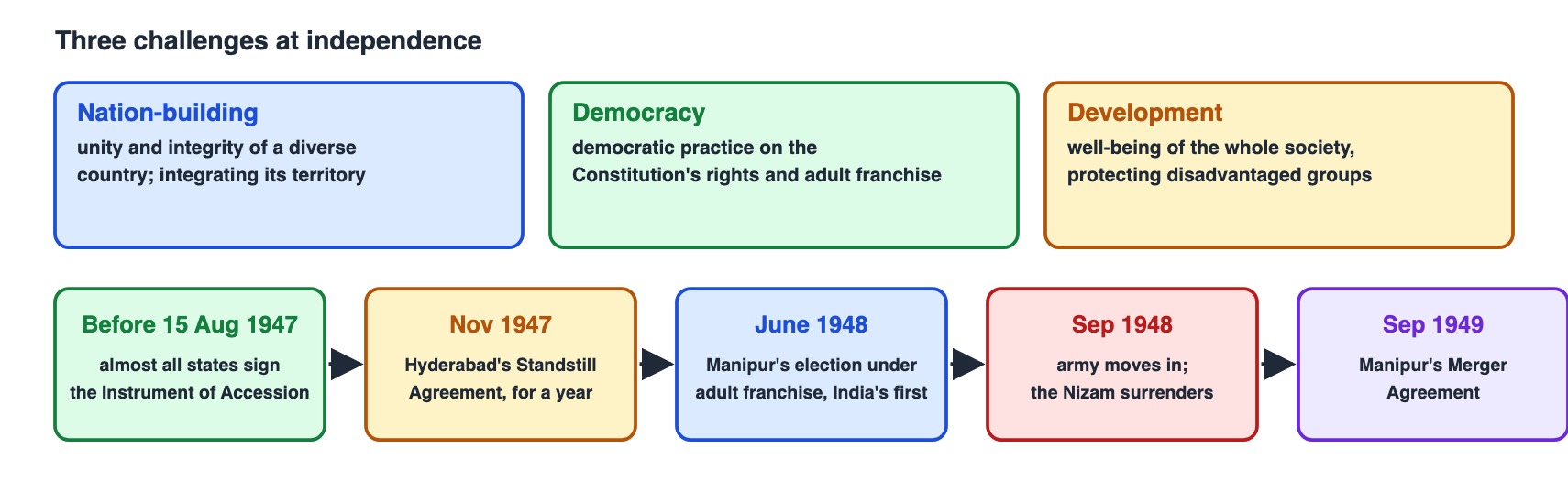
Three challenges at independence, and how the princely states were integrated.
Difficult case | How it was resolved |
Junagadh | A plebiscite confirmed the people's wish to join India |
Hyderabad | The Nizam sought independence; a Standstill Agreement (November 1947, for a year); his Razakar militia unleashed atrocities; the Indian army moved in in September 1948 and the Nizam surrendered |
Manipur | The Maharaja, Bodhachandra Singh, acceded on assurance of internal autonomy; elections in June 1948 (the first in India under universal adult franchise) made it a constitutional monarchy; sharp differences in its Legislative Assembly over merger; a Merger Agreement was signed in September 1949 |
Kashmir | Covered in the chapter on regional aspirations (article 08) |
Problems of Integration and Early Consolidation
Problems in integration (2021)
Administrative issues | Socio-cultural problems |
Merging hundreds of units with different laws, revenue systems, armies and services | Princes' loss of power and status (their privy purses, promised at accession, were removed by constitutional amendment after the 1971 election, article 06) |
Rulers bargaining for independence or special terms (Travancore, Hyderabad, Bhopal) | Communal violence in Hyderabad (the Razakars) amid partition tensions |
Military action where negotiation failed | Distinct identities and fear of losing autonomy (Manipur) |
Drawing new provincial boundaries | Linguistic and regional aspirations that soon demanded reorganisation (article 02) |
Consolidation in the early years (2025)
Polity: integration of the princely states; the Constitution of 1950; the first general election of 1952 (article 03); linguistic reorganisation of states (article 02).
Economy: the planning model and the Planning Commission (article 04).
Education: building schools, universities and scientific institutions to create the skills that development required (illustrate with institutions of your choice).
International relations: non-alignment and the Panchsheel principles (article 05).
Write the 2025 answer as a map of these four strands, each with one or two concrete examples, and conclude that India consolidated as a democratic, secular and federal union despite partition's trauma.
Further Reading
PIB press releases, ministry websites and annual reports, the Gazette of India, MEA and UN documents and the official sources named in each note — the primary sources behind every fact above.
Test Yourself: Practice Questions & PYQs
12 practice questions, then the GS1 questions on integration and consolidation.
Practice Questions
Q1. According to NCERT, how many people were forced to migrate across the new border by Partition?
(a) About 2 crore
(b) About 5 lakh
(c) About 80 lakh
(d) About 10 lakh
Show answer
Answer: (c) — Between five and ten lakh were killed.
Q2. How many princely states became legally independent when British paramountcy lapsed?
(a) 118
(b) 29
(c) 362
(d) 565
Show answer
Answer: (d) — Rulers, not people, were to decide their future.
Q3. The document by which most princely states joined India was the
(a) Instrument of Accession
(b) Treaty of Union
(c) Merger Agreement
(d) Standstill Agreement
Show answer
Answer: (a) — Signed before 15 August 1947 in most cases.
Q4. Which princely state's accession was resolved by a plebiscite?
(a) Hyderabad
(b) Travancore
(c) Junagadh
(d) Manipur
Show answer
Answer: (c) — The people confirmed their wish to join India.
Q5. The Nizam of Hyderabad's para-military force was called
(a) the Khaksars
(b) the Ikhwan
(c) the Razakars
(d) the Red Shirts
Show answer
Answer: (c) — The Indian army moved in in September 1948.
Q6. Which part of India first held an election under universal adult franchise?
(a) Delhi
(b) Hyderabad
(c) Kerala
(d) Manipur (June 1948)
Show answer
Answer: (d) — It then became a constitutional monarchy.
Q7. The Manipur Merger Agreement was signed in
(a) January 1950
(b) September 1949
(c) June 1948
(d) August 1947
Show answer
Answer: (b) — It was signed without consulting the elected Assembly.
Q8. Consider the following statements:
1. Patel's approach included flexibility in giving autonomy to some regions.
2. It treated the integrity of territorial boundaries as supreme.
3. It left the decision to the princes alone with no pressure.
Which of the statements given above are correct?
(a) 1 and 2 only
(b) 2 and 3 only
(c) 1 and 3 only
(d) 1, 2 and 3
Show answer
Answer: (a) — 1 and 2 are correct. Negotiation was backed by firmness, and by force in Hyderabad.
Q9. Which ruler announced that his state had decided on independence?
(a) The Maharaja of Manipur
(b) The ruler of Travancore
(c) The Nawab of Junagadh only
(d) The Maharaja of Mysore
Show answer
Answer: (b) — The Nizam of Hyderabad made a similar announcement the next day.
Q10. Mahatma Gandhi was assassinated on
(a) 15 August 1947
(b) 30 January 1948
(c) 2 October 1948
(d) 26 January 1950
Show answer
Answer: (b) — By Nathuram Godse, during his evening prayer in Delhi.
Q11. The three challenges of independent India named by NCERT are
(a) industry, agriculture and trade
(b) war, famine and partition
(c) nation-building, democracy and development
(d) language, religion and caste
Show answer
Answer: (c) — This book's first three chapters follow them.
Q12. Who negotiated the integration of the princely states as Deputy Prime Minister and Home Minister?
(a) Maulana Azad
(b) B.R. Ambedkar
(c) Sardar Vallabhbhai Patel
(d) Jawaharlal Nehru
Show answer
Answer: (c) — He combined negotiation with firmness.
Mains Practice Questions
Use these to frame full-length answers. You don't have to answer one exactly — they show the angles UPSC tests, so let them guide which points you cover.
Assess the administrative issues and socio-cultural problems in the integration of the princely states.
Trace India's consolidation in the early years in polity, economy, education and international relations.
How did Partition shape the challenges of nation-building?
UPSC Mains — Previous Years’ Questions on this topic (last 10 years)
These are the actual GS Mains questions UPSC has asked on this theme — real proof of how, and when, it is tested. Try to write a full answer to each.
2021 (GS-I): Assess the main administrative issues and socio-cultural problems in the integration process of Indian Princely States.
2025 (GS-I): Trace India's consolidation process during early phase of independence in terms of polity, economy, education and international relations.