The Era of One-party Dominance for UPSC GS1: The First General Election, the Congress System, Kerala 1957 and the Opposition
The First General Election and Congress Dominance
🎯 Exam priority: Important (Mains GS1). The second challenge after independence was to build democracy. This chapter of the NCERT book covers the first general elections, the Congress's dominance from 1952 to the 1960s and the role of the opposition, essential for the "polity" strand of the 2025 question on early consolidation (article 01).
The first general election (1951-1952)
The Election Commission was set up in January 1950; Sukumar Sen was the first Chief Election Commissioner.
Scale: 17 crore eligible voters electing about 3,200 MLAs and 489 Lok Sabha members; only 15% of voters were literate; over 3 lakh officials were trained. Voters used a separate box for each candidate, marked with the candidate's election symbol.
Timing: postponed twice, held from October 1951 to February 1952 (called the 1952 election as most voted in January 1952), taking six months in all.
Significance: the first big test of democracy in a poor and illiterate country, at a time when democracy existed mainly in rich, literate countries and many Europeans still lacked the vote; sceptics who called it a farce were proved wrong.
Congress dominance
Election | Result |
1952 | Congress won 364 of 489 Lok Sabha seats; the CPI came next with only 16. Congress won 45% of votes but 74% of seats; the Socialist Party won over 10% of votes but under 3% of seats (first-past-the-post magnifies the winner's lead) |
1957 and 1962 | Congress kept about three-fourths of Lok Sabha seats; no opposition party won even a tenth as many |
States | Congress governed almost everywhere; the main exception came in Kerala in 1957 |
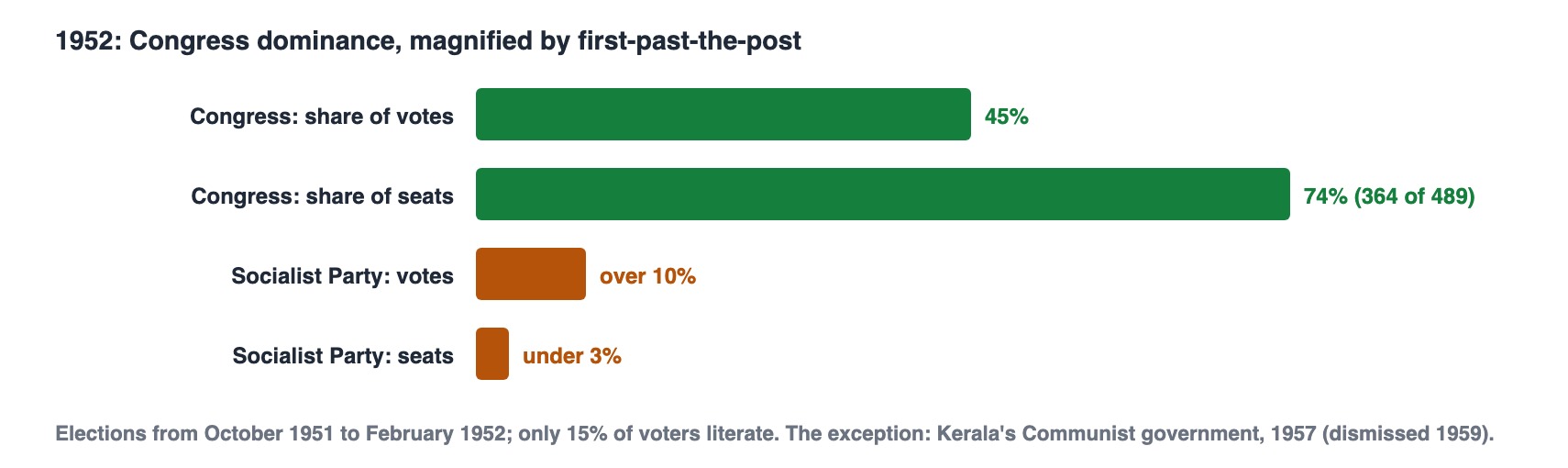
Votes against seats in 1952: first-past-the-post magnified the Congress's lead.
Why the Congress Dominated; Kerala 1957
Why the Congress dominated
Legacy of the national movement: founded in 1885 as a pressure group for the newly educated, professional and commercial classes, it became a mass movement that drew in peasants, workers and every region.
A social and ideological coalition: it accommodated all groups and avoided extreme positions; compromise and inclusiveness were its hallmarks, leaving the opposition little space.
Tolerance and management of factions: its coalitional nature tolerated and even encouraged factions, ideological or personal, which let dissent stay inside the party; political scientists called this the "Congress system".
Democratic dominance: unlike one-party states, the Congress won free and fair elections, like the African National Congress in South Africa.
The Kerala exception (1957-1959)
In March 1957 the Communist Party won the largest number of seats in Kerala (60 of 126, with five independents) and E.M.S. Namboodiripad formed the government: for the first time in the world, a communist party came to power through democratic elections. After a Congress-backed "liberation struggle", the Centre dismissed the government in 1959 under Article 356, widely cited as an early misuse of emergency powers.
Opposition Parties and Significance
The opposition parties
India had a larger number of diverse and vibrant opposition parties than many multi-party democracies, though they won few seats.
Party | Ideas |
Socialist Party (1948, after the Congress barred dual membership) | Democratic socialism, distinct from both the Congress and the Communists; second in votes in 1952 |
Communist Party of India | Second in seats in 1952; won Kerala in 1957 |
Bharatiya Jana Sangh (1951, founder-president Shyama Prasad Mukherjee) | 'One country, one culture, one nation'; Hindi as official language; Akhand Bharat; opposed concessions to minorities; advocated nuclear weapons |
Swatantra Party | An economy free from state control |
Their role: they offered sustained, principled criticism, kept the ruling party in check, and kept democratic alternatives alive; in the early years there was much mutual respect between Congress and opposition leaders, and the interim government included opposition leaders such as Dr. Ambedkar. When the Congress weakened in the late 1960s, these parties were ready to step in (article 06).
Why it matters
One-party dominance in India coexisted with free elections, a free press and an active opposition. It allowed stable consolidation in the first two decades, while the "Congress system" absorbed India's diversity inside one broad party. Its later decline (article 06) marked India's shift to competitive, and later coalition, politics.
Further Reading
PIB press releases, ministry websites and annual reports, the Gazette of India, MEA and UN documents and the official sources named in each note — the primary sources behind every fact above.
Test Yourself: Practice Questions & PYQs
12 practice questions on the era of one-party dominance.
Practice Questions
Q1. India's first Chief Election Commissioner was
(a) V.P. Menon
(b) B.N. Rau
(c) Sukumar Sen
(d) T.N. Seshan
Show answer
Answer: (c) — The Election Commission was set up in January 1950.
Q2. How many eligible voters were there in the first general election?
(a) About 36 crore
(b) About 17 crore
(c) About 50 crore
(d) About 5 crore
Show answer
Answer: (b) — Only 15% of them were literate.
Q3. The first general election was held between
(a) June and December 1952
(b) January and March 1950
(c) August 1947 and January 1948
(d) October 1951 and February 1952
Show answer
Answer: (d) — It was postponed twice.
Q4. How many of the 489 Lok Sabha seats did the Congress win in 1952?
(a) 245
(b) 415
(c) 364
(d) 282
Show answer
Answer: (c) — The CPI came second with 16.
Q5. In 1952 the Congress won what share of votes?
(a) 35%
(b) 60%
(c) 45%
(d) 74%
Show answer
Answer: (c) — But it won 74% of the seats.
Q6. The period of the Congress's inclusive, faction-tolerating dominance is called
(a) the Congress system
(b) the Nehruvian consensus
(c) the dominant caste system
(d) the Westminster model
Show answer
Answer: (a) — Factions kept dissent inside the party.
Q7. The world's first communist government to come to power through democratic elections was formed in
(a) Tripura in 1978
(b) Andhra in 1952
(c) West Bengal in 1977
(d) Kerala in 1957
Show answer
Answer: (d) — E.M.S. Namboodiripad became Chief Minister.
Q8. The Kerala communist government was dismissed in 1959 under
(a) Article 352
(b) Article 356
(c) Article 370
(d) Article 360
Show answer
Answer: (b) — It is cited as a misuse of emergency powers.
Q9. The Bharatiya Jana Sangh was founded in 1951 with its founder-president
(a) Shyama Prasad Mukherjee
(b) Deen Dayal Upadhyaya
(c) Ram Manohar Lohia
(d) C. Rajagopalachari
Show answer
Answer: (a) — It emphasised 'one country, one culture and one nation'.
Q10. Consider the following statements:
1. Congress dominance in India occurred under free and fair elections.
2. The Socialist Party won over 10% of votes in 1952 but under 3% of seats.
3. The Congress lost the 1957 Lok Sabha election.
Which of the statements given above are correct?
(a) 1 and 2 only
(b) 2 and 3 only
(c) 1 and 3 only
(d) 1, 2 and 3
Show answer
Answer: (a) — 1 and 2 are correct. It kept about three-fourths of Lok Sabha seats in 1957 and 1962.
Q11. Which party advocated a free-market economy against state control?
(a) Swatantra Party
(b) Socialist Party
(c) Bharatiya Jana Sangh
(d) Communist Party of India
Show answer
Answer: (a) — It opposed the planned economy's controls.
Q12. The Congress began in 1885 as
(a) a workers' union
(b) a pressure group of educated, professional and commercial classes
(c) a peasant party
(d) a religious body
Show answer
Answer: (b) — It became a mass movement through civil disobedience campaigns.
Mains Practice Questions
Use these to frame full-length answers. You don't have to answer one exactly — they show the angles UPSC tests, so let them guide which points you cover.
Why was the first general election a big test for Indian democracy?
Explain the nature of Congress dominance in the first two decades.
What role did opposition parties play in the era of one-party dominance?
UPSC Mains — Previous Years’ Questions on this topic (last 10 years)
These are the actual GS Mains questions UPSC has asked on this theme — real proof of how, and when, it is tested. Try to write a full answer to each.
This chapter supports the polity strand of the 2025 GS1 question on India's early consolidation (article 01).