Linguistic Reorganisation of States for UPSC GS1: Vishalandhra, Potti Sriramulu, the SRC and 1956 Act, and New States to Telangana
From Promise to Pressure
🎯 Exam priority: High-yield (Mains GS1). 2026 asked you to comment that "linguistic reorganization of Indian States was driven by popular pressure from below". Reorganisation is the second half of "post-independence consolidation and reorganization within the country" in the syllabus.
The problem
Colonial provincial boundaries followed administrative convenience or the accidents of conquest. The new boundaries had to reflect India's linguistic and cultural plurality without weakening national unity.
From promise to postponement
The promise: the national movement had rejected colonial divisions as artificial; after the Nagpur session of 1920, the Congress reorganised its own provincial committees on linguistic lines.
The hesitation: after partition, leaders feared that language-based states might cause disruption and disintegration, and distract from social and economic challenges; the princely states were still being integrated. The central leadership decided to postpone the question.
Pressure from below: the Andhra movement
The Vishalandhra movement demanded that the Telugu-speaking areas be separated from the Madras province; nearly all political forces in Andhra supported it.
Potti Sriramulu, a veteran Gandhian and Congress leader, began a fast unto death on 19 October 1952 and died on 15 December 1952, after 56 days. Unrest, violence and police firing followed; legislators in Madras resigned.
The Prime Minister announced a separate Andhra state in December 1952.
The Commission and New States
The States Reorganisation Commission and after
Year
How India's states were redrawn, from Andhra in 1952 to Telangana in 2014. | Event |
1953 | States Reorganisation Commission appointed; it accepted that state boundaries should reflect the boundaries of languages |
1956 | States Reorganisation Act: 14 states and 6 union territories |
1960 | The bilingual state of Gujarati- and Marathi-speaking people split into Maharashtra and Gujarat after popular agitation |
1963 | Nagaland becomes a state |
1966 | Punjab reorganised; Haryana and Himachal Pradesh separated |
1972 | Meghalaya carved out of Assam; Manipur and Tripura become states |
1987 | Mizoram and Arunachal Pradesh become states |
2000 | Chhattisgarh, Uttarakhand and Jharkhand created, on grounds of regional culture and imbalance, not language |
2 June 2014 | Telangana formed |
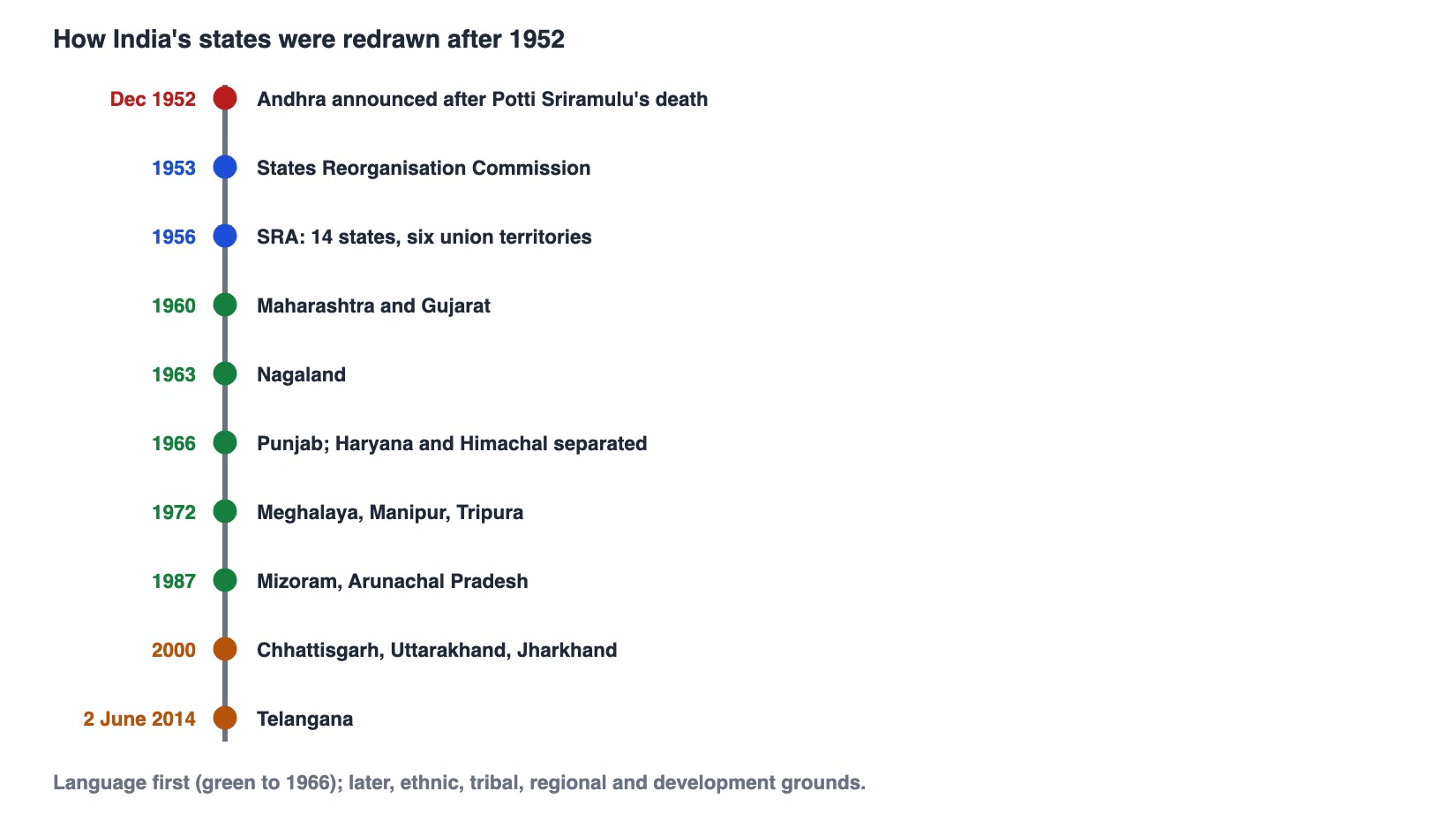
Language did not remain the only basis: later states rested on regional culture, tribal identity or complaints of uneven development. Demands continue, for example for Vidarbha in Maharashtra and Harit Pradesh in western Uttar Pradesh.
Pressure from Below? Consequences
Was it driven by popular pressure from below? (2026)
Yes, largely. The leadership had decided to postpone linguistic states; it was popular agitation that forced its hand: the Vishalandhra movement and Potti Sriramulu's death, the agitation that divided the bilingual state into Maharashtra and Gujarat, and the Punjabi-speaking people's demand for their own state. NCERT notes that Nehru and other leaders were very popular, "and yet the people did not hesitate to agitate for linguistic states against the wishes of the leaders", and that "the leadership, under popular pressure, finally made a choice in favour of linguistic states".
But not only from below. The principle came from the national movement itself (the Congress's 1920 decision); the response was institutional (the States Reorganisation Commission and the 1956 Act), and the leadership shaped the outcome, for example by delaying Punjab until 1966 and by keeping some multilingual units. It was a meeting of popular demand and leaders' democratic accommodation.
Consequences
It did not lead to disintegration, as many had feared; NCERT concludes it strengthened national unity, because accommodating regional claims reduced the threat of separatism.
It democratised politics: power opened to people beyond the small English-speaking elite, in regional languages.
It gave a uniform basis to state boundaries and affirmed the acceptance of diversity within unity.
Problems remained: new demands based on regional identity and uneven development continue.
Further Reading
PIB press releases, ministry websites and annual reports, the Gazette of India, MEA and UN documents and the official sources named in each note — the primary sources behind every fact above.
Test Yourself: Practice Questions & PYQs
12 practice questions, then the GS1 question on linguistic reorganisation.
Practice Questions
Q1. The Congress reorganised its own provincial committees on linguistic lines after its
(a) Lahore session of 1929
(b) Haripura session of 1938
(c) Karachi session of 1931
(d) Nagpur session of 1920
Show answer
Answer: (d) — The national movement had promised linguistic states.
Q2. The movement for a separate Telugu-speaking state was called the
(a) Vishalandhra movement
(b) Dravida movement
(c) Samyukta Maharashtra movement
(d) Punjabi Suba movement
Show answer
Answer: (a) — It demanded separation from the Madras province.
Q3. Potti Sriramulu died during his fast for a separate Andhra state after how many days?
(a) 21
(b) 100
(c) 14
(d) 56
Show answer
Answer: (d) — He died on 15 December 1952.
Q4. The formation of a separate Andhra state was announced in
(a) November 1956
(b) May 1960
(c) August 1947
(d) December 1952
Show answer
Answer: (d) — After Potti Sriramulu's death and widespread unrest.
Q5. The States Reorganisation Commission was appointed in
(a) 1960
(b) 1950
(c) 1956
(d) 1953
Show answer
Answer: (d) — It accepted that state boundaries should reflect languages.
Q6. The States Reorganisation Act of 1956 created
(a) 21 states and 9 union territories
(b) 16 states and 3 union territories
(c) 14 states and 6 union territories
(d) 28 states and 7 union territories
Show answer
Answer: (c) — Further states were created later.
Q7. Maharashtra and Gujarat were created in
(a) 1960
(b) 1966
(c) 1972
(d) 1956
Show answer
Answer: (a) — After a popular agitation in the bilingual state.
Q8. Haryana and Himachal Pradesh were separated from Punjab in
(a) 1987
(b) 1966
(c) 1956
(d) 1972
Show answer
Answer: (b) — Statehood for Punjab came ten years after 1956.
Q9. Consider the following statements:
1. Meghalaya was carved out of Assam in 1972.
2. Nagaland became a state in 1963.
3. Mizoram became a state in 1956.
Which of the statements given above are correct?
(a) 1 and 2 only
(b) 2 and 3 only
(c) 1 and 3 only
(d) 1, 2 and 3
Show answer
Answer: (a) — 1 and 2 are correct. Mizoram and Arunachal Pradesh became states in 1987.
Q10. Chhattisgarh, Uttarakhand and Jharkhand were created in 2000 mainly on the basis of
(a) princely state boundaries
(b) religion
(c) regional culture and development imbalance
(d) language alone
Show answer
Answer: (c) — Language did not remain the sole basis.
Q11. Telangana was formed on
(a) 15 August 2000
(b) 1 November 1956
(c) 26 January 1966
(d) 2 June 2014
Show answer
Answer: (d) — It is India's newest state.
Q12. According to NCERT, linguistic reorganisation
(a) was imposed by the British
(b) was opposed by all regional leaders
(c) strengthened national unity
(d) led to disintegration
Show answer
Answer: (c) — It also opened politics beyond the English-speaking elite.
Mains Practice Questions
Use these to frame full-length answers. You don't have to answer one exactly — they show the angles UPSC tests, so let them guide which points you cover.
Linguistic reorganisation of Indian states was driven by popular pressure from below. Comment.
Did linguistic reorganisation strengthen or weaken national unity?
Why did the bases for creating new states change after 1956?
UPSC Mains — Previous Years’ Questions on this topic (last 10 years)
These are the actual GS Mains questions UPSC has asked on this theme — real proof of how, and when, it is tested. Try to write a full answer to each.
2026 (GS-I): Linguistic reorganization of Indian States was driven by popular pressure from below. Comment.