PMOS (Formerly PCOS), Hirsutism and Endometriosis for NEET PG OBG: Rotterdam Criteria, Tests, Long-term Risks, Treatment and Endometriosis Basics
Start Here
🎯 Exam priority: Very high. Expect: Rotterdam criteria, the ultrasound definition of polycystic ovaries, which tests exclude CAH, Cushing, tumours, hyperprolactinaemia and thyroid disease, why endometrial cancer risk rises, first-line treatment and ovulation induction, hirsutism vs virilisation, and endometriosis sites, triad and treatment.
CBME mapping: OG30. Note: MSD now calls PCOS polyendocrine metabolic ovarian syndrome (PMOS) — exams may use either name.
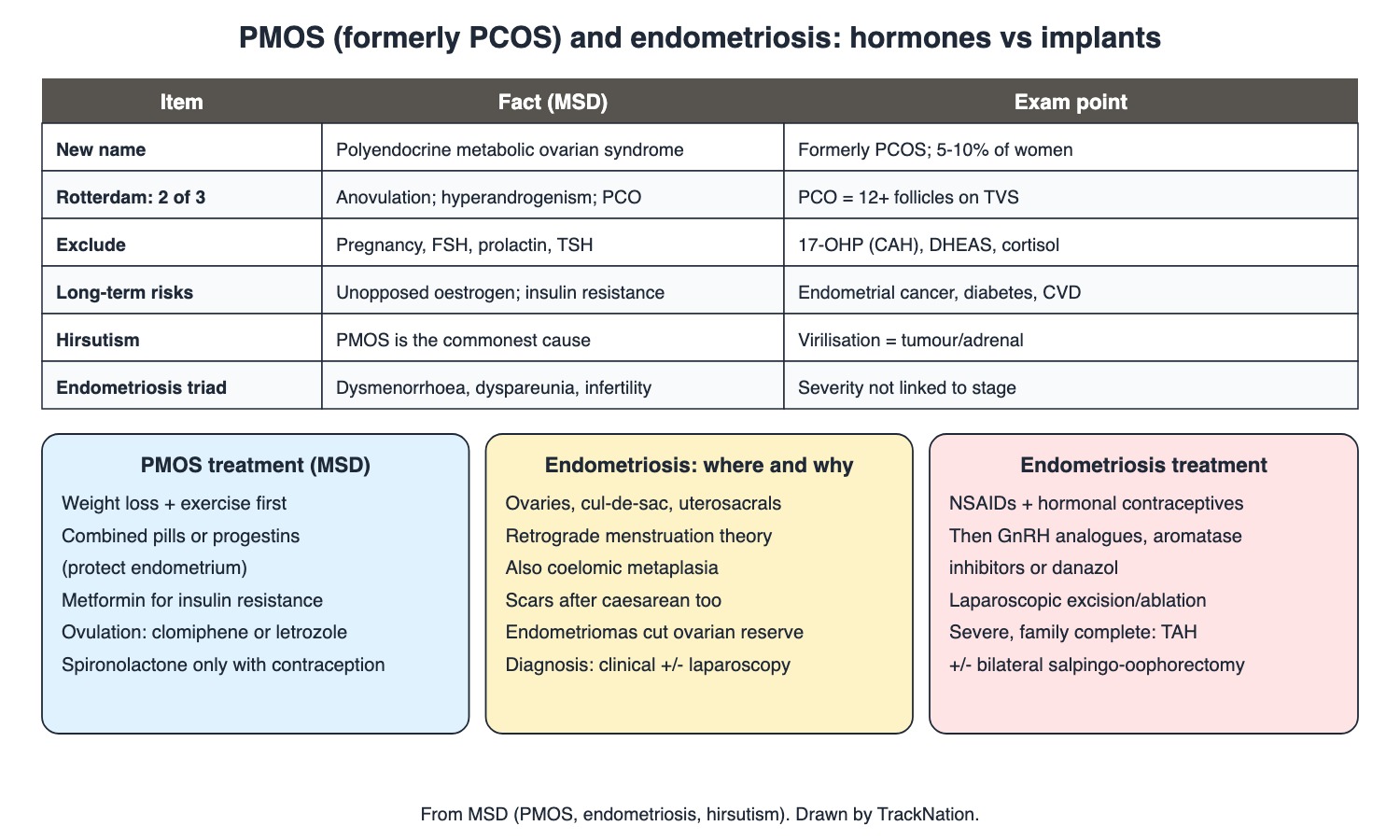
PMOS criteria, tests, risks and treatment; endometriosis essentials. Drawn by TrackNation.
PMOS (Formerly PCOS): Diagnosis (MSD)
Affects 5–10% of women; the renaming stresses hormonal and metabolic risks (insulin resistance is thought to be the initial abnormality) rather than "cysts".
Rotterdam — any 2 of 3: oligo/anovulation; clinical or biochemical hyperandrogenism; polycystic ovaries = ≥12 follicles of 2–9 mm in each ovary and/or ovarian volume >10 ml on TVS (TVS is not done in adolescents).
Exclude mimics: pregnancy test, FSH, prolactin, TSH; early-morning 17-hydroxyprogesterone (non-classic CAH); cortisol (Cushing). Tumour clues: testosterone >150 ng/dl, DHEAS >800 mcg/dl (adrenal), or virilisation (clitoromegaly, deep voice, male-pattern baldness).
Features: irregular periods, hirsutism, acne, obesity, acanthosis nigricans (from high insulin), infertility.
PMOS: Risks and Treatment (MSD)
Long-term: unopposed oestrogen → endometrial hyperplasia and cancer; type 2 diabetes, impaired glucose tolerance, dyslipidaemia, hypertension, sleep apnoea, fatty liver, depression and anxiety.
Treatment: weight loss and exercise (can restore ovulation); combined pills or progestins to regulate cycles and protect the endometrium (antiandrogenic progestins: drospirenone, dienogest); metformin for insulin resistance.
Infertility: MSD's PMOS chapter lists clomiphene as first-line with letrozole as an option, while its ovulatory-dysfunction chapter says many clinicians now prefer letrozole (better in obese women) — know both.
Hirsutism: PMOS is the commonest cause; others — CAH, Cushing, adrenal/ovarian tumours, drugs. Antiandrogens (spironolactone 25–100 mg twice daily, finasteride) only with reliable contraception; plus hair removal methods.
Endometriosis (MSD)
Endometrial tissue outside the uterus — commonly ovaries, broad ligaments, posterior cul-de-sac, uterosacral ligaments, peritoneum; also caesarean scars, bowel, bladder, rarely lung/pleura.
Theories: retrograde menstruation (most accepted), coelomic metaplasia, Müllerian rests.
Triad: dysmenorrhoea, dyspareunia, infertility (± dysuria, dyschezia). Symptom severity does not match stage. Infertility: endometriomas destroy follicles (low reserve), adhesions, luteinised unruptured follicle, raised peritoneal prostaglandins and macrophage activity.
Diagnosis is often clinical (± TVS/MRI); laparoscopy (± biopsy) helps planning but is not required, and lesions are treated at the same time.
Treatment ladder: NSAIDs + hormonal contraceptives → GnRH analogues, aromatase inhibitors or danazol, or laparoscopic excision/ablation → if severe and family complete, hysterectomy ± bilateral salpingo-oophorectomy.
Traps the Examiner Sets
PCOS needs only 2 of 3 criteria — polycystic ovaries are not mandatory.
Hirsutism with virilisation = look for a tumour or adrenal cause, not PCOS.
Endometriosis pain does not correlate with the extent of disease.
Antiandrogens need contraception (fetal risk).
Memory Hooks & Shortcuts
Shortcuts to lock in this article's numbers and lists. Each one only re-packages facts proven above.
🧠 Rotterdam: 'any 2 of A-H-P' — Anovulation, Hyperandrogenism, Polycystic ovaries — criteria
🧠 PCO on scan '12 follicles, 2–9 mm, 10 ml' — ultrasound
🧠 Tumour flags '150 and 800': testosterone >150, DHEAS >800 — tumour
🧠 Endometriosis '3 Ds': Dysmenorrhoea, Dyspareunia, Difficulty conceiving — triad
🧠 'Little disease, lots of pain' — endometriosis stage ≠ symptoms — staging
Rapid-Revision Cards
New name
PMOS (formerly PCOS).
Prevalence
5–10%.
Rotterdam
2 of 3.
PCO on TVS
≥12 follicles 2–9 mm; >10 ml.
Adolescents
No TVS.
Exclude
hCG, FSH, PRL, TSH, 17-OHP, cortisol.
Tumour clues
T >150 ng/dl; DHEAS >800.
Virilisation
Not PCOS — tumour/adrenal.
Acanthosis
Insulin resistance.
Endometrial risk
Unopposed oestrogen.
Metabolic
T2DM, IGT, OSA.
First step
Weight loss.
Cycles
COC/progestin.
Ovulation
Letrozole or clomiphene.
Hirsutism #1
PMOS.
Antiandrogens
With contraception.
Endometriosis sites
Ovary, cul-de-sac, uterosacrals.
Theory
Retrograde menstruation.
Triad
Dysmenorrhoea, dyspareunia, infertility.
Stage vs pain
Not related.
Ladder
NSAID+OCP → GnRH/AI/danazol → surgery.
Sources
Facts in this article were checked against these documents.
MSD Manual Professional: Polyendocrine Metabolic Ovarian Syndrome (PMOS); Endometriosis; Ovulatory Dysfunction; Hirsutism and Hypertrichosis — Merck & Co. (MSD Manuals), 2024–26 (link)
Competency Based Undergraduate Curriculum, Vol III: Obstetrics & Gynaecology (OG30) — National Medical Commission, 2024
Test Yourself: Practice Questions
Thirty questions in NEET PG style, most of them clinical vignettes.
Practice Questions (NEET PG pattern)
Original questions written in the style of the exam: +4 for a correct answer, −1 for a wrong one. Every answer was checked against the sources listed above. NEET PG papers are not published by NBEMS, so these are not past-paper questions.
Q1. MSD now uses which name for polycystic ovary syndrome?
(a) Stein–Leventhal disease only
(b) primary ovarian insufficiency
(c) ovarian hyperstimulation syndrome
(d) polyendocrine metabolic ovarian syndrome (PMOS)
Show answer
Answer: (d) — Same condition.
Q2. PMOS/PCOS affects about
(a) 70%
(b) 0.1%
(c) 40%
(d) 5–10% of women
Show answer
Answer: (d) — MSD.
Q3. The Rotterdam criteria need
(a) all 3 features
(b) polycystic ovaries plus obesity
(c) any 2 of: anovulation, hyperandrogenism, polycystic ovaries
(d) raised LH:FSH ratio
Show answer
Answer: (c) — PCO not mandatory.
Q4. On ultrasound, polycystic ovarian morphology is
(a) a single 5 cm cyst
(b) a dermoid
(c) ≥12 follicles of 2–9 mm per ovary and/or volume >10 ml
(d) ≥5 follicles of 20 mm
Show answer
Answer: (c) — MSD.
Q5. A 15-year-old with irregular periods and acne is suspected of PCOS. Which test is avoided at this age per MSD?
(a) prolactin
(b) transvaginal ultrasound
(c) serum testosterone
(d) TSH
Show answer
Answer: (b) — Not in adolescents.
Q6. To exclude non-classic congenital adrenal hyperplasia in a hirsute woman, measure
(a) AMH
(b) estradiol
(c) CA-125
(d) early-morning 17-hydroxyprogesterone
Show answer
Answer: (d) — MSD.
Q7. A woman with hirsutism has testosterone of 220 ng/dl. Suspect
(a) an androgen-secreting tumour
(b) simple PCOS
(c) normal variation
(d) hypothyroidism
Show answer
Answer: (a) — >150 ng/dl.
Q8. Markedly raised DHEAS (>800 mcg/dl) suggests
(a) pregnancy
(b) ovarian PCOS
(c) an adrenal androgen-secreting tumour
(d) Cushing's disease only
Show answer
Answer: (c) — MSD.
Q9. A hirsute woman develops clitoromegaly and a deep voice over 6 months. This virilisation suggests
(a) an androgen-secreting tumour or adrenal cause
(b) constitutional hirsutism
(c) drug-free normal
(d) uncomplicated PCOS
Show answer
Answer: (a) — Investigate urgently.
Q10. Before diagnosing PCOS, which tests exclude mimics?
(a) CA-125 only
(b) HbA1c only
(c) karyotype
(d) pregnancy test, FSH, prolactin, TSH (± cortisol)
Show answer
Answer: (d) — MSD.
Q11. Velvety dark skin on the neck in a woman with PCOS reflects
(a) insulin resistance (acanthosis nigricans)
(b) vitiligo
(c) high oestrogen
(d) Addison disease
Show answer
Answer: (a) — MSD.
Q12. Why is endometrial cancer risk raised in chronic anovulatory PCOS?
(a) high FSH
(b) unopposed oestrogen without cyclical progesterone
(c) high progesterone
(d) low oestrogen
Show answer
Answer: (b) — Protect with progestin.
Q13. A metabolic complication more common in PCOS is
(a) hyperthyroidism
(b) osteoporosis in youth
(c) hypocalcaemia
(d) type 2 diabetes and impaired glucose tolerance
Show answer
Answer: (d) — Also sleep apnoea.
Q14. First step for an obese woman with PCOS and irregular cycles:
(a) immediate IVF
(b) danazol
(c) hysterectomy
(d) weight loss and regular exercise
Show answer
Answer: (d) — May restore ovulation.
Q15. For cycle control and endometrial protection in PCOS (no pregnancy wish), use
(a) combined oral contraceptives or progestins
(b) GnRH agonists long-term
(c) oestrogen alone
(d) clomiphene
Show answer
Answer: (a) — MSD.
Q16. Antiandrogenic progestins used in PCOS include
(a) drospirenone and dienogest
(b) medroxyprogesterone only
(c) danazol
(d) levonorgestrel and norgestrel
Show answer
Answer: (a) — MSD.
Q17. An obese woman with PCOS wants to conceive. MSD says many clinicians prefer
(a) letrozole
(b) spironolactone
(c) danazol
(d) combined pills
Show answer
Answer: (a) — Clomiphene also first-line in PMOS chapter.
Q18. MSD's PMOS chapter names the first-line infertility drug as
(a) IVF
(b) clomiphene (letrozole also used)
(c) gonadotropins
(d) metformin alone
Show answer
Answer: (b) — Know both views.
Q19. The commonest cause of hirsutism is
(a) PMOS (PCOS)
(b) ovarian Sertoli–Leydig tumour
(c) Cushing syndrome
(d) adrenal carcinoma
Show answer
Answer: (a) — MSD.
Q20. Spironolactone for hirsutism in a sexually active woman must be combined with
(a) oestrogen alone
(b) reliable contraception
(c) metformin
(d) nothing
Show answer
Answer: (b) — Fetal risk.
Q21. Common sites of endometriosis include
(a) ovaries, posterior cul-de-sac and uterosacral ligaments
(b) liver and spleen
(c) kidneys only
(d) brain
Show answer
Answer: (a) — MSD.
Q22. The most widely accepted theory of endometriosis is
(a) infection
(b) trauma
(c) retrograde menstruation
(d) coelomic metaplasia only
Show answer
Answer: (c) — Also metaplasia, rests.
Q23. The classic triad of endometriosis is
(a) fever, pain, discharge
(b) hirsutism, acne, obesity
(c) amenorrhoea, galactorrhoea, headache
(d) dysmenorrhoea, dyspareunia, infertility
Show answer
Answer: (d) — ± dyschezia.
Q24. A woman with minimal endometriosis at laparoscopy has severe pain. This is
(a) expected — severity does not match stage
(b) a sign of cancer
(c) proof of another cause
(d) impossible
Show answer
Answer: (a) — MSD.
Q25. Endometriomas can impair fertility by
(a) raising sperm count
(b) blocking the cervix
(c) destroying primordial follicles (reduced reserve)
(d) causing hyperprolactinaemia
Show answer
Answer: (c) — Also adhesions.
Q26. A painful nodule in a caesarean scar may be
(a) scar endometriosis
(b) hernia only
(c) keloid
(d) lipoma
Show answer
Answer: (a) — MSD.
Q27. Is laparoscopy mandatory before treating suspected endometriosis?
(a) No — treatment can start on clinical diagnosis
(b) Only CA-125 is needed
(c) Yes, always
(d) Only CT is needed
Show answer
Answer: (a) — Helps planning.
Q28. First-line medical treatment of suspected endometriosis is
(a) NSAIDs plus hormonal contraceptives
(b) antibiotics
(c) hysterectomy
(d) danazol first
Show answer
Answer: (a) — Then GnRH analogues.
Q29. If first-line therapy fails, second-line options for endometriosis include
(a) metformin
(b) GnRH analogues, aromatase inhibitors or danazol
(c) oestrogen alone
(d) clomiphene
Show answer
Answer: (b) — Or laparoscopy.
Q30. A 46-year-old with severe endometriosis who has completed her family and failed treatment may be offered
(a) IVF
(b) observation only
(c) clomiphene
(d) hysterectomy with or without bilateral salpingo-oophorectomy
Show answer
Answer: (d) — MSD.
Active Recall
From memory: state the Rotterdam criteria and ultrasound definition, list tests to exclude mimics and tumour clues, describe PMOS long-term risks and treatment including ovulation induction, outline hirsutism management, and summarise endometriosis sites, theory, triad, diagnosis and treatment.