Movement Disorders, Neuromuscular Disease and Dementia for NEET PG Medicine: Parkinson, GBS, Myasthenia, MS, Alzheimer, Delirium
Start Here
🎯 Exam priority: Medium–High. Expect: Parkinson triad and drugs, drug-induced parkinsonism, essential tremor treatment, Huntington genetics, the ICMR acute paralysis algorithm, GBS (ascending, areflexia, albuminocytological dissociation, no steroids), myasthenia (fatigability, thymoma, crisis, drugs that worsen it), ALS, MS signs (INO, Lhermitte, Uhthoff), dementia vs delirium, reversible dementias, NPH triad, Alzheimer drugs.
CBME mapping: GM 19.1–19.9. Neuroanatomy in Anatomy; antiparkinsonian and anticholinesterase drugs in Pharmacology; psychiatric aspects in Psychiatry.
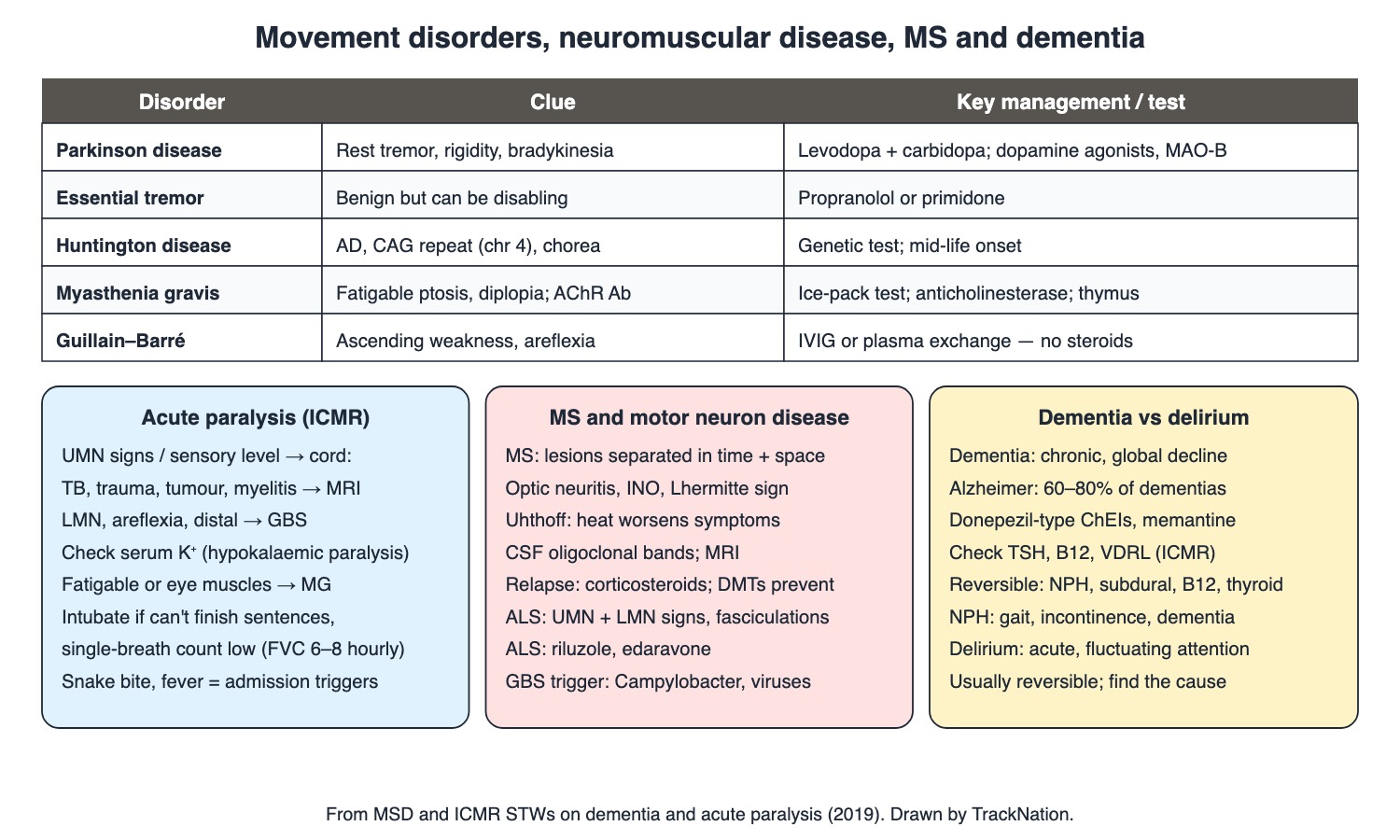
Movement disorders, neuromuscular disease, MS and dementia. Drawn by TrackNation.
Movement Disorders
Parkinson disease: resting tremor, rigidity, bradykinesia, later postural instability; degeneration of pigmented dopaminergic neurons (substantia nigra). Treat with levodopa + carbidopa, dopamine agonists, MAO-B inhibitors, amantadine; long-term levodopa brings motor fluctuations and dyskinesias (early use does not hasten this). Refractory, non-demented patients: deep brain stimulation.
Rule out secondary parkinsonism — most commonly drugs (antipsychotics, some antiemetics) or toxins.
Essential tremor: benign but disabling; propranolol or primidone.
Huntington disease: autosomal dominant CAG repeat in HTT (chromosome 4); chorea, psychiatric symptoms and dementia from middle age.
Acute Paralysis and Neuromuscular Disease
ICMR approach: UMN signs (brisk reflexes, extensor plantars, sensory level, bladder/bowel involvement) → cord disease (TB, trauma, tumour, transverse myelitis, epidural abscess) → MRI. LMN pattern with absent reflexes → GBS; check potassium (hypokalaemic periodic paralysis). Fatigable weakness or eye-muscle involvement → myasthenia. Intubate if the patient cannot finish sentences or the single-breath count falls; refer for plasma exchange/IVIG and ventilation.
Neuromuscular (MSD) | Key features | Treatment |
Guillain–Barré | Ascending symmetric weakness from legs, areflexia; trigger in > 50% (Campylobacter); CSF protein ↑ with normal cells | IVIG or plasma exchange; monitor FVC 6–8-hourly; NO glucocorticoids |
Myasthenia gravis | Fatigable ptosis, diplopia; AChR antibodies; thymic hyperplasia 65%, thymoma 10% | Anticholinesterases, immunosuppression, PLEX/IVIG, thymectomy |
Myasthenic crisis | Respiratory or generalised weakness (15–20% at least once) | Ventilatory support; differentiate cholinergic crisis (too much pyridostigmine) |
ALS | UMN + LMN signs, fasciculations, bulbar/facial weakness | Riluzole, edaravone; supportive |
Multiple Sclerosis, Dementia and Delirium
MS: retrobulbar optic neuritis, INO, limb fatigue or stiffness, sensory symptoms, bladder symptoms; Lhermitte sign (electric shock on neck flexion); Uhthoff (heat worsens symptoms). Diagnosis: ≥ 2 lesions separated in time and space (clinical or MRI); CSF oligoclonal bands. Steroids for relapses; disease-modifying therapy prevents them. Relapsing-remitting is a common pattern.
Dementia: chronic, global, usually irreversible cognitive decline. ICMR: history from a close caregiver, exclude delirium and depression, test TSH, B12, VDRL (and others), image for subdural haematoma, tumour, NPH. Reversible causes: NPH, subdural, hypothyroidism, B12 deficiency, chronic meningitis, toxins.
Alzheimer disease: 60–80% of dementias; beta-amyloid plaques and neurofibrillary tangles; cholinesterase inhibitors, memantine.
NPH: gait disturbance, urinary incontinence, dementia with enlarged ventricles; improvement after CSF removal predicts benefit from a VP shunt.
Delirium: acute, fluctuating, usually reversible disturbance of attention and consciousness — search for the medical cause and offending drugs (e.g. benzodiazepines, anticholinergics).
Traps the Examiner Sets
GBS: steroids are harmful; monitor vital capacity.
Myasthenia worsens with aminoglycosides; look for thymoma.
Parkinsonism on antipsychotics is drug-induced until proven otherwise.
Inattention = delirium; memory loss over months = dementia.
NPH: wet, wobbly, wacky.
Memory Hooks & Shortcuts
Shortcuts to lock in this article's numbers and lists. Each one only re-packages facts proven above.
🧠 Parkinson 'TRAP': Tremor, Rigidity, Akinesia, Postural instability — Parkinson
🧠 GBS: 'Going up, reflexes gone, no steroids' — GBS
🧠 Myasthenia: 'tired by evening, better after rest' — myasthenia
🧠 MS heat: 'Uhthoff = hot tub trouble' — Uhthoff
🧠 NPH 'Wet, Wobbly, Wacky' — NPH
🧠 Delirium 'Distractible and Day-to-day changing' — delirium
Rapid-Revision Cards
Parkinson triad
Rest tremor, rigidity, bradykinesia.
PD pathology
Substantia nigra dopaminergic loss.
PD drug
Levodopa + carbidopa.
Late PD
Motor fluctuations, dyskinesias; DBS.
Secondary parkinsonism
Antipsychotics, antiemetics.
Essential tremor
Propranolol, primidone.
Huntington
AD; CAG repeat HTT chr 4; chorea.
ICMR UMN paralysis
Cord lesion → MRI.
Flaccid paralysis
Check K⁺.
GBS
Ascending, areflexia; Campylobacter.
GBS CSF
High protein, normal cells.
GBS Rx
IVIG/PLEX; no steroids; FVC 6–8 h.
Myasthenia
Fatigable ptosis/diplopia; AChR Ab.
MG thymus
Hyperplasia 65%, thymoma 10%.
MG worsened by
Aminoglycosides, infection, surgery.
Cholinergic crisis
Too much pyridostigmine.
ALS
UMN + LMN, fasciculations; riluzole.
MS signs
Optic neuritis, INO, Lhermitte, Uhthoff.
MS diagnosis
Lesions in time + space; oligoclonal bands.
MS relapse
Steroids.
Alzheimer
60–80%; ChEIs, memantine.
NPH
Gait, incontinence, dementia; shunt.
Dementia work-up (ICMR)
TSH, B12, VDRL, imaging.
Delirium
Acute, fluctuating inattention.
Sources
Facts in this article were checked against these documents.
Standard Treatment Workflows: Management of Dementia; Approach to Acute Paralysis — Indian Council of Medical Research, DHR, 2019 (link)
MSD Manual Professional: Parkinson Disease; Tremor; Huntington Disease; Guillain–Barré Syndrome; Myasthenia Gravis; ALS; Multiple Sclerosis; Polyneuropathy; Alzheimer Disease; Dementia; Normal Pressure Hydrocephalus; Delirium — Merck & Co. (MSD Manuals), reviewed 2025–26 (link)
Competency Based Undergraduate Curriculum, General Medicine (GM 19) — National Medical Commission, 2024
Test Yourself: Practice Questions
Thirty questions in NEET PG style, most of them clinical vignettes.
Practice Questions (NEET PG pattern)
Original questions written in the style of the exam: +4 for a correct answer, −1 for a wrong one. Every answer was checked against the sources listed above. NEET PG papers are not published by NBEMS, so these are not past-paper questions.
Q1. A 65-year-old has a resting tremor, stiffness and slowness of movement. The diagnosis is
(a) Parkinson disease
(b) cerebellar disease
(c) Huntington disease
(d) essential tremor
Show answer
Answer: (a) — Postural instability comes later.
Q2. Parkinson disease results from degeneration of pigmented dopaminergic neurons mainly in the
(a) substantia nigra
(b) cerebellum
(c) caudate only
(d) motor cortex
Show answer
Answer: (a) — Also locus ceruleus.
Q3. The most effective drug treatment for Parkinson disease is
(a) donepezil
(b) propranolol
(c) levodopa with carbidopa
(d) haloperidol
Show answer
Answer: (c) — Others: dopamine agonists, MAO-B inhibitors, amantadine.
Q4. A patient on long-term levodopa develops involuntary movements and a fluctuating response. These are
(a) drug allergy
(b) new stroke
(c) motor fluctuations and dyskinesias of advanced Parkinson disease
(d) Huntington disease
Show answer
Answer: (c) — Early levodopa does not hasten this.
Q5. A patient on an antipsychotic develops rigidity and bradykinesia. The most likely cause is
(a) MS
(b) idiopathic Parkinson disease
(c) drug-induced (secondary) parkinsonism
(d) ALS
Show answer
Answer: (c) — Medications are the commonest cause of secondary parkinsonism.
Q6. A benign but disabling tremor without parkinsonism is treated with
(a) haloperidol
(b) propranolol or primidone
(c) riluzole
(d) levodopa
Show answer
Answer: (b) — Essential tremor.
Q7. A 40-year-old has chorea, irritability and declining memory; his father had the same. The genetic basis is
(a) mitochondrial DNA
(b) trinucleotide repeat in FMR1
(c) X-linked recessive
(d) autosomal dominant CAG repeat expansion in HTT on chromosome 4
Show answer
Answer: (d) — Huntington disease.
Q8. Per the ICMR acute paralysis workflow, brisk reflexes, extensor plantars and a sensory level point to
(a) myasthenia gravis
(b) a spinal cord lesion needing MRI
(c) GBS
(d) hypokalaemia
Show answer
Answer: (b) — TB, trauma, tumour, transverse myelitis.
Q9. A patient with acute flaccid quadriparesis should have which electrolyte checked early (ICMR)?
(a) serum sodium only
(b) serum magnesium only
(c) serum calcium only
(d) serum potassium (hypokalaemic periodic paralysis)
Show answer
Answer: (d) — A treatable mimic.
Q10. After a diarrhoeal illness, a man develops symmetric weakness starting in the legs and spreading to the arms, with absent reflexes. The likely diagnosis is
(a) polymyositis
(b) transverse myelitis
(c) myasthenia gravis
(d) Guillain–Barré syndrome
Show answer
Answer: (d) — Campylobacter is a common trigger.
Q11. CSF in Guillain–Barré syndrome typically shows
(a) oligoclonal bands only
(b) blood
(c) high neutrophils and low glucose
(d) raised protein with a normal cell count (may take a week to appear)
Show answer
Answer: (d) — Albuminocytological dissociation.
Q12. The treatment of Guillain–Barré syndrome is
(a) IVIG or plasma exchange (not glucocorticoids)
(b) high-dose prednisolone
(c) pyridostigmine
(d) antibiotics
Show answer
Answer: (a) — Steroids may worsen outcome.
Q13. In GBS, respiratory function should be monitored by
(a) chest X-ray daily
(b) peak flow once a week
(c) forced vital capacity every 6–8 hours
(d) ABG only at admission
Show answer
Answer: (c) — ICMR: intubate if the patient cannot finish sentences.
Q14. A young woman has drooping eyelids and double vision that worsen with use and improve with rest. The likely diagnosis is
(a) Horner syndrome
(b) myasthenia gravis
(c) MS
(d) GBS
Show answer
Answer: (b) — Fatigable weakness; AChR antibodies.
Q15. In myasthenia gravis, a CT of the chest is done because
(a) TB is common
(b) lung cancer always coexists
(c) it shows AChR antibodies
(d) thymic hyperplasia (65%) or thymoma (10%) may be present
Show answer
Answer: (d) — Thymectomy may help.
Q16. A myasthenic patient is given gentamicin and becomes weaker. The explanation is
(a) aminoglycosides precipitate myasthenic weakness
(b) gentamicin causes GBS
(c) allergy
(d) hypokalaemia
Show answer
Answer: (a) — Also infection and surgery.
Q17. A myasthenic patient on a high dose of pyridostigmine becomes weaker. One cause to consider is
(a) GBS
(b) myasthenic crisis only
(c) cholinergic crisis from excess anticholinesterase
(d) stroke
Show answer
Answer: (c) — Distinguish from myasthenic crisis.
Q18. A bedside test that supports myasthenia gravis in a patient with ptosis is
(a) Tinel sign
(b) straight-leg raise
(c) the ice-pack test
(d) Romberg test
Show answer
Answer: (c) — Also the rest test.
Q19. A patient has muscle wasting, fasciculations, facial weakness and brisk reflexes with extensor plantars. The diagnosis is
(a) amyotrophic lateral sclerosis
(b) MS
(c) GBS
(d) myasthenia gravis
Show answer
Answer: (a) — UMN + LMN signs; riluzole.
Q20. A drug used in ALS is
(a) pyridostigmine
(b) donepezil
(c) riluzole
(d) levodopa
Show answer
Answer: (c) — Also edaravone.
Q21. A young woman has painful loss of vision in one eye, and a year later double vision from internuclear ophthalmoplegia. The likely diagnosis is
(a) multiple sclerosis
(b) myasthenia gravis
(c) pituitary tumour
(d) migraine
Show answer
Answer: (a) — Lesions separated in time and space.
Q22. An electric shock-like sensation down the spine on neck flexion in MS is
(a) Kernig sign
(b) Uhthoff phenomenon
(c) Lhermitte sign
(d) Romberg sign
Show answer
Answer: (c) — Uhthoff: heat worsens symptoms.
Q23. An MS patient's symptoms worsen after a hot bath. This is
(a) a new relapse always
(b) Lhermitte sign
(c) Uhthoff phenomenon
(d) drug toxicity
Show answer
Answer: (c) — Temporary.
Q24. Acute relapses of multiple sclerosis are treated with
(a) IV immunoglobulin first-line always
(b) corticosteroids
(c) antibiotics
(d) levodopa
Show answer
Answer: (b) — DMTs prevent relapses.
Q25. The commonest cause of dementia in older adults is
(a) Alzheimer disease (60–80%)
(b) B12 deficiency
(c) NPH
(d) vascular dementia
Show answer
Answer: (a) — Amyloid plaques and tangles.
Q26. Drugs used for symptomatic treatment of Alzheimer disease include
(a) cholinesterase inhibitors and memantine
(b) haloperidol long-term
(c) levodopa
(d) phenytoin
Show answer
Answer: (a) — Anti-amyloid antibodies in selected patients.
Q27. A man has gait difficulty, urinary incontinence and memory decline; CT shows enlarged ventricles. The likely diagnosis and treatment are
(a) Parkinson disease — levodopa
(b) Alzheimer disease — donepezil
(c) normal pressure hydrocephalus — ventriculoperitoneal shunt
(d) stroke — aspirin
Show answer
Answer: (c) — Improvement after CSF removal predicts response.
Q28. Per ICMR, tests to exclude treatable causes of dementia include
(a) TSH, vitamin B12 and VDRL
(b) HLA typing
(c) EMG
(d) serum amylase
Show answer
Answer: (a) — Also neuroimaging for subdural haematoma, tumour, NPH.
Q29. A hospitalised patient becomes acutely confused with fluctuating attention over a day. This is
(a) delirium — look for a medical cause
(b) schizophrenia
(c) dementia
(d) depression
Show answer
Answer: (a) — Acute, fluctuating, usually reversible.
Q30. The core feature distinguishing delirium from dementia is
(a) apathy
(b) old age
(c) inattention with fluctuating consciousness of acute onset
(d) memory loss
Show answer
Answer: (c) — Dementia is chronic and global.
Active Recall
From memory: describe Parkinson disease and its treatment, secondary parkinsonism, essential tremor and Huntington disease, the ICMR acute paralysis approach, GBS diagnosis and treatment, myasthenia gravis and crises, ALS, MS signs and diagnosis, dementia work-up and reversible causes, Alzheimer treatment, NPH and delirium.