Intellectual Disability for NEET PG: IQ Grades, Causes, Work-up, Global Developmental Delay, Learning Disorders and Management
Start Here
🎯 Exam priority: High. Expect: IQ cut-offs for mild, moderate, severe and profound, onset in the developmental period, the commonest causes (Down, fragile X, fetal alcohol), the preferred genetic test, global developmental delay under 5, dyslexia, "no drug raises IQ" and prevention.
CBME mapping: PS 11.1 — intellectual disability: classification, causes, assessment and management. Child psychiatry was article 12.
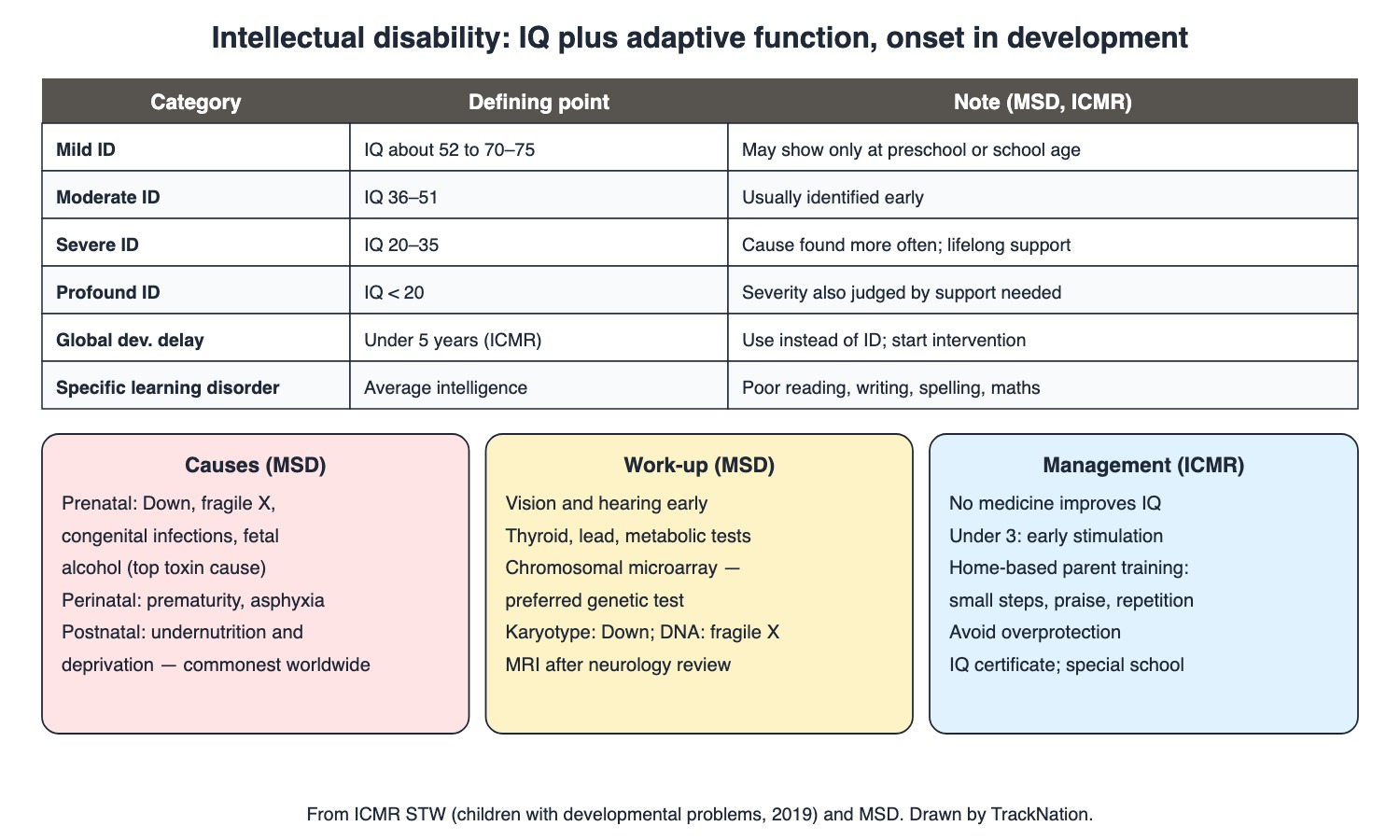
Intellectual disability grades by IQ, global developmental delay and learning disorder; causes; work-up; ICMR management. Drawn by TrackNation.
Definition and Grades
Intellectual disability (intellectual developmental disorder; ICMR's developmental problems STW covers ICD-10 F70–89) = significantly below-average intellectual functioning, often IQ < 70–75, plus limits in adaptive functioning (communication, self-care, social skills, safety), with onset during the developmental period (MSD: before 22). Prevalence about 1%.
IQ bands (MSD): mild 52–70/75, moderate 36–51, severe 20–35, profound < 20 — but IQ alone is inadequate; grade by support needed too: intermittent, limited, extensive, pervasive.
Present with slow learning, immature behaviour, limited self-care; delay is usually apparent by preschool age, more in communication than motor skills. Mild cases may surface only at school. Aggression drives most psychiatric referrals. Comorbidity is common — ADHD, mood disorders, autism, anxiety.
ICMR: in children under 5, avoid labelling ID — call it global developmental delay and start intervention. Specific speech delay = speech alone lags with normal intelligence, hearing and non-verbal communication.
Causes and Work-up (MSD)
Prenatal: chromosomal (Down, cri du chat, Turner, Klinefelter), metabolic (PKU, galactosaemia), neurogenetic (fragile X, Rett, tuberous sclerosis, Angelman, Prader-Willi); congenital infections (rubella, CMV, toxoplasma, syphilis, HIV, Zika); toxins — fetal alcohol syndrome is the commonest, plus phenytoin, valproate, lead. Perinatal: prematurity, asphyxia, CNS bleeding. Postnatal: undernutrition and deprivation (commonest worldwide), meningitis, encephalitis, poisoning, head injury.
A cause is found more often in severe than mild ID; when found it is genetic in about half. Exclude mimics — deafness, emotional problems, deprivation, learning disorder.
Screen with ASQ or PEDS (not a substitute for IQ tests by psychologists). Check vision and hearing early, thyroid, lead, metabolic tests. Genetics: chromosomal microarray is the preferred test; karyotype for Down; direct DNA study for fragile X; exome sequencing if needed; MRI after neurology review. ICMR: keep a high threshold for invasive procedures; treat treatable causes like hypothyroidism.
Management (ICMR and MSD)
ICMR: assess development against peers (ask the mother to estimate the child's mental age; is delay global or one area?), physical examination (head size, vision, hearing, anomalies), behaviour and family. Psychoeducation: no medication can improve intelligence; teaching and training build skills and independence. Mild delay "at risk" → early intervention and follow-up.
Under 3: early sensory-motor stimulation. Home-based parent-mediated training: choose a target skill, model it, break it into small steps, praise every effort, repeat; avoid overprotection, overindulgence and understimulation. Treat epilepsy, ADHD, vision or hearing problems. School: special school enrolment, vocational training for adolescents; IQ testing and certification for welfare benefits; link to DEICs and parent groups. Refer for regression, severe problems, suspected autism or SLD, genetic counselling.
MSD: family counselling is crucial; multidisciplinary team; drugs only for comorbid illness and rarely helpful without behaviour therapy; living at home is usually best. Many with mild–moderate ID live and work independently.
Prevention: rubella vaccination, no alcohol in pregnancy, folic acid 400–800 mcg from 3 months before conception, good obstetric and neonatal care, anti-D.
Specific Learning Disorder and Dyslexia
ICMR: SLD = average intelligence with poor reading, writing, spelling or maths despite adequate schooling. MSD: learning disorders affect 5–15%; dyslexia (reading) is the commonest; heritability 40–70%; more often identified in boys.
Core problem: phonological processing (essential for diagnosis); letter reversals (b/d, was/saw) are normal under 8. DSM-5-TR needs ≥ 6 months of slow or inaccurate reading. Check vision and hearing.
Treatment is educational — phonics and component skills, audiobooks; optometric, perceptual training and medicines are unproved. ICMR: remediation advice, school liaison, exemption certificates.
Traps the Examiner Sets
Low IQ alone is not ID — adaptive deficits are needed.
No drug raises intelligence.
Under 5: "global developmental delay", not ID.
SLD has normal intelligence; letter reversal under 8 is normal.
Memory Hooks & Shortcuts
Shortcuts to lock in this article's numbers and lists. Each one only re-packages facts proven above.
🧠 ID = 'IQ + I can't cope': low IQ plus adaptive deficits — definition
🧠 Grades '52–36–20': mild from 52, moderate from 36, severe from 20; below 20 profound — grades
🧠 'Under 5? Say GDD' — label
🧠 'No pill for IQ' — training builds skills — management
🧠 Dyslexia: 'sounds, not sight' — phonics — SLD
Rapid-Revision Cards
ID definition
IQ < 70–75 + adaptive deficits.
Onset
Developmental period (< 22, MSD).
Mild
IQ 52–70/75.
Moderate
IQ 36–51.
Severe
IQ 20–35.
Profound
IQ < 20.
Support levels
Intermittent, limited, extensive, pervasive.
Prevalence
About 1%.
Top toxin
Fetal alcohol.
Commonest worldwide
Undernutrition, deprivation.
Genetic share
Half of identified causes.
Preferred genetic test
Chromosomal microarray.
Fragile X test
Direct DNA study.
Mimics
Deafness, deprivation, SLD.
Under 5
Global developmental delay.
Drugs
None raise IQ.
Home training
Small steps, praise, repeat.
Certificate
IQ for welfare benefits.
Red flag
Regression.
SLD
Average IQ, poor reading/maths.
Dyslexia Rx
Phonics.
Sources
Facts in this article were checked against these documents.
Standard Treatment Workflow: Children with Developmental Problems — Indian Council of Medical Research, DHR, 2019 (link)
MSD Manual Professional: Intellectual Disability; Dyslexia — Merck & Co. (MSD Manuals), reviewed Oct 2026 (link)
Competency Based Undergraduate Curriculum, Psychiatry (PS 11) — National Medical Commission, 2024
Test Yourself: Practice Questions
Thirty questions in NEET PG style, most of them clinical vignettes.
Practice Questions (NEET PG pattern)
Original questions written in the style of the exam: +4 for a correct answer, −1 for a wrong one. Every answer was checked against the sources listed above. NEET PG papers are not published by NBEMS, so these are not past-paper questions.
Q1. A child has an IQ of 65 but manages self-care, communication and school tasks at age level. Intellectual disability is
(a) not diagnosed — adaptive deficits are also required
(b) moderate
(c) certain
(d) mild
Show answer
Answer: (a) — IQ plus adaptive function.
Q2. According to MSD, the onset of intellectual disability must be during the developmental period, defined as before age
(a) 40
(b) 12
(c) 22
(d) 5
Show answer
Answer: (c) — Developmental period.
Q3. An IQ of 40 with matching adaptive deficits falls in which grade?
(a) moderate
(b) profound
(c) mild
(d) severe
Show answer
Answer: (a) — Moderate 36–51.
Q4. An IQ of 25 with adaptive deficits is graded
(a) moderate
(b) profound
(c) mild
(d) severe
Show answer
Answer: (d) — Severe 20–35.
Q5. Profound intellectual disability corresponds to an IQ of
(a) 52–70
(b) 36–51
(c) below 20
(d) 20–35
Show answer
Answer: (c) — Pervasive support.
Q6. Modern grading of intellectual disability adds to IQ the
(a) family income
(b) level of support needed (intermittent to pervasive)
(c) head size
(d) age at walking
Show answer
Answer: (b) — IQ alone is inadequate.
Q7. The approximate prevalence of intellectual disability is
(a) 1%
(b) 0.01%
(c) 25%
(d) 10%
Show answer
Answer: (a) — MSD.
Q8. The most common toxic prenatal cause of intellectual disability is
(a) radiation
(b) lead
(c) methylmercury
(d) fetal alcohol syndrome
Show answer
Answer: (d) — Preventable.
Q9. Worldwide, the most common causes of intellectual disability may be
(a) undernutrition and environmental deprivation in early childhood
(b) Down syndrome
(c) fragile X
(d) head injury
Show answer
Answer: (a) — Postnatal.
Q10. Two antiseizure drugs taken in pregnancy that can cause intellectual disability are
(a) insulin and metformin
(b) paracetamol and iron
(c) levetiracetam and lamotrigine
(d) phenytoin and valproate
Show answer
Answer: (d) — Teratogens.
Q11. When a cause of intellectual disability is identified, it is genetic in about
(a) half of cases
(b) none
(c) 5%
(d) all cases
Show answer
Answer: (a) — More often found in severe ID.
Q12. An X-linked neurogenetic cause of intellectual disability is
(a) Down syndrome
(b) neurofibromatosis
(c) Angelman syndrome
(d) fragile X syndrome
Show answer
Answer: (d) — Also Rett.
Q13. A toddler with suspected developmental delay has not been tested for this yet. Before labelling cognitive delay, examine
(a) ECG
(b) vision and hearing
(c) bone age only
(d) lipid profile
Show answer
Answer: (b) — Deafness mimics ID.
Q14. The preferred genetic investigation in unexplained intellectual disability is
(a) chromosomal microarray analysis
(b) HLA typing
(c) sweat chloride
(d) karyotype only
Show answer
Answer: (a) — Exome if needed.
Q15. Fragile X syndrome is suspected in a boy with intellectual disability. The confirmatory test is
(a) MRI only
(b) karyotype for trisomy 21
(c) direct DNA study for fragile X
(d) thyroid test only
Show answer
Answer: (c) — Targeted test.
Q16. ASQ and PEDS are
(a) developmental screening tools, not substitutes for standardised IQ tests
(b) depression scales
(c) autism diagnostic tests
(d) IQ tests
Show answer
Answer: (a) — Refer for formal testing.
Q17. ICMR advises that in a child under 5 with delay in all areas you should
(a) wait until 10
(b) diagnose severe ID
(c) give nootropics
(d) call it global developmental delay and start intervention
Show answer
Answer: (d) — Avoid ID label under 5.
Q18. A child lags only in speech, with normal intelligence, hearing and non-verbal communication. ICMR calls this
(a) intellectual disability
(b) autism
(c) global developmental delay
(d) specific speech delay
Show answer
Answer: (d) — Isolated area.
Q19. Parents ask for a tablet to improve their child's intelligence. ICMR advice is that
(a) steroids help
(b) no medication can improve intelligence; teaching and training build skills
(c) vitamins cure ID
(d) nootropics work
Show answer
Answer: (b) — Psychoeducation.
Q20. For a child under 3 with developmental delay, ICMR recommends
(a) vocational training
(b) special school enrolment
(c) IQ certification only
(d) early sensory-motor stimulation
Show answer
Answer: (d) — Early intervention.
Q21. In home-based parent training, parents are taught to
(a) break tasks into small steps, teach one at a time and praise small gains
(b) punish failure
(c) do every task for the child
(d) avoid play
Show answer
Answer: (a) — Avoid overprotection.
Q22. ICMR warns parents of children with ID to avoid
(a) all schooling
(b) outdoor play
(c) vaccines
(d) overprotection, overindulgence and understimulation
Show answer
Answer: (d) — Encourage independence.
Q23. ICMR lists IQ testing and certification in ID for
(a) driving licence
(b) social welfare benefits
(c) marriage
(d) military service
Show answer
Answer: (b) — Social welfare measures.
Q24. A child with developmental delay starts losing skills already acquired. ICMR advises
(a) wait 6 months
(b) reassurance
(c) referral — regression is a red flag
(d) special school only
Show answer
Answer: (c) — Reason for referral.
Q25. A treatable cause of intellectual disability ICMR asks tertiary care to manage is
(a) cri du chat
(b) Down syndrome
(c) hypothyroidism
(d) fragile X
Show answer
Answer: (c) — Also metabolic disorders.
Q26. A school child of average intelligence reads slowly and inaccurately despite good schooling. The likely diagnosis is
(a) autism
(b) intellectual disability
(c) specific learning disorder (dyslexia)
(d) ADHD
Show answer
Answer: (c) — Normal IQ.
Q27. The core deficit essential for diagnosing dyslexia is
(a) eye-movement disorder
(b) phonological processing problems
(c) low IQ
(d) visual acuity loss
Show answer
Answer: (b) — Sounds, not sight.
Q28. Parents worry that their 6-year-old writes b for d. This is
(a) diagnostic of dyslexia
(b) a visual defect
(c) a sign of ID
(d) normal under 8 years
Show answer
Answer: (d) — Reversals common early.
Q29. The most widely used, evidence-based treatment for dyslexia is
(a) phonics instruction
(b) optometric training
(c) stimulant medication
(d) coloured lenses
Show answer
Answer: (a) — Educational.
Q30. A preventive measure for intellectual disability before pregnancy is
(a) iron only after delivery
(b) no prevention exists
(c) vitamin A megadose
(d) folic acid 400–800 mcg daily from 3 months before conception
Show answer
Answer: (d) — Also no alcohol, rubella vaccine.
Active Recall
From memory: define intellectual disability and give the IQ grades, list the main causes and the work-up, explain the ICMR approach for young children and families, and contrast it with specific learning disorder and dyslexia.