Read This First: How UPSC Mains Answers Are Set and Marked, and How to Write Them
What Mains Tests
🎯 Exam priority: High-yield. The four GS papers carry 1,000 of the 1,750 written marks. Read this first, then work through the playlist in order.
Most students prepare content for years and practise writing for weeks. Mains rewards the second as much as the first. This playlist teaches the writing: how to read a question, how to build an answer in the time the paper allows, what to add so the examiner sees depth, and how to check your own answers. Every rule about the papers below comes from UPSC's own notification and the instructions printed on the question papers.
What UPSC says Mains is for
The Civil Services notification states the aim in one sentence: the Main examination is meant to assess a candidate's overall intellectual traits and depth of understanding, rather than merely the range of their information and memory. It adds three things every answer should keep in view:
The GS questions are pitched so that a well-educated person can answer them without specialised study. Depth means clear reasoning, not obscure facts.
They test the ability to analyse and to take a view on conflicting socio-economic goals, objectives and demands. Most questions have two sides; the marks are in weighing them.
Candidates must give relevant, meaningful and succinct answers. Relevance to the exact question comes first; length comes last.
Keep these three phrases in mind. Every technique in this playlist serves one of them.
The Papers, Marks and Time
The written papers and their marks
Paper | Subject | Marks | Counted for merit? |
Paper A | One Indian language from the Eighth Schedule | 300 | No, qualifying |
Paper B | English | 300 | No, qualifying |
Paper I | Essay | 250 | Yes |
Paper II | General Studies I: heritage and culture, history and geography of the world, society | 250 | Yes |
Paper III | General Studies II: governance, Constitution, polity, social justice, international relations | 250 | Yes |
Paper IV | General Studies III: technology, economy, biodiversity, environment, security, disaster management | 250 | Yes |
Paper V | General Studies IV: ethics, integrity and aptitude | 250 | Yes |
Papers VI and VII | Optional subject, two papers | 250 each | Yes |
The written papers counted for merit total 1,750 marks; the personality test adds 275, for a grand total of 2,025. The four GS papers are 1,000 of the 1,750, so a small gain per answer adds up across 80 questions.
How a GS paper is set
GS I, II and III | GS IV | |
Questions | Twenty, all compulsory | Twelve, in two sections (A: theory, B: case studies) |
Word limit | Questions 1-10: 150 words; 11-20: 250 words | Printed against each question |
Marks | 10 for each 150-word answer, 15 for each 250-word answer | Printed against each question |
Time and total | Three hours, 250 marks | Three hours, 250 marks |
The instructions also say that answers must be in the medium authorised in the Admission Certificate (no marks otherwise), that the word limit should be kept in mind, and that any page or part of a page left blank must be struck off. The 150/250-word split has been printed in the same form since at least 2019.
The arithmetic of a GS paper
Words: 10 × 150 + 10 × 250 = 4,000 words in three hours, plus thinking time.
Time: 180 minutes for 20 questions is 9 minutes each on average. A workable plan is 7 minutes for each 10-mark answer and 11 for each 15-mark answer: 70 + 110 = 180. Practise until you can keep to it, because a skipped question scores zero however good the others are.
Marks per minute: a 10-marker in 7 minutes and a 15-marker in 11 minutes earn marks at almost the same rate, so neither type deserves extra time at the other's expense.
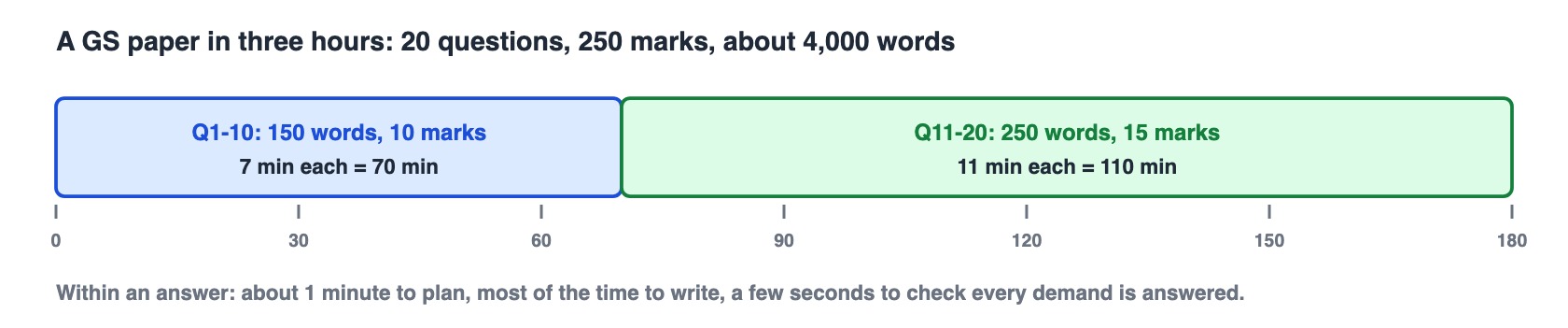
How the three hours divide between the ten short and ten long answers.
How to Use This Playlist
🔎 Looking for a particular past question? Open the question finder and search it for any word from the question.
The articles in this playlist
01 Reading the question: the directive words UPSC actually uses, counted from 21 papers, and how to break a question into its demands.
02 Structure and time: introduction, body and conclusion for 150- and 250-word answers, with a word budget for each part.
03 Value addition: data, reports, judgments, Articles, examples and quick diagrams, and where to find each.
04-07 Model answers: real questions from GS I, II, III and IV answered in full, with notes on why each part scores.
09 More model answers: terror funding and the FATF (GS III 2026) and BRICS and the Global South (GS II 2026).
08 Self-check and practice: a rubric to mark your own answers and a daily routine (read it last).
How to use it with the subject playlists
Each subject article on TrackNation ends with the real Mains questions on that topic. After reading an article, write one of them in the time limit, then mark it with the rubric in article 08.
The For your Mains answer sections being added to the subject articles collect the data, reports, judgments and sketches worth using. Use them as your value-addition bank.
Write by hand. The exam is handwritten, and speed comes only from practice on paper.
Three habits that matter most
Habit | Why |
Answer every part of the question | Each part carries marks; a missed part cannot be made up elsewhere |
Attempt all twenty questions | The last five answers are worth as much as the first five |
Take a view where asked | UPSC tests the ability to weigh conflicting goals, not to list them |
Further Reading
PIB press releases, ministry websites and annual reports, the Gazette of India, MEA and UN documents and the official sources named in each note — the primary sources behind every fact above.
Test Yourself: Practice Questions
12 questions on how the Mains papers are set and marked.
Practice Questions
Q1. According to the UPSC notification, the Main examination is intended to assess
(a) overall intellectual traits and depth of understanding
(b) handwriting and speed
(c) memory of facts and dates
(d) only the range of information
Show answer
Answer: (a) — The notification adds: rather than merely the range of information and memory.
Q2. How many questions are there in GS Papers I, II and III, and how many must be answered?
(a) Twenty-five; any twenty
(b) Twelve; all compulsory
(c) Twenty; any fifteen
(d) Twenty; all compulsory
Show answer
Answer: (d) — All twenty are compulsory.
Q3. In GS I-III, answers to Questions 11-20 should be in
(a) 200 words
(b) 150 words
(c) 300 words
(d) 250 words
Show answer
Answer: (d) — Questions 1-10 are 150 words.
Q4. In the 2026 GS II paper, a 150-word answer carried
(a) 20 marks
(b) 15 marks
(c) 10 marks
(d) 12.5 marks
Show answer
Answer: (c) — 250-word answers carried 15 marks.
Q5. The written papers counted for merit total
(a) 1,750 marks
(b) 2,025 marks
(c) 1,250 marks
(d) 2,000 marks
Show answer
Answer: (a) — Adding the 275-mark personality test gives 2,025.
Q6. GS Paper IV has
(a) twenty questions
(b) two case studies only
(c) fifteen questions
(d) twelve questions in two sections
Show answer
Answer: (d) — Section A is theory, Section B case studies.
Q7. Consider the following statements:
1. Papers A and B are qualifying and not counted for merit.
2. Paper B is English, 300 marks.
3. The personality test carries 250 marks.
Which of the statements given above are correct?
(a) 1 and 2 only
(b) 2 and 3 only
(c) 1 and 3 only
(d) 1, 2 and 3
Show answer
Answer: (a) — 1 and 2 are correct. The personality test carries 275 marks.
Q8. Writing all twenty answers to the word limits in a GS paper means about
(a) 4,000 words
(b) 3,000 words
(c) 2,500 words
(d) 5,000 words
Show answer
Answer: (a) — 10 × 150 + 10 × 250 = 4,000.
Q9. A time plan that fits a three-hour GS paper is
(a) 15 minutes per answer
(b) 9 minutes per 10-marker and 15 per 15-marker
(c) 5 minutes per answer
(d) 7 minutes per 10-marker and 11 per 15-marker
Show answer
Answer: (d) — 70 + 110 = 180 minutes.
Q10. The notification says GS questions are pitched so that
(a) a well-educated person can answer without specialised study
(b) they test the optional subject
(c) they need coaching notes
(d) only specialists can answer
Show answer
Answer: (a) — Depth of reasoning matters more than obscure facts.
Q11. What must be done with a page left blank in the answer booklet?
(a) Nothing
(b) It must be clearly struck off
(c) It must be signed
(d) It must be torn out
Show answer
Answer: (b) — This is printed in the paper's instructions.
Q12. An answer written in a medium other than the one authorised in the Admission Certificate
(a) is sent for translation
(b) gets no marks
(c) is marked normally
(d) loses 10 per cent
Show answer
Answer: (b) — The instruction is printed on every paper.
Mains Practice Questions
Use these to frame full-length answers. You don't have to answer one exactly — they show the angles UPSC tests, so let them guide which points you cover.
What does 'relevant, meaningful and succinct' mean for a 150-word answer?
Why does attempting all twenty questions usually matter more than polishing a few?
How would you divide three hours across a GS paper?