How to Read a UPSC Mains Question: The Directive Words UPSC Actually Uses, Counted from 21 Papers
The Directive Words UPSC Uses
🎯 Exam priority: High-yield. Most lost marks come from answering a different question from the one asked. Learn to read the question before you learn anything else.
The directive words UPSC actually uses
We counted the directive words in all 21 GS I, II and III papers of 2019 and 2021-2026 (420 questions). A question with two directives counts twice, and 'critically examine' is counted inside 'examine'.
Directive word | Times used | What the examiner wants (working meaning) |
Discuss | 106 | Several sides or dimensions, with reasons and examples, ending in a balanced view |
Explain | 67 | How and why something works or happened: causes, mechanism, effects |
Examine | 41 | Look into the claim or issue in detail, test it with evidence, and conclude |
Comment | 27 | Your reasoned opinion on a statement, after weighing for and against |
Analyse | 22 | Break the issue into parts, show how they relate, and draw an inference |
Suggest | 18 | Practical measures, each tied to a problem you have named |
Describe / Elaborate | 14 each | Features and details, with little judgment needed |
Evaluate | 10 | Judge worth or success against criteria; give a verdict |
Elucidate | 10 | Make clear with explanation and examples |
To what extent | 7 | A measured verdict: how far the claim holds and where it fails |
Justify | 6 | Defend a position with arguments and evidence |
Distinguish | 6 | Differences, best in a table |
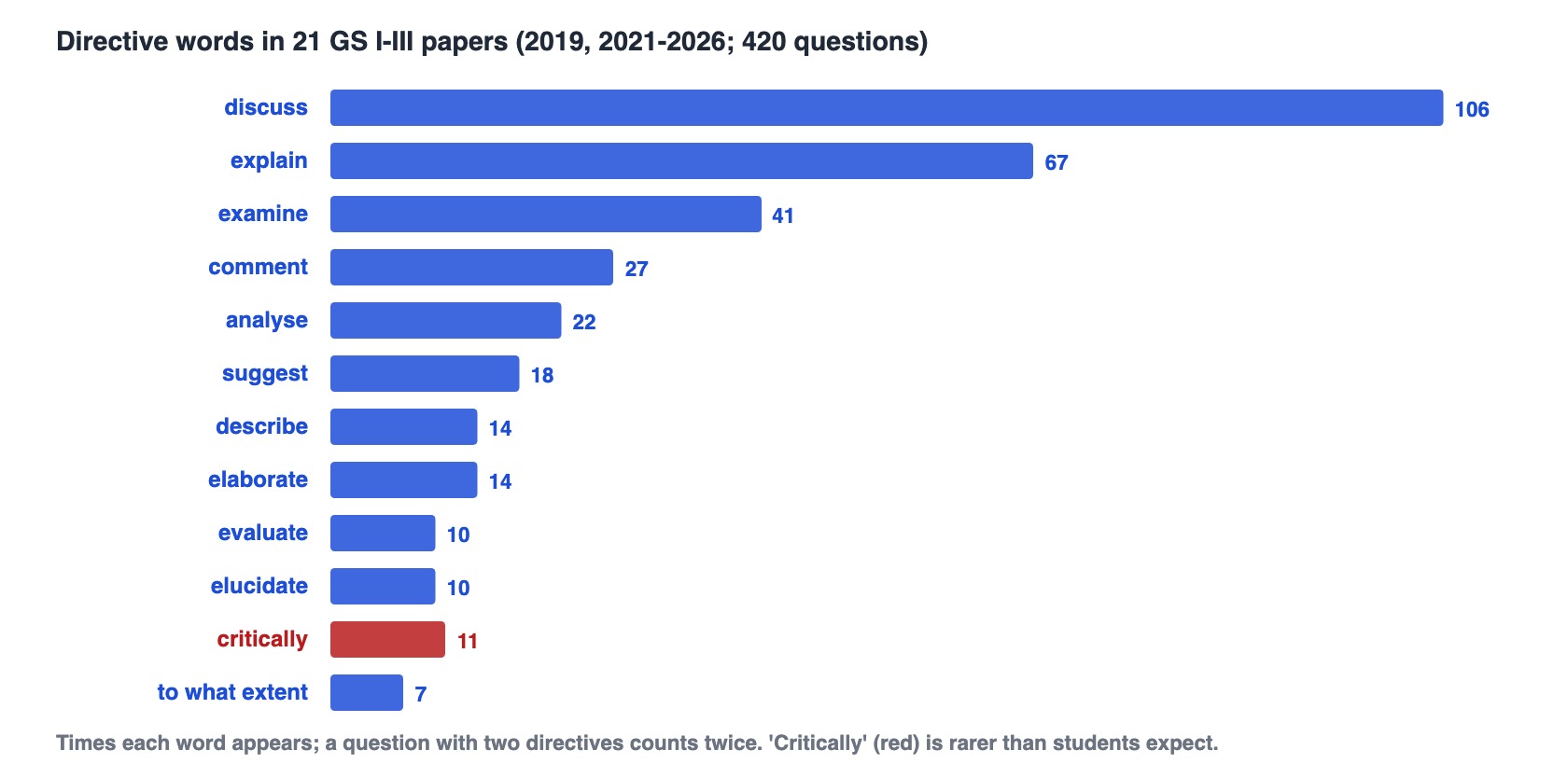
The directive words UPSC actually uses, counted from 21 papers.
Three things stand out:
'Discuss' and 'explain' dominate. Together they appear 173 times. Most questions want explanation with balance, not a verdict alone.
'Critically' is rarer than students think: 11 times in 420 questions. When it appears, it may come after the verb ("Examine this statement critically", GS I 2026, on tundra regions) as well as before it.
Most questions have more than one directive. 'Discuss ... Mention ... Suggest' in one question is normal, and each verb is a separate demand with its own marks.
UPSC does not publish definitions of these words. The meanings in the table are working meanings: what an answer must do so that no part of the demand is left out.
Breaking a Question into Its Demands
Breaking a question into its demands
Before writing, underline each directive and number the demands. Then give each demand its share of the word limit. A real example from GS III 2026 (Question 19, 15 marks, 250 words):
Separatist movements have been one of the major factors contributing to militancy and instability in Jammu & Kashmir. Bring out actions taken by the Government to bring J&K into the national mainstream. Discuss pre and post abrogation status of Articles 370 and 35A. Also bring out positive impacts of abrogation...
Demand | Directive | Words (of about 250) |
Context: separatism as a driver of militancy | (statement) | 25-30 in the introduction |
Government actions for mainstreaming | Bring out | about 70 |
Articles 370 and 35A, before and after | Discuss | about 70 (a two-column table saves words) |
Positive impacts of abrogation | Bring out | about 55 |
Balanced close | — | 20-25 |
An answer that spends 200 words on history and 50 on the rest has covered one demand of three. The plan takes 30 seconds and protects most of the marks.
Questions that start from a quotation
GS II 2026 opened one 15-mark question with: "Transparency and accountability in governance are not about controlling corruption but about creating the trust of stakeholders in the policy process by following the Rule of Law and Participatory Governance." Then: Comment. Such a question asks you to:
state what the quotation claims in one line of your own words;
agree where it holds, with evidence (for example, RTI and social audit build trust, not only punish corruption);
qualify where it overreaches (controlling corruption is itself a large part of building trust);
end with your own balanced position.
Questions with a choice built in
"Should education be treated primarily as a welfare obligation of the state or as a strategic investment ...? Critically evaluate." (GS II 2026). Here a one-sided answer loses marks. Weigh both framings, show where each is right, and conclude, often that they are complementary, with a reason.
A Reading Routine and Common Misreadings
A five-step reading routine (about one minute)
Underline the directive(s) and number each demand.
Circle the keywords that limit the scope: a time period ("post-reforms"), a place ("in India"), a lens ("from the perspective of accountability").
Spot the hidden demand: 'with suitable examples' means examples are marked; 'in the context of' means the context must appear in the body, not only the introduction.
Decide your view if the directive needs one (comment, evaluate, to what extent, do you agree).
Budget the words across demands before you start.
Common misreadings
Question says | Weak answer does | Strong answer does |
Distinguish between X and Y (GS III 2026: fast breeder vs thermal reactor) | Two separate paragraphs | A comparison table on the same criteria |
Discuss the position of the Governor ... Is he bound by aid and advice in all functions? (GS II 2026) | Only describes the Governor's powers | Answers each sub-question directly, including 'No, not in discretionary functions', with the Article |
Mention India's commitments ... giving suitable examples (GS III 2026) | Lists commitments only | Names commitments and gives at least two examples |
Examine this statement critically | Agrees and elaborates | Tests both halves of the statement and concludes |
Practice
Take any five questions from the end of a subject article. For each, write only the plan: the directives, the numbered demands and the word budget. Five plans take ten minutes and train the habit faster than full answers.
Further Reading
PIB press releases, ministry websites and annual reports, the Gazette of India, MEA and UN documents and the official sources named in each note — the primary sources behind every fact above.
Test Yourself: Practice Questions
12 questions on reading Mains questions.
Practice Questions
Q1. In the GS I-III papers of 2019 and 2021-2026, which directive word appears most often?
(a) Critically examine
(b) Justify
(c) Discuss
(d) Comment
Show answer
Answer: (c) — Discuss appears 106 times, explain 67.
Q2. How many times does 'critically' appear in those 420 questions?
(a) 60
(b) 106
(c) 11
(d) 41
Show answer
Answer: (c) — It is rarer than students think.
Q3. A 'distinguish between' question is best answered with
(a) two unrelated paragraphs
(b) a single definition
(c) a flowchart only
(d) a comparison table on the same criteria
Show answer
Answer: (d) — Same criteria on both sides make the differences visible.
Q4. 'Comment' on a quotation asks you to
(a) weigh for and against and give a reasoned view
(b) only summarise the quotation
(c) list facts
(d) only agree
Show answer
Answer: (a) — State the claim, agree where it holds, qualify where it overreaches, conclude.
Q5. 'With suitable examples' in a question means
(a) examples should be foreign
(b) examples are part of what is marked
(c) only one example is allowed
(d) examples are optional
Show answer
Answer: (b) — It is a hidden demand.
Q6. The 2026 GS III question on J&K had how many distinct demands after the opening statement?
(a) Three
(b) Five
(c) Two
(d) One
Show answer
Answer: (a) — Government actions, Articles 370 and 35A before and after, and the positive impacts.
Q7. Which directive asks for a measured verdict on how far a claim holds?
(a) Elucidate
(b) To what extent
(c) Describe
(d) Enumerate
Show answer
Answer: (b) — It appears 7 times in the 420 questions.
Q8. Consider the following statements:
1. UPSC publishes official definitions of directive words.
2. A question can contain several directives, each with its own marks.
3. Planning the demands before writing protects marks.
Which of the statements given above are correct?
(a) 1 and 2 only
(b) 2 and 3 only
(c) 1 and 3 only
(d) 1, 2 and 3
Show answer
Answer: (b) — 2 and 3 are correct. UPSC does not publish definitions.
Q9. 'Suggest measures' is best answered by
(a) only government schemes
(b) measures each tied to a problem you have named
(c) a list of slogans
(d) the history of the issue
Show answer
Answer: (b) — Measures without problems read as generic.
Q10. The 2026 GS II education question asked candidates to
(a) critically evaluate two framings of education
(b) compare India with the USA
(c) describe NEP 2020 only
(d) list schemes
Show answer
Answer: (a) — Welfare obligation or strategic investment.
Q11. In the five-step reading routine, circling words like 'post-reforms' or 'in India' does what?
(a) Sets the word count
(b) Adds a value point
(c) Picks the directive
(d) Limits the scope of the answer
Show answer
Answer: (d) — Scope words stop the answer drifting.
Q12. How long should the reading-and-planning routine take?
(a) No time at all
(b) About one minute
(c) About ten minutes
(d) Half the time for the question
Show answer
Answer: (b) — A minute of planning saves the most marks.
Mains Practice Questions
Use these to frame full-length answers. You don't have to answer one exactly — they show the angles UPSC tests, so let them guide which points you cover.
Pick a 2026 question with three directives and write only its plan.
What is the difference between 'discuss' and 'critically evaluate' in practice?
How do you handle a question that begins with a quotation?