Structure of a UPSC Mains Answer: Introduction, Body and Conclusion, with Word Budgets for 150 and 250 Words
Introduction, Body, Conclusion
🎯 Exam priority: High-yield. A clear structure lets the examiner find your points in seconds. Learn one structure well and use it for every answer.
The three parts
Part | Job | 150-word answer (10 marks) | 250-word answer (15 marks) |
Introduction | Define, set context or state the core fact; show you understood the question | 20-25 words, 1-2 lines | 30-40 words, 2-3 lines |
Body | Answer every demand, in the order asked, under short headings | about 100-110 words | about 170-190 words |
Conclusion | A balanced view, a way forward or a link to a constitutional or SDG goal | 15-20 words | 25-30 words |
The paper itself sets the totals: 150 words for Questions 1-10 (10 marks) and 250 words for Questions 11-20 (15 marks). The split inside is yours, but keep the body at two-thirds or more. That is where the demands are answered.
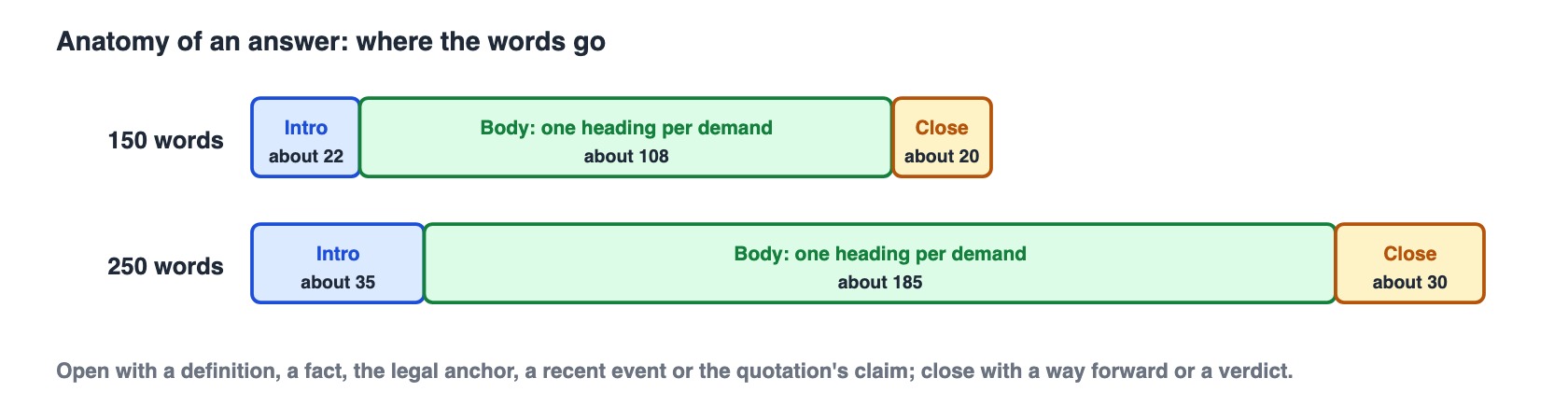
Where the words go in a 150-word and a 250-word answer.
Five ways to open
Definition: for 'what is' questions (for example, "What is agentic AI?", GS III 2026).
A fact or figure from an official source: a law's year, a survey number, a report's finding.
The constitutional or legal anchor: the Article or Act the question turns on.
A recent event that makes the question live, in one line.
Restating a quotation's claim in your own words, for 'comment' questions.
Avoid long background, a quotation of your own, and phrases like "since time immemorial". The introduction must lead straight into the demand.
Building the Body
Building the body
One heading per demand, in the order asked. If the question says "Analyse ... Also discuss the challenges ... and measures", the body has three headings: analysis, challenges, measures.
Points, not paragraphs, but full sentences. Each point starts with its idea in a few words, then one line of explanation or evidence.
Dimensions help you think of points. For most GS II and III questions, run quickly through: constitutional/legal, political, economic, social, administrative, environmental, technological, international. Use only the ones that fit.
Evidence on every second or third point: a figure, a committee, a judgment, a scheme, an example from a state.
A diagram where it saves words: a flowchart, a cycle or a two-column table is often worth 40 words.
A worked plan
GS III 2026, Question 18 (15 marks, 250 words): "Community participation is the cornerstone of effective disaster management". Analyse this statement with suitable examples from India. Also discuss the challenges to community participation and measures to strengthen it.
Part | Content | Words |
Introduction | Communities are the first responders before outside help arrives; the shift from relief to preparedness needs them | 35 |
Analysis with Indian examples | Why it works (local knowledge, first hour, ownership); two or three examples, e.g. cyclone preparedness, volunteer schemes | 85 |
Challenges | Low awareness, weak local plans, exclusion of the vulnerable, little funding at the local level | 50 |
Measures | Train volunteers, village disaster plans, include women and the disabled, link to local bodies | 55 |
Conclusion | Community as partner, not just beneficiary; link to the Sendai Framework's all-of-society engagement | 25 |
Article 06 writes this answer in full with the facts and their sources.
Conclusions, Presentation and Time
Conclusions that score
Type | When to use | Example line |
Way forward | Problem-and-solution questions | A short list of two or three priority steps |
Balanced verdict | Comment, evaluate, to what extent | The claim holds for X but not for Y; on balance ... |
Constitutional value | Polity, rights, governance | Link to the Preamble's justice, liberty, equality or to a Directive Principle |
Goal link | Economy, environment, social sector | Link to a national target or an SDG |
Do not introduce new facts in the conclusion and do not repeat the introduction. Two lines are enough.
Presentation
Short headings, underlined sparingly (keywords only, not whole lines).
Leave a line between parts so the structure is visible at a glance.
Write the question number clearly; answer in the space given.
Neat beats fancy. Boxes and colours do not earn marks; clear points do.
Precise words: replace the vague with the exact
Vague | Precise | Why it scores |
many people migrated | about 80 lakh people migrated (NCERT) | a sourced figure shows depth |
recently | in 2025; in March 2026 | a date shows currency |
the government has done a lot | name the scheme and a number (Jan Dhan: over 54 crore accounts) | the examiner can check it |
the Court said rights matter | name the case and the holding (Maneka Gandhi, 1978) | precision on the law |
it is very important | say why, in one clause | reasoning, not emphasis |
in conclusion, we can say that | start the conclusion with the verdict itself | saves words and time |
Every word should carry a fact, a reason or a link. If a sentence can lose five words without losing meaning, cut them: 150 and 250 words are limits, not targets.
Time inside an answer
For a 15-mark answer in 11 minutes: about 1 minute reading and planning, 9 minutes writing, 1 minute checking that every demand is answered. For a 10-marker in 7 minutes: 1 minute plan, 5½ writing, ½ check. If you are behind, shorten the body of the current answer; do not skip the next question.
Practice drill
Take two real questions, one 10-marker and one 15-marker (for example, "Analyse the advantages and limitations of the generalist structure of the Indian Civil Services" and "Explain the key challenges for India's energy security ..." from 2026). Write them in 7 and 11 minutes. Count the words. Then mark them with the rubric in article 08.
Further Reading
PIB press releases, ministry websites and annual reports, the Gazette of India, MEA and UN documents and the official sources named in each note — the primary sources behind every fact above.
Test Yourself: Practice Questions
12 questions on structuring Mains answers.
Practice Questions
Q1. In a 150-word answer, the body should be about
(a) 30 words
(b) 50 words
(c) 140 words
(d) 100-110 words
Show answer
Answer: (d) — At least two-thirds of the answer goes to the demands.
Q2. The body of an answer should be organised
(a) as one long paragraph
(b) by the student's favourite topics
(c) one heading per demand, in the order asked
(d) chronologically always
Show answer
Answer: (c) — The examiner checks demand by demand.
Q3. Which opening suits a 'What is agentic AI?' question?
(a) A quotation
(b) A conclusion
(c) A definition
(d) A history of computers
Show answer
Answer: (c) — 'What is' questions open with a definition.
Q4. A conclusion should
(a) repeat the introduction
(b) be as long as the body
(c) give a balanced view or way forward without new facts
(d) introduce new data
Show answer
Answer: (c) — Two lines are enough.
Q5. For a 15-mark answer in 11 minutes, planning should take about
(a) 3 minutes
(b) No time
(c) 1 minute
(d) 5 minutes
Show answer
Answer: (c) — Then about 9 minutes writing and 1 minute checking.
Q6. A diagram is worth using when
(a) it is decorative
(b) it saves words or shows a process clearly
(c) you cannot write
(d) the answer is too short
Show answer
Answer: (b) — A flowchart or table can replace 40 words.
Q7. Consider the following statements:
1. The 150/250-word split is set by the question paper.
2. The split between introduction, body and conclusion is the candidate's choice.
3. Boxes and colours earn extra marks.
Which of the statements given above are correct?
(a) 1 and 2 only
(b) 2 and 3 only
(c) 1 and 3 only
(d) 1, 2 and 3
Show answer
Answer: (a) — 1 and 2 are correct. Presentation helps readability, not marks by itself.
Q8. If you are running behind time, you should
(a) write faster with no structure
(b) leave the conclusion and the next two questions
(c) shorten the current answer and move on
(d) skip the next question
Show answer
Answer: (c) — A skipped question scores zero.
Q9. The 2026 GS III disaster question had how many headings in the body?
(a) Five
(b) Three: analysis, challenges, measures
(c) Two
(d) One
Show answer
Answer: (b) — One per demand.
Q10. Running through dimensions such as legal, economic, social and administrative helps to
(a) fill the word count
(b) replace evidence
(c) think of points quickly
(d) choose the directive
Show answer
Answer: (c) — Use only the dimensions that fit the question.
Q11. How often should a point carry evidence such as a figure, committee or judgment?
(a) Every second or third point
(b) Only in the introduction
(c) Only in the conclusion
(d) Never
Show answer
Answer: (a) — Evidence shows depth.
Q12. A 'balanced verdict' conclusion suits which directives?
(a) List
(b) Define
(c) Describe, enumerate
(d) Comment, evaluate, to what extent
Show answer
Answer: (d) — They ask for a judgment.
Mains Practice Questions
Use these to frame full-length answers. You don't have to answer one exactly — they show the angles UPSC tests, so let them guide which points you cover.
Plan a 250-word answer to any 2026 question in this format.
Which opening would you use for a question that starts with a quotation, and why?
Write two conclusions for the same question: a way forward and a balanced verdict.