Read This First: How UPSC Tests Ethics, Integrity and Aptitude (GS4), with Every Question of 2021-2026 Mapped
What GS4 Is and Its Syllabus
🎯 Start here. This playlist covers General Studies Paper IV, Ethics, Integrity and Aptitude, in the order of the UPSC syllabus: 15 articles, each built from official sources (the Second Administrative Reforms Commission's reports on ethics, citizen-centric administration and RTI, the Acts and conduct rules, the Constituent Assembly Debates, NCERT, and open philosophy and psychology textbooks) and each mapped to the actual GS4 questions of 2021-2026.
What the paper is
Feature | Detail |
Paper | Paper V of the Main examination: General Studies IV, 250 marks (of 1,750 for the written papers) |
Format | Twelve compulsory questions in two sections |
Section A | Concepts, thinkers, quotations: parts of 10 marks, 150 words each (about 130 marks) |
Section B | Six case studies of 20 marks, 250 words each (120 marks) |
Purpose (UPSC's words) | To test the candidate's attitude and approach to integrity, probity in public life and problem-solving in conflicts faced in dealing with society, possibly through case studies |
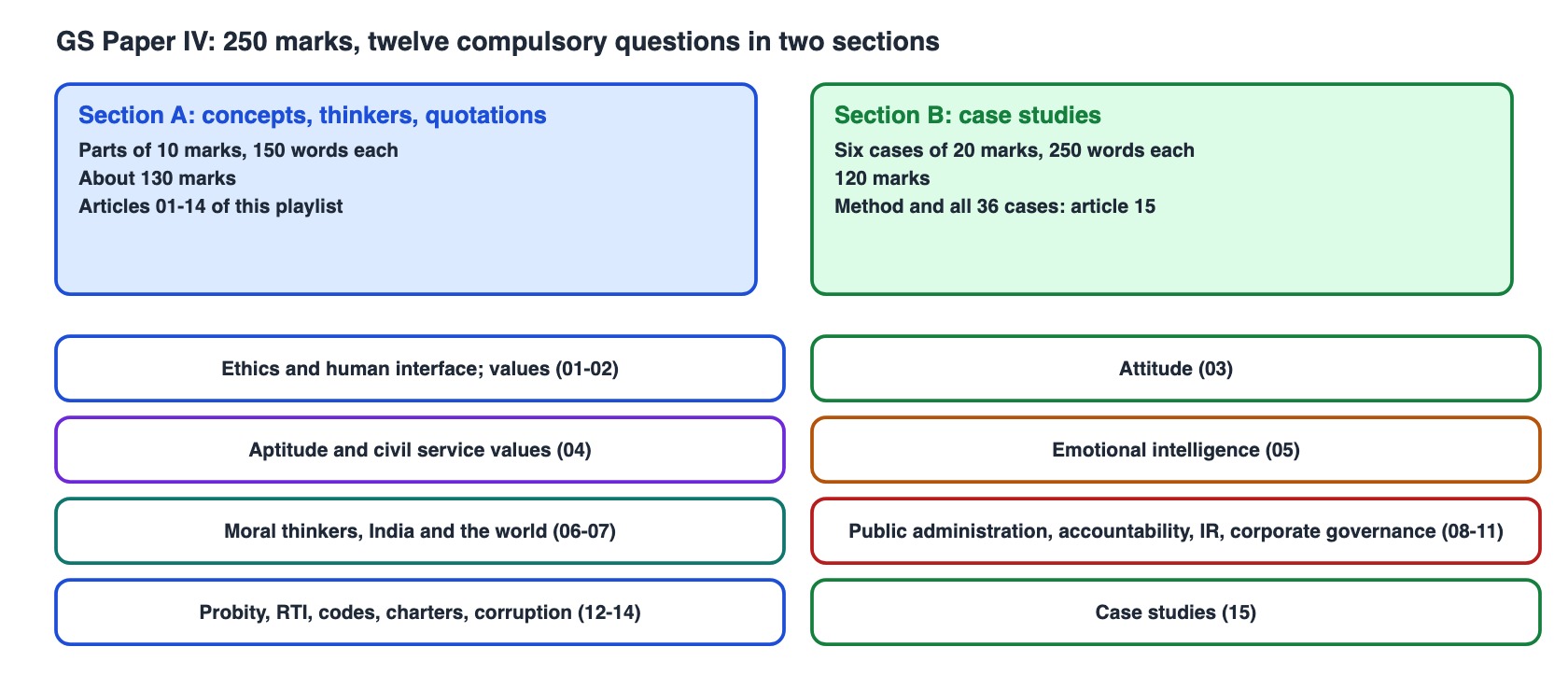
GS Paper IV at a glance: two sections, eight syllabus blocks, and the article that covers each.
GS4 is the one Mains paper where the syllabus is short and the questions are predictable in type. Marks come from precise concepts, real examples, and a clear method for case studies, not from memorising facts.
The syllabus in eight blocks
Ethics and human interface; human values, lessons from great lives, role of family, society and education (articles 01-02).
Attitude: content, structure, function, moral and political attitudes, social influence and persuasion (03).
Aptitude and foundational values of the civil service (04).
Emotional intelligence (05).
Moral thinkers from India and the world (06-07).
Public service values and ethics in public administration, accountability, international relations and funding, corporate governance (08-11).
Probity in governance: public service, RTI, codes, citizens' charters, work culture, service delivery, public funds, corruption (12-14).
Case studies on all of the above (15).
Where the Questions Come From
Where the questions come from (2021-2026)
We classified every Section A question part from the 2021-2026 papers (about 77 in all) by the article that answers it. The three quotation questions each year make "values" the largest block; administration, international ethics and civil service values follow.
Article | Theme | Section A parts, 2021-2026 |
02 | Values and quotation questions (three quotations every year) | 15 |
08 | Ethics in public administration: dilemmas, conscience, constitutional morality, AI | 10 |
10 | International relations, security, aid and climate | 9 |
04 | Foundational values of the civil service | 7 |
09 | Accountability, social audit, Mission Karmayogi, BNS | 7 |
06 | Western thinkers, bioethics, duty vs charity | 5 |
07 | Indian thinkers: Guru Nanak, Mahavira, Gandhi, Ambedkar | 4 |
12 | Probity, good governance, RTI | 4 |
13 | Codes, charters, work culture, public funds | 4 |
01 | Ethics and the human interface | 3 |
03 | Attitude and persuasion | 3 |
05 | Emotional intelligence | 2 |
11 | Corporate governance and CSR | 2 |
14 | Corruption and whistle-blowers | 2 |
15 | Case studies (Section B) | 36 cases |
Five patterns to prepare for
Quotations every year (three, 30 marks): Vivekananda appears most often, along with Gandhi, Kant, the Dalai Lama, Thiruvalluvar and others (article 02 has every one).
A named Indian thinker since 2023: Guru Nanak, Mahavira, Ambedkar and Gandhi's trusteeship (article 07).
Technology: digital decision-making (2021), AI in administration (2024), social media (2025), AI-written evaluations and AI policing (2026).
Global ethics: refugees, wars, aid, arms, climate and security vs rights, every year since 2021 (article 10).
Institutions and reforms: Mission Karmayogi, BNS, codes of ethics, social audit, whistle-blowers (articles 09, 13, 14).
How to Use This Playlist
How to use this playlist
Read articles 01-07 first: they give the vocabulary (values, attitude, EI, theories, thinkers) that every answer uses.
Then 08-14: the governance half, with laws and reports you can cite (AIS Conduct Rules, RTI Act, PC Act 2018, Lokpal Act, Whistle Blowers Act, 2nd ARC).
Then 15, and practise one case a day with the six-step method.
Build an example bank: for each value, one administrator, one scheme and one current event.
Write, don't just read: each article ends with practice questions and the real GS4 questions it answers.
What examiners reward
Do | Avoid |
Define the term precisely, then apply it | Vague moralising |
Use a real example: a scheme, a law, a case, a thinker | Hypothetical examples only |
Balance: both sides, then a reasoned position | One-sided answers |
Lawful and humane courses of action | Illegal shortcuts, however kind |
Short paragraphs, headings, a closing line on the civil servant's role | Long unbroken text |
Further Reading
PIB press releases, ministry websites and annual reports, the Gazette of India, MEA and UN documents and the official sources named in each note — the primary sources behind every fact above.
Test Yourself: Practice Questions & PYQs
12 questions on the paper and the playlist.
Practice Questions
Q1. General Studies Paper IV of the Civil Services Main examination carries
(a) 200 marks
(b) 250 marks
(c) 275 marks
(d) 300 marks
Show answer
Answer: (b) — It is Paper V of the Main examination: Ethics, Integrity and Aptitude.
Q2. How many questions are in the GS4 paper?
(a) Eight
(b) Fifteen
(c) Twenty, choose any ten
(d) Twelve, all compulsory
Show answer
Answer: (d) — Divided into two sections.
Q3. Section B of GS4 consists of
(a) six case studies of 20 marks each
(b) four essays
(c) MCQs
(d) twelve short notes
Show answer
Answer: (a) — 120 marks in all, 250 words per case.
Q4. Section A answers in GS4 usually carry
(a) 15 marks and 200 words
(b) 10 marks and 150 words per part
(c) 5 marks and 50 words
(d) 20 marks and 250 words
Show answer
Answer: (b) — Section A carries about 130 marks.
Q5. According to the UPSC syllabus preamble, GS4 tests the candidate's
(a) attitude and approach to integrity, probity and problem-solving
(b) knowledge of Indian history
(c) knowledge of foreign languages
(d) mathematical ability
Show answer
Answer: (a) — It may use the case study approach.
Q6. Which theme has appeared every year from 2021 to 2025 in GS4 Section A?
(a) Three quotations of great thinkers
(b) Map questions
(c) Questions on the Rajya Sabha
(d) Questions on monetary policy
Show answer
Answer: (a) — They carry about 30 marks.
Q7. Consider the following statements:
1. Emotional intelligence is in the GS4 syllabus.
2. Corporate governance is in the GS4 syllabus.
3. Ancient Indian art is in the GS4 syllabus.
Which of the statements given above are correct?
(a) 1 and 2 only
(b) 2 and 3 only
(c) 1 and 3 only
(d) 1, 2 and 3
Show answer
Answer: (a) — 1 and 2 are correct. Art and culture belong to GS1.
Q8. Which named Indian thinkers appeared in GS4 from 2023 to 2026?
(a) Guru Nanak, Mahavira, Ambedkar and Gandhi
(b) Tagore and Raja Ravi Varma
(c) Kalidasa and Bhasa
(d) Aryabhata and Varahamihira
Show answer
Answer: (a) — Article 07 covers their teachings and relevance.
Q9. Which technology themes appeared in recent GS4 papers?
(a) None
(b) Only space missions
(c) Only nuclear energy
(d) AI in decision-making, social media ethics and AI policing
Show answer
Answer: (d) — Technology ethics is a growing pattern.
Q10. What share of the written Main examination's 1,750 marks does GS4 carry?
(a) 300
(b) 250
(c) 500
(d) 175
Show answer
Answer: (b) — Each of the four GS papers carries 250.
Q11. The best way to prepare for Section B is to
(a) memorise thinkers' birth dates
(b) practise a method on real past cases
(c) read only newspapers
(d) skip it
Show answer
Answer: (b) — Article 15 maps all 36 cases of 2021-2026.
Q12. Which source does this playlist rely on most for governance ethics?
(a) Newspaper editorials
(b) The Second Administrative Reforms Commission's reports
(c) Coaching notes
(d) Social media posts
Show answer
Answer: (b) — Its 4th Report, Ethics in Governance (2007), is the core text.
Mains Practice Questions
Use these to frame full-length answers. You don't have to answer one exactly — they show the angles UPSC tests, so let them guide which points you cover.
What does GS4 test, and how is it different from the other GS papers?
Which themes recur most in GS4, 2021-2026?
How would you plan your GS4 preparation in eight weeks?
UPSC Mains — Previous Years’ Questions on this topic (last 10 years)
These are the actual GS Mains questions UPSC has asked on this theme — real proof of how, and when, it is tested. Try to write a full answer to each.
Every GS4 question of 2021-2026 is mapped to an article in this playlist: see the table above and the Mains questions at the end of each article.