Read This First: How UPSC Tests World History in GS1, with Every Question of 2019-2026 Mapped
The Syllabus and This Playlist
🎯 Start here. This playlist covers world history for GS Paper 1 in twelve articles, from the Enlightenment to globalisation, built from NCERT (Class 10 India and the Contemporary World II, Class 11 Themes in World History, Class 12 Contemporary World Politics) and OpenStax World History Volume 2, with every GS1 world-history question of 2019 and 2021-2026 mapped.
The syllabus
UPSC's GS1 syllabus says world history "will include events from 18th century such as industrial revolution, world wars, redrawal of national boundaries, colonization, decolonization, political philosophies like communism, capitalism, socialism etc., their forms and effect on the society". The playlist follows that span in chronological order:
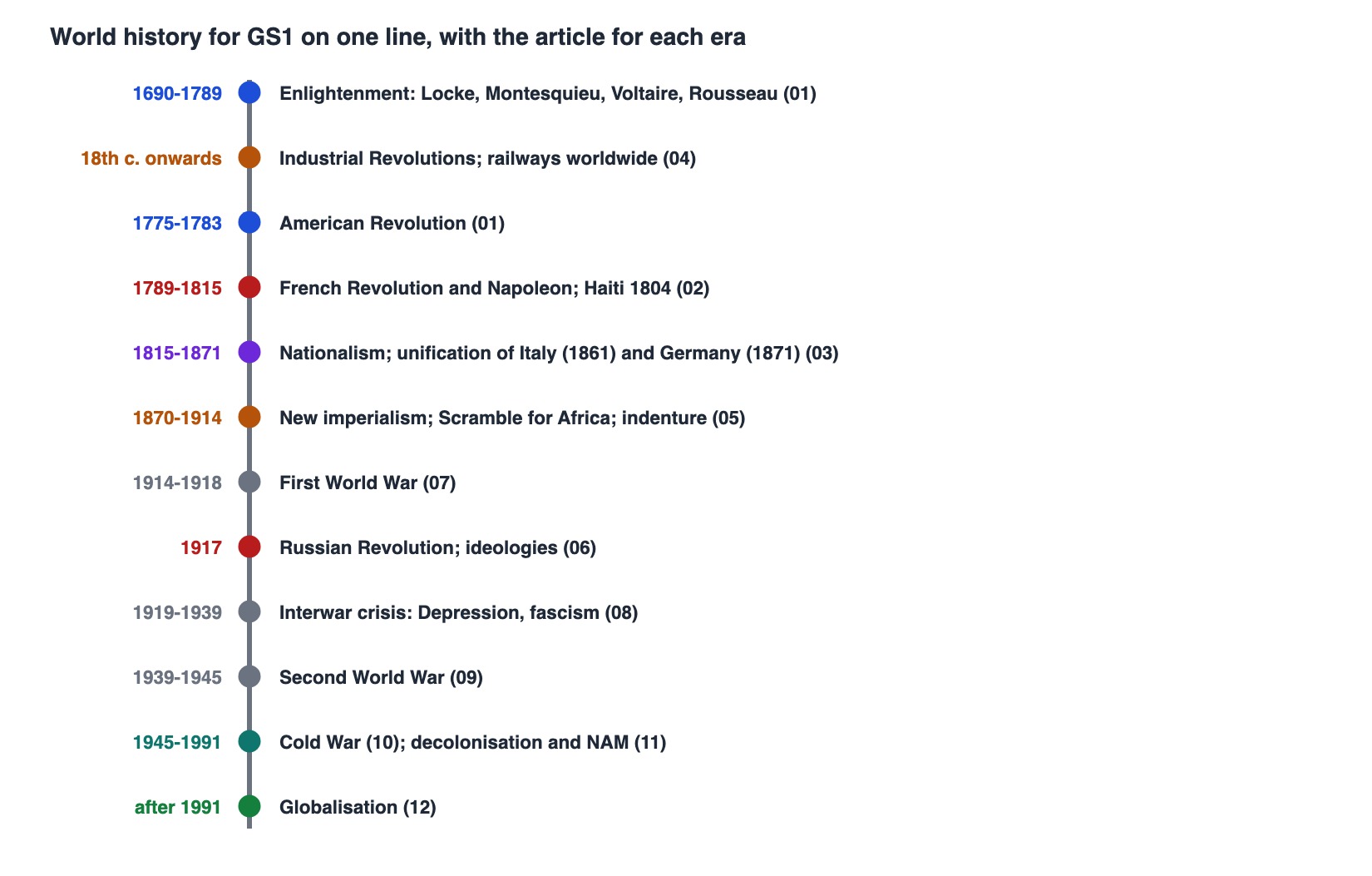
Modern world history on one line, with the article that covers each era.
The Enlightenment and the American Revolution (01)
The French Revolution, Napoleon and Haiti (02)
Nationalism and the unification of Germany and Italy (03)
The Industrial Revolution, railways and Indian handicrafts (04)
Imperialism and colonialism (05)
Capitalism, socialism, communism and the Russian Revolution (06)
The First World War (07)
The interwar crisis: Depression, fascism and the League (08)
The Second World War (09)
The Cold War (10)
Decolonisation and non-alignment (11)
Globalisation (12)
What UPSC Has Asked
What UPSC has asked
World history gets about one question a year in GS1 (none in 2022 or 2026). The questions are analytical ("how far", "evaluate", "explain how") and favour the revolutions, the world wars and industrialisation.
Year | Question (theme) | Article |
2019 | How the American and French Revolutions laid the foundations of the modern world | 01, 02 |
2021 | The serious challenge to the democratic state system between the two World Wars | 08 |
2023 | Socio-economic effects of railways in different countries | 04 |
2024 | Was the First World War fought essentially to preserve the balance of power? | 07 |
2024 | Industrial Revolution in England and the decline of Indian handicrafts | 04 |
2025 | The French Revolution's enduring relevance to the contemporary world | 02 |
Patterns
Revolutions (American, French) asked twice in seven papers: know their causes, ideas and legacy.
India-linked questions: the Industrial Revolution and Indian crafts, railways. World history is often asked through its effect on India.
"How far" questions: they want a balanced answer: accept part of the claim, add other causes, and conclude with a judgment.
How to Use This Playlist
How to use this playlist
Read in order: each article builds on the last (the Enlightenment explains the revolutions; the revolutions explain nationalism; industrialisation explains imperialism; and so on).
For each article, learn a timeline of five to eight dates and three "big ideas" (causes, effects, legacy).
Link every topic to India: the French Revolution to the Preamble, industrialisation to de-industrialisation, the world wars to the freedom struggle, the Cold War to non-alignment.
Practise the six real questions above; each article ends with model approaches.
Answer-writing tips for world history
Do | Avoid |
Open with context and a clear thesis | A narrative retelling of events |
Use dates and named examples sparingly but precisely | Long lists of dates |
Balance causes and weigh them ('essentially', 'how far') | A single-cause explanation |
Connect to India and the present | Treating world history as unrelated to India |
Further Reading
PIB press releases, ministry websites and annual reports, the Gazette of India, MEA and UN documents and the official sources named in each note — the primary sources behind every fact above.
Test Yourself: Practice Questions & PYQs
12 questions on the syllabus and the playlist, then all GS1 world-history questions of 2019-2026.
Practice Questions
Q1. From which century does the UPSC GS1 world-history syllabus begin?
(a) The 18th century
(b) The 12th century
(c) The 15th century
(d) The 20th century
Show answer
Answer: (a) — It lists the industrial revolution, world wars, colonisation, decolonisation and political philosophies.
Q2. Which world-history theme was asked in both 2019 and 2025?
(a) The Cold War
(b) Decolonisation
(c) The Russian Revolution
(d) The French Revolution
Show answer
Answer: (d) — 2019 paired it with the American Revolution.
Q3. The 2024 GS1 paper asked whether the First World War was fought essentially to preserve
(a) colonies only
(b) free trade
(c) democracy
(d) the balance of power
Show answer
Answer: (d) — Article 07 gives a balanced answer.
Q4. Which 2024 question linked world history to India?
(a) The Haitian Revolution
(b) The Industrial Revolution and the decline of Indian handicrafts
(c) The unification of Italy
(d) The Cuban Missile Crisis
Show answer
Answer: (b) — See article 04.
Q5. The 2021 question on the challenge to the democratic state system concerned the period
(a) during the Cold War
(b) after 1991
(c) before 1789
(d) between the two World Wars
Show answer
Answer: (d) — See article 08.
Q6. The 2023 question asked about the socio-economic effects of
(a) railways in different countries
(b) the internet
(c) the steam engine only
(d) the printing press
Show answer
Answer: (a) — See article 04.
Q7. Consider the following statements:
1. Political philosophies such as communism and capitalism are in the GS1 syllabus.
2. Decolonisation is in the GS1 syllabus.
3. Ancient Greek history is in the GS1 world-history syllabus.
Which of the statements given above are correct?
(a) 1 and 2 only
(b) 2 and 3 only
(c) 1 and 3 only
(d) 1, 2 and 3
Show answer
Answer: (a) — 1 and 2 are correct. The syllabus begins in the 18th century.
Q8. In which years of 2019-2026 did GS1 carry no world-history question?
(a) 2019 and 2021
(b) 2025 only
(c) 2022 and 2026
(d) 2023 and 2024
Show answer
Answer: (c) — About one question a year otherwise.
Q9. 'How far' questions in world history expect
(a) a single cause
(b) a balanced judgment weighing several causes
(c) a biography
(d) a list of dates
Show answer
Answer: (b) — Accept part, add other causes, conclude with a judgment.
Q10. Which NCERT book provides this playlist's chapters on nationalism in Europe and industrialisation?
(a) Class 12 Themes in Indian History
(b) Class 6 Our Pasts
(c) Class 10 India and the Contemporary World II
(d) Class 9 Democratic Politics
Show answer
Answer: (c) — Class 11 and Class 12 political science books are also used.
Q11. The Preamble's 'liberty, equality, fraternity' links India's Constitution to
(a) the Industrial Revolution
(b) the Russian Revolution
(c) the French Revolution
(d) the Cold War
Show answer
Answer: (c) — A useful India link for 2025-type questions.
Q12. Which open textbook supplements NCERT in this playlist?
(a) A newspaper series
(b) Wikipedia
(c) A coaching module
(d) OpenStax World History Volume 2
Show answer
Answer: (d) — It is a peer-reviewed, openly licensed textbook.
Mains Practice Questions
Use these to frame full-length answers. You don't have to answer one exactly — they show the angles UPSC tests, so let them guide which points you cover.
Which world-history themes recur in GS1, and why?
How would you link world history topics to India in answers?
Plan a one-week revision of this playlist.
UPSC Mains — Previous Years’ Questions on this topic (last 10 years)
These are the actual GS Mains questions UPSC has asked on this theme — real proof of how, and when, it is tested. Try to write a full answer to each.
2019 (GS-I): Explain how the foundations of the modern world were laid by the American and French Revolutions.
2021 (GS-I): "There arose a serious challenge to the Democratic State System between the two World Wars." Evaluate the statement.
2023 (GS-I): Bring out the socio-economic effects of the introduction of railways in different countries of the world.
2024 (GS-I): How far is it correct to say that the First World War was fought essentially for the preservation of balance of power?
2024 (GS-I): How far was the Industrial Revolution in England responsible for the decline of handicrafts and cottage industries in India?
2025 (GS-I): The French Revolution has enduring relevance to the contemporary world. Explain.