Nationalism in Europe for UPSC GS1: Vienna 1815, Liberalism, 1830 and 1848, the Unification of Germany and Italy, and the Balkans
Conservatism, Liberalism and the Rise of Nationalism
🎯 Exam priority: Foundational (Mains GS1). The syllabus names the "redrawal of national boundaries" and political philosophies. Nationalism explains the map of modern Europe, the unifications of Italy and Germany, and the Balkan rivalries that led to the First World War (article 07). Know the sequence and the key figures.
After Napoleon: conservatism and the Vienna settlement (1815)
Britain, Russia, Prussia and Austria, who had defeated Napoleon, met at the Congress of Vienna, hosted by the Austrian Chancellor Metternich. The Treaty of Vienna (1815) aimed to undo the changes of the Napoleonic wars: the Bourbons were restored in France, France lost Napoleon's annexations, and a series of states (such as the kingdom of the Netherlands, including Belgium) was set up on France's borders to prevent French expansion. The ruling spirit was conservatism: the belief that traditional institutions (monarchy, the Church, social hierarchies, property, the family) should be preserved, with only gradual change.
Liberalism and nationalism
Liberalism (from the Latin liber, free) meant, for the new middle classes, individual freedom and equality before the law, government by consent, a constitution and representative government, and, economically, free markets. In 1834 a customs union (Zollverein) formed at Prussia's initiative abolished tariff barriers among most German states and cut the number of currencies from over thirty to two; an economist wrote that its aim was "to bind the Germans economically into a nation".
Revolutions of 1830: in July 1830 liberals in France overthrew the Bourbons and installed a constitutional monarchy under Louis Philippe. "When France sneezes," Metternich said, "the rest of Europe catches cold."
Greece: the war of independence from the Ottoman Empire began in 1821, drew sympathy across Europe (the poet Lord Byron died there of fever in 1824), and ended with the Treaty of Constantinople (1832) recognising Greece.
Romanticism and culture: art, poetry, folk songs and language shaped national feeling. Herder held that the true spirit of the nation (volksgeist) lay among the common people (das volk); the Grimm brothers collected German folktales as national heritage.
1848: revolutions across Europe; in the German lands, an elected Frankfurt parliament met in the Church of St Paul and drafted a constitution for a German nation under a monarchy subject to a parliament, but it was crushed by the monarchy and army backed by the Prussian landowning Junkers.
The Unification of Germany and Italy
The unification of Germany
After 1848, Prussia took the lead. Its chief minister Otto von Bismarck was the architect of unification, using the Prussian army and bureaucracy. Three wars over seven years, with Austria, Denmark and France, ended in Prussian victory. In January 1871 the new German Empire was proclaimed in the Hall of Mirrors at Versailles, headed by Kaiser William I of Prussia: unification from above, demonstrating the dominance of Prussian state power.
The unification of Italy
Figure | Role |
Giuseppe Mazzini (born Genoa, 1805) | Revolutionary idealist; member of the Carbonari; founded Young Italy (Marseilles) and Young Europe (Berne); believed nations were the natural units of mankind |
Count Cavour | Chief minister of Sardinia-Piedmont; neither a revolutionary nor a democrat; a diplomatic alliance with France helped defeat Austria in 1859 |
Giuseppe Garibaldi | Led the Expedition of the Thousand (1860) into South Italy and the Kingdom of the Two Sicilies, winning peasant support |
Victor Emmanuel II | King of Sardinia-Piedmont; proclaimed king of united Italy in 1861 |
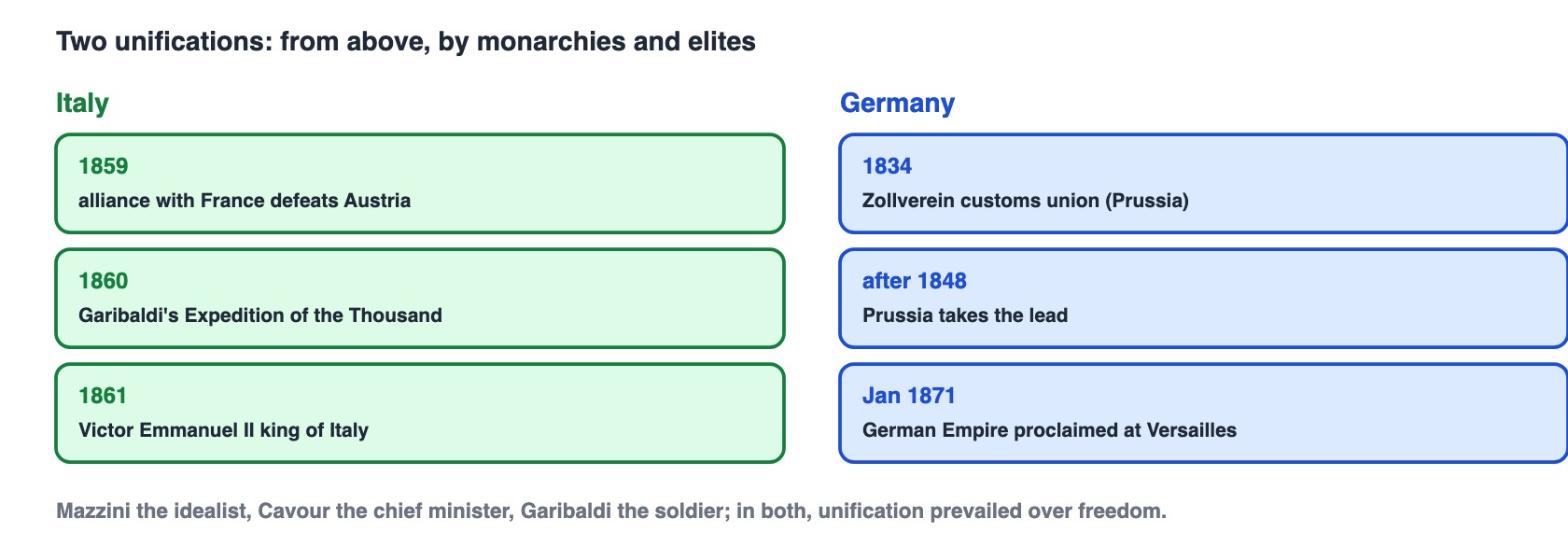
Italy and Germany: two unifications from above.
In both cases, OpenStax notes, the desire for unification prevailed over the desire for freedom: new states were born, but under monarchies and elites, not democracies. Many Italian peasants, largely illiterate, remained unaware of liberal-nationalist ideas.
Britain: a nation forged differently
Britain's nation-state formed through a long process rather than a revolution: the Act of Union (1707) joined England and Scotland into the United Kingdom of Great Britain, with England at its centre.
Symbols, the Balkans and Lessons
Visualising the nation
Nations were imagined through symbols: female allegories such as Marianne (France, on coins and stamps) and Germania (Germany, with a crown of oak leaves for heroism); flags, anthems and maps. In 1882 the French philosopher Ernst Renan, in "What is a Nation?", rejected the idea that a nation is formed by a common language, race, religion or territory: a nation is "the culmination of a long past of endeavours, sacrifice and devotion", and its existence is "a daily plebiscite".
From liberal nationalism to the Balkan powder keg
After 1871, nationalism lost its liberal-democratic idealism and became narrow and aggressive, a tool of rival empires. The Balkans, a region of many Slav peoples largely under the declining Ottoman Empire, became the most serious source of tension: romantic nationalism, Ottoman disintegration, jealous rivalries among Balkan states, and big power rivalry (Russia, Germany, England, Austria-Hungary) over trade, colonies and military might made it explosive, a direct path to the First World War.
Why it matters for India
Indian nationalism differed from the European pattern: it was anti-colonial, built a nation of many languages and faiths, and was tied to mass democracy. The European story also warns how nationalism can turn exclusive and militarist, a contrast useful in GS1 and Essay answers.
Further Reading
PIB press releases, ministry websites and annual reports, the Gazette of India, MEA and UN documents and the official sources named in each note — the primary sources behind every fact above.
Test Yourself: Practice Questions & PYQs
12 practice questions on nationalism in Europe.
Practice Questions
Q1. The Congress of Vienna (1815) was hosted by
(a) the Austrian Chancellor Metternich
(b) Napoleon
(c) Cavour
(d) Bismarck
Show answer
Answer: (a) — It aimed to undo the changes of the Napoleonic wars.
Q2. The Treaty of Vienna of 1815 restored to power in France
(a) Louis Philippe
(b) the Bourbon dynasty
(c) Napoleon
(d) the Directory
Show answer
Answer: (b) — Conservatism dominated European governments after 1815.
Q3. 'Liberalism' comes from the Latin root 'liber', meaning
(a) nation
(b) people
(c) law
(d) free
Show answer
Answer: (d) — For the middle classes it meant individual freedom and equality before the law.
Q4. The Zollverein, formed in 1834, was
(a) a customs union in the German lands
(b) a French constitution
(c) a secret society in Italy
(d) a Prussian army reform
Show answer
Answer: (a) — It abolished tariff barriers to bind the Germans economically into a nation.
Q5. Greece was recognised as an independent nation by the
(a) Treaty of Paris, 1783
(b) Treaty of Vienna, 1815
(c) Treaty of Constantinople, 1832
(d) Treaty of Versailles, 1919
Show answer
Answer: (c) — The war of independence began in 1821.
Q6. Who argued that the true spirit of a nation (volksgeist) lay among the common people?
(a) Bismarck
(b) Johann Gottfried Herder
(c) Ernst Renan
(d) Metternich
Show answer
Answer: (b) — He was a German Romantic philosopher.
Q7. Germany was unified after three wars over seven years against
(a) the Ottomans, Russia and Denmark
(b) Italy, Spain and Austria
(c) Russia, Britain and France
(d) Austria, Denmark and France
Show answer
Answer: (d) — The German Empire was proclaimed at Versailles in January 1871.
Q8. Young Italy was founded by
(a) Cavour
(b) Giuseppe Mazzini
(c) Garibaldi
(d) Victor Emmanuel II
Show answer
Answer: (b) — He also founded Young Europe in Berne.
Q9. The Expedition of the Thousand into South Italy in 1860 was led by
(a) Napoleon III
(b) Garibaldi
(c) Cavour
(d) Mazzini
Show answer
Answer: (b) — It won the support of local peasants.
Q10. Consider the following statements:
1. Victor Emmanuel II was proclaimed king of united Italy in 1861.
2. Cavour was neither a revolutionary nor a democrat.
3. Italy was unified by a popular democratic republic.
Which of the statements given above are correct?
(a) 1 and 2 only
(b) 2 and 3 only
(c) 1 and 3 only
(d) 1, 2 and 3
Show answer
Answer: (a) — 1 and 2 are correct. Unification came under the monarchy of Sardinia-Piedmont.
Q11. After 1871, the most serious source of nationalist tension in Europe was
(a) the Low Countries
(b) Scandinavia
(c) the Iberian peninsula
(d) the Balkans
Show answer
Answer: (d) — Ottoman decline and big power rivalry made it explosive.
Q12. The allegory of the French nation on coins and stamps was
(a) Britannia
(b) Germania
(c) Marianne
(d) Helvetia
Show answer
Answer: (c) — Germania wore a crown of oak leaves.
Mains Practice Questions
Use these to frame full-length answers. You don't have to answer one exactly — they show the angles UPSC tests, so let them guide which points you cover.
Compare the unification of Italy and Germany.
How did liberal nationalism in early 19th-century Europe turn into aggressive nationalism by 1914?
What role did culture play in creating national identity in 19th-century Europe?
UPSC Mains — Previous Years’ Questions on this topic (last 10 years)
These are the actual GS Mains questions UPSC has asked on this theme — real proof of how, and when, it is tested. Try to write a full answer to each.
No GS1 question on 19th-century European nationalism was set in 2019 or 2021-2026; the theme underpins the 2024 question on the First World War and the balance of power (article 07).