The French Revolution for UPSC GS1: Causes, Phases 1789-1815, the Rights of Man, Napoleon, the Haitian Revolution and Enduring Relevance
Causes and Phases of the French Revolution
🎯 Exam priority: High-yield (Mains GS1). The French Revolution is the most-asked world-history event: 2019 (with the American Revolution, foundations of the modern world) and 2025 (its enduring relevance to the contemporary world). Know the causes, the phases with dates, the ideas, and the legacy.
Causes
A society of privilege: the clergy (First Estate) and nobility (Second Estate) were exempt from most taxes; the burden fell on the Third Estate, about 95% of the population (peasants, the urban poor and the wealthy bourgeoisie). Voting by estate let the two privileged orders outvote the Third.
Crisis: famines and economic crises in the 18th century, debts of the Crown, and hunger among peasants and the urban poor.
Ideas: the Enlightenment's natural rights, popular sovereignty and the example of the American Revolution.
Phases of the Revolution
Date | Event |
1789 | Louis XVI summons the Estates General to raise taxes; the Third Estate, joined by many clergy, meets as the National Assembly |
14 July 1789 | Storming of the Bastille, a fortress-prison in Paris; peasants refuse taxes and seize land |
1789 | Declaration of the Rights of Man and of the Citizen: natural rights, representative government, equality before the law, freedom of expression |
1791 | A constitution and a Legislative Assembly; Olympe de Gouges's Declaration of the Rights of Woman and of the Female Citizen |
January 1793 | Execution of Louis XVI |
1793-1794 | Reign of Terror under Robespierre's Committee of Public Safety: 'liberty, equality, fraternity', grain price controls, divorce legalised, slavery abolished (1794), but mass executions |
July 1794 | Robespierre executed; the Terror ends |
1795 | Constitution creating the five-member Directory |
1799-1815 | The Directory invites General Napoleon Bonaparte to form a more authoritarian government (1799); he declares himself emperor (1804), abdicates after the failed invasion of Russia (1814), returns and is finally defeated at Waterloo by the British and Prussians (1815) |
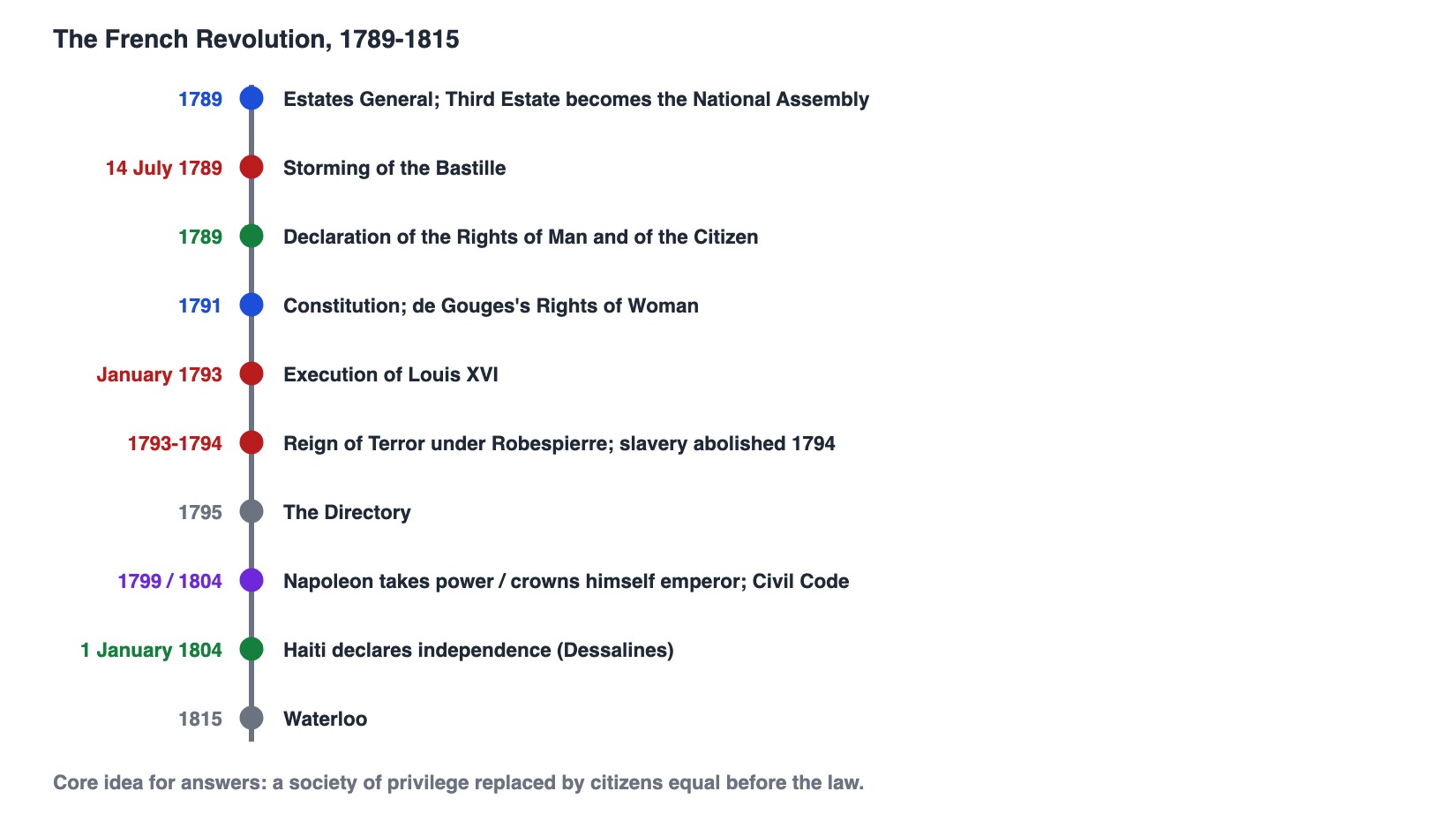
The French Revolution from 1789 to 1815, with Haiti's independence.
The Nation, Napoleon and the Haitian Revolution
The Revolution and the idea of the nation
The NCERT text shows how the Revolution transferred sovereignty from the monarchy to the citizens and built a collective national identity: the ideas of la patrie (the fatherland) and le citoyen (the citizen); a new flag, the tricolour; the Estates General renamed the National Assembly; new hymns, oaths and martyrs; a centralised administration with uniform laws; abolition of internal customs duties and a uniform system of weights and measures; and Parisian French as the national language.
Napoleon
He destroyed democracy in France but made administration rational. The Civil Code of 1804 (the Napoleonic Code) abolished privileges based on birth, established equality before the law and secured the right to property.
In conquered lands (the Dutch Republic, Switzerland, Italy, Germany) he abolished feudalism and freed peasants from serfdom and manorial dues, removed guild restrictions and improved transport, while imposing taxes, censorship and conscription, which turned many against French rule.
He also reinstated slavery in France's colonies, showing the limits of revolutionary equality.
The Haitian Revolution: the most radical break
In the French colony of Saint-Domingue, enslaved people met at Bois Caiman in August 1791 and rose in revolt.
France abolished slavery in 1794; Toussaint Louverture, a formerly enslaved military leader, led the colony, but Napoleon tried to restore French control and slavery in 1802 and Louverture died in a French prison.
Jean-Jacques Dessalines declared Haiti's independence on 1 January 1804; plantation lands were redistributed among formerly enslaved and free Black people. In 1825 France imposed a crushing independence debt on it.
Legacy and Answer Frames
Enduring relevance (2025)
Legacy | In the contemporary world |
Liberty, equality, fraternity | The Preamble of India's Constitution names all three |
Declaration of the Rights of Man | A forerunner of bills of rights and the Universal Declaration of Human Rights |
Popular sovereignty and the nation of citizens | Democracy and nationalism worldwide, including anti-colonial movements |
Secularism and equality before the law | End of privileges by birth; uniform civil and criminal codes |
Rational administration | Uniform laws for all citizens and uniform weights and measures |
Women's rights claimed (de Gouges) and slavery abolished (1794) | The continuing struggle to make rights universal |
The Terror and Napoleon | A warning that revolutions can devour liberty: the need for constitutional limits |
Answer frame for 2019 and 2025
Open with the core idea: the Revolution replaced a society of privilege with one of citizens equal before the law, holding sovereignty themselves. Then give three to five legacies with present-day examples (Indian Preamble, human rights law, nationalism, secularism). Add the Haitian Revolution to show how far the ideas could go, and the Terror and Napoleon's restoration of slavery to show their limits. Conclude: its ideals remain the vocabulary of democratic politics everywhere, while its excesses teach why liberty needs institutions.
Further Reading
PIB press releases, ministry websites and annual reports, the Gazette of India, MEA and UN documents and the official sources named in each note — the primary sources behind every fact above.
Test Yourself: Practice Questions & PYQs
12 practice questions, then the GS1 questions on the French Revolution.
Practice Questions
Q1. In pre-revolutionary France, the Third Estate made up about what share of the population?
(a) 95%
(b) 10%
(c) 50%
(d) 75%
Show answer
Answer: (a) — It carried most of the tax burden; the clergy and nobility were largely exempt.
Q2. In 1789 Louis XVI summoned the Estates General mainly to
(a) approve new taxes and economic reform
(b) elect a president
(c) declare war on Britain
(d) abolish the monarchy
Show answer
Answer: (a) — The Third Estate then met separately as the National Assembly.
Q3. The Bastille, stormed on 14 July 1789, was
(a) a fortress-prison in Paris
(b) the royal palace at Versailles
(c) the parliament building
(d) a church
Show answer
Answer: (a) — 14 July is commemorated every year as France's national holiday.
Q4. Which document upheld natural rights and mandated representative government and equality before the law in 1789?
(a) Declaration of Independence
(b) The Napoleonic Code
(c) Declaration of the Rights of Man and of the Citizen
(d) The Social Contract
Show answer
Answer: (c) — Olympe de Gouges answered it in 1791 with a declaration of women's rights.
Q5. The Reign of Terror (1793-1794) was led by
(a) Napoleon
(b) Louis XVI
(c) the Directory
(d) Robespierre and the Committee of Public Safety
Show answer
Answer: (d) — It also abolished slavery and legalised divorce.
Q6. The Directory established by the 1795 constitution was
(a) a royal council
(b) an executive council of five men
(c) a parliament of nobles
(d) a single dictator
Show answer
Answer: (b) — Napoleon overthrew it in 1799.
Q7. The Civil Code of 1804 (Napoleonic Code)
(a) abolished private property
(b) restored feudalism
(c) gave women equal rights
(d) abolished privileges based on birth and established equality before the law
Show answer
Answer: (d) — It also secured the right to property.
Q8. Consider the following statements:
1. The revolutionaries promoted the ideas of la patrie and le citoyen.
2. They abolished internal customs duties and adopted uniform weights and measures.
3. They encouraged regional dialects over French.
Which of the statements given above are correct?
(a) 1 and 2 only
(b) 2 and 3 only
(c) 1 and 3 only
(d) 1, 2 and 3
Show answer
Answer: (a) — 1 and 2 are correct. Regional dialects were discouraged.
Q9. Who declared Haiti's independence on 1 January 1804?
(a) Napoleon
(b) Toussaint Louverture
(c) Simon Bolivar
(d) Jean-Jacques Dessalines
Show answer
Answer: (d) — Louverture had died in a French prison.
Q10. In 1825 France imposed on Haiti
(a) slavery again
(b) an independence debt
(c) a ban on sugar exports
(d) a new constitution
Show answer
Answer: (b) — It crippled Haiti's economy for years.
Q11. Which revolutionary slogan appears in the Preamble of India's Constitution in the form of its ideals?
(a) Life, liberty, property
(b) Unity, faith, discipline
(c) Peace, land, bread
(d) Liberty, equality, fraternity
Show answer
Answer: (d) — The French Revolution's battle cry.
Q12. Napoleon's policy towards slavery in France's colonies was to
(a) reinstate it
(b) compensate the enslaved
(c) abolish it
(d) ignore it
Show answer
Answer: (a) — This showed the limits of revolutionary equality.
Mains Practice Questions
Use these to frame full-length answers. You don't have to answer one exactly — they show the angles UPSC tests, so let them guide which points you cover.
The French Revolution has enduring relevance to the contemporary world. Explain.
How did the French Revolution create a sense of national identity?
Was Napoleon a destroyer or a preserver of the Revolution?
UPSC Mains — Previous Years’ Questions on this topic (last 10 years)
These are the actual GS Mains questions UPSC has asked on this theme — real proof of how, and when, it is tested. Try to write a full answer to each.
2025 (GS-I): The French Revolution has enduring relevance to the contemporary world. Explain.
2019 (GS-I): Explain how the foundations of the modern world were laid by the American and French Revolutions.