The Industrial Revolution for UPSC GS1: Britain, the Second Industrial Revolution, the Decline of Indian Handicrafts and Railways Worldwide
The First and Second Industrial Revolutions
🎯 Exam priority: Important (Mains GS1). The Industrial Revolution is the first item in the GS1 world-history syllabus. It was asked in 2024 (was it responsible for the decline of India's handicrafts?) and, through railways, in 2023 (their socio-economic effects in different countries).
Before the factory: proto-industrialisation
Industrial production did not start with factories. In the 17th and 18th centuries, merchants from European towns supplied money to peasants and artisans in the countryside to produce for an international market, a phase historians call proto-industrialisation.
The First Industrial Revolution (Britain, 18th century onwards)
Britain was first, mechanising production in the 18th century. Cotton led the first phase up to the 1840s; then iron and steel, driven by railways (in England from the 1840s, in the colonies from the 1860s).
Key inventions: Richard Arkwright's cotton mill brought production under one roof; James Watt improved Newcomen's steam engine and patented it in 1781. Adoption was slow: there were no more than 321 steam engines in England at the start of the 19th century.
Social cost: production shifted from skilled artisans to low-paid unskilled labour; workers lost control over their working conditions; cities grew crowded, polluted and diseased (cholera, tuberculosis), though cheap goods, sanitation and medicine later raised living standards and cut infant mortality.
The Second Industrial Revolution (late 19th century)
Britain, France, Belgium, Germany and the United States moved into steel, chemicals, rubber and machines, powered by electricity and the internal combustion engine, with new transport and communications. Canada, Italy, Russia and Japan followed. But India, Egypt, Latin America and China became export economies, supplying raw materials and markets for the industrialised world: industrialisation in the West and de-industrialisation in the colonies were two sides of one process.
The Industrial Revolution and Indian Handicrafts
Did the Industrial Revolution ruin Indian handicrafts? (2024)
The case for "yes":
Protection at home, free trade in India: British manufacturers pressed their government to impose import duties on cotton textiles so that Manchester goods faced no competition in Britain, while the East India Company sold British manufactures in Indian markets.
Flood of imports: at the end of the 18th century there was virtually no import of cotton piece-goods into India; by 1850 they were over 31% of the value of India's imports, and by the 1870s over 50%.
Double blow: weavers' export market collapsed and the local market shrank, glutted with cheap machine-made Manchester imports. By the 1850s most weaving regions reported "decline and desolation".
Raw cotton: when the American Civil War cut supplies, Britain turned to India; raw cotton exports rose and weavers were forced to buy cotton at exorbitant prices.
The case for "not entirely":
Decline had begun earlier through the Company's control: its paid agents (gomasthas) tied weavers to advances and fixed prices, provoking clashes.
Colonial policy, not technology alone, decided the outcome: one-sided tariffs, and an export economy that sent raw materials out and brought machine-made goods in.
Handlooms adapted and survived in coarse and specialised cloth; by 1941 over 35% of India's handlooms had fly shuttles.
Indian factory industry emerged: the first Bombay cotton mill (1854), the first Bengal jute mill (1855), entrepreneurs such as Dwarkanath Tagore, though machinery, railways and locomotives were mostly imported.
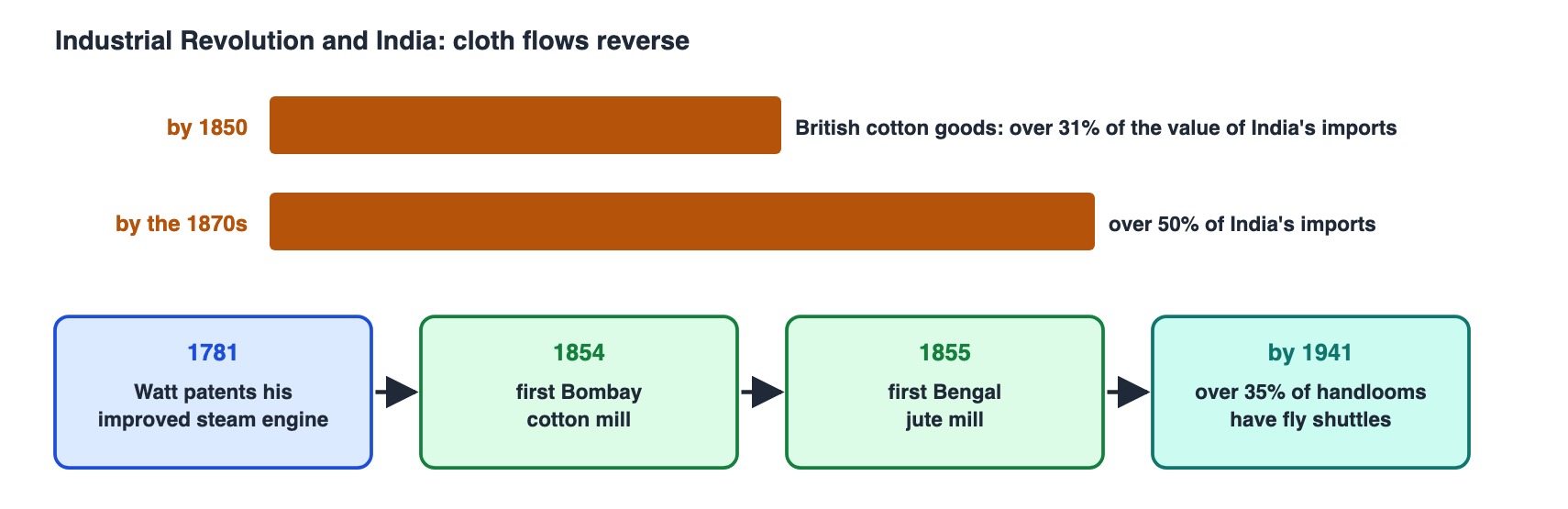
How the Industrial Revolution reversed India's cloth trade.
Verdict: the Industrial Revolution supplied the cheap goods, but colonial rule turned competition into de-industrialisation by denying India protection while protecting Britain. Dadabhai Naoroji called British rule Sakar ki Churi, "the knife of sugar": smooth and sweet, but a knife.
Railways Around the World
Railways around the world (2023)
Where | What railways did |
Britain (from the 1840s) | Drove demand for iron, steel and coal; created mass employment in construction; urban commuting and new cities |
Settler colonies: America, Australia | Linked newly cleared farmlands to ports, making them suppliers of food to Britain |
Russia | Sergei Witte's push; the line across Siberia begun in 1891; about 36,000 miles of track by 1900, opening the interior's resources |
Japan | Built railways as part of state-led Meiji modernisation |
Africa | Imperial projects such as Cecil Rhodes's proposed 'Cape to Cairo' line to bind British colonies |
India and the colonies (from the 1860s) | Expansion drove demand for British iron and steel; locomotives and machinery were imported; Naoroji counted railway loans among the material costs of British rule; Indian and Chinese indentured labourers also built lines abroad |
Socio-economic effects: a balanced answer
Economic: national markets, cheaper food and goods, industrial demand, but in colonies an export economy of raw materials and the ruin of local crafts.
Social: migration and urbanisation, new jobs in construction and transport, faster movement of people and news; also hard, often coerced labour in construction.
Political: tools of state consolidation and imperial control (troop movement), and later carriers of national movements.
Further Reading
PIB press releases, ministry websites and annual reports, the Gazette of India, MEA and UN documents and the official sources named in each note — the primary sources behind every fact above.
Test Yourself: Practice Questions & PYQs
12 practice questions, then the GS1 questions on industrialisation and railways.
Practice Questions
Q1. The phase when merchants financed rural producers for an international market before factories is called
(a) the putting-out ban
(b) de-industrialisation
(c) mercantilism
(d) proto-industrialisation
Show answer
Answer: (d) — It ran through the 17th and 18th centuries.
Q2. Which industry led the first phase of British industrialisation up to the 1840s?
(a) Chemicals
(b) Electricity
(c) Cotton
(d) Iron and steel
Show answer
Answer: (c) — Iron and steel took the lead with the railways.
Q3. James Watt patented his improved steam engine in
(a) 1781
(b) 1712
(c) 1830
(d) 1851
Show answer
Answer: (a) — He improved Newcomen's engine; adoption was slow.
Q4. The Second Industrial Revolution was powered especially by
(a) water wheels
(b) animal power
(c) wind mills
(d) electricity and the internal combustion engine
Show answer
Answer: (d) — It involved steel, chemicals and rubber.
Q5. By the 1870s, cotton piece-goods made up what share of the value of India's imports?
(a) About 31%
(b) About 10%
(c) Over 50%
(d) Over 90%
Show answer
Answer: (c) — It was over 31% by 1850.
Q6. Indian weavers in the 19th century faced the twin problem of
(a) free raw cotton and new patrons
(b) rising exports and rising wages
(c) protection and subsidies
(d) a collapsed export market and a shrinking local market
Show answer
Answer: (d) — The local market was glutted with Manchester imports.
Q7. Why did raw cotton become expensive for Indian weavers in the 1860s?
(a) The American Civil War made Britain turn to India for raw cotton
(b) Monsoon failure only
(c) Japanese competition
(d) A ban on cotton farming
Show answer
Answer: (a) — Raw cotton exports from India rose sharply.
Q8. The first cotton mill in Bombay came up in
(a) 1880
(b) 1854
(c) 1905
(d) 1818
Show answer
Answer: (b) — The first Bengal jute mill followed in 1855.
Q9. Construction of the railway across Siberia began in
(a) 1891
(b) 1861
(c) 1917
(d) 1905
Show answer
Answer: (a) — Russia had about 36,000 miles of track by 1900.
Q10. Consider the following statements:
1. India became an export economy of raw materials in the 19th century.
2. In colonial India, machinery and locomotives were mostly imported.
3. Indian handlooms vanished completely by 1900.
Which of the statements given above are correct?
(a) 1 and 2 only
(b) 2 and 3 only
(c) 1 and 3 only
(d) 1, 2 and 3
Show answer
Answer: (a) — 1 and 2 are correct. Handlooms survived and adapted, with fly shuttles in over 35% of looms by 1941.
Q11. Who called British rule 'Sakar ki Churi', the knife of sugar?
(a) Gopal Krishna Gokhale
(b) Bal Gangadhar Tilak
(c) Dadabhai Naoroji
(d) Mahatma Gandhi
Show answer
Answer: (c) — He was elected Congress president three times.
Q12. Cecil Rhodes's 'Cape to Cairo' railway was meant to
(a) join the Atlantic and Pacific
(b) link Britain's colonies in Africa
(c) cross Siberia
(d) connect India and Britain
Show answer
Answer: (b) — German East Africa blocked its path.
Mains Practice Questions
Use these to frame full-length answers. You don't have to answer one exactly — they show the angles UPSC tests, so let them guide which points you cover.
How far was the Industrial Revolution in England responsible for the decline of Indian handicrafts?
Bring out the socio-economic effects of railways in different countries.
Why did some countries industrialise in the 19th century while others became export economies?
UPSC Mains — Previous Years’ Questions on this topic (last 10 years)
These are the actual GS Mains questions UPSC has asked on this theme — real proof of how, and when, it is tested. Try to write a full answer to each.
2024 (GS-I): How far was the Industrial Revolution in England responsible for the decline of handicrafts and cottage industries in India?
2023 (GS-I): Bring out the socio-economic effects of the introduction of railways in different countries of the world.