Rectum and Anal Canal for NEET PG Surgery: Haemorrhoids, Fissure, Abscess, Fistula-in-Ano, Pilonidal Sinus, Prolapse, Anal Cancer and Anal Atresia
Start Here
🎯 Exam priority: High. Expect: internal vs external piles and the dentate line, classic positions, grades I–IV and matching treatment, banding rules, exclude cancer before blaming piles, fissure site, sentinel pile, GTN/diltiazem/botox and lateral sphincterotomy, abscess spaces and drainage, fistula tests and operations, Crohn fistulas, pilonidal sinus, procidentia vs piles, anal cancer and chemoradiation, and VACTERL.
CBME mapping: SU28.16–28.17.
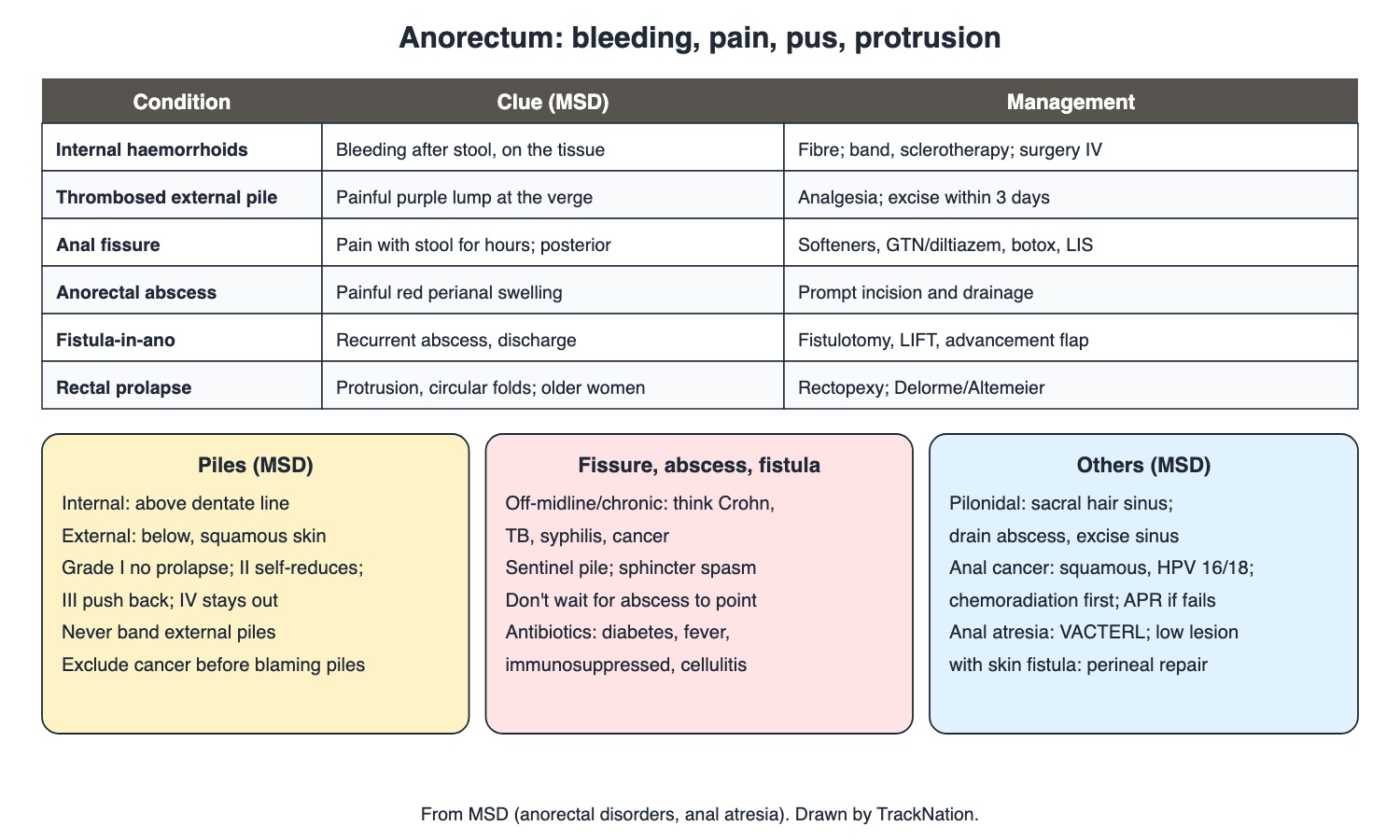
Anorectal conditions at a glance. Drawn by TrackNation.
Haemorrhoids (MSD)
Raised anorectal venous pressure: pregnancy, heavy lifting, straining. Internal: above the dentate line, rectal mucosa; external: below it, squamous skin. Typical sites: right anterior, right posterior, left lateral. Rectal varices from portal hypertension are a different thing.
Internal: bleeding after defecation onto the tissue, prolapse, mucus; not very painful. External: thrombosed → painful purple swelling. Strangulated piles necrose.
Grades: I no prolapse; II prolapse that reduces itself; III needs manual reduction; IV stays out. Anoscopy; exclude more serious causes (sigmoidoscopy/colonoscopy) before blaming piles.
Treatment: stool softeners, fibre, sitz baths. Thrombosed external pile: NSAIDs, or excision within 3 days. Grades I–II (some III): injection sclerotherapy (5% phenol in oil), rubber band ligation (never on external piles), infrared coagulation. Haemorrhoidectomy for grade IV or failures (pain, urinary retention, constipation); stapled haemorrhoidopexy: less pain, more recurrence.
Fissure, Abscess and Fistula (MSD)
Fissure: tear from hard stool; internal sphincter spasm keeps it ischaemic. Posterior midline (sometimes anterior); off-midline → think Crohn. Sentinel pile below, hypertrophied papilla above. Pain during and for hours after defecation, bleeding. Chronic fissures: exclude cancer, syphilis, TB, Crohn. Treat: softeners, fibre, sitz baths, topical GTN, nifedipine or diltiazem, or botulinum toxin; failure → internal anal sphincterotomy.
Abscess: from an anal crypt; perianal (superficial, very painful, fever rare), ischiorectal (can cross → horseshoe), supralevator (from diverticulitis/PID; toxic, few local signs). CT/MRI for deep or Crohn disease. Drain promptly — don't wait for it to point. Antibiotics only if fever, diabetes, immunosuppression, cellulitis. Fistulas may follow.
Fistula-in-ano: tract from anal canal to perianal skin; mostly cryptoglandular; also Crohn, TB, cancer, trauma. Recurrent abscess then discharge; a probe defines the tract. Fistulotomy (lay open) — risk of incontinence if much sphincter is cut; sphincter-saving LIFT or advancement flap; plugs/glue fail often. Crohn: avoid fistulotomy; metronidazole, infliximab.
Pilonidal, Prolapse, Cancer, Atresia (MSD)
Pilonidal disease: sacrococcygeal midline pits containing hair; young hirsute men. Abscess → incision and drainage; chronic sinus → excision with primary closure or laid open; flaps for big defects.
Rectal prolapse: mucosal prolapse common in infants (strap buttocks, stop straining). Procidentia = full-thickness; mostly women >60; circumferential folds (piles show radial ones), weak sphincter, incontinence. Adults: rectopexy if fit; perineal Delorme or Altemeier if not. Look for colonic or neurological disease.
Anal cancer: mostly squamous; HPV 16/18, receptive anal sex, HIV, smoking; bleeding with defecation; spreads to inguinal nodes. Chemoradiation first (high cure); APR only for residual or recurrent disease.
Anal atresia (imperforate anus): often with VACTERL anomalies; meconium in urine = urinary fistula; skin (perineal) fistula = low lesion → primary perineal repair; no perineal fistula = high → colostomy then later repair.
Traps the Examiner Sets
Never band an external pile; never blame piles before excluding cancer.
Lateral fissure → think Crohn.
Drain an abscess now — antibiotics alone are wrong.
Anal cancer: chemoradiation first, not APR.
Memory Hooks & Shortcuts
Shortcuts to lock in this article's numbers and lists. Each one only re-packages facts proven above.
🧠 Piles: 'Right gets two (anterior, posterior), Left gets one (lateral)' — positions
🧠 Grades: 'In, Out-In, Push-In, Stays Out' — grades
🧠 'Fissure Fires after Faeces' — pain for hours — fissure
🧠 'Pus needs a Pathway' — drain, don't wait to point — abscess
🧠 Anal cancer: 'Rays and drugs before the knife' — anal cancer
Rapid-Revision Cards
Internal piles
Above dentate; bleed.
External piles
Below dentate; thrombose.
Pile positions
RA, RP, LL.
Grades
I none, II self-reduce, III push, IV out.
Rectal bleeding
Exclude cancer first.
Thrombosed pile
Excise within 3 days.
Banding
Internal only.
Sclerosant
5% phenol in oil.
Haemorrhoidectomy
Grade IV or failure.
Fissure site
Posterior midline.
Lateral fissure
Crohn, TB, syphilis, cancer.
Sentinel pile
Below fissure.
Fissure Rx
GTN/diltiazem/botox → sphincterotomy.
Abscess
Drain now.
Horseshoe
Ischiorectal, both sides.
Fistula
Recurrent abscess + discharge.
Fistula ops
Fistulotomy; LIFT; flap.
Crohn fistula
Infliximab; no fistulotomy.
Pilonidal
Hair sinus; excise.
Procidentia
Circular folds; rectopexy.
Anal cancer
Squamous, HPV; chemoradiation.
Sources
Facts in this article were checked against these documents.
MSD Manual Professional: Hemorrhoids; Anal Fissure; Anorectal Abscess; Anorectal Fistula; Pilonidal Disease; Rectal Prolapse and Procidentia; Anal Cancer; Anal Atresia — Merck & Co. (MSD Manuals), 2025 (link)
Competency Based Undergraduate Curriculum, Vol III: General Surgery (SU28) — National Medical Commission, 2024
Test Yourself: Practice Questions
Thirty questions in NEET PG style, most of them clinical vignettes.
Practice Questions (NEET PG pattern)
Original questions written in the style of the exam: +4 for a correct answer, −1 for a wrong one. Every answer was checked against the sources listed above. NEET PG papers are not published by NBEMS, so these are not past-paper questions.
Q1. Internal haemorrhoids lie
(a) in the sigmoid colon
(b) below the dentate line, covered by skin
(c) above the dentate line, covered by rectal mucosa
(d) outside the anal verge only
Show answer
Answer: (c) — External are below.
Q2. Haemorrhoids are typically found in which positions?
(a) midline only
(b) left anterior, left posterior, right lateral
(c) circumferential always
(d) right anterior, right posterior, left lateral
Show answer
Answer: (d) — MSD.
Q3. A patient has bright red blood on the toilet paper after stools and a soft prolapse that goes back by itself. Grade:
(a) IV
(b) II internal haemorrhoids
(c) III
(d) I
Show answer
Answer: (b) — III needs manual reduction.
Q4. A prolapsed internal haemorrhoid that the patient must push back is grade
(a) II
(b) I
(c) IV
(d) III
Show answer
Answer: (d) — IV stays out.
Q5. A 55-year-old with known piles has new rectal bleeding. Before attributing it to piles you must
(a) reassure
(b) band immediately
(c) exclude more serious causes by sigmoidoscopy or colonoscopy
(d) give laxatives only
Show answer
Answer: (c) — Cancer.
Q6. A patient has a sudden, very painful purple lump at the anal verge for 2 days. Best option:
(a) haemorrhoidectomy of all piles
(b) rubber band ligation
(c) excision of the thrombosed external haemorrhoid
(d) sclerotherapy
Show answer
Answer: (c) — Within 3 days.
Q7. Rubber band ligation must NOT be applied to
(a) bleeding internal piles
(b) grade II internal piles
(c) prolapsing internal piles
(d) external haemorrhoids
Show answer
Answer: (d) — Painful, below dentate line.
Q8. The sclerosant traditionally used for bleeding internal haemorrhoids is
(a) sodium tetradecyl sulfate only
(b) talc
(c) 5% phenol in vegetable oil
(d) absolute alcohol
Show answer
Answer: (c) — MSD.
Q9. Surgical haemorrhoidectomy is indicated for
(a) grade IV internal haemorrhoids or failure of other treatment
(b) all grade I piles
(c) rectal varices
(d) every thrombosed pile
Show answer
Answer: (a) — Pain and urinary retention are common.
Q10. Compared with conventional haemorrhoidectomy, stapled haemorrhoidopexy has
(a) no complications
(b) higher cure in all
(c) less pain but more recurrence
(d) more pain, less recurrence
Show answer
Answer: (c) — For circumferential piles.
Q11. A patient has severe pain during and for hours after each bowel movement, with a little bright blood. Likely:
(a) internal haemorrhoids
(b) fistula-in-ano
(c) pilonidal sinus
(d) anal fissure
Show answer
Answer: (d) — Posterior midline.
Q12. Most anal fissures lie in the
(a) circumferentially
(b) left lateral position
(c) right anterior position
(d) posterior midline
Show answer
Answer: (d) — Off-midline → Crohn.
Q13. A lateral (off-midline) anal fissure should raise suspicion of
(a) constipation only
(b) Crohn disease
(c) pregnancy
(d) haemorrhoids
Show answer
Answer: (b) — Also TB, syphilis, cancer.
Q14. The skin tag at the lower end of a chronic fissure is the
(a) sentinel pile
(b) hypertrophied papilla
(c) condyloma
(d) external haemorrhoid
Show answer
Answer: (a) — Papilla is at the upper end.
Q15. Topical diltiazem or nitroglycerin helps an anal fissure by
(a) softening stool
(b) relaxing the internal sphincter
(c) numbing the skin only
(d) killing bacteria
Show answer
Answer: (b) — Improves blood flow.
Q16. A chronic fissure fails medical treatment. The operation is
(a) APR
(b) internal anal sphincterotomy
(c) fistulotomy
(d) haemorrhoidectomy
Show answer
Answer: (b) — Breaks spasm cycle.
Q17. A painful, red, tender swelling beside the anus without fever in a healthy adult needs
(a) banding
(b) antibiotics alone
(c) prompt incision and drainage without antibiotics
(d) wait until it points
Show answer
Answer: (c) — Antibiotics only if high-risk.
Q18. An ischiorectal abscess that spreads to the opposite side forms a
(a) horseshoe abscess
(b) supralevator abscess
(c) Morison pouch abscess
(d) pilonidal abscess
Show answer
Answer: (a) — Across the midline.
Q19. A supralevator abscess often arises from
(a) haemorrhoids
(b) anal fissure
(c) diverticulitis or pelvic inflammatory disease
(d) pilonidal sinus
Show answer
Answer: (c) — Needs CT.
Q20. Antibiotics, in addition to drainage, are indicated for an anorectal abscess in a patient with
(a) diabetes
(b) a small superficial abscess and no risk factors
(c) pain only
(d) first episode at age 30
Show answer
Answer: (a) — Also fever, immunocompromise, cellulitis.
Q21. A man who had a perianal abscess drained now has intermittent purulent discharge from an opening near the anus. Diagnosis:
(a) pilonidal sinus
(b) haemorrhoids
(c) fissure
(d) fistula-in-ano
Show answer
Answer: (d) — Recurrent abscess then discharge.
Q22. Causes of fistula-in-ano besides cryptoglandular infection include
(a) anal fissure only
(b) Crohn disease and tuberculosis
(c) haemorrhoids
(d) pilonidal sinus
Show answer
Answer: (b) — Also cancer, diverticulitis.
Q23. The main risk of laying open (fistulotomy) a fistula that crosses much of the sphincter is
(a) anal cancer
(b) faecal incontinence
(c) bleeding to death
(d) stricture of the rectum
Show answer
Answer: (b) — Use LIFT or flap.
Q24. A sphincter-preserving operation for fistula-in-ano that divides the tract between the sphincters is
(a) Delorme
(b) LIFT
(c) lateral sphincterotomy
(d) fistulotomy
Show answer
Answer: (b) — Ligation of intersphincteric fistula tract.
Q25. In a patient with Crohn disease and a perianal fistula, the preferred approach is
(a) fistulotomy at once
(b) APR
(c) medical therapy (metronidazole, infliximab) and avoid fistulotomy
(d) banding
Show answer
Answer: (c) — Poor healing, incontinence.
Q26. A hairy young man has a discharging sinus in the natal cleft containing hair. Diagnosis and definitive treatment:
(a) anal fissure; botox
(b) pilonidal sinus; excision
(c) fistula-in-ano; fistulotomy
(d) hidradenitis; antibiotics only
Show answer
Answer: (b) — Drain acute abscess first.
Q27. An elderly woman has a full-thickness rectal protrusion with circumferential folds and weak anal tone. Treatment if fit for laparotomy:
(a) strapping the buttocks
(b) sclerotherapy
(c) rectopexy
(d) rubber band ligation
Show answer
Answer: (c) — Delorme/Altemeier if unfit.
Q28. An infant has a small mucosal rectal prolapse when straining. Management:
(a) APR
(b) Altemeier operation
(c) rectopexy
(d) remove the cause of straining; strap the buttocks
Show answer
Answer: (d) — Conservative in children.
Q29. First-line treatment of squamous cell carcinoma of the anal canal is
(a) abdominoperineal resection
(b) chemoradiation
(c) local excision always
(d) observation
Show answer
Answer: (b) — APR for residual/recurrent disease.
Q30. A newborn with imperforate anus has a small opening on the perineal skin passing meconium. This suggests
(a) a high lesion needing colostomy
(b) a low lesion suitable for primary perineal repair
(c) rectal atresia always
(d) no associated anomalies
Show answer
Answer: (b) — Screen for VACTERL.
Active Recall
From memory: distinguish internal and external haemorrhoids with grades and treatment, describe anal fissure and its management, outline anorectal abscess and fistula management including Crohn disease, and summarise pilonidal disease, rectal prolapse, anal cancer and anal atresia.