Food Security for UPSC: National Food Security Act 2013 (5 kg, 35 kg, Schedule II), PMGKAY Free Grain, One Nation One Ration Card and PDS Reforms
The National Food Security Act, 2013
🎯 Exam priority: Important. UPSC asked the National Food Security Act's provisions statement by statement in 2018. The Act's numbers (75/50 coverage, 5 kg and 35 kg, the nutrition schedule) and free grain under PMGKAY are the core.
India's food safety net is a legal right, not just a scheme. The National Food Security Act, 2013 (NFSA), Act No. 20 of 2013, aims at "food and nutritional security in a human life-cycle approach": grain for households, meals for children and mothers, and maternity cash.
Provision | What the Act says |
Coverage | Up to 75% of the rural and 50% of the urban population; the Centre fixes each State's percentage, the State identifies the households |
Priority households (PHH) | 5 kg of foodgrains per person per month |
Antyodaya Anna Yojana (AAY) | 35 kg per household per month, for the poorest |
Prices (Schedule I) | Not more than Rs 3/kg rice, Rs 2/kg wheat, Re 1/kg coarse grains (free since 2023) |
Women's empowerment | The eldest woman aged 18 or above is head of the household for the ration card |
If grain is not supplied | A food security allowance from the State Government |
Grievances and monitoring | District Grievance Redressal Officer, State Food Commission, vigilance committees and social audits |
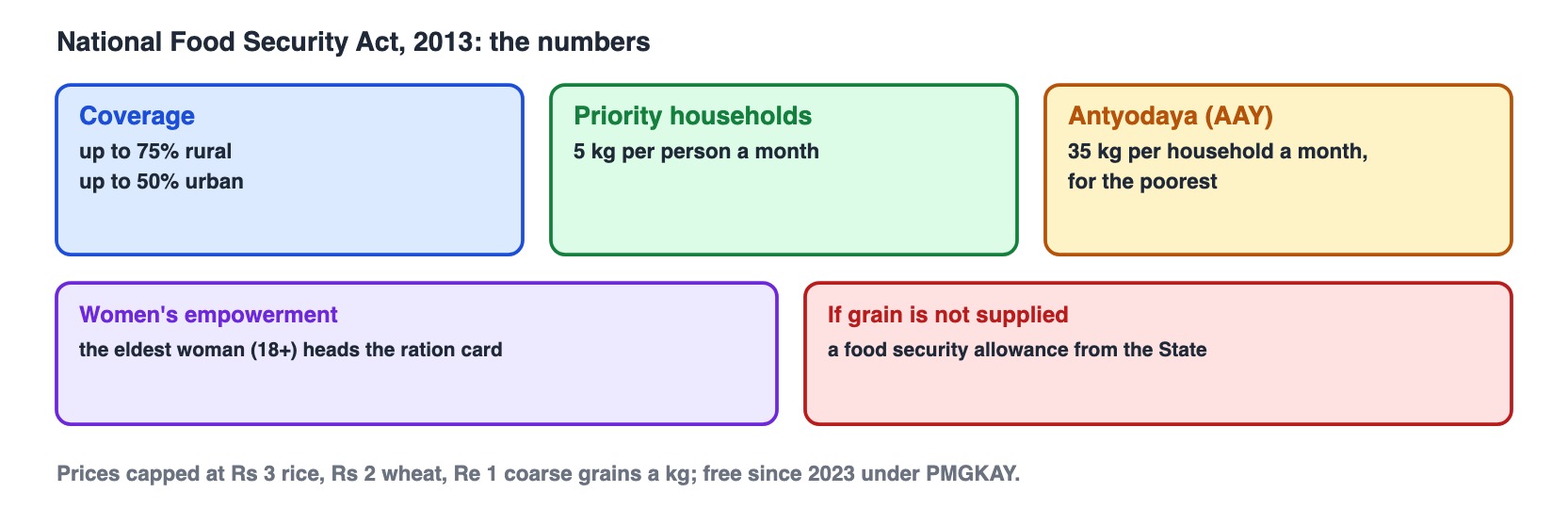
The National Food Security Act's numbers at a glance.
Today the Act's coverage works out to 81.35 crore persons.
Nutrition and Maternity Entitlements
The Act goes beyond the ration shop: it guarantees meals at the anganwadi and the school, and cash at childbirth.
Nutrition and maternity entitlements
Pregnant women and lactating mothers: a free meal during pregnancy and for six months after childbirth through the anganwadi, and a maternity benefit of at least Rs 6,000. The Centre's PM Matru Vandana Yojana separately pays Rs 5,000 for a first child.
Children 6 months to 6 years: an age-appropriate free meal through the anganwadi; malnourished children get more.
Children in classes I-VIII (or aged 6-14): one free mid-day meal every school day in Government, local-body and aided schools; NFSA grain is allotted for PM POSHAN.
Schedule II sets the nutrition standards, met either by a take-home ration or a hot cooked meal:
Beneficiary | Type of meal | Calories (kcal) | Protein (g) |
Children 6 months to 3 years | Take-home ration | 500 | 12-15 |
Children 3 to 6 years | Morning snack and hot cooked meal | 500 | 12-15 |
Malnourished children 6 months to 6 years | Take-home ration | 800 | 20-25 |
Lower primary classes | Hot cooked meal | 450 | 12 |
Upper primary classes | Hot cooked meal | 700 | 20 |
Pregnant women and lactating mothers | Take-home ration | 600 | 18-20 |
Schedule III lists wider steps for "advancing food security", such as agrarian reform and investment in agriculture.
PM Garib Kalyan Anna Yojana
Since 2023 the subsidised price has fallen to zero.
PM Garib Kalyan Anna Yojana: free grain
PMGKAY began during the COVID-19 crisis to ease hardship for the poor, at first as free grain in addition to regular NFSA allocations: about 1,118 lakh tonnes over 28 months (Phases I-VII), with an outlay of about Rs 3.91 lakh crore.
From 1 January 2023 the Centre made NFSA grain itself free of cost for AAY and priority households, folding it into PMGKAY.
Free distribution was extended for five years from 1 January 2024. About 80 crore of the intended 81.35 crore persons now receive free grain.
NFSA grain also feeds PM POSHAN and the wheat-based nutrition programme of the umbrella ICDS. Separately, Bharat Atta (November 2023) and Bharat Rice (February 2024) are sold to all consumers at subsidised rates under the Open Market Sale Scheme (Domestic), through NAFED, Kendriya Bhandar and NCCF.
Behind the ration shop: procurement, storage and subsidy
Free grain depends on a chain the Government runs from the farm to the fair price shop. Food management has three aims: buy from farmers at remunerative prices, supply consumers (especially the vulnerable) at affordable prices, and hold a buffer stock for food security and price stability.
Procurement at MSP: the Food Corporation of India (FCI) and State agencies buy wheat, paddy and coarse grains that meet the quality norms at the Minimum Support Price; farmers may sell to them or in the open market. In 2025-26 about 300 lakh tonnes of wheat came from 25 lakh farmers; in 2024-25 about 832 lakh tonnes of paddy from about 1.19 crore farmers. Millet procurement was about 11.7 lakh tonnes in 2024-25.
Decentralised Procurement (DCP): in DCP States the State itself buys and distributes the grain and the Centre reimburses it; elsewhere the FCI does it.
Food subsidy: about Rs 1.995 lakh crore in 2024-25 (Rs 1.29 lakh crore through the FCI, Rs 70,411 crore to DCP States); Rs 2.03 lakh crore allotted for 2025-26.
Storage: steel silos are being built in PPP mode, now in a "hub and spoke" design (hubs on rail sidings; Phase I at 80 sites, 34.875 lakh tonnes); rice silos were piloted at Kaimur and Buxar in Bihar. The Depot Darpan portal star-rates FCI and CWC depots using IoT sensors and CCTV, and the CWC runs on a new ERP, Bhandaran 360.
Moving grain: Anna Chakra route optimisation is estimated to save about Rs 250 crore a year in transport costs.
Helping farmers hold stock: a Rs 1,000 crore Credit Guarantee Scheme backs loans against electronic negotiable warehouse receipts (e-NWRs), so farmers can store grain and borrow instead of selling at harvest.
Controlling prices: wheat stock limits on traders, retailers and processors (from May 2025) prevent hoarding, alongside open-market sales of wheat and rice.
PDS Reforms and One Nation One Ration Card
The other big change is technology in the Public Distribution System.
PDS reforms and One Nation One Ration Card
Reform | Status (2025) |
One Nation One Ration Card (ONORC) | Began with inter-State portability in 4 States in August 2019; now in all 36 States and UTs, covering about 79.8 crore beneficiaries, with over 195.9 crore portability transactions |
Digitised ration cards | 100% of ration cards digitised; about 20.55 crore cards |
Aadhaar seeding | Over 99.9% of ration cards (at least one member) |
ePoS at fair price shops | 99.8% of 5.51 lakh shops automated |
Anna Chakra | Route optimisation of PDS supply chains, using algorithms from IIT-Delhi and the UN World Food Programme |
ONORC gives portability: a beneficiary can draw NFSA grain at a fair price shop outside their home State, which matters most for migrant workers. The Act itself named Aadhaar-based identification, computerisation and doorstep delivery to ration shops as reforms the governments should pursue.
How UPSC asks it
Who is eligible (not only BPL), who heads the ration card, what pregnant women get: the 2018 question.
The 5 kg and 35 kg entitlements, the 75/50 coverage, and the Schedule II calorie figures.
Mains: targeting errors, leakages, ONORC and migrants, nutrition versus calories, and the fiscal cost of free grain.
Further Reading
PIB press releases, ministry websites and annual reports, the Gazette of India, MEA and UN documents and the official sources named in each note — the primary sources behind every fact above.
For Your Mains Answer
For your Mains answer
✍️ Sketch to draw (30 seconds): a box of the NFSA's numbers: 75% rural and 50% urban coverage; 5 kg per person (priority households); 35 kg per household (Antyodaya); eldest woman as head of the card.
Use in your answer
Kind | Item to quote |
Law | National Food Security Act, 2013: a legal right, 'food and nutritional security in a human life-cycle approach' |
Entitlement | Priority households 5 kg per person a month; Antyodaya households 35 kg per household |
Price | Grain free since 2023 under PMGKAY (Schedule I caps: Rs 3 rice, Rs 2 wheat, Re 1 coarse grains) |
Rights | If grain is not supplied, a food security allowance from the State; grievance officers and State Food Commissions |
Gender | The eldest woman aged 18 or above heads the ration card |
An opening for a question on food security and PDS reform
India's food safety net is a legal right, not a scheme: the National Food Security Act, 2013 covers up to 75% of rural and 50% of urban people, and grain has been free since 2023.
A way-forward line
Improve targeting with updated data, add nutrition (pulses, millets, fortified food) to the basket, and make portability under One Nation One Ration Card work for migrants.
Method, model answers and a self-check rubric: the Mains Answer Writing playlist.
Test Yourself: Practice Questions & PYQs
14 practice questions, then a real UPSC question on the NFSA.
Practice Questions
Q1. Under the National Food Security Act, 2013, coverage of the Targeted Public Distribution System extends up to
(a) all BPL families only
(b) 50% of the rural and 75% of the urban population
(c) 67% of the rural and urban population each
(d) 75% of the rural and 50% of the urban population
Show answer
Answer: (d) — The Act covers up to 75% rural and 50% urban; nationally this is about 81.35 crore persons.
Q2. Under the NFSA, a household covered by the Antyodaya Anna Yojana is entitled to
(a) 10 kg per household per month
(b) 5 kg per person per month
(c) 35 kg of foodgrains per household per month
(d) 20 kg per person per month
Show answer
Answer: (c) — AAY households get 35 kg per household; priority households get 5 kg per person.
Q3. Who identifies the eligible households under the NFSA?
(a) The State Government, within the numbers fixed by the Centre
(b) The Food Corporation of India
(c) The Central Government directly
(d) The gram sabha alone
Show answer
Answer: (a) — The Centre fixes the coverage percentage for each State; the State identifies AAY and priority households.
Q4. If entitled foodgrains or meals are not supplied, the NFSA provides for
(a) a fine on the fair price shop only
(b) nothing; the Act has no remedy
(c) a food security allowance paid by the State Government
(d) compensation from the Food Corporation of India
Show answer
Answer: (c) — Section 8 entitles the person to a food security allowance from the State.
Q5. Under Schedule II of the NFSA, a pregnant woman's take-home ration must provide
(a) 800 kcal and 20-25 g of protein
(b) 600 kcal and 18-20 g of protein
(c) 1,600 kcal and 50 g of protein
(d) 500 kcal and 12-15 g of protein
Show answer
Answer: (b) — 600 kcal and 18-20 g protein for pregnant and lactating women; 800 kcal for malnourished children; 700 kcal for upper primary meals.
Q6. The NFSA entitles a pregnant woman to a maternity benefit of not less than
(a) Rs 10,000
(b) Rs 6,000
(c) Rs 5,000
(d) Rs 3,000
Show answer
Answer: (b) — Section 4 sets a floor of Rs 6,000, along with a free meal during pregnancy and six months after childbirth.
Q7. Consider the following statements:
1. Since 1 January 2023, foodgrains under the NFSA are distributed free of cost under PMGKAY.
2. Free distribution under PMGKAY was extended for five years from 1 January 2024.
3. PMGKAY covers only Antyodaya households.
Which of the statements given above are correct?
(a) 1 and 2 only
(b) 2 and 3 only
(c) 1 and 3 only
(d) 1, 2 and 3
Show answer
Answer: (a) — 1 and 2 are correct. Free grain goes to both AAY and priority households, about 80 crore people.
Q8. The One Nation One Ration Card plan began with inter-State portability in
(a) 4 States in August 2019
(b) all States in 2014
(c) the North-Eastern States in 2017
(d) Delhi alone in 2021
Show answer
Answer: (a) — It started in 4 States in August 2019 and now runs in all 36 States and UTs.
Q9. 'Anna Chakra' in the Public Distribution System refers to
(a) a grain ATM in fair price shops
(b) a scheme for fortified rice
(c) the national buffer stock policy
(d) route optimisation of the PDS supply chain
Show answer
Answer: (d) — Anna Chakra uses optimisation algorithms from IIT-Delhi and the UN World Food Programme to plan PDS transport routes.
Q10. Bharat Atta and Bharat Rice are sold
(a) only to NFSA beneficiaries free of cost
(b) for export to neighbouring countries
(c) to all consumers at subsidised rates under the Open Market Sale Scheme (Domestic)
(d) only to the armed forces
Show answer
Answer: (c) — They are sold through NAFED, Kendriya Bhandar and NCCF under OMSS(b) to general consumers; they are separate from NFSA.
Q11. Under the NFSA, a free mid-day meal is an entitlement of children
(a) only in classes I-V
(b) up to class VIII or aged 6-14, in Government, local-body and aided schools
(c) in all private schools
(d) only in aspirational districts
Show answer
Answer: (b) — Section 5 covers children up to class VIII or 6-14 years, every school day.
Q12. Which body does every State constitute under the NFSA to monitor and review the Act?
(a) The State Human Rights Commission
(b) The State Food Commission
(c) The State Election Commission
(d) The State Finance Commission
Show answer
Answer: (b) — Each State notifies a State Food Commission; districts have a District Grievance Redressal Officer.
Q13. Under Decentralised Procurement (DCP),
(a) procurement is done only by cooperatives
(b) the State Government procures and distributes foodgrains and the Centre reimburses it
(c) the FCI procures all grain in every State
(d) farmers sell only to private traders
Show answer
Answer: (b) — In non-DCP States the FCI procures for the central pool.
Q14. The Credit Guarantee Scheme for e-NWR based Pledge Financing helps farmers to
(a) export rice
(b) get crop insurance
(c) borrow against grain stored in accredited warehouses
(d) sell directly to the FCI
Show answer
Answer: (c) — It has a Rs 1,000 crore corpus and runs till 2030-31.
UPSC Previous Year Questions (PYQs)
Real UPSC Prelims question, checked against the official paper and answer key.
Q1. With reference to the provisions made under the National Food Security Act, 2013, consider the following statements:
1. The families coming under the category of below poverty line (BPL) only are eligible to receive subsidised food grains.
2. The eldest woman in a household, of age 18 years or above, shall be the head of the household for the purpose of issuance of a ration card.
3. Pregnant women and lactating mothers are entitled to a 'take-home ration' of 1600 calories per day during pregnancy and for six months thereafter.
Which of the statements given above is/are correct? (UPSC CSE 2018)
(a) 1 and 2
(b) 2 only
(c) 1 and 3
(d) 3 only
Show answer
Answer: (b) — 2 only. Coverage is up to 75% rural and 50% urban, far wider than BPL families. The eldest woman aged 18 or above heads the household for the ration card. Schedule II sets 600 kcal, not 1,600, for pregnant and lactating women.
Mains Practice Questions
Use these to frame full-length answers. You don't have to answer one exactly — they show the angles UPSC tests, so let them guide which points you cover.
The National Food Security Act moved food from welfare to a legal right. Examine its achievements and the problems that remain in targeting and nutrition.
Discuss the significance of One Nation One Ration Card for migrant workers and the technological reforms behind it.
Free foodgrains under PMGKAY cost the exchequer heavily. Should food security shift from cereals to nutrition? Argue both sides.