Abnormal Labour for NEET PG OBG: Preterm Labour, PROM, Post-term, Induction, Breech, Arrest, Shoulder Dystocia and Cord Prolapse
Start Here
🎯 Exam priority: Very high. Expect: steroid regimens and gestational windows, which tocolytic and its limits, MgSO4 for neuroprotection, PROM diagnosis and the 34-week line, post-term timing, induction contraindications, breech types and ECV, arrest criteria, obstructed labour signs, shoulder dystocia manoeuvres and cord prolapse first aid.
CBME mapping: OG13–OG14. Indian anchors: MoHFW SBA guidelines 2010 and the GoI dexamethasone regimen (as quoted in MoHFW GDM guidelines 2018).
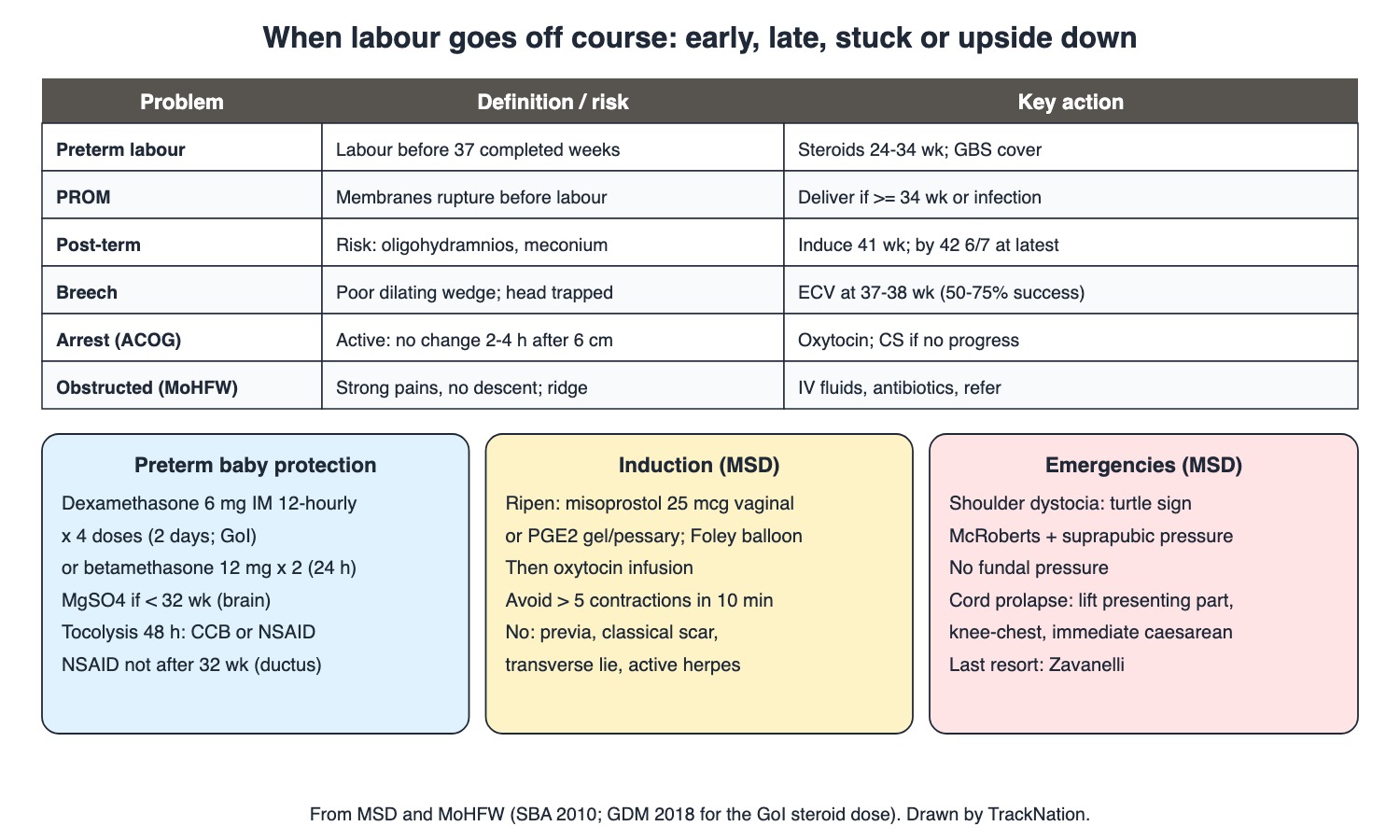
Preterm labour, PROM, post-term, malpresentation, arrest and labour emergencies. Drawn by TrackNation.
Preterm Labour (MSD, MoHFW)
Preterm labour = labour before 37 completed weeks. Triggers: PROM, chorioamnionitis, group B streptococcus, twins, uterine/fetal anomalies, pyelonephritis, STIs. Risk factors: previous preterm birth, cervical insufficiency. ANM: refer to the FRU if time allows; if delivery is imminent, deliver and refer mother and baby.
Antenatal corticosteroids at 24–34 weeks unless delivery is imminent: GoI uses dexamethasone 6 mg IM 12-hourly for 2 days (4 doses); alternative betamethasone 12 mg IM 24-hourly × 2. They cut RDS, intracranial bleeding and death. One repeat course if still <34 weeks and ≥7 days since the first.
Tocolysis buys 48 hours for steroids: calcium channel blocker or prostaglandin inhibitor (NSAID); NSAIDs are not used after 32 weeks (ductus closure) or beyond 48 hours (oligohydramnios).
MgSO4 for neuroprotection <32 weeks (less cerebral palsy). GBS antibiotics (penicillin G or ampicillin) until cultures are negative.
Prevention update (MSD): 17-OHPC injections withdrawn (US FDA, April 2023); previous preterm birth + short cervix <25 mm before 24 weeks → cerclage or vaginal progesterone.
PROM and Post-term (MSD, MoHFW)
PROM = membranes rupture before labour; preterm PROM if <37 weeks. Risks: chorioamnionitis, neonatal sepsis, malpresentation, abruption; before 24 weeks, pulmonary hypoplasia (Potter sequence). At term >90% labour within 24 hours.
Diagnosis: sterile speculum — pooling, vernix or meconium; ferning, nitrazine blue (false positive with blood, semen, urine, antiseptics). Avoid digital examinations (infection). Fever, foul discharge, tenderness and fetal tachycardia → chorioamnionitis.
Management: deliver if fetal compromise, infection or ≥34 weeks. 24–34 weeks: expectant care, steroids, latency antibiotics (ampicillin + erythromycin; azithromycin alternative), GBS cover, MgSO4 if <32 weeks. No steroids with chorioamnionitis; before viability no steroids, tocolysis or MgSO4.
MoHFW (ANM): term PROM without fever or foul discharge — if planned home/SC birth, wait; contractions within 8–12 hours → manage as normal labour; greenish liquor = fetal distress → refer.
Post-term risks: oligohydramnios, meconium, macrosomia, postmaturity (dry peeling skin, long nails, much hair), stillbirth. Surveillance from 41 weeks; induce at 41 weeks (especially if favourable), and no later than 42 6/7. Post-dates alone is not an indication for caesarean.
Induction, Malpresentation and Arrest (MSD, MoHFW)
Induction contraindications: classical or transfundal uterine scar, myomectomy entering the cavity, placenta or vasa previa, transverse lie/cord presentation, active genital herpes. Breech and multiple scars are relative.
Unfavourable cervix → ripen with misoprostol 25 mcg vaginally every 2–4 h, PGE2 gel/pessary or Foley balloon; prostaglandins are avoided after caesarean (rupture). Then oxytocin infusion; avoid tachysystole (>5 contractions in 10 minutes); above 40 mU/min → water intoxication. Inducing low-risk women at 39 weeks lowered caesarean rates (2018 trial).
Breech (frank = hips flexed, knees extended; complete; footling): poor dilating wedge, head entrapment, cord prolapse. External cephalic version at 37–38 weeks (50–75% success); otherwise caesarean at 39 weeks. Transverse lie → caesarean. Mentoposterior face rarely delivers vaginally. Occiput posterior is the commonest malposition.
Arrest (ACOG via MSD): latent phase >20 h (nullipara) / >14 h (multipara); active-phase arrest = no change for 2–4 h after 6 cm. Augment with oxytocin if fetal weight <5000 g (<4500 g in diabetes); forceps or vacuum only at station +2 or lower.
Obstructed labour (MoHFW): strong contractions without descent, Alert line crossed, fetal distress, rapid pulse, horizontal ridge below the umbilicus; linked to transverse lie and malpresentations. Before referral: IV fluids at 30 drops/min, ampicillin 1 g + metronidazole 400 mg orally + gentamicin 80 mg IM, no solid food.
Labour Emergencies (MSD, MoHFW)
Shoulder dystocia (0.2–3% of vaginal births): risks — macrosomia, obesity, diabetes, previous dystocia. Sign: turtle sign. Call for help; McRoberts + suprapubic pressure first; then Rubin/Wood screw rotation, delivery of the posterior arm, Gaskin (all fours); last resort Zavanelli. Never fundal pressure. Baby: brachial plexus injury, fractures.
Cord prolapse: commoner with breech or transverse lie, or membranes rupturing before engagement. Lift the presenting part off the cord and keep holding it, knee-chest position, immediate caesarean. Occult prolapse shows as severe bradycardia or variable decelerations.
Fetal distress (MoHFW): FHR <120 or >160 or meconium; transport in the left lateral position with IV fluids and oxygen.
Traps the Examiner Sets
No NSAID tocolysis after 32 weeks; MgSO4 for neuroprotection is below 32 weeks.
Steroids are contraindicated with chorioamnionitis.
Shoulder dystocia: suprapubic pressure yes, fundal pressure no.
Prostaglandins are not used to ripen a scarred uterus.
Memory Hooks & Shortcuts
Shortcuts to lock in this article's numbers and lists. Each one only re-packages facts proven above.
🧠 Steroids 'Dexa 6 × 4, Beta 12 × 2' (GoI: dexamethasone) — steroids
🧠 '32 rules': NSAID tocolysis stops at 32; MgSO4 neuroprotection below 32 — preterm
🧠 PROM '34 = go': deliver at 34 weeks or with infection — PROM
🧠 Shoulder dystocia '3 H': call Help, flex the Hips (McRoberts), Hand above the pubis — never on the fundus — dystocia
🧠 Cord prolapse: 'Lift, Knee-chest, Knife' — cord
Rapid-Revision Cards
Preterm
<37 completed weeks.
GoI steroid
Dexa 6 mg IM 12-h × 2 days.
Betamethasone
12 mg IM × 2, 24 h apart.
Steroid window
24–34 weeks.
Tocolysis goal
48 h for steroids.
NSAID tocolysis
Not after 32 wk.
MgSO4 neuroprotection
<32 weeks.
GBS
Penicillin/ampicillin.
Potter sequence
PROM <24 wk → lung hypoplasia.
PROM exam
Sterile speculum; avoid PV.
PROM deliver
≥34 wk, infection, distress.
Chorioamnionitis
No steroids; deliver.
Post-term
Induce 41; by 42 6/7.
Induction no-go
Classical scar, previa, transverse lie.
Scarred uterus
No prostaglandins.
Tachysystole
>5 in 10 min.
Frank breech
Hips flexed, knees extended.
ECV
37–38 wk; 50–75%.
Commonest malposition
Occiput posterior.
Shoulder dystocia
McRoberts + suprapubic.
Cord prolapse
Lift part; knee-chest; CS.
Sources
Facts in this article were checked against these documents.
MSD Manual Professional: Preterm Labor; PROM; Induction of Labor; Late-term and Postterm Pregnancy; Protracted or Arrested Labor; Fetal Presentation; Shoulder Dystocia; Umbilical Cord Prolapse — Merck & Co. (MSD Manuals), 2023–26 (link)
Guidelines for Antenatal Care and Skilled Attendance at Birth by ANMs/LHVs/SNs — Maternal Health Division, MoHFW, 2010
Diagnosis & Management of Gestational Diabetes Mellitus: Technical and Operational Guidelines (GoI antenatal steroid regimen) — Maternal Health Division, MoHFW, 2018
Competency Based Undergraduate Curriculum, Vol III: Obstetrics & Gynaecology (OG13–OG14) — National Medical Commission, 2024
Test Yourself: Practice Questions
Thirty questions in NEET PG style, most of them clinical vignettes.
Practice Questions (NEET PG pattern)
Original questions written in the style of the exam: +4 for a correct answer, −1 for a wrong one. Every answer was checked against the sources listed above. NEET PG papers are not published by NBEMS, so these are not past-paper questions.
Q1. Preterm labour is labour before
(a) 37 completed weeks
(b) 28 weeks
(c) 40 weeks
(d) 34 weeks
Show answer
Answer: (a) — MoHFW.
Q2. A woman at 30 weeks is in preterm labour. The Indian antenatal steroid regimen is
(a) dexamethasone 12 mg once
(b) prednisolone 40 mg orally for 5 days
(c) dexamethasone 6 mg IM 12-hourly for 2 days
(d) hydrocortisone 100 mg IV
Show answer
Answer: (c) — 4 doses.
Q3. The alternative steroid regimen is betamethasone
(a) 6 mg IM 12-hourly × 4
(b) 24 mg once
(c) 12 mg IM 24 hours apart, 2 doses
(d) 4 mg daily for a week
Show answer
Answer: (c) — MSD.
Q4. Antenatal corticosteroids are routinely given between
(a) 36 and 40 weeks
(b) 24 and 34 weeks
(c) 12 and 20 weeks
(d) any time after 20 weeks
Show answer
Answer: (b) — Unless delivery imminent.
Q5. The main purpose of tocolysis in preterm labour is to
(a) prevent preterm birth until term
(b) ripen the cervix
(c) treat infection
(d) delay delivery about 48 hours so steroids can act
Show answer
Answer: (d) — Buy time.
Q6. Indomethacin tocolysis is avoided after 32 weeks because it may
(a) cause maternal hypertension
(b) close the fetal ductus arteriosus
(c) cause neural tube defects
(d) cause hyperkalaemia
Show answer
Answer: (b) — Also oligohydramnios.
Q7. A woman at 29 weeks is about to deliver preterm. To reduce the baby's cerebral palsy risk, give
(a) progesterone
(b) IV magnesium sulphate
(c) nifedipine
(d) betamethasone only
Show answer
Answer: (b) — Neuroprotection <32 wk.
Q8. In preterm labour with unknown GBS status, MSD advises
(a) penicillin G or ampicillin until cultures are negative
(b) ceftriaxone for 14 days
(c) oral metronidazole
(d) no antibiotics
Show answer
Answer: (a) — GBS cover.
Q9. A woman with a previous preterm birth has a cervix of 20 mm at 20 weeks. Options per MSD include
(a) cerclage or vaginal progesterone
(b) weekly 17-OHPC injections
(c) bed rest only
(d) immediate induction
Show answer
Answer: (a) — 17-OHPC withdrawn.
Q10. Rupture of membranes before 24 weeks with prolonged leaking can cause
(a) polyhydramnios
(b) macrosomia
(c) pulmonary hypoplasia and limb deformities (Potter sequence)
(d) neural tube defects
Show answer
Answer: (c) — MSD.
Q11. In suspected PROM, which examination should be avoided?
(a) repeated digital vaginal examinations
(b) ultrasound
(c) sterile speculum examination
(d) abdominal palpation
Show answer
Answer: (a) — Infection risk.
Q12. A false-positive nitrazine test can be caused by
(a) clear amniotic fluid
(b) a low vaginal pH
(c) oligohydramnios
(d) blood or semen in the sample
Show answer
Answer: (d) — Also urine, antiseptics.
Q13. A woman with PROM at 31 weeks develops fever, uterine tenderness and fetal tachycardia. Management:
(a) tocolysis
(b) cerclage
(c) steroids and wait
(d) antibiotics and delivery
Show answer
Answer: (d) — Chorioamnionitis.
Q14. A woman with PROM at 35 weeks, no infection, normal fetal tests. Per MSD the gestation cut-off favouring delivery is
(a) 37 weeks only
(b) 34 weeks
(c) 28 weeks
(d) 40 weeks
Show answer
Answer: (b) — Individualise 34–36.
Q15. Latency antibiotics in preterm PROM (MSD) are usually
(a) co-amoxiclav for 2 weeks
(b) metronidazole alone
(c) no antibiotics
(d) ampicillin and erythromycin IV for 48 h, then oral amoxicillin and erythromycin for 5 days
Show answer
Answer: (d) — Azithromycin alternative.
Q16. At a sub-centre, a woman at 39 weeks has clear fluid leaking, no fever and wants to deliver there. The ANM should
(a) do repeated PV checks
(b) start antibiotics and discharge
(c) induce with oxytocin
(d) wait; if contractions start within 8–12 hours, manage as normal labour
Show answer
Answer: (d) — MoHFW.
Q17. A newborn after 42 weeks has dry peeling skin, long nails and much scalp hair. This is
(a) postmaturity syndrome
(b) ichthyosis
(c) congenital hypothyroidism
(d) prematurity
Show answer
Answer: (a) — Placental insufficiency.
Q18. In late-term pregnancy, MSD recommends that induction occur no later than
(a) 40 weeks
(b) 42 6/7 weeks
(c) 44 weeks
(d) 41 weeks exactly
Show answer
Answer: (b) — Consider from 41 wk.
Q19. Absolute contraindication to induction of labour:
(a) post-term pregnancy
(b) one previous lower-segment caesarean
(c) pre-eclampsia
(d) previous classical caesarean
Show answer
Answer: (d) — Also previa, transverse lie, active herpes.
Q20. For cervical ripening in a woman with a previous caesarean, avoid
(a) membrane assessment
(b) prostaglandins
(c) oxytocin in all cases
(d) Foley balloon
Show answer
Answer: (b) — Rupture risk.
Q21. During oxytocin induction, which is uterine tachysystole?
(a) 3 contractions in 10 minutes
(b) 1 contraction in 10 minutes
(c) contractions lasting 40 s
(d) more than 5 contractions in 10 minutes
Show answer
Answer: (d) — Averaged over 30 min.
Q22. Very high oxytocin doses (>40 mU/min) risk
(a) water intoxication
(b) hypercalcaemia
(c) hyperglycaemia
(d) hypokalaemia
Show answer
Answer: (a) — Antidiuretic effect.
Q23. A frank breech has
(a) one foot presenting
(b) hips flexed and knees extended
(c) the head extended
(d) hips and knees flexed
Show answer
Answer: (b) — Pike position.
Q24. A woman with a breech at 37 weeks wants a vaginal-birth chance. Offer
(a) induction now
(b) forceps
(c) external cephalic version (50–75% success)
(d) fundal pressure in labour
Show answer
Answer: (c) — 37–38 weeks.
Q25. The commonest abnormal fetal position in labour is
(a) brow
(b) occiput posterior
(c) transverse lie
(d) mentoposterior face
Show answer
Answer: (b) — Deflexed head.
Q26. At a PHC, a woman in labour has strong contractions without descent and a horizontal ridge below the umbilicus. Diagnosis and step:
(a) normal second stage — push
(b) hypotonic labour — start oxytocin
(c) false labour — reassure
(d) obstructed labour — IV fluids, antibiotics, urgent referral
Show answer
Answer: (d) — MoHFW.
Q27. Pre-referral antibiotics for obstructed labour (MoHFW) are
(a) azithromycin 1 g
(b) none
(c) ampicillin 1 g + metronidazole 400 mg orally + gentamicin 80 mg IM
(d) ceftriaxone IV only
Show answer
Answer: (c) — Then refer.
Q28. After delivery of the head, it retracts against the perineum and the shoulders do not deliver. First manoeuvres:
(a) forceps on the head
(b) fundal pressure
(c) McRoberts with suprapubic pressure
(d) Zavanelli
Show answer
Answer: (c) — Call for help.
Q29. In shoulder dystocia, fundal pressure is avoided because it
(a) is too slow
(b) causes cord prolapse
(c) is painful only
(d) can worsen impaction and cause uterine rupture
Show answer
Answer: (d) — MSD.
Q30. The cord is seen at the introitus after membranes rupture with a breech. Immediate action:
(a) pull on the breech
(b) push the cord back and continue labour
(c) wait for full dilatation
(d) lift the presenting part off the cord, knee-chest position, immediate caesarean
Show answer
Answer: (d) — Keep holding until delivery.
Active Recall
From memory: manage preterm labour (steroids, tocolysis, MgSO4, antibiotics), diagnose and manage PROM by gestation, time induction for post-term pregnancy, list induction contraindications, manage breech, arrest and obstructed labour, and the first steps in shoulder dystocia and cord prolapse.