Normal Labour for NEET PG OBG: Stages, Partograph Alert and Action Lines, Fetal Heart Monitoring, Conduct of Delivery and AMTSL
Start Here
🎯 Exam priority: Very high. Expect: stage definitions and durations, the 4 cm active-labour rule and its newer 6 cm contrast, partograph alert/action lines and referral triggers, monitoring intervals, AMTSL drugs and doses, placenta examination, CTG features, decelerations, and episiotomy facts.
CBME mapping: OG13. Indian anchor: MoHFW Guidelines for Antenatal Care and Skilled Attendance at Birth (SBA), 2010.
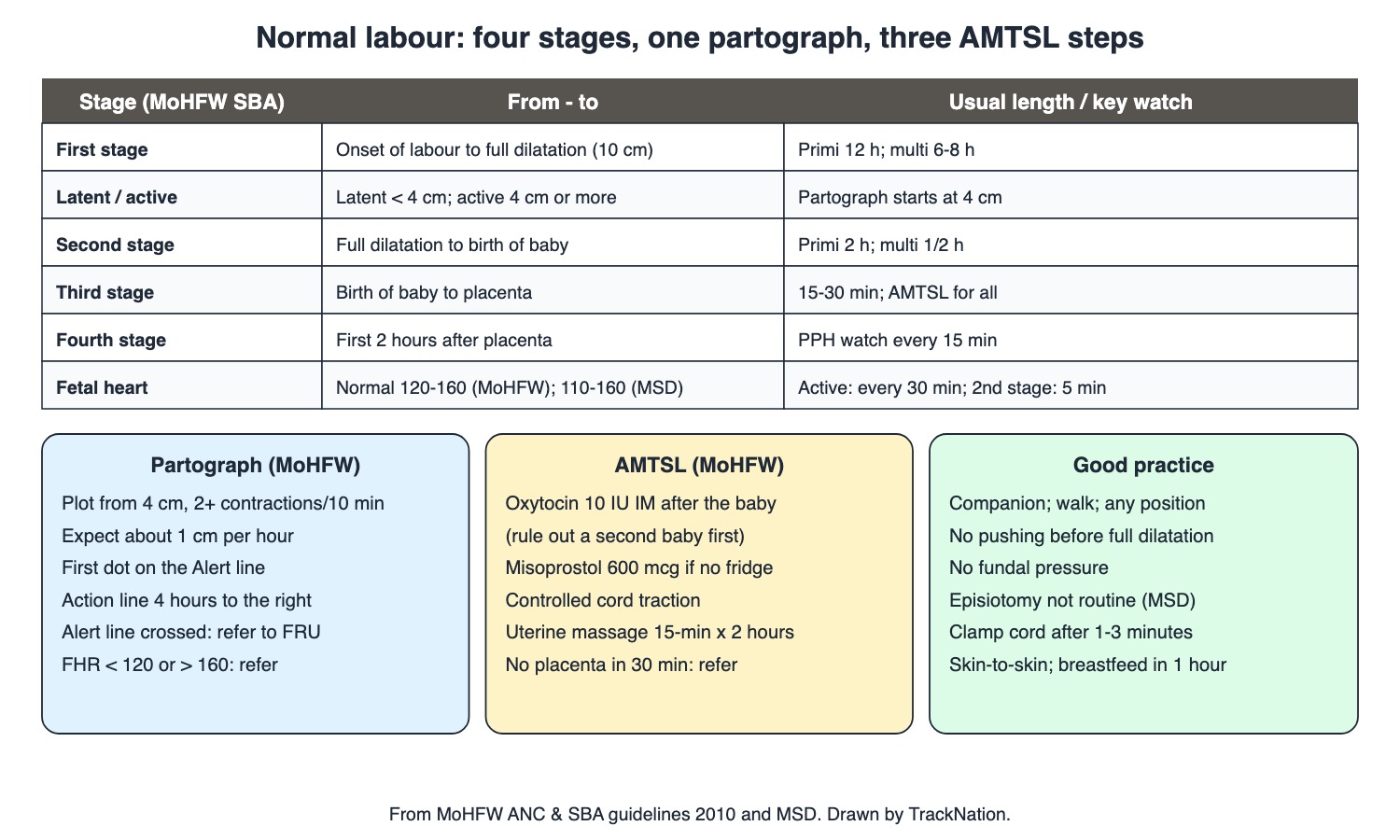
Stages of labour, the partograph and active management of the third stage. Drawn by TrackNation.
Onset and Stages (MoHFW SBA, MSD)
True labour: becomes regular, starts in the back and sweeps to the front, persists despite activity, increases in frequency and intensity, comes with show and dilates the cervix. False labour stays irregular and settles with walking or sleep. Show can come up to 72 hours before labour (MSD).
First stage: onset to full dilatation (10 cm) — about 12 hours in a primigravida, 6–8 in a multigravida. Latent <4 cm (fewer than 2 contractions in 10 min); active ≥4 cm with at least 2 good contractions in 10 minutes (MoHFW). MSD (ACOG) now judges active-phase progress only after 6 cm; arrest = no change for 2–4 hours.
Second stage: full dilatation to birth — about 2 hours (primi), ½ hour (multi). MSD second-stage arrest: ≥3 h of pushing (nullipara), ≥2 h (multipara); an epidural adds about an hour.
Third stage: baby to placenta, 15–30 minutes (about 5 minutes with active management). Fourth stage: first 2 hours after the placenta — the PPH danger window.
On admission (MSD): no shaving; if the placental site is unknown or low, no digital vaginal examination before a scan. Station 0 = level of the ischial spines. Ruptured membranes: pooling, nitrazine turns blue (pH >6.5), ferning.
Monitoring and the Partograph (MoHFW SBA)
Latent phase: contractions and FHR hourly; cervix, temperature, pulse, BP every 4 hours. Strong contractions for 8 hours without dilatation = non-progress → refer.
Active phase: pulse, contractions and FHR every 30 minutes (count for one full minute, just after a contraction); cervix, temperature, BP every 4 hours. Fluids but no solid food; walking and any position she likes.
Partograph: start at 4 cm; expect about 1 cm/hour. First point goes on the Alert line; the Action line is 4 hours to its right. Crossing the Alert line → refer to the FRU at once (do not wait for the Action line). Liquor coded I (intact), C (clear), M (meconium). Good contractions last >20 seconds.
Refer if FHR <120 or >160, meconium or blood-stained liquor, Alert line crossed, contractions not building up, or pulse >100, BP >140/90, temperature >38 °C.
No oxytocin before delivery at peripheral level — risk of uterine rupture.
CTG (MSD): category I = baseline 110–160, variability 6–25, no late or variable decelerations (early decelerations allowed). Early deceleration mirrors the contraction; late starts after its peak; variable is abrupt (≥15 bpm, <30 s to nadir). Low-risk auscultation: every 30 min in the first stage, 15 min in the second.
Delivery and the Third Stage (MoHFW SBA, MSD)
Signs of imminent delivery: vulval gaping, bulging perineum, anal pouting, head visible. FHR every 5 minutes in the second stage. No pushing before full dilatation (cervical oedema); no fundal pressure.
Controlled delivery of the head with perineal support; loose cord round the neck → slip it over; tight cord → clamp twice and cut. Anterior shoulder down, posterior shoulder up.
Episiotomy is not routine (MSD); mediolateral (45–60°) extends into the sphincter less often than median but is harder to repair.
Clamp the cord when pulsation stops, about 1–3 minutes — prevents neonatal anaemia. Skin-to-skin and breastfeeding within 1 hour (even after caesarean).
AMTSL for every birth: (1) oxytocin 10 IU IM after ruling out another baby (store at 4–8 °C; never an IV bolus) — or misoprostol 600 mcg orally if oxytocin/refrigeration is unavailable; (2) controlled cord traction with counter-traction above the pubis, only during a contraction; (3) uterine massage every 15 minutes for 2 hours. Placenta not out in 30 minutes → refer.
Check the placenta: 15–20 lobules complete; free-ending vessels or holes suggest a retained lobe; single umbilical artery → look for malformations. Analgesia (MSD): neuraxial (epidural/spinal) is preferred; watch for hypotension.
Traps the Examiner Sets
Refer when the Alert line is crossed, not the Action line.
Normal FHR is 120–160 in MoHFW guidance but 110–160 in the CTG category I definition.
Rule out a second baby before giving oxytocin.
Early decelerations are compatible with a normal trace; late and variable are not.
Memory Hooks & Shortcuts
Shortcuts to lock in this article's numbers and lists. Each one only re-packages facts proven above.
🧠 Stages '12-2-½-2': first 12 h (primi), second 2 h (primi), third ½ h, fourth 2 h — stages
🧠 Partograph: 'Start at 4, 1 an hour, Alert means Go (refer), Action is 4 later' — partograph
🧠 AMTSL 'O-C-M': Oxytocin 10 IU IM, Cord traction with counter-traction, Massage every 15 min — third stage
🧠 Decelerations: Early = Echo of the contraction; Late = Lags behind; Variable = V-shaped and abrupt — CTG
🧠 Misoprostol '600 by mouth when the fridge fails' — drugs
Rapid-Revision Cards
True labour
Regular, show, dilates cervix.
First stage
Primi 12 h; multi 6–8 h.
Active labour (India)
≥4 cm + 2 contractions/10 min.
Active progress (ACOG)
Judged after 6 cm.
Second stage
Primi 2 h; multi ½ h.
Third stage
15–30 min.
Fourth stage
First 2 h after placenta.
Dilatation rate
~1 cm/h.
Alert → Action
4 hours.
Refer
Alert line crossed.
FHR active phase
Every 30 min, 1 full min.
FHR second stage
Every 5 min.
Partograph liquor
I, C, M.
No oxytocin before birth
Uterine rupture.
Cord clamp
1–3 min.
AMTSL drug
Oxytocin 10 IU IM.
No fridge
Misoprostol 600 mcg oral.
CCT
With counter-traction, in a contraction.
Placenta not out
30 min → refer.
Single umbilical artery
Look for anomalies.
CTG category I
110–160; no late/variable.
Sources
Facts in this article were checked against these documents.
Guidelines for Antenatal Care and Skilled Attendance at Birth by ANMs/LHVs/SNs — Maternal Health Division, MoHFW, 2010
MSD Manual Professional: Management of Normal Labor; Spontaneous Vaginal Delivery; Fetal Monitoring; Analgesia and Anesthesia for Labor — Merck & Co. (MSD Manuals), 2024–26 (link)
Competency Based Undergraduate Curriculum, Vol III: Obstetrics & Gynaecology (OG13) — National Medical Commission, 2024
Test Yourself: Practice Questions
Thirty questions in NEET PG style, most of them clinical vignettes.
Practice Questions (NEET PG pattern)
Original questions written in the style of the exam: +4 for a correct answer, −1 for a wrong one. Every answer was checked against the sources listed above. NEET PG papers are not published by NBEMS, so these are not past-paper questions.
Q1. A woman at 39 weeks has irregular tightenings that stop when she walks, with no show and no cervical change. This is
(a) obstructed labour
(b) false labour
(c) active labour
(d) latent phase of true labour
Show answer
Answer: (b) — True labour dilates the cervix.
Q2. Per MoHFW SBA guidelines, the first stage of labour lasts about
(a) 12 hours in a primigravida and 6–8 hours in a multigravida
(b) 24 hours in both
(c) 30 minutes in a multigravida
(d) 2 hours in both
Show answer
Answer: (a) — Onset to 10 cm.
Q3. Active labour, when the partograph is started, is defined by MoHFW as
(a) cervix 2 cm
(b) cervix 8 cm
(c) rupture of membranes
(d) cervix 4 cm or more with at least 2 good contractions in 10 minutes
Show answer
Answer: (d) — MSD/ACOG uses 6 cm for progress.
Q4. Expected rate of cervical dilatation in the active phase per MoHFW is about
(a) 1 cm per 4 hours
(b) 3 cm per hour
(c) 0.2 cm per hour
(d) 1 cm per hour
Show answer
Answer: (d) — Faster in multigravidae.
Q5. On the partograph, the first cervical dilatation is plotted
(a) on the Alert line
(b) on the Action line
(c) 4 hours left of the Alert line
(d) anywhere
Show answer
Answer: (a) — MoHFW.
Q6. The gap between the Alert and Action lines is
(a) 1 hour
(b) 8 hours
(c) 2 hours
(d) 4 hours
Show answer
Answer: (d) — Action line to the right.
Q7. At a PHC, a woman's dilatation plot crosses to the right of the Alert line. The ANM should
(a) wait until the Action line
(b) refer to the FRU immediately with the partograph
(c) start oxytocin
(d) do a fundal push
Show answer
Answer: (b) — Do not wait.
Q8. In active labour, MoHFW advises checking the fetal heart
(a) only at full dilatation
(b) every 2 minutes continuously
(c) every 4 hours
(d) every 30 minutes, for one full minute after a contraction
Show answer
Answer: (d) — Every 5 min in second stage.
Q9. Cervical dilatation, temperature and BP in the active phase are recorded every
(a) 30 minutes
(b) 15 minutes
(c) 8 hours
(d) 4 hours
Show answer
Answer: (d) — MoHFW.
Q10. Which partograph finding needs referral from a sub-centre?
(a) FHR of 100/min
(b) clear liquor
(c) FHR of 140/min
(d) 2 good contractions in 10 minutes at 5 cm
Show answer
Answer: (a) — <120 or >160.
Q11. On the partograph, ruptured membranes with clear liquor are marked
(a) M
(b) B
(c) I
(d) C
Show answer
Answer: (d) — I intact, M meconium.
Q12. Why should ANMs not give oxytocin to speed up labour before delivery?
(a) it causes PPH
(b) high risk of uterine rupture
(c) it causes hypertension only
(d) it is ineffective
Show answer
Answer: (b) — MoHFW.
Q13. Per MoHFW, the second stage of labour usually lasts
(a) 5 minutes
(b) 12 hours
(c) about 2 hours in primigravidas and half an hour in multigravidas
(d) 4 hours in all
Show answer
Answer: (c) — Full dilatation to birth.
Q14. A sign of imminent delivery is
(a) quickening
(b) anal pouting
(c) bloody show
(d) lightening
Show answer
Answer: (b) — Also vulval gaping, bulging perineum.
Q15. A woman feels the urge to push at 7 cm. Advice:
(a) push hard
(b) do an episiotomy
(c) do not push yet — it can cause cervical oedema
(d) apply fundal pressure
Show answer
Answer: (c) — Wait for full dilatation.
Q16. After delivery of the head, the cord is found tight around the neck. Next step:
(a) clamp the cord twice, cut between, then unwind
(b) pull the baby out quickly
(c) push the head back
(d) wait 10 minutes
Show answer
Answer: (a) — Loose cord: slip over.
Q17. MoHFW advises clamping the cord after about
(a) 1–3 minutes, when pulsation stops
(b) immediately
(c) 10 minutes
(d) after the placenta
Show answer
Answer: (a) — Prevents neonatal anaemia.
Q18. Before giving oxytocin for AMTSL you must first
(a) rule out another baby in the uterus
(b) do a vaginal examination
(c) start an IV drip
(d) deliver the placenta
Show answer
Answer: (a) — Twins.
Q19. The AMTSL dose of oxytocin at a sub-centre is
(a) 40 units IM
(b) 10 units IM
(c) 2 units IM
(d) 5 units IV bolus
Show answer
Answer: (b) — Never an IV bolus.
Q20. A home birth with no refrigerated oxytocin. The AMTSL uterotonic is
(a) ergometrine IV
(b) carboprost
(c) misoprostol 25 mcg vaginally
(d) misoprostol 600 mcg orally
Show answer
Answer: (d) — Shivering is a common side-effect.
Q21. During controlled cord traction, the other hand should
(a) press the fundus downwards hard
(b) push the uterus upwards above the pubis (counter-traction)
(c) rest on the thigh
(d) massage the perineum
Show answer
Answer: (b) — Only during a contraction.
Q22. After the placenta, uterine massage per MoHFW is repeated
(a) once only
(b) never
(c) every 15 minutes for the first 2 hours
(d) every hour for 24 hours
Show answer
Answer: (c) — Fourth stage.
Q23. At a sub-centre, the placenta is not delivered 30 minutes after oxytocin. Next:
(a) give a second oxytocin dose IV push
(b) pull hard on the cord
(c) wait 6 hours
(d) refer to the FRU with notes of drugs given
Show answer
Answer: (d) — Retained placenta.
Q24. On examining a placenta you see a vessel ending at a hole in the membranes. Suspect
(a) complete membranes
(b) a normal cord insertion
(c) a normal placenta
(d) a placental lobe left behind in the uterus
Show answer
Answer: (d) — Free-ending vessels.
Q25. The umbilical cord has only one artery. You should
(a) give the mother antibiotics
(b) look for congenital malformations in the baby
(c) send cord blood for culture
(d) ignore it
Show answer
Answer: (b) — Normally 2 arteries, 1 vein.
Q26. A CTG category I (normal) trace requires baseline FHR of
(a) 160–180 bpm
(b) 110–160 bpm with moderate variability and no late or variable decelerations
(c) 90–110 bpm
(d) any rate if accelerations present
Show answer
Answer: (b) — Early decelerations allowed.
Q27. A deceleration begins after the peak of each contraction and recovers after it ends. It is
(a) a late deceleration
(b) a variable deceleration
(c) an acceleration
(d) an early deceleration
Show answer
Answer: (a) — Not part of a normal trace.
Q28. A woman with HIV is in active labour with intact membranes. MSD advises
(a) routine amniotomy
(b) avoid amniotomy
(c) fetal scalp blood sampling
(d) fetal scalp electrode
Show answer
Answer: (b) — Limit fetal exposure.
Q29. Compared with median, a mediolateral episiotomy
(a) is always needed in primigravidas
(b) involves cutting the rectum
(c) is easier to repair and extends more
(d) extends into the anal sphincter less often but is harder to repair
Show answer
Answer: (d) — Not routine.
Q30. A woman has leaking at 40 weeks; fluid turns nitrazine paper deep blue and shows a fern pattern. This confirms
(a) rupture of membranes
(b) urine leak
(c) bacterial vaginosis
(d) cervical mucus only
Show answer
Answer: (a) — pH >6.5.
Active Recall
From memory: distinguish true and false labour, define the four stages with durations, describe monitoring and the partograph rules, list referral criteria, and explain cord clamping, AMTSL and examination of the placenta.