Operative Obstetrics for NEET PG OBG: Caesarean Section, Robson Groups, VBAC, Forceps and Vacuum, Uterine Rupture and Perineal Tears
Start Here
🎯 Exam priority: High. Expect: India's caesarean rate and the private–public gap, Robson group 5, common indications, lower-segment vs classical incisions, VBAC success and rupture risk, forceps/vacuum prerequisites and their typical injuries, uterine rupture signs and the four degrees of perineal tear.
CBME mapping: OG15. Indian anchors: NFHS-6 India fact sheets (2023–24, provisional) and MoHFW SBA guidelines.
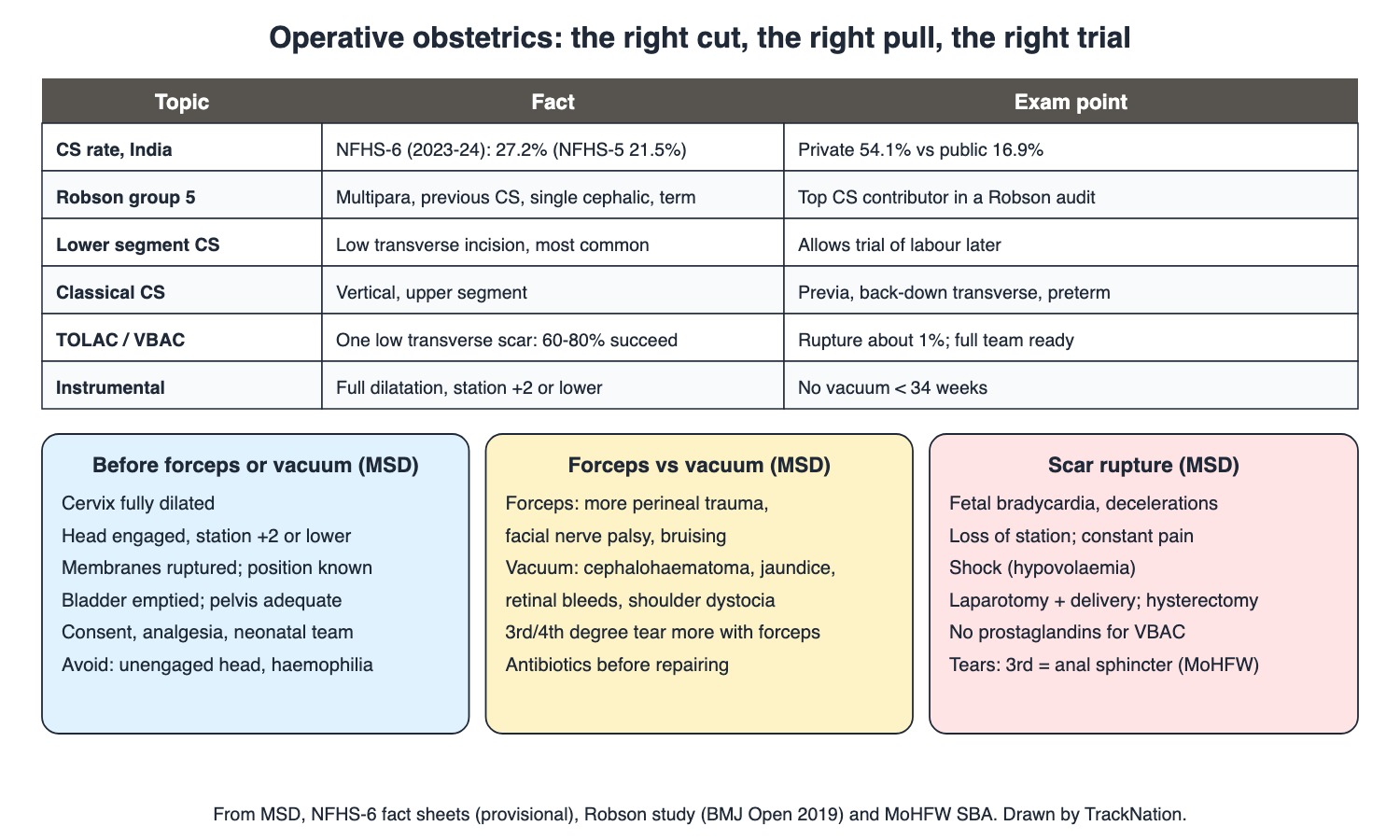
Caesarean rates, incisions, VBAC, instrumental delivery and scar rupture. Drawn by TrackNation.
Caesarean Section in India (NFHS-6, Robson)
NFHS-6 (2023–24, provisional): 27.2% of births in India were by caesarean (urban 40.5%, rural 22.8%), up from 21.5% in NFHS-5. In private facilities 54.1%, in public facilities 16.9%. Institutional births: 90.6%.
Robson ten-group classification compares CS rates between units. Group 5 = multiparous women with at least one previous CS, single cephalic, ≥37 weeks; in a Robson audit (BMJ Open 2019; CS rate 30%) it was the largest contributor (29.6%). Group 6 = nulliparous single breech.
Commonest indications (MSD): previous caesarean, protracted labour, malpresentation (breech, transverse lie), non-reassuring fetal heart, abruption, placenta previa. Surgical risk rises with each repeat caesarean.
Lower-segment (low transverse) incision — most common, least blood loss, permits later trial of labour. A vertical lower-segment cut is for some malpresentations or very large babies (a transverse cut could tear into the uterine arteries). Classical (vertical upper segment): placenta previa, back-down transverse lie, preterm fetus, poorly formed lower segment, fetal anomaly — more bleeding and rupture risk.
Surgical safety checklist (LaQshya): antibiotic prophylaxis within the last 60 minutes before incision.
VBAC and Uterine Rupture (MSD)
Trial of labour after caesarean (TOLAC) is offered after one low transverse scar: 60–80% deliver vaginally (VBAC); rupture about 1% overall (higher with several scars or a vertical incision). Only where an obstetrician, anaesthetist and theatre are immediately available.
No prostaglandins for ripening or induction in a scarred uterus; a classical scar is a contraindication to labour.
Uterine rupture (usually along an old scar; also overdistension, version, excess uterotonics, unrecognised obstruction): fetal bradycardia, variable decelerations, loss of fetal station, constant pain, shock. Treatment: immediate laparotomy, delivery, hysterectomy if needed.
Forceps, Vacuum and Perineal Tears (MSD, MoHFW)
Indications: prolonged second stage (nullipara: 3 h without / 4 h with regional analgesia; multipara: 2 h / 3 h), suspected fetal compromise, or need to avoid pushing (maternal heart disease, neurological disorders, exhaustion).
Prerequisites: fully dilated cervix, engaged head at station +2 or lower, ruptured membranes, known position, empty bladder, adequate pelvis, consent, analgesia, neonatal team. Contraindications: unengaged head, unknown position, fetal haemophilia; no vacuum below 34 weeks (intraventricular haemorrhage).
Forceps: more perineal trauma and anal sphincter injury, facial lacerations, facial nerve palsy, bruising. Vacuum: cephalohaematoma, jaundice, retinal haemorrhage, shoulder dystocia. Consider antibiotics before repairing a 3rd/4th degree tear.
Perineal tears (MoHFW): 1st — vaginal mucosa and connective tissue; 2nd — plus muscles; 3rd — complete transection of the anal sphincter; 4th — rectal mucosa. ANMs repair only first-degree tears; deeper tears go to a 24-hour PHC/FRU.
Traps the Examiner Sets
Back-down transverse lie needs a classical incision.
VBAC is offered after one lower-segment scar, never after a classical scar.
Cephalohaematoma and retinal bleeds point to vacuum; facial nerve palsy points to forceps.
Fourth-degree tear involves the rectal mucosa.
Memory Hooks & Shortcuts
Shortcuts to lock in this article's numbers and lists. Each one only re-packages facts proven above.
🧠 NFHS-6 CS: '27 overall, 54 private, 17 public' — rates
🧠 Robson 5 = 'the previous-scar group' — the biggest slice — Robson
🧠 VBAC '1 scar, low, 60–80 succeed, 1 ruptures' — VBAC
🧠 Vacuum = 'Vertex bumps': cephalohaematoma; Forceps = 'Face': facial palsy — instruments
🧠 Tears '1 skin, 2 muscle, 3 sphincter, 4 rectum' — tears
Rapid-Revision Cards
CS India (NFHS-6)
27.2% (NFHS-5 21.5%).
Private vs public CS
54.1% vs 16.9%.
Robson group 5
Previous CS, multipara, cephalic, term.
Top indications
Previous CS, malpresentation, distress.
Usual incision
Low transverse (LSCS).
Classical CS
Previa, back-down transverse, preterm.
Vertical lower segment
Big baby; avoid uterine artery tear.
VBAC success
60–80%.
Rupture risk
~1%.
VBAC no-go
Classical scar; prostaglandins.
Rupture signs
Bradycardia, loss of station.
Rupture Rx
Laparotomy ± hysterectomy.
Prolonged 2nd stage (nullip)
3 h / 4 h with epidural.
Prolonged 2nd stage (multip)
2 h / 3 h with epidural.
Instrument prerequisites
Full, +2, ROM, bladder empty.
No vacuum
<34 weeks.
Vacuum injuries
Cephalohaematoma, retinal bleeds.
Forceps injuries
Perineal tears, facial palsy.
3rd-degree tear
Anal sphincter.
4th-degree tear
Rectal mucosa.
Antibiotic before CS
Within 60 min.
Sources
Facts in this article were checked against these documents.
National Family Health Survey (NFHS-6), 2023-24: India and State/UT Fact Sheets (provisional) — International Institute for Population Sciences, 2026
Implementation of the WHO manual for Robson classification: an example from Sri Lanka using a local database for developing quality improvement recommendations (BMJ Open 9:e027317) — Senanayake H, Piccoli M, Valente EP, et al., 2019 (link)
MSD Manual Professional: Cesarean Delivery; Operative Vaginal Delivery; Management of Spontaneous Vaginal Delivery; Uterine Rupture — Merck & Co. (MSD Manuals), 2024–26 (link)
Guidelines for Antenatal Care and Skilled Attendance at Birth by ANMs/LHVs/SNs; LaQshya SOP for District Hospitals — Ministry of Health & Family Welfare / NHM, 2010–2018
Competency Based Undergraduate Curriculum, Vol III: Obstetrics & Gynaecology (OG15) — National Medical Commission, 2024
Test Yourself: Practice Questions
Thirty questions in NEET PG style, most of them clinical vignettes.
Practice Questions (NEET PG pattern)
Original questions written in the style of the exam: +4 for a correct answer, −1 for a wrong one. Every answer was checked against the sources listed above. NEET PG papers are not published by NBEMS, so these are not past-paper questions.
Q1. According to NFHS-6 (2023–24) fact sheets, the share of births in India delivered by caesarean is about
(a) 27%
(b) 15%
(c) 50%
(d) 8%
Show answer
Answer: (a) — 21.5% in NFHS-5.
Q2. In NFHS-6, caesarean rates in private vs public facilities were about
(a) 30% vs 30%
(b) 54% vs 17%
(c) 80% vs 5%
(d) 17% vs 54%
Show answer
Answer: (b) — Big private–public gap.
Q3. Robson group 5 is
(a) multiple pregnancies
(b) nulliparous single breech
(c) all preterm births
(d) multiparous women with at least one previous CS, single cephalic, ≥37 weeks
Show answer
Answer: (d) — Largest contributor in audits.
Q4. In the Robson audit published in BMJ Open (2019), the largest contributor to the CS rate was
(a) group 6
(b) group 1
(c) group 5
(d) group 10
Show answer
Answer: (c) — 29.6%.
Q5. The most common specific indications for caesarean (MSD) include
(a) anaemia
(b) maternal age above 30
(c) maternal request only
(d) previous caesarean and malpresentation
Show answer
Answer: (d) — Also protracted labour, abnormal FHR.
Q6. The most commonly used uterine incision at caesarean is
(a) classical vertical
(b) low transverse lower-segment
(c) J-shaped
(d) fundal transverse
Show answer
Answer: (b) — Less bleeding, safer later labour.
Q7. A transverse lie with the fetal back down at caesarean usually needs
(a) forceps
(b) a low transverse incision
(c) vacuum
(d) a classical incision
Show answer
Answer: (d) — MSD.
Q8. Why is a vertical lower-segment incision chosen for a very large baby?
(a) it avoids the bladder
(b) it heals faster
(c) it is cosmetic
(d) a transverse incision may extend into the uterine arteries
Show answer
Answer: (d) — Bleeding risk.
Q9. A woman with one previous low transverse caesarean asks about vaginal birth. Success rate of TOLAC is about
(a) 30–40%
(b) 10–20%
(c) 95–100%
(d) 60–80%
Show answer
Answer: (d) — Offer it.
Q10. Overall risk of uterine rupture during a trial of labour after one caesarean is about
(a) 10%
(b) 25%
(c) 0.01%
(d) 1%
Show answer
Answer: (d) — Higher with vertical or multiple scars.
Q11. TOLAC should be attempted only where
(a) a sub-centre ANM is present
(b) an obstetrician, anaesthetist and surgical team are immediately available
(c) the woman is at home with a midwife
(d) an ultrasound machine is available
Show answer
Answer: (b) — Emergency CS possible.
Q12. For ripening the cervix in a woman attempting VBAC, avoid
(a) a Foley catheter
(b) prostaglandins
(c) fetal monitoring
(d) membrane assessment
Show answer
Answer: (b) — Rupture risk.
Q13. During labour after a previous caesarean, sudden fetal bradycardia, loss of station and constant pain suggest
(a) cord prolapse only
(b) uterine rupture
(c) normal second stage
(d) placenta previa
Show answer
Answer: (b) — Laparotomy.
Q14. Treatment of uterine rupture is
(a) oxytocin infusion
(b) immediate laparotomy with delivery, and hysterectomy if needed
(c) vacuum delivery
(d) observation
Show answer
Answer: (b) — MSD.
Q15. Uterine rupture occurs most often
(a) along an old caesarean scar
(b) at 12 weeks
(c) after spontaneous abortion
(d) in primigravidas without risk factors
Show answer
Answer: (a) — MSD.
Q16. A nulliparous woman without epidural has pushed for 3 hours with no progress. This is
(a) precipitate labour
(b) a prolonged second stage
(c) a prolonged latent phase
(d) normal
Show answer
Answer: (b) — 4 h with epidural.
Q17. A multiparous woman with an epidural has a prolonged second stage after
(a) 30 minutes
(b) 3 hours without progress
(c) 1 hour
(d) 6 hours
Show answer
Answer: (b) — 2 h without epidural.
Q18. Before applying forceps you must confirm
(a) full dilatation, engaged head at +2 or lower, ruptured membranes
(b) cervix 7 cm and head at −2
(c) intact membranes
(d) head floating
Show answer
Answer: (a) — Plus position, empty bladder.
Q19. A woman with severe heart disease should avoid prolonged pushing. In the second stage you may use
(a) operative vaginal delivery to shorten it
(b) fundal pressure
(c) oxytocin bolus
(d) nothing
Show answer
Answer: (a) — Maternal indication.
Q20. Vacuum extraction is avoided at 32 weeks because of the risk of
(a) shoulder dystocia
(b) facial palsy
(c) intraventricular haemorrhage
(d) cord prolapse
Show answer
Answer: (c) — <34 weeks.
Q21. Operative vaginal delivery is contraindicated when the fetus has
(a) a cephalic presentation
(b) a normal heart rate
(c) an occiput anterior position
(d) haemophilia
Show answer
Answer: (d) — Also unengaged head.
Q22. A newborn has a cephalohaematoma and retinal haemorrhages. The likely mode of delivery was
(a) spontaneous breech
(b) elective caesarean
(c) vacuum extraction
(d) forceps
Show answer
Answer: (c) — Also jaundice.
Q23. A newborn has a facial nerve palsy after an assisted birth. The likely instrument was
(a) forceps
(b) Foley catheter
(c) vacuum
(d) none
Show answer
Answer: (a) — MSD.
Q24. Compared with vacuum, forceps more often cause
(a) neonatal jaundice
(b) third- and fourth-degree perineal tears
(c) retinal bleeds
(d) cephalohaematoma
Show answer
Answer: (b) — Anal sphincter injury.
Q25. A tear involving complete transection of the anal sphincter is
(a) fourth-degree
(b) third-degree
(c) second-degree
(d) first-degree
Show answer
Answer: (b) — MoHFW.
Q26. A tear that reaches the rectal mucosa is
(a) second-degree
(b) first-degree
(c) fourth-degree
(d) third-degree
Show answer
Answer: (c) — MoHFW.
Q27. A tear through vaginal mucosa and perineal muscles but sparing the sphincter is
(a) fourth-degree
(b) second-degree
(c) third-degree
(d) first-degree
Show answer
Answer: (b) — MoHFW.
Q28. At a sub-centre, which tears may the ANM manage herself?
(a) all degrees
(b) up to third-degree
(c) none
(d) first-degree only
Show answer
Answer: (d) — Refer deeper tears.
Q29. Before the skin incision for caesarean, the surgical safety checklist confirms antibiotic prophylaxis within the last
(a) 5 minutes
(b) 24 hours
(c) 6 hours
(d) 60 minutes
Show answer
Answer: (d) — LaQshya SOP.
Q30. After a third-degree tear from forceps delivery, before repair MSD suggests considering
(a) oxytocin bolus
(b) no suturing
(c) prophylactic antibiotics
(d) immediate hysterectomy
Show answer
Answer: (c) — Fewer wound complications.
Active Recall
From memory: state India's caesarean rates and Robson group 5, list caesarean indications and incision types, describe VBAC criteria and uterine rupture, give the prerequisites and complications of forceps and vacuum, and grade perineal tears.