Contraception for NEET PG OBG: Mechanisms, Failure Rates, Combined Pill Contraindications, IUCD Timing and Problems, Emergency and Permanent Methods
Start Here
🎯 Exam priority: Very high. Expect: mechanisms of action, perfect vs typical failure rates, the combined pill "never" list, IUCD timings, contraindications and complications (perforation, missing strings, PID), emergency contraception choices, DMPA side-effects, LAM criteria and sterilisation failure/ectopic facts.
CBME mapping: OG21. The national programme, schemes and incentives are in PSM 12 (Family Planning); this article is the clinical side.
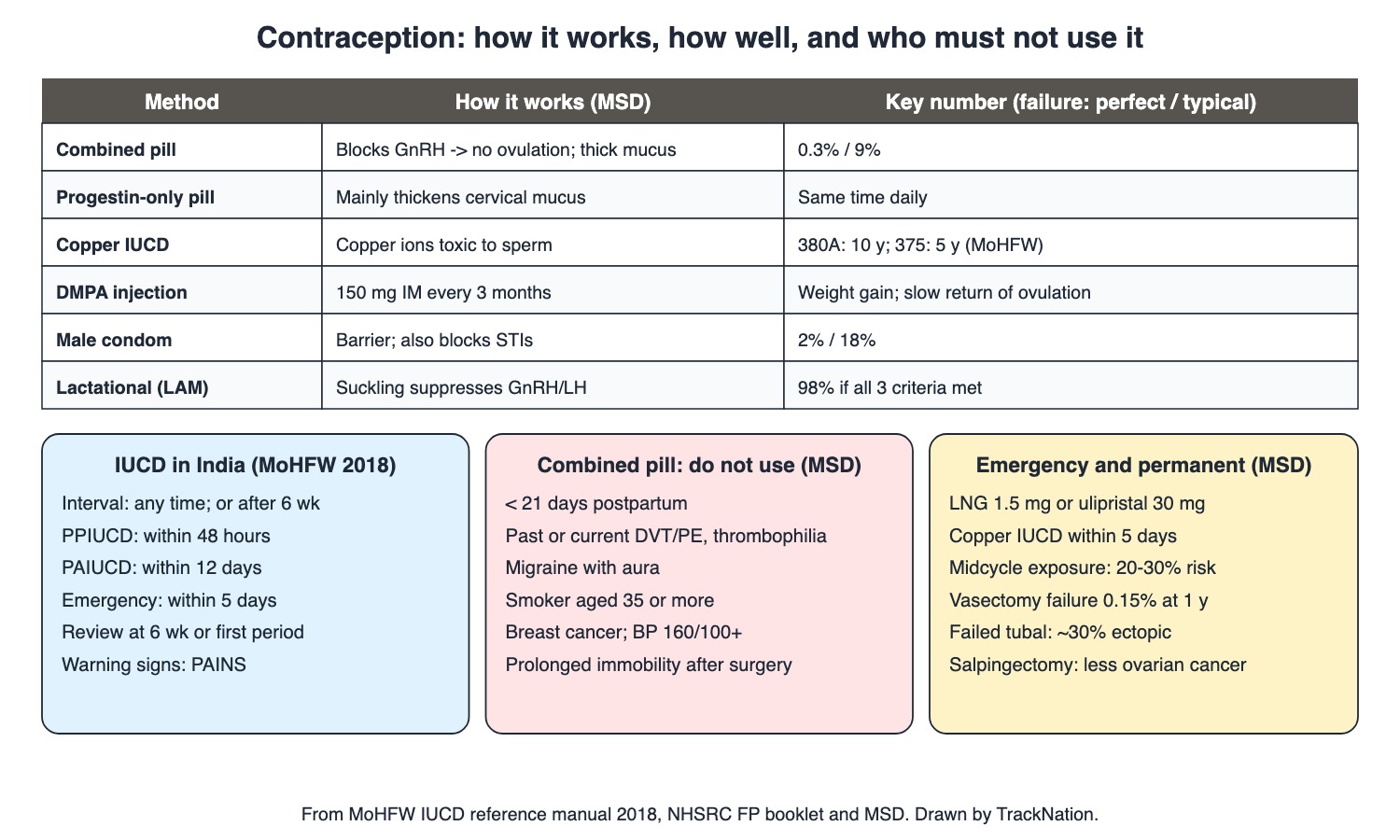
Mechanisms, failure rates, IUCD timing, pill contraindications, emergency and permanent methods. Drawn by TrackNation.
Hormonal Methods (MSD)
Combined pill: suppresses GnRH → no ovulation; also endometrial changes and thick cervical mucus. Failure 0.3% perfect, 9% typical. Needs a history, not a physical examination. Lowers ovarian and endometrial cancer risk.
Unacceptable risk (do not use): <21 days postpartum, thrombophilia or past/current DVT/PE, active cancer, current breast cancer, prolonged immobility after major surgery, migraine with aura, smoker aged ≥35, severe hypertension (≥160/100). Rifampicin, lamotrigine and some antiepileptics: risks usually outweigh benefits.
Progestin-only pill: works mainly by thickening cervical mucus; must be taken at the same time every day; breakthrough bleeding is common.
DMPA: 150 mg IM (or 104 mg SC) every 3 months. Weight gain 1.5–4 kg in year 1; bone density may fall but no fracture increase (no routine scans); ovulation may be delayed up to 18 months — not for women wanting a quick pregnancy.
Intrauterine Devices (MoHFW, MSD)
India supplies Cu IUCD 380A (10 years) and Cu IUCD 375 (5 years) — copper on a plastic frame with barium sulphate. Copper ions make a sterile inflammatory reaction toxic to sperm (prevents fertilisation); LNG-IUDs thicken mucus. Fertility returns at once after removal.
Timing (MoHFW): interval — any time in the cycle if not pregnant, or after 6 weeks postpartum; PPIUCD within 48 hours; PAIUCD within 12 days of abortion; emergency — within 5 days. Follow-up at 6 weeks or the first period, whichever is earlier.
Warning signs PAINS: Period problems/pregnancy, Abdominal pain/dyspareunia, Infection/discharge, Not feeling well/fever, String problems.
Contraindications: pregnancy, current PID/cervicitis/pelvic TB, septic abortion or puerperal sepsis within 3 months, unexplained bleeding, distorted cavity, Wilson disease or copper allergy (copper device). Not contraindications: past ectopic (MEC 1), past PID/STI, breastfeeding, adolescence.
Problems: copper IUCD → heavier periods and cramps; LNG-IUD → amenorrhoea in up to 20% at 1 year. Perforation ~1 in 1000 (less with PPIUCD); strings trimmed to 3 cm. Missing strings → cytobrush, ultrasound, then probe; intraperitoneal device removed laparoscopically. PID risk is in the first month; no routine antibiotic prophylaxis.
Emergency, Barrier, LAM and Permanent Methods (MSD, NHSRC)
Emergency: copper IUCD within 5 days (most effective), levonorgestrel 1.5 mg or ulipristal 30 mg once (MSD: within 120 hours; LNG less effective if BMI >30). Risk from one act ~5%, 20–30% at midcycle.
Male condom: 2% perfect / 18% typical failure; the only method with dual protection against pregnancy and STI/HIV.
LAM — 98% effective only if baby <6 months, (nearly) exclusive breastfeeding (at least 4-hourly by day, 6-hourly at night) and no return of periods.
Sterilisation: vasectomy failure 0.15% at 1 year; postpartum tubal procedures fail less than interval ones; minilaparotomy for postpartum, laparoscopy for interval. If a tubal sterilisation fails, about 30% of pregnancies are ectopic. Salpingectomy lowers ovarian cancer risk by 40–50%.
Traps the Examiner Sets
History of ectopic pregnancy is not a contraindication to the copper IUCD.
Progestin-only pills work mainly via cervical mucus, not ovulation suppression.
Combined pill is barred in the first 21 days after delivery.
A pregnancy after failed tubal sterilisation is ectopic until proved otherwise.
Memory Hooks & Shortcuts
Shortcuts to lock in this article's numbers and lists. Each one only re-packages facts proven above.
🧠 COC 'never' list: '21 days, Clots, Aura, Smoker 35, Breast cancer' — COC
🧠 IUCD timings '48 hours, 12 days, 6 weeks, 5 days EC' — IUCD
🧠 PAINS — when an IUCD user must come back — warning signs
🧠 Pill families: Combined stops ovulation; Mini-pill thickens mucus — mechanisms
🧠 Failed tubal = 'think tube first' (~30% ectopic) — sterilisation
Rapid-Revision Cards
COC mechanism
GnRH ↓ → no ovulation.
COC failure
0.3% / 9%.
COC never
<21 d postpartum, DVT, aura, smoker ≥35.
COC benefit
↓ ovarian, endometrial cancer.
POP
Mucus; same time daily.
Copper IUCD
Sperm-toxic inflammation.
380A / 375
10 y / 5 y.
PPIUCD
≤48 h.
PAIUCD
≤12 days.
IUCD follow-up
6 wk or first period.
PAINS
Period, Abdomen, Infection, Not well, Strings.
Past ectopic
IUCD MEC 1.
Perforation
~1/1000.
Missing strings
Cytobrush → USG.
Best EC
Cu IUCD ≤5 days.
Oral EC
LNG 1.5 mg / UPA 30 mg.
DMPA
150 mg IM 3-monthly.
DMPA fertility
Up to 18 months delay.
Dual protection
Condom.
LAM
<6 mo, exclusive BF, no periods.
Failed tubal
~30% ectopic.
Sources
Facts in this article were checked against these documents.
Reference Manual for IUCD Services — Family Planning Division, MoHFW, 2018
Family Planning Booklet for Community Health Officers — National Health Systems Resource Centre, 2022
MSD Manual Professional: Overview of Contraception; Oral Contraceptives; IUDs; Emergency Contraception; Progestin Injections; Permanent Contraception; Fertility-awareness Methods — Merck & Co. (MSD Manuals), 2024–26 (link)
Competency Based Undergraduate Curriculum, Vol III: Obstetrics & Gynaecology (OG21) — National Medical Commission, 2024
Test Yourself: Practice Questions
Thirty questions in NEET PG style, most of them clinical vignettes.
Practice Questions (NEET PG pattern)
Original questions written in the style of the exam: +4 for a correct answer, −1 for a wrong one. Every answer was checked against the sources listed above. NEET PG papers are not published by NBEMS, so these are not past-paper questions.
Q1. Combined oral contraceptives mainly prevent pregnancy by
(a) suppressing GnRH and ovulation
(b) blocking implantation only
(c) causing endometrial atrophy only
(d) killing sperm with copper ions
Show answer
Answer: (a) — Plus mucus, endometrium.
Q2. First-year failure of combined pills with typical use is about
(a) 30%
(b) 9%
(c) 1%
(d) 0.3%
Show answer
Answer: (b) — 0.3% perfect.
Q3. A 37-year-old who smokes 20 cigarettes a day asks for the combined pill. Advice:
(a) start COC with aspirin
(b) start low-dose COC
(c) avoid — unacceptable risk
(d) any COC is fine
Show answer
Answer: (c) — Smoker ≥35.
Q4. A woman with migraine with aura wants contraception. Avoid
(a) condoms
(b) combined oestrogen-progestin methods
(c) progestin-only pill
(d) copper IUCD
Show answer
Answer: (b) — Stroke risk.
Q5. Combined hormonal contraception is unacceptable in the first
(a) 21 days after delivery
(b) it is never restricted
(c) 6 months after delivery for all
(d) 48 hours only
Show answer
Answer: (a) — VTE risk.
Q6. Long-term combined pill use reduces the risk of
(a) liver adenoma
(b) cervical cancer
(c) breast cancer
(d) ovarian and endometrial cancer
Show answer
Answer: (d) — MSD.
Q7. Before prescribing combined pills, MSD says you must take
(a) a coagulation profile
(b) a pelvic ultrasound
(c) a thorough history (a physical examination is not required)
(d) a Pap smear
Show answer
Answer: (c) — Screen by history.
Q8. Progestin-only pills work mainly by
(a) blocking prostaglandins
(b) suppressing ovulation in all cycles
(c) thickening cervical mucus
(d) copper toxicity
Show answer
Answer: (c) — Same time daily.
Q9. The copper IUCD prevents pregnancy mainly by
(a) thinning the endometrium hormonally
(b) blocking the tubes
(c) a sterile inflammatory reaction toxic to sperm
(d) suppressing ovulation
Show answer
Answer: (c) — Prevents fertilisation.
Q10. The Cu IUCD 375 supplied in India is effective for
(a) 10 years
(b) 3 years
(c) 1 year
(d) 5 years
Show answer
Answer: (d) — 380A: 10 years.
Q11. Postpartum IUCD after vaginal delivery is inserted within
(a) 7 days
(b) 6 hours only
(c) 4 weeks
(d) 48 hours
Show answer
Answer: (d) — Or interval after 6 weeks.
Q12. A woman had a surgical abortion 8 days ago and wants an IUCD. Per MoHFW
(a) IUCD is contraindicated after abortion
(b) she must wait for her next period
(c) she must wait 6 weeks
(d) she can have a post-abortion IUCD (within 12 days)
Show answer
Answer: (d) — PAIUCD.
Q13. After IUCD insertion, MoHFW advises the first follow-up at
(a) 1 year
(b) 6 weeks or the first period, whichever is earlier
(c) 1 day
(d) only if there is a problem
Show answer
Answer: (b) — PAINS.
Q14. In the IUCD warning-sign mnemonic PAINS, 'S' stands for
(a) spotting
(b) sepsis
(c) smoking
(d) string problems
Show answer
Answer: (d) — MoHFW.
Q15. Which is a contraindication to IUCD insertion?
(a) history of ectopic pregnancy
(b) adolescence
(c) current pelvic inflammatory disease
(d) breastfeeding
Show answer
Answer: (c) — Past ectopic is MEC 1.
Q16. A woman develops fever and foul discharge 10 days after an abortion and asks for an IUCD. Per MoHFW MEC
(a) Category 1 — insert
(b) insert after 1 day
(c) insert with antibiotics
(d) Category 4 — do not insert
Show answer
Answer: (d) — Post-abortal sepsis.
Q17. A common side-effect of the copper IUCD is
(a) amenorrhoea
(b) acne
(c) heavier periods and more cramping
(d) weight gain
Show answer
Answer: (c) — LNG-IUD causes amenorrhoea.
Q18. Uterine perforation at IUCD insertion occurs in about
(a) 1 in 1000
(b) 1 in 100,000
(c) 1 in 10
(d) 1 in 50
Show answer
Answer: (a) — Lower with PPIUCD.
Q19. IUCD threads are not seen at review and she is not pregnant. After trying a cytobrush, next:
(a) ultrasound to locate the device
(b) insert another IUCD
(c) immediate hysterectomy
(d) ignore it
Show answer
Answer: (a) — Then probe/X-ray/laparoscopy.
Q20. The risk of PID after IUCD insertion is concentrated in
(a) it never rises
(b) after removal
(c) the first month after insertion
(d) years 5–10
Show answer
Answer: (c) — No routine prophylaxis.
Q21. A device found free in the peritoneal cavity should be
(a) dissolved with drugs
(b) removed, ideally laparoscopically
(c) pushed back into the uterus
(d) left in place
Show answer
Answer: (b) — Adhesions.
Q22. The most effective emergency contraceptive is
(a) a copper IUCD inserted within 5 days
(b) levonorgestrel 1.5 mg after 5 days
(c) a combined pill
(d) a condom
Show answer
Answer: (a) — Also ongoing contraception.
Q23. The risk of pregnancy after a single unprotected act at midcycle is about
(a) 60%
(b) 1%
(c) 20–30%
(d) 5%
Show answer
Answer: (c) — ~5% overall.
Q24. For a woman with BMI 34, the more effective oral emergency pill is
(a) levonorgestrel 1.5 mg
(b) both equal
(c) neither works
(d) ulipristal 30 mg
Show answer
Answer: (d) — MSD.
Q25. A woman wants a baby soon after stopping contraception. Avoid DMPA because
(a) it is teratogenic
(b) it causes infertility permanently
(c) it needs daily dosing
(d) ovulation may be delayed up to 18 months
Show answer
Answer: (d) — Slow return.
Q26. DMPA users should have
(a) yearly DEXA scans
(b) calcium infusions
(c) oestrogen add-back always
(d) no routine bone density scans (no fracture increase shown)
Show answer
Answer: (d) — MSD.
Q27. The only contraceptive giving dual protection against pregnancy and STI/HIV is
(a) DMPA
(b) the condom
(c) the combined pill
(d) the copper IUCD
Show answer
Answer: (b) — NHSRC.
Q28. LAM is reliable only if the baby is under 6 months, periods have not returned and
(a) she breastfeeds (nearly) exclusively, at least 4-hourly by day
(b) she pumps milk only
(c) she breastfeeds twice daily
(d) she gives formula at night
Show answer
Answer: (a) — 98% effective.
Q29. A woman who had tubal sterilisation 3 years ago has a positive pregnancy test. First concern:
(a) ectopic pregnancy
(b) normal pregnancy only
(c) false-positive test
(d) molar pregnancy
Show answer
Answer: (a) — ~30% ectopic.
Q30. Removing the fallopian tubes (salpingectomy) for sterilisation also
(a) raises ovarian cancer risk
(b) has no other effect
(c) causes early menopause always
(d) reduces ovarian cancer risk by 40–50%
Show answer
Answer: (d) — MSD.
Active Recall
From memory: explain how combined pills, progestin-only pills and copper IUCDs work, list combined pill contraindications, give MoHFW IUCD timings, follow-up and warning signs, manage IUCD problems, and describe emergency contraception, DMPA, LAM and sterilisation facts.