Postpartum Haemorrhage for NEET PG OBG: Definitions, Causes, MoHFW First Steps, Uterotonics, Tamponade, Uterine Inversion and Amniotic Fluid Embolism
Start Here
🎯 Exam priority: Very high. Expect: PPH definitions, primary vs secondary, causes (atony first), MoHFW oxytocin doses and drip rate, bimanual compression, second-line drugs and who must not get them, tranexamic acid dose, tamponade and surgery, retained placenta, uterine inversion and amniotic fluid embolism.
CBME mapping: OG16. Indian anchors: MoHFW SBA guidelines 2010 and NHM LaQshya SOP. PPH is a leading direct cause of maternal death (see OBG 01).
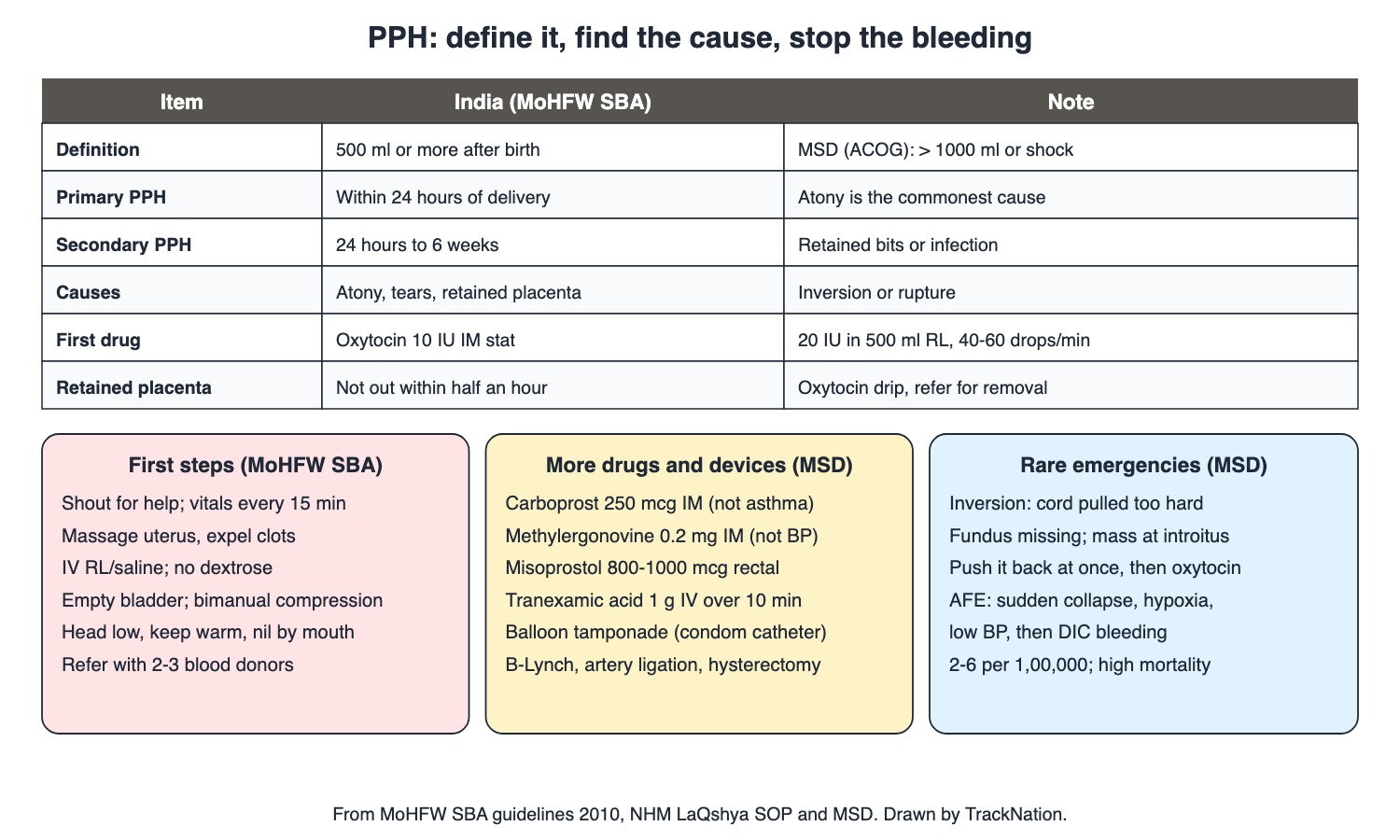
PPH definitions, first steps, drugs and devices, and rare third-stage emergencies. Drawn by TrackNation.
Definitions and Causes (MoHFW, MSD)
PPH (MoHFW) = blood loss of 500 ml or more after birth. Primary: during or within 24 hours; secondary (delayed): 24 hours to 6 weeks — retained clots/fragments or uterine infection. LaQshya: ≥500 ml triggers the PPH protocol. MSD (ACOG) defines PPH as >1000 ml or bleeding with signs of hypovolaemia within 24 hours.
Causes: atonic uterus (commonest), tears of vagina, cervix or perineum, retained placenta/fragments, inverted or ruptured uterus; also bleeding disorders, haematoma, subinvolution. Soft, flabby uterus = atonic; bleeding with a well-contracted uterus = traumatic (look for tears).
Atony risks: overdistension (twins, polyhydramnios, big baby), prolonged or very rapid labour, grand multiparity, relaxant anaesthetics, chorioamnionitis, fibroids, previous PPH.
Death can follow within two hours of onset. Shock signs (MoHFW): pulse ≥110, systolic <90, RR >30, cold clammy skin.
Management (MoHFW SBA, MSD)
Prevention: AMTSL for every birth; LaQshya — oxytocin within one minute of delivery.
First steps: shout for help; vitals every 15 minutes; massage the uterus and expel clots; oxytocin 10 IU IM (if not already given); IV Ringer lactate or saline (not dextrose) with 20 IU oxytocin in 500 ml at 40–60 drops/min; fast fluids (60 drops/min) if soaking a pad in <5 minutes or in shock; empty the bladder; foot end raised; nil by mouth.
Bimanual compression: fist in the anterior fornix, other hand on the abdomen, compress the uterus. Refer to the FRU with IV running, notes and 2–3 blood donors.
Second-line uterotonics (MSD): carboprost (15-methyl PGF2α) 250 mcg IM every 15–90 min, up to 8 doses — avoid in asthma; methylergometrine 0.2 mg IM — avoid in hypertension; misoprostol 800–1000 mcg rectally; carbetocin if oxytocin unavailable. Never oxytocin as an IV bolus (hypotension).
Tranexamic acid 1 g IV over 10 minutes if first measures fail. Saline up to 2 L, then blood; massive transfusion RBC:FFP:platelets 1:1:1. Balloon tamponade (Bakri or condom catheter; aortic compression meanwhile); then B-Lynch suture, internal iliac ligation or hysterectomy.
Secondary PPH: oxytocin IM and drip; suspect infection if there is fever or foul discharge; refer.
Retained Placenta, Inversion and Amniotic Fluid Embolism (MoHFW, MSD)
Retained placenta = not delivered within half an hour. Separated and in the canal → remove gently; not separated → oxytocin drip and refer for manual removal (ANMs must not attempt it); antibiotics after manual removal (LaQshya).
Uterine inversion: commonest cause excess cord traction (also fundal pressure, atony, accreta). Haemorrhage and shock; fundus not palpable; mass at the introitus. Replace immediately by pushing up the fundus — before removing an attached placenta — then a uterotonic; relaxants (terbutaline, nitroglycerin) or laparotomy if needed.
Amniotic fluid embolism: 2–6 per 1,00,000; an inflammatory reaction to fetal antigens (fluid dissolves in blood, so it is not a mechanical block). Sudden collapse or cardiac arrest in labour or just after, hypoxia, hypotension, then DIC with bleeding from the uterus and puncture sites. High mortality; supportive care.
Traps the Examiner Sets
Indian definition: 500 ml; ACOG: 1000 ml.
Methylergometrine is barred in hypertension; carboprost in asthma.
Inversion: replace the uterus first, then remove the placenta.
Bleeding with a firm uterus = look for tears.
Memory Hooks & Shortcuts
Shortcuts to lock in this article's numbers and lists. Each one only re-packages facts proven above.
🧠 Causes — the 4 Ts: Tone (atony), Trauma (tears), Tissue (retained), Thrombin (clotting) — causes
🧠 India '500', ACOG '1000' — definition
🧠 Oxytocin '10 in the muscle, 20 in the bag (500 ml), 40–60 drops' — drugs
🧠 'Ergot raises BP, Carboprost tightens the chest' — avoid in hypertension and asthma — contraindications
🧠 Inversion: 'Push it Up before you Pull it Out' (replace before placenta removal) — inversion
Rapid-Revision Cards
PPH (India)
≥500 ml.
PPH (ACOG)
>1000 ml or shock.
Primary
Within 24 h.
Secondary
24 h – 6 wk.
Commonest cause
Atony.
Firm uterus, bleeding
Look for tears.
First drug
Oxytocin 10 IU IM.
Drip
20 IU/500 ml RL, 40–60 drops.
Never
Oxytocin IV bolus.
Bimanual
Fist in anterior fornix.
Methylergometrine
Not in hypertension.
Carboprost
250 mcg IM; not in asthma.
Misoprostol (Rx)
800–1000 mcg rectal.
Tranexamic acid
1 g IV over 10 min.
Tamponade
Balloon / condom catheter.
Surgery
B-Lynch, ligation, hysterectomy.
Retained placenta
>30 min.
LaQshya
Oxytocin within 1 min.
Inversion cause
Cord traction.
Inversion Rx
Replace first, then placenta.
AFE
Collapse + hypoxia + DIC.
Sources
Facts in this article were checked against these documents.
Guidelines for Antenatal Care and Skilled Attendance at Birth by ANMs/LHVs/SNs — Maternal Health Division, MoHFW, 2010
LaQshya Standard Operating Procedures for District Hospitals — National Health Mission, MoHFW, 2018 (link)
MSD Manual Professional: Postpartum Hemorrhage; Uterine Inversion; Amniotic Fluid Embolism — Merck & Co. (MSD Manuals), 2024–26 (link)
Competency Based Undergraduate Curriculum, Vol III: Obstetrics & Gynaecology (OG16) — National Medical Commission, 2024
Test Yourself: Practice Questions
Thirty questions in NEET PG style, most of them clinical vignettes.
Practice Questions (NEET PG pattern)
Original questions written in the style of the exam: +4 for a correct answer, −1 for a wrong one. Every answer was checked against the sources listed above. NEET PG papers are not published by NBEMS, so these are not past-paper questions.
Q1. MoHFW defines postpartum haemorrhage as blood loss of
(a) 500 ml or more after birth
(b) 250 ml or more
(c) 1500 ml or more
(d) any visible bleeding
Show answer
Answer: (a) — ACOG uses 1000 ml.
Q2. Secondary (delayed) PPH occurs
(a) after 24 hours up to 6 weeks
(b) after 12 weeks
(c) within 1 hour
(d) within 24 hours
Show answer
Answer: (a) — Retained bits or infection.
Q3. MSD (ACOG) defines PPH as blood loss of
(a) >500 ml at caesarean
(b) >1000 ml or bleeding with hypovolaemia within 24 hours
(c) >300 ml
(d) >2000 ml
Show answer
Answer: (b) — Differs from India.
Q4. The commonest cause of PPH is
(a) uterine atony
(b) uterine inversion
(c) coagulopathy
(d) cervical tear
Show answer
Answer: (a) — Soft, boggy uterus.
Q5. Which is a risk factor for atonic PPH?
(a) twin pregnancy
(b) primigravida with small baby
(c) short second stage of 30 min in a multipara
(d) oligohydramnios
Show answer
Answer: (a) — Overdistension.
Q6. After a normal birth, bleeding continues though the uterus is firm and well contracted. Next:
(a) give more oxytocin only
(b) start carboprost
(c) do a hysterectomy
(d) look for genital tract tears
Show answer
Answer: (d) — Traumatic PPH.
Q7. At a sub-centre a woman has atonic PPH and had no AMTSL. First drug:
(a) tranexamic acid only
(b) carboprost 250 mcg
(c) oxytocin 10 IU IM
(d) methylergometrine IV bolus
Show answer
Answer: (c) — Then drip.
Q8. The MoHFW oxytocin drip for PPH is
(a) 40 IU as IV bolus
(b) 10 IU in 100 ml over 1 minute
(c) 5 IU in 1 L dextrose at 10 drops/min
(d) 20 IU in 500 ml RL/saline at 40–60 drops/min
Show answer
Answer: (d) — No dextrose.
Q9. Oxytocin should never be given as an IV bolus because it can cause
(a) hyperkalaemia
(b) severe hypotension
(c) convulsions
(d) bradycardia only
Show answer
Answer: (b) — MSD.
Q10. During bimanual compression, the vaginal hand is placed
(a) in the posterior fornix flat
(b) on the cervix pulling down
(c) in the rectum
(d) as a fist in the anterior fornix
Show answer
Answer: (d) — Other hand on abdomen.
Q11. Before bimanual compression, MoHFW advises
(a) giving dextrose
(b) giving solid food
(c) sitting the woman up
(d) emptying the bladder with a catheter
Show answer
Answer: (d) — Full bladder hinders contraction.
Q12. A woman with PPH also has severe pre-eclampsia. Avoid
(a) methylergometrine
(b) misoprostol
(c) oxytocin
(d) tranexamic acid
Show answer
Answer: (a) — Hypertension.
Q13. A woman with PPH has asthma. Avoid
(a) oxytocin
(b) methylergometrine
(c) tranexamic acid
(d) carboprost (15-methyl PGF2α)
Show answer
Answer: (d) — Bronchospasm.
Q14. The carboprost dose for PPH is
(a) 2.5 mg IM once
(b) 25 mcg IV
(c) 1 mg orally
(d) 250 mcg IM, repeat every 15–90 min up to 8 doses
Show answer
Answer: (d) — MSD.
Q15. Rectal misoprostol for PPH treatment per MSD is
(a) 200 mcg
(b) 5 mg
(c) 800–1000 mcg
(d) 25 mcg
Show answer
Answer: (c) — Uterotonic.
Q16. Tranexamic acid for PPH is given as
(a) 1 g IV over 10 minutes
(b) 10 g orally
(c) 1 g IV bolus over 10 seconds
(d) 100 mg IM
Show answer
Answer: (a) — If first measures fail.
Q17. Atonic PPH continues despite uterotonics. A simple next step before surgery is
(a) lithotomy and wait
(b) uterine balloon tamponade (condom catheter), with aortic compression while preparing
(c) fundal pressure
(d) oral iron
Show answer
Answer: (b) — Then B-Lynch etc.
Q18. A compression suture used for atonic PPH at laparotomy is the
(a) B-Lynch suture
(b) Shirodkar suture
(c) McDonald suture
(d) purse-string suture
Show answer
Answer: (a) — Others are cerclage.
Q19. In massive obstetric haemorrhage, blood components may be given in a ratio of
(a) 1:4:1
(b) 1:1:1 RBC:FFP:platelets
(c) only crystalloid
(d) 4:1:0
Show answer
Answer: (b) — After blood bank consult.
Q20. A woman bleeding heavily soaks a pad in under 5 minutes. MoHFW advises IV fluids at
(a) 60 drops per minute through another drip
(b) 10 drops per minute
(c) oral fluids only
(d) keep vein open only
Show answer
Answer: (a) — Rapid.
Q21. Per MoHFW, which shock sign is listed?
(a) systolic 120 mmHg
(b) RR 14/min
(c) pulse 110/min or more
(d) pulse 70/min
Show answer
Answer: (c) — Also systolic <90.
Q22. Ten days after delivery a woman has fresh bleeding, fever and foul lochia. Likely cause:
(a) amniotic fluid embolism
(b) atony immediately after birth
(c) retained fragments or uterine infection (secondary PPH)
(d) uterine inversion
Show answer
Answer: (c) — Delayed PPH.
Q23. A placenta is said to be retained if not delivered within
(a) 4 hours
(b) 5 minutes
(c) half an hour of the birth
(d) 24 hours
Show answer
Answer: (c) — MoHFW.
Q24. At a sub-centre the placenta has not separated after 30 minutes. The ANM should
(a) start an oxytocin drip and refer for manual removal
(b) pull firmly on the cord
(c) remove it manually herself
(d) wait 12 hours
Show answer
Answer: (a) — Not for ANMs.
Q25. Under LaQshya, oxytocin for AMTSL is given
(a) after the placenta
(b) within one minute of delivery
(c) only if bleeding starts
(d) before the head delivers
Show answer
Answer: (b) — Prevention.
Q26. The commonest cause of acute uterine inversion is
(a) twin delivery
(b) fibroid
(c) epidural
(d) excessive cord traction
Show answer
Answer: (d) — Also fundal pressure.
Q27. After delivery a woman is in shock, the fundus cannot be felt abdominally and a mass is seen at the introitus. Diagnosis:
(a) uterine inversion
(b) cervical fibroid
(c) cord prolapse
(d) uterine rupture
Show answer
Answer: (a) — Replace immediately.
Q28. In acute inversion with the placenta still attached, you should
(a) leave it for 24 hours
(b) remove the placenta first
(c) replace the uterus first, then remove the placenta
(d) give oxytocin before replacement
Show answer
Answer: (c) — MSD.
Q29. A woman in labour suddenly becomes breathless, cyanosed and hypotensive, then bleeds from IV sites. Most likely
(a) amniotic fluid embolism
(b) eclampsia
(c) vasovagal syncope
(d) atonic PPH
Show answer
Answer: (a) — Then DIC.
Q30. Amniotic fluid embolism is now thought to be
(a) an air embolism
(b) an inflammatory reaction to fetal antigens, not a mechanical block
(c) a fat embolism
(d) a clot from the leg
Show answer
Answer: (b) — Fluid dissolves in blood.
Active Recall
From memory: define PPH (India vs ACOG) and its types, list causes and atony risk factors, give the MoHFW first steps with oxytocin doses, the second-line drugs with contraindications, tranexamic acid, tamponade and surgery, and manage retained placenta, uterine inversion and amniotic fluid embolism.