Puerperium for NEET PG OBG: Normal Changes, MoHFW Postnatal Visits and Danger Signs, Breastfeeding, Infections, Postpartum Depression and Newborn Care
Start Here
🎯 Exam priority: High. Expect: lochia timeline, uterine involution landmarks, the MoHFW postnatal visit schedule and danger signs, breastfeeding rules, vitamin K doses, endometritis vs engorgement vs mastitis, and blues vs depression vs psychosis.
CBME mapping: OG17–OG19. Indian anchors: MoHFW Guidance Note on Optimizing Post-Natal Care and SBA guidelines.
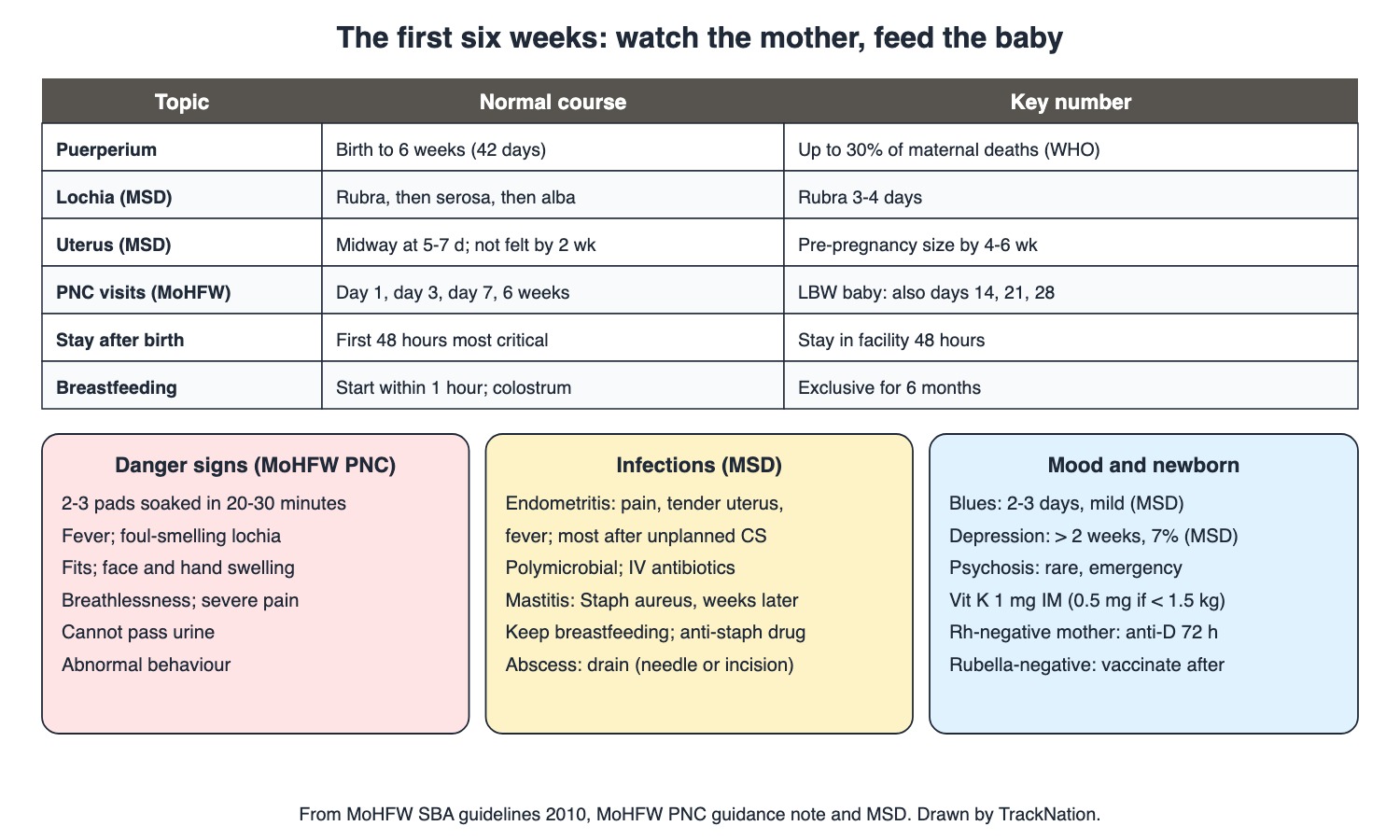
Normal puerperium, postnatal visits, danger signs, infections, mood and newborn care. Drawn by TrackNation.
Normal Puerperium (MoHFW, MSD)
The postnatal period runs from birth to 6 weeks (42 days); up to 30% of maternal deaths happen in it (WHO 2022, quoted by MoHFW). The first 48 hours are the most critical — women should stay in the facility for 48 hours.
Lochia: rubra (red) for 3–4 days → serosa (pale brown) → alba (yellow-white) after a further 10–12 days. A bleed at 1–2 weeks as the placental-site eschar sloughs is usually self-limited.
Involution: at 5–7 days the fundus is midway between symphysis and umbilicus; not palpable by 2 weeks; pre-pregnancy size by 4–6 weeks. Afterpains in the first days. WBC can reach 20,000–30,000/µL.
Ovulation returns about 4–6 weeks if not breastfeeding (before the first period — so contraception first); later with breastfeeding. MoHFW advises abstaining for about 6 weeks or until the perineum heals.
Rh-negative mother with Rh-positive baby, not sensitised: anti-D within 72 hours. MMR and varicella (live) are given after delivery to non-immune women, never in pregnancy.
Postnatal Care in India (MoHFW)
Visits: home/SC birth — day 1 (within 24 h), day 3, day 7, 6 weeks; facility birth (discharged after 48 h) — day 3, day 7, 6 weeks. Low birth weight babies: extra visits on days 14, 21 and 28. At least four postnatal visits.
Each visit: pulse, BP, temperature, pallor, uterus (firm, non-tender), perineum, lochia (amount and smell), breasts, breastfeeding. Advice: hygiene (pads every 4–6 hours), more food and fluids, no food taboos, IFA and calcium, rest, contraception.
Danger signs: soaking 2–3 pads in 20–30 minutes, fever, foul-smelling lochia, convulsions, swelling of face and hands, breathlessness, severe abdominal pain, jaundice, pallor, inability to pass urine, abnormal behaviour → ASHA arranges transport (108/102).
High-risk postnatal tracking: ASHA gets Rs 500 per antenatally identified HRP and Rs 250 per newly detected high-risk postnatal mother with a healthy outcome at day 45. PPH and puerperal sepsis are the major postnatal killers.
Breastfeeding and Newborn Care (MoHFW SBA)
Start breastfeeding within one hour, even after caesarean; give colostrum. Early breastfeeding also reduces maternal bleeding.
Exclusive breastfeeding for 6 months — not even water; breast milk is enough even in summer.
Vitamin K (prevents haemorrhagic disease of the newborn): 1 mg IM if ≥1500 g, 0.5 mg if <1500 g, in the upper outer thigh.
Keep the baby warm (skin-to-skin), put on an identification band, and early recognition of newborn danger signs (see Paediatrics).
Puerperal Infection and Mood Disorders (MSD)
Endometritis: 1% after vaginal birth, 3% after scheduled and 5–10% after unscheduled caesarean. Risks: prolonged ROM or labour, many vaginal examinations, chorioamnionitis, manual removal, PPH. Polymicrobial. Pain and a soft, large, tender uterus, then fever within 24–72 hours. Treat with IV clindamycin + gentamicin until afebrile 48 hours; persistent fever → pelvic abscess or septic pelvic thrombophlebitis. Antibiotics within 60 minutes before caesarean cut the risk by up to 75%.
Breast engorgement fever stays ≤39 °C. Mastitis comes weeks into breastfeeding, mostly Staphylococcus aureus: red, hot, tender breast with fever — analgesia, empty the breast, anti-staphylococcal antibiotic (e.g. dicloxacillin), and keep breastfeeding. Abscess → ultrasound and drainage.
Postpartum blues: very common, mild, 2–3 days (up to 2 weeks). Postpartum depression: 7% in the first year, lasts >2 weeks and is disabling; prior depression is the main risk; screen with the Edinburgh Postnatal Depression Scale. Postpartum psychosis: rare, risk of suicide and infanticide — admit, antipsychotics.
Traps the Examiner Sets
Uterus is not palpable abdominally by 2 weeks.
Mastitis: continue breastfeeding.
Blues settle within 2 weeks; depression lasts beyond 2 weeks.
Vitamin K dose halves for babies under 1500 g.
Memory Hooks & Shortcuts
Shortcuts to lock in this article's numbers and lists. Each one only re-packages facts proven above.
🧠 Lochia 'Red, Brown, White' — Rubra 3–4 days, Serosa, Alba — lochia
🧠 PNC visits '1-3-7-42' (+14, 21, 28 for LBW) — visits
🧠 Vitamin K '1 for big, half for small (<1500 g)' — newborn
🧠 Mastitis 'Staph it, empty it, keep feeding it' — mastitis
🧠 Mood '3 days blues, 2 weeks depression, voices = psychosis' — mood
Rapid-Revision Cards
Postnatal period
42 days.
Most critical
First 48 h.
Postnatal deaths
Up to 30% (WHO).
Lochia rubra
3–4 days.
Sequence
Rubra → serosa → alba.
Uterus midway
5–7 days.
Not palpable
By 2 weeks.
PNC visits
Day 1, 3, 7, 6 wk.
LBW extra visits
Days 14, 21, 28.
Danger: bleeding
2–3 pads in 20–30 min.
Breastfeed
Within 1 hour.
Exclusive
6 months; no water.
Vit K
1 mg (0.5 mg <1500 g).
Ovulation (no BF)
4–6 weeks.
Anti-D
Within 72 h.
Endometritis risk
Unscheduled CS 5–10%.
Endometritis Rx
Clindamycin + gentamicin.
Mastitis bug
Staph aureus.
Mastitis rule
Keep breastfeeding.
Blues vs depression
<2 wk vs >2 wk.
PPD screen
Edinburgh scale.
Sources
Facts in this article were checked against these documents.
Guidance Note on Optimizing Post-Natal Care — Maternal Health Division, MoHFW, n.d.
Guidelines for Antenatal Care and Skilled Attendance at Birth by ANMs/LHVs/SNs — Maternal Health Division, MoHFW, 2010
MSD Manual Professional: Postpartum Care; Postpartum Endometritis; Mastitis; Postpartum Depression — Merck & Co. (MSD Manuals), 2024–26 (link)
Competency Based Undergraduate Curriculum, Vol III: Obstetrics & Gynaecology (OG17–OG19) — National Medical Commission, 2024
Test Yourself: Practice Questions
Thirty questions in NEET PG style, most of them clinical vignettes.
Practice Questions (NEET PG pattern)
Original questions written in the style of the exam: +4 for a correct answer, −1 for a wrong one. Every answer was checked against the sources listed above. NEET PG papers are not published by NBEMS, so these are not past-paper questions.
Q1. The postnatal period lasts up to
(a) 24 hours
(b) 7 days
(c) 1 year
(d) 42 days after birth
Show answer
Answer: (d) — MoHFW.
Q2. The most critical part of the puerperium per MoHFW is
(a) the second week
(b) the first 48 hours
(c) the sixth week
(d) after 3 months
Show answer
Answer: (b) — Stay 48 h.
Q3. Lochia rubra normally lasts
(a) 6 weeks
(b) 3–4 weeks
(c) 3–4 days
(d) 1 day
Show answer
Answer: (c) — Then serosa, alba.
Q4. The correct sequence of lochia is
(a) serosa → rubra → alba
(b) alba → serosa → rubra
(c) rubra → alba → serosa
(d) rubra → serosa → alba
Show answer
Answer: (d) — Red, brown, white.
Q5. The uterus is no longer palpable abdominally by about
(a) 2 days
(b) 3 months
(c) 2 weeks after delivery
(d) 6 weeks
Show answer
Answer: (c) — Midway at 5–7 days.
Q6. At 10 days postpartum a woman has a brief fresh bleed that settles; uterus firm, no fever. Likely
(a) choriocarcinoma
(b) placental-site eschar sloughing
(c) atonic PPH
(d) uterine inversion
Show answer
Answer: (b) — Self-limited at 1–2 weeks.
Q7. For a home delivery, MoHFW postnatal visits by ANM/ASHA are on
(a) days 2, 10, 30
(b) monthly for a year
(c) day 7 only
(d) day 1, day 3, day 7 and 6 weeks
Show answer
Answer: (d) — At least four.
Q8. A low-birth-weight baby needs additional home visits on
(a) days 2 and 4
(b) days 14, 21 and 28
(c) day 60 only
(d) none
Show answer
Answer: (b) — IMNCI.
Q9. Which is a postnatal danger sign in the MoHFW guidance note?
(a) lochia serosa on day 6
(b) afterpains on day 2
(c) soaking 2–3 pads in 20–30 minutes
(d) mild breast fullness on day 3
Show answer
Answer: (c) — Excess bleeding.
Q10. Under the MoHFW postnatal note, an ASHA receives for each newly detected high-risk postnatal mother with a healthy outcome at day 45
(a) Rs 500
(b) Rs 1000
(c) Rs 250
(d) nothing
Show answer
Answer: (c) — Rs 500 for antenatal HRP.
Q11. Breastfeeding should begin
(a) after 24 hours
(b) within one hour of birth, even after caesarean
(c) after the milk 'comes in'
(d) only after vaginal birth
Show answer
Answer: (b) — Colostrum.
Q12. In peak summer a mother asks whether her 2-month-old needs water. Advice:
(a) no — exclusive breast milk, not even water, for 6 months
(b) give boiled water twice a day
(c) give glucose water
(d) give diluted cow's milk
Show answer
Answer: (a) — MoHFW.
Q13. Vitamin K for a 1.2 kg newborn per MoHFW is
(a) 5 mg orally
(b) 0.5 mg IM
(c) 1 mg IM
(d) not needed
Show answer
Answer: (b) — 1 mg if ≥1500 g.
Q14. Vitamin K at birth prevents
(a) rickets
(b) neonatal jaundice
(c) haemorrhagic disease of the newborn
(d) hypoglycaemia
Show answer
Answer: (c) — Low stores at birth.
Q15. Without breastfeeding, ovulation usually returns about
(a) 1 year
(b) 4–6 weeks postpartum, before the first period
(c) 2 weeks after the first period
(d) 6 months
Show answer
Answer: (b) — Contraception first.
Q16. A rubella non-immune woman should receive MMR
(a) in the third trimester
(b) after delivery
(c) at 20 weeks
(d) never
Show answer
Answer: (b) — Live vaccine.
Q17. An unsensitised Rh-negative mother delivers an Rh-positive baby. Anti-D is due
(a) at 6 weeks
(b) not needed
(c) only in the next pregnancy
(d) within 72 hours of delivery
Show answer
Answer: (d) — MSD.
Q18. Postpartum endometritis is most common after
(a) scheduled caesarean
(b) home birth
(c) vaginal birth
(d) unscheduled (in-labour) caesarean
Show answer
Answer: (d) — 5–10%.
Q19. Day 2 after an emergency caesarean: fever 38.6 °C, lower abdominal pain and a large, soft, tender uterus. Diagnosis:
(a) postpartum blues
(b) endometritis
(c) normal afterpains
(d) breast engorgement
Show answer
Answer: (b) — Polymicrobial.
Q20. First-line treatment of postpartum endometritis (MSD) is
(a) no antibiotics
(b) IV clindamycin plus gentamicin until afebrile 48 hours
(c) metronidazole alone
(d) oral amoxicillin for 3 days
Show answer
Answer: (b) — Add ampicillin if needed.
Q21. Fever persists despite 72 hours of correct antibiotics for endometritis. Consider
(a) lochia alba
(b) postpartum blues
(c) normal involution
(d) pelvic abscess or septic pelvic thrombophlebitis
Show answer
Answer: (d) — MSD.
Q22. Fever from breast engorgement usually stays
(a) above 41 °C
(b) above 40 °C
(c) at or below 39 °C
(d) with rigors
Show answer
Answer: (c) — A sudden rise suggests infection.
Q23. Three weeks into breastfeeding, a woman has fever and a red, hot, tender area of one breast. Most likely organism:
(a) E. coli
(b) Streptococcus pneumoniae
(c) Staphylococcus aureus
(d) Candida
Show answer
Answer: (c) — Mastitis.
Q24. During treatment of mastitis, she should
(a) stop breastfeeding from both sides
(b) start bromocriptine
(c) bind the breasts
(d) continue breastfeeding or pumping
Show answer
Answer: (d) — Emptying is treatment.
Q25. A fluctuant tender breast lump with fever despite antibiotics is managed by
(a) mammography
(b) more oral antibiotics only
(c) stopping feeding
(d) ultrasound and drainage
Show answer
Answer: (d) — Breast abscess.
Q26. On day 3 a mother cries easily and feels anxious but copes and cares for the baby. This is
(a) puerperal sepsis
(b) postpartum blues
(c) postpartum psychosis
(d) postpartum depression
Show answer
Answer: (b) — Self-limited.
Q27. Postpartum depression differs from blues because it
(a) lasts more than 2 weeks and is disabling
(b) never needs treatment
(c) only follows caesarean
(d) always resolves in 3 days
Show answer
Answer: (a) — MSD.
Q28. The strongest risk factor for postpartum depression is
(a) breastfeeding
(b) male baby
(c) vaginal delivery
(d) prior depression
Show answer
Answer: (d) — MSD.
Q29. A validated screening tool for postpartum depression is the
(a) Glasgow Coma Scale
(b) Bishop score
(c) Apgar score
(d) Edinburgh Postnatal Depression Scale
Show answer
Answer: (d) — Screen at postpartum visit.
Q30. Two weeks after birth a woman hears voices and has strange beliefs about her baby. Management:
(a) stop breastfeeding only
(b) psychiatric admission and antipsychotics
(c) outpatient review in 6 weeks
(d) reassure — it is blues
Show answer
Answer: (b) — Suicide/infanticide risk.
Active Recall
From memory: describe normal lochia and involution, the MoHFW postnatal visit schedule and danger signs, breastfeeding and vitamin K rules, and the diagnosis and treatment of endometritis, mastitis and postpartum mood disorders.