Hypertensive Disorders of Pregnancy for NEET PG OBG: Pre-eclampsia, Severe Features, HELLP, Eclampsia and the Indian MgSO4 Regimen
Start Here
🎯 Exam priority: Very high. Expect: BP and proteinuria criteria, severe features, HELLP lab cut-offs, gestational vs chronic hypertension, the Indian MgSO4 doses (pre-referral, loading, maintenance, recurrence), when to withhold a dose and the antidote, which drugs are safe or banned, when to deliver, and aspirin/calcium for prevention.
CBME mapping: OG12.1. Indian anchors: NHM Dakshata MgSO4 checklist and LaQshya district-hospital SOP; MoHFW ANM guidelines.
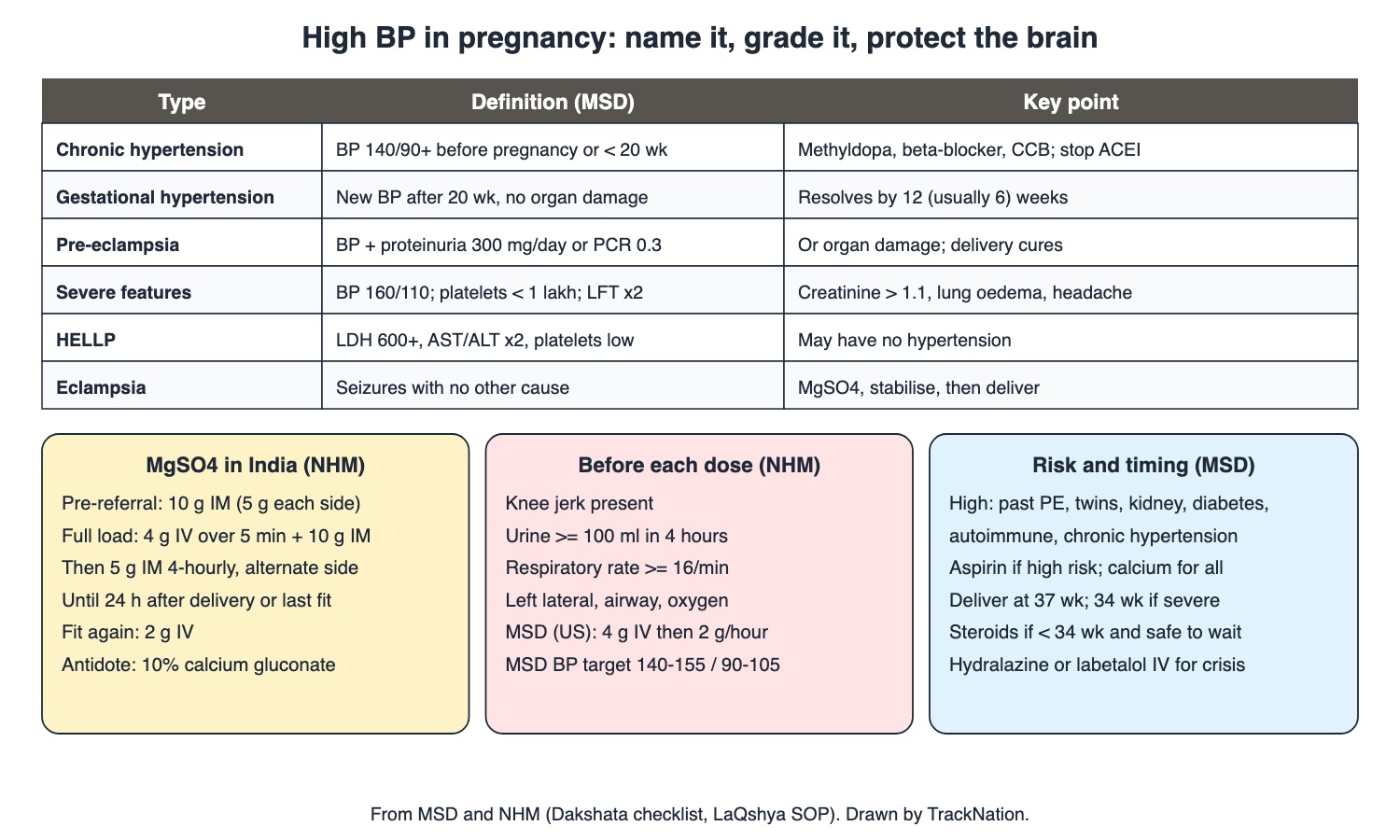
Hypertensive disorders, the Indian MgSO4 regimen and delivery timing. Drawn by TrackNation.
Classification and Diagnosis (MSD, NHM)
Hypertension in pregnancy = BP ≥140/90 on two readings at least 4 hours apart (NHM, MSD).
Chronic hypertension: before pregnancy or before 20 weeks, or persisting beyond 6–12 weeks postpartum (1–5% of pregnancies). Gestational hypertension: new after 20 weeks without proteinuria or organ damage; gone by 12 (usually 6) weeks postpartum.
Pre-eclampsia: new hypertension after 20 weeks plus proteinuria (>300 mg/24 h, PCR ≥0.3, or dipstick 2+ if nothing else) and/or end-organ damage. A negative dipstick does not exclude it. 4.6% of deliveries worldwide; may appear up to 6 weeks postpartum.
Severe features: BP ≥160/110, platelets <1,00,000, transaminases >2×, persistent RUQ/epigastric pain, creatinine >1.1, pulmonary oedema, severe headache, visual disturbance. Face and hand swelling (a tight ring) is more specific than ankle oedema.
HELLP: LDH ≥600, transaminases >2×, platelets <1,00,000 — up to 15% have no hypertension or proteinuria. Superimposed pre-eclampsia: new or worse proteinuria, BP rise or organ damage in chronic hypertension (raised uric acid supports it).
Eclampsia: seizures with no other cause. MoHFW tells ANMs: treat every convulsion in pregnancy, labour or postpartum as eclampsia until proven otherwise.
Mechanism: poorly remodelled spiral arterioles → placental ischaemia, endothelial dysfunction (low prostacyclin, high endothelin, sFlt-1). Risks: abruption, FGR, oligohydramnios, stillbirth; maternal lung oedema, AKI, liver rupture, stroke.
Magnesium Sulphate — the Indian Regimen (NHM)
Drug of choice to prevent and treat eclamptic fits. Left lateral, clear airway, oxygen.
Pre-referral (sub-centre/PHC, L1–L2): 10 g of 50% MgSO4 deep IM — 5 g in each buttock, then refer to the FRU with a note of the dose (ANMs do not repeat it).
Full loading dose (L3, 14 g total): 4 g IV as 20% solution slowly over 5 minutes + 10 g IM (5 g each buttock, with 1 mL 2% lignocaine).
Maintenance: 5 g deep IM every 4 hours in alternate buttocks, continued until 24 hours after delivery or the last fit (Dakshata: whichever is later). Another fit: 2 g IV (20%) slowly.
Withhold the next dose if the knee jerk is absent, urine <100 mL in 4 hours, or respiratory rate <16/min. Antidote: 10% calcium gluconate (MSD: 1 g IV).
MSD (US) uses an IV regimen — 4 g over 20 minutes, then 2 g/hour, for 12–24 hours postpartum. Fits despite magnesium: IV diazepam or lorazepam.
Blood Pressure, Delivery and Prevention (MSD, MoHFW)
First-line oral drugs: methyldopa (250 mg twice daily upward), beta-blockers (labetalol), calcium channel blockers (nifedipine). Stop ACE inhibitors and ARBs once pregnancy is confirmed; avoid diuretics. Treat severe BP (≥160/110); acute control with IV labetalol or hydralazine to 140–155/90–105.
Delivery is the cure. Deliver after stabilisation at ≥37 weeks, at ≥34 weeks with severe features, or any time for eclampsia, HELLP, organ deterioration or fetal compromise. Below 34 weeks, if it is safe to wait, give corticosteroids for 48 hours. Chronic hypertension: deliver by 37–39 weeks. Vaginal route if feasible (oxytocin); caesarean for an unfavourable cervix.
After delivery, pre-eclampsia usually settles in 6–12 hours; BP still high at 6 weeks → chronic hypertension.
Prevention: low-dose aspirin for high-risk women (previous pre-eclampsia, twins, kidney or autoimmune disease, diabetes, chronic hypertension) or several moderate risks (first pregnancy, age ≥35, BMI >30, family history). Calcium supplementation for all pregnant women in India.
Traps the Examiner Sets
HELLP can occur without hypertension or proteinuria.
Lost knee jerk, scanty urine or slow breathing: withhold MgSO4; give calcium gluconate if toxic.
ACE inhibitors and ARBs are stopped in pregnancy.
Pre-eclampsia can appear after delivery.
Memory Hooks & Shortcuts
Shortcuts to lock in this article's numbers and lists. Each one only re-packages facts proven above.
🧠 MgSO4 India: '10 to refer, 14 to load, 5 every 4' — regimen
🧠 Withhold MgSO4 — 'Reflex, Respiration, Renal': no knee jerk, RR <16, urine <100 mL/4 h — toxicity
🧠 HELLP: 'LDH 600, LFT double, platelets under a lakh' — HELLP
🧠 '140/90 twice, 4 hours apart' — the pregnancy BP rule — definition
🧠 Safe BP drugs: 'Mother Likes Nifty' — Methyldopa, Labetalol, Nifedipine — drugs
Rapid-Revision Cards
HTN in pregnancy
≥140/90 twice, 4 h apart.
Chronic HTN
Before 20 wk / pre-pregnancy.
Gestational HTN
After 20 wk, no organ damage.
Proteinuria
>300 mg/24 h or PCR ≥0.3.
Dipstick negative
Doesn't exclude PE.
Severe BP
≥160/110.
Severe labs
Plt <1 lakh, LFT ×2, Cr >1.1.
HELLP
LDH ≥600, LFT ×2, Plt <1 lakh.
HELLP without HTN
Up to 15%.
Any fit in pregnancy
Eclampsia until proven.
Pre-referral MgSO4
10 g IM, 5 g each buttock.
Full load (L3)
4 g IV + 10 g IM = 14 g.
Maintenance
5 g IM 4-hourly, alternate.
Continue till
24 h after delivery/last fit.
Recurrent fit
2 g IV.
Withhold if
No knee jerk; urine <100/4 h; RR <16.
Antidote
10% calcium gluconate.
Safe drugs
Methyldopa, labetalol, nifedipine.
Banned
ACEI, ARB.
Deliver
≥37 wk; ≥34 wk if severe.
Prevention
Aspirin (high risk); calcium (all).
Sources
Facts in this article were checked against these documents.
MSD Manual Professional: Preeclampsia and Eclampsia; Hypertension in Pregnancy — Merck & Co. (MSD Manuals), 2024–26 (link)
Dakshata: Checklist for Administering Inj. MgSO4 for Initial Management of Eclampsia — National Health Mission, MoHFW, n.d. (link)
LaQshya Standard Operating Procedures for District Hospitals — National Health Mission, MoHFW, 2018 (link)
Guidelines for Antenatal Care and Skilled Attendance at Birth by ANMs/LHVs/SNs; National Guidelines for Calcium Supplementation — Ministry of Health & Family Welfare, 2010–2014
Competency Based Undergraduate Curriculum, Vol III: Obstetrics & Gynaecology (OG12.1) — National Medical Commission, 2024
Test Yourself: Practice Questions
Thirty questions in NEET PG style, most of them clinical vignettes.
Practice Questions (NEET PG pattern)
Original questions written in the style of the exam: +4 for a correct answer, −1 for a wrong one. Every answer was checked against the sources listed above. NEET PG papers are not published by NBEMS, so these are not past-paper questions.
Q1. Hypertension in pregnancy is diagnosed when BP is
(a) ≥130/80 once
(b) ≥120/80 twice
(c) ≥140/90 on two readings at least 4 hours apart
(d) ≥160/110 only
Show answer
Answer: (c) — NHM and MSD.
Q2. A woman known to have BP 150/96 at 10 weeks of pregnancy has
(a) gestational hypertension
(b) pre-eclampsia
(c) white-coat hypertension only
(d) chronic hypertension
Show answer
Answer: (d) — Before 20 weeks.
Q3. A primigravida has BP 146/94 twice at 34 weeks, no proteinuria, normal labs and symptoms. Diagnosis:
(a) gestational hypertension
(b) pre-eclampsia with severe features
(c) HELLP
(d) chronic hypertension
Show answer
Answer: (a) — No organ damage.
Q4. Proteinuria for diagnosing pre-eclampsia is
(a) >30 mg/24 h
(b) >300 mg/24 h or protein/creatinine ratio ≥0.3
(c) >3 g/24 h only
(d) any trace on dipstick
Show answer
Answer: (b) — Dipstick 2+ if nothing else.
Q5. A woman at 32 weeks has new BP 150/100 and a negative urine dipstick. Pre-eclampsia
(a) cannot occur before 34 weeks
(b) is not excluded; check PCR or 24-h protein and organ function
(c) is excluded
(d) is confirmed
Show answer
Answer: (b) — Dipstick is insensitive.
Q6. A more specific sign of pre-eclampsia than ankle swelling is
(a) weight gain of 1 kg a month
(b) pedal oedema in the evening
(c) swelling of the face or hands (ring too tight)
(d) varicose veins
Show answer
Answer: (c) — Non-dependent oedema.
Q7. Which is a severe feature of pre-eclampsia?
(a) trace proteinuria
(b) platelets below 1,00,000/µL
(c) BP 142/92
(d) mild pedal oedema
Show answer
Answer: (b) — Also creatinine >1.1, pulmonary oedema.
Q8. A woman at 35 weeks has epigastric pain, LDH 820 IU/L, AST three times normal and platelets 80,000. Diagnosis:
(a) HELLP syndrome
(b) viral hepatitis
(c) acute fatty liver only
(d) gallstones
Show answer
Answer: (a) — Deliver after stabilising.
Q9. In HELLP syndrome, hypertension and proteinuria
(a) are always severe
(b) rule it out if absent
(c) always precede it by weeks
(d) may be absent in up to 15%
Show answer
Answer: (d) — Atypical presentation.
Q10. A woman with chronic hypertension develops new proteinuria at 30 weeks and a raised uric acid. This suggests
(a) renal stones
(b) superimposed pre-eclampsia
(c) gestational hypertension
(d) simple chronic hypertension
Show answer
Answer: (b) — MSD.
Q11. An ANM sees a pregnant woman having a convulsion. MoHFW advises her to assume
(a) epilepsy and give phenytoin
(b) hypoglycaemia
(c) eclampsia until proven otherwise and give MgSO4
(d) hysteria
Show answer
Answer: (c) — Then refer.
Q12. The pre-referral MgSO4 dose at a PHC (L1/L2) in India is
(a) 4 g IV only
(b) 2 g IV
(c) 1 g IM
(d) 10 g of 50% solution deep IM, 5 g in each buttock
Show answer
Answer: (d) — Then refer to FRU.
Q13. The full MgSO4 loading dose at an L3 facility per NHM totals
(a) 20 g IV
(b) 6 g IV then 2 g/h
(c) 14 g: 4 g IV (20%) + 10 g IM (50%)
(d) 4 g IV only
Show answer
Answer: (c) — Pritchard-type regimen.
Q14. The IV part of the loading dose is given
(a) as a rapid push
(b) as 50% undiluted
(c) over 4 hours
(d) slowly over 5 minutes as 20% solution
Show answer
Answer: (d) — NHM checklist.
Q15. The NHM maintenance dose of MgSO4 is
(a) 5 g deep IM every 4 hours in alternate buttocks
(b) 2 g IM daily
(c) 1 g IV hourly
(d) 10 g IM every 12 hours
Show answer
Answer: (a) — With lignocaine.
Q16. MgSO4 maintenance is continued until
(a) 24 hours after delivery or the last convulsion, whichever is later
(b) 6 hours postpartum
(c) discharge
(d) the first fit stops
Show answer
Answer: (a) — Dakshata.
Q17. A woman on MgSO4 has another fit. Per NHM give
(a) 2 g of 20% MgSO4 IV slowly
(b) another 14 g load
(c) nothing more
(d) phenytoin first
Show answer
Answer: (a) — Recurrent fit.
Q18. Before the next MgSO4 dose, the patellar reflex is absent. You should
(a) double the dose
(b) ignore the reflex
(c) give it IV instead
(d) withhold the dose
Show answer
Answer: (d) — Toxicity sign.
Q19. MgSO4 should also be withheld if urine output over 4 hours is below
(a) 100 mL
(b) 400 mL
(c) 1 L
(d) 30 mL
Show answer
Answer: (a) — Or RR <16.
Q20. A woman on MgSO4 develops respiratory depression. The antidote is
(a) flumazenil
(b) 10% calcium gluconate
(c) atropine
(d) naloxone
Show answer
Answer: (b) — MSD: 1 g IV.
Q21. The MSD (US) magnesium regimen is
(a) 1 g orally daily
(b) 5 g IM 4-hourly
(c) 10 g IM only
(d) 4 g IV over 20 min then 2 g/hour infusion
Show answer
Answer: (d) — Continue 12–24 h postpartum.
Q22. A pregnant woman with BP 170/112 needs urgent control. Suitable IV drugs are
(a) enalapril
(b) labetalol or hydralazine
(c) losartan
(d) furosemide
Show answer
Answer: (b) — Target 140–155/90–105.
Q23. A woman with chronic hypertension on enalapril finds she is pregnant. Next step:
(a) continue enalapril
(b) stop enalapril and switch to methyldopa, labetalol or nifedipine
(c) stop all treatment
(d) add an ARB
Show answer
Answer: (b) — ACEI/ARB stopped.
Q24. The definitive treatment of pre-eclampsia is
(a) bed rest
(b) salt restriction
(c) delivery
(d) diuretics
Show answer
Answer: (c) — Timing depends on gestation and severity.
Q25. Pre-eclampsia with severe features at 35 weeks should be managed by
(a) expectant care to 40 weeks
(b) outpatient follow-up
(c) stabilisation then delivery
(d) aspirin only
Show answer
Answer: (c) — ≥34 weeks.
Q26. At 31 weeks a stable woman has pre-eclampsia and delivery can safely wait. Give
(a) nothing
(b) immediate caesarean
(c) corticosteroids for 48 hours for fetal lungs
(d) diuretics
Show answer
Answer: (c) — If <34 weeks.
Q27. A woman develops severe headache and BP 160/110 on day 3 after a normal delivery. Consider
(a) migraine only
(b) postpartum pre-eclampsia
(c) postpartum psychosis
(d) normal puerperium
Show answer
Answer: (b) — Up to 6 weeks.
Q28. A woman with previous pre-eclampsia should take in the next pregnancy
(a) nothing special
(b) high-dose aspirin
(c) diuretics
(d) low-dose aspirin
Show answer
Answer: (d) — High-risk factor.
Q29. A moderate risk factor for pre-eclampsia is
(a) first pregnancy
(b) age 25
(c) BMI 22
(d) multiparity
Show answer
Answer: (a) — Also age ≥35, BMI >30.
Q30. Women with pre-eclampsia have an increased risk of which other obstetric emergency?
(a) shoulder dystocia
(b) cord prolapse
(c) placenta previa
(d) placental abruption
Show answer
Answer: (d) — Uteroplacental insufficiency.
Active Recall
From memory: classify hypertensive disorders of pregnancy with diagnostic criteria, list severe features and HELLP thresholds, give the NHM magnesium sulphate regimen with toxicity checks and antidote, name safe and unsafe antihypertensives, state delivery timing, and describe prevention with aspirin and calcium.