Diabetes and Anaemia in Pregnancy for NEET PG OBG: Indian GDM Test, Insulin and Metformin, Delivery, Newborn Sugar and Anemia Mukt Bharat Treatment
Start Here
🎯 Exam priority: Very high. Expect: the Indian GDM test (dose, timing, cut-off) vs the US two-step test, when to start insulin or metformin, the insulin dose steps, delivery timing, neonatal sugar cut-offs, postpartum follow-up; anaemia grades in pregnancy and the Anemia Mukt Bharat treatment ladder (oral vs IV iron, referral, admission).
CBME mapping: OG12.2 (anaemia) and OG12.3 (diabetes). Indian anchors: MoHFW GDM technical and operational guidelines 2018 and Anemia Mukt Bharat operational guidelines 2018.
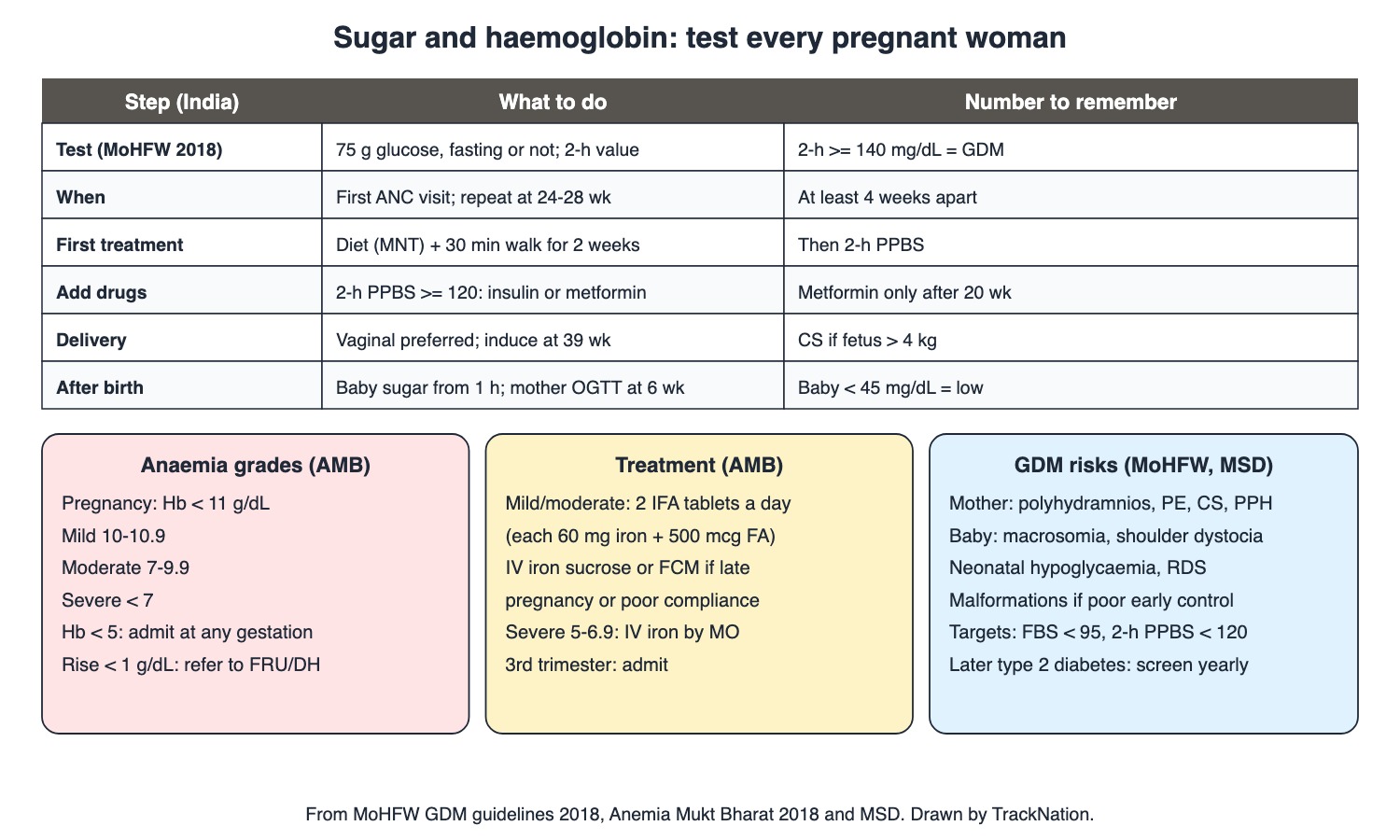
The Indian GDM pathway, anaemia grades and treatment. Drawn by TrackNation.
Gestational Diabetes: the Indian Test (MoHFW 2018)
GDM = impaired glucose tolerance with onset or first recognition in pregnancy. India: 10–14.3% of pregnancies.
Single-step test: 75 g glucose in about 300 mL water, fasting or not, irrespective of the last meal; plasma-calibrated glucometer reading at 2 hours. 2-h ≥140 mg/dL = GDM. Vomiting within 30 minutes → repeat the next day.
Universal, twice: at the first antenatal contact, and again at 24–28 weeks if negative, at least 4 weeks apart. Presenting after 28 weeks → one test only.
Contrast — US (ACOG via MSD): two steps, a 50 g 1-hour screen (positive >130–140) then a 100 g 3-hour OGTT (Carpenter–Coustan 95/180/155/140).
Risks: mother — polyhydramnios, pre-eclampsia, prolonged/obstructed labour, caesarean, PPH, infection; baby — abortion, stillbirth, malformations (poor control in the first ~10 weeks; HbA1c ≥8.5% in the first trimester), macrosomia, shoulder dystocia, neonatal hypoglycaemia, hypocalcaemia, polycythaemia, jaundice and RDS.
Treating GDM and Delivery (MoHFW 2018, MSD)
Step 1: medical nutrition therapy + 30 minutes of walking a day for 2 weeks, then a 2-h post-meal sugar (PPBS). PPBS ≥120 → add drugs. Targets: fasting <95, 2-h PPBS <120.
Insulin is the first drug of choice (does not cross the placenta) and can start at any gestation; metformin only after 20 weeks, 500 mg twice daily up to 2 g/day (less hypoglycaemia and weight gain).
Insulin in the programme: human premix 30/70, subcutaneous, 30 minutes before breakfast — 4 units (PPBS 120–160), 6 units (160–200), 8 units (>200); adjust by 2 units every third day.
Refer if insulin >20 units/day, PPBS >200 at any time, fasting >200, or more than one hypoglycaemic episode a day. Maternal hypoglycaemia = <70 mg/dL → 15–20 g glucose by mouth.
Scans: anomaly scan at 18–20 weeks if diagnosed before 20 weeks; growth scans at 28–30 and 34–36 weeks. Early delivery needed at 24–34 weeks → dexamethasone 6 mg IM 12-hourly × 2 days and watch sugar for 72 hours.
No routine delivery before 39 weeks (lung maturity is delayed); induce at or after 39 weeks if well controlled; earlier only for poor control or complications. Vaginal delivery preferred; consider caesarean at 39 weeks if estimated fetal weight >4 kg. In labour: skip the morning insulin/metformin, check sugar 2-hourly, insulin in saline as needed.
Newborn and After Delivery (MoHFW 2018)
Every baby of a GDM mother: early breastfeeding; glucose from 1 hour, then before feeds until four stable values.
Neonatal hypoglycaemia: <45 mg/dL (<54 in a growth-restricted baby) → breastfeed at once. <20 mg/dL → 10% dextrose 2 mL/kg IV bolus, then infusion.
Mother: 75 g OGTT at 6 weeks postpartum — 2-h <140 normal, 140–199 IGT, ≥200 diabetes (fasting ≥126). Normal → yearly screening in the NCD clinic. Mother and child have a higher lifetime risk of type 2 diabetes.
Pre-existing diabetes (MSD): eye examination every trimester; insulin needs can fall by up to 50% after delivery. Before the next pregnancy (MoHFW): fasting <100, PPBS <140.
Anaemia in Pregnancy (AMB 2018, MSD)
Physiology: plasma volume rises 40–50% but red cell mass only 15–25% → haemodilution (physiological anaemia).
India (AMB, WHO grades): pregnancy anaemia = Hb <11 g/dL; mild 10–10.9, moderate 7–9.9, severe <7. US cut-offs (MSD): 11 / 10.5 / 11 g/dL by trimester.
Mild or moderate: two IFA tablets daily (each 60 mg iron + 500 mcg folic acid); consider IV iron sucrose or ferric carboxymaltose first if detected late in pregnancy or compliance is poor. Hb rechecked at follow-up; rise <1 g/dL after 1 month (mild) or 2 months (moderate) → refer to FRU/DH. Normal Hb → back to the prophylactic dose.
Severe (5–6.9): IV iron by the medical officer; admit in the third trimester. Hb <5: admit at any gestation. This protocol is not for thalassaemia major or sickle cell disease — folic acid instead in thalassaemia major. Deworming in the second trimester.
Iron deficiency is the commonest pathological cause: low MCV, low ferritin and serum iron, high transferrin. About 20% cannot absorb or tolerate oral iron. Oral iron failing → suspect folate deficiency too (treat with folic acid 1 mg/day; 4 mg if a previous baby had spina bifida).
Haemoglobinopathies: sickle cell disease raises infection, pre-eclampsia, thrombosis, FGR and stillbirth risk; a fetus homozygous for alpha-thalassaemia develops hydrops. FGR should prompt a check for maternal anaemia.
Traps the Examiner Sets
The Indian GDM test needs no fasting; the cut-off is 140 at 2 hours.
Metformin is used only after 20 weeks; insulin can be used at any time.
Severe anaemia in pregnancy is Hb <7, not <8 (non-pregnant women).
No routine GDM delivery before 39 weeks.
Memory Hooks & Shortcuts
Shortcuts to lock in this article's numbers and lists. Each one only re-packages facts proven above.
🧠 GDM India: '75 grams, 2 hours, 140 — and no fasting' — test
🧠 Drugs: 'Insulin any time, Metformin after 20' — drugs
🧠 Premix ladder: '120-160 four, 160-200 six, over 200 eight' — insulin
🧠 AMB pregnancy grades: '11, 10, 7' — anaemia below 11, moderate below 10, severe below 7 — anaemia
🧠 Baby sugar: '45 feed, 20 drip' — newborn
Rapid-Revision Cards
GDM test (India)
75 g, any time, 2-h value.
GDM cut-off
2-h ≥140 mg/dL.
When to test
First visit + 24–28 wk.
Gap
≥4 weeks.
US test
50 g screen → 100 g 3-h.
First treatment
Diet + 30 min walk × 2 wk.
Drug trigger
2-h PPBS ≥120.
First drug
Insulin (any time).
Metformin
After 20 wk; max 2 g.
Premix 30/70
4 / 6 / 8 units.
Targets
FBS <95; PPBS <120.
Refer
Insulin >20 U/day.
Delivery
Not before 39 wk routinely.
Macrosomia CS
EFW >4 kg.
Newborn low sugar
<45 (IUGR <54).
Very low
<20 → 10% dextrose 2 mL/kg.
Postpartum
OGTT at 6 wk.
Anaemia grades
10–10.9 / 7–9.9 / <7.
Mild–moderate
2 IFA tablets daily.
IV iron
Late detection, poor compliance.
Hb <5
Admit at any gestation.
Sources
Facts in this article were checked against these documents.
Diagnosis & Management of Gestational Diabetes Mellitus: Technical and Operational Guidelines — Maternal Health Division, MoHFW, 2018 (link)
Anemia Mukt Bharat: Intensified National Iron Plus Initiative, Operational Guidelines — Ministry of Health & Family Welfare, 2018
MSD Manual Professional: Diabetes Mellitus in Pregnancy; Anemia in Pregnancy — Merck & Co. (MSD Manuals), 2023–26 (link)
Competency Based Undergraduate Curriculum, Vol III: Obstetrics & Gynaecology (OG12.2–12.3) — National Medical Commission, 2024
Test Yourself: Practice Questions
Thirty questions in NEET PG style, most of them clinical vignettes.
Practice Questions (NEET PG pattern)
Original questions written in the style of the exam: +4 for a correct answer, −1 for a wrong one. Every answer was checked against the sources listed above. NEET PG papers are not published by NBEMS, so these are not past-paper questions.
Q1. The MoHFW (2018) test for gestational diabetes is
(a) 100 g 3-hour OGTT after an overnight fast
(b) 75 g oral glucose, irrespective of the last meal, with a 2-hour reading
(c) 50 g glucose with a 1-hour reading
(d) HbA1c alone
Show answer
Answer: (b) — Single step.
Q2. In the Indian single-step test, GDM is diagnosed when the 2-hour value is
(a) ≥140 mg/dL
(b) ≥180 mg/dL
(c) ≥200 mg/dL
(d) ≥120 mg/dL
Show answer
Answer: (a) — Plasma-calibrated glucometer.
Q3. A woman comes for her first ANC visit at 10 weeks and has just eaten breakfast. For GDM testing you should
(a) send her home to fast overnight
(b) do a urine sugar only
(c) do the 75 g test now, without asking her to fast
(d) wait until 24 weeks
Show answer
Answer: (c) — Fasting not needed.
Q4. Her first test is 128 mg/dL. Next GDM test is due at
(a) no further test
(b) 36 weeks
(c) 24–28 weeks, at least 4 weeks after the first
(d) postpartum only
Show answer
Answer: (c) — Two tests in pregnancy.
Q5. A woman first books at 31 weeks. GDM testing per MoHFW:
(a) two tests a week apart
(b) 100 g OGTT
(c) no test as it is too late
(d) one test at the first contact
Show answer
Answer: (d) — After 28 weeks.
Q6. She vomits 15 minutes after drinking the 75 g glucose. You should
(a) repeat the test the next day
(b) diagnose GDM
(c) read the 2-hour value anyway
(d) give a 50 g load
Show answer
Answer: (a) — Within 30 minutes.
Q7. The two-step US approach (ACOG, per MSD) starts with
(a) random sugar only
(b) a 75 g 2-hour test
(c) fasting sugar only
(d) a 50 g 1-hour screen, then a 100 g 3-hour test if positive
Show answer
Answer: (d) — Carpenter–Coustan.
Q8. A woman newly diagnosed with GDM at 26 weeks should first receive
(a) insulin immediately
(b) diet therapy and 30 minutes of daily walking for 2 weeks
(c) early delivery
(d) metformin 2 g at once
Show answer
Answer: (b) — Then 2-h PPBS.
Q9. After 2 weeks of diet and exercise, drugs are started if the 2-hour post-meal sugar is
(a) ≥140 mg/dL
(b) ≥120 mg/dL
(c) ≥200 mg/dL
(d) ≥95 mg/dL
Show answer
Answer: (b) — MoHFW trigger.
Q10. A woman at 16 weeks has GDM uncontrolled on diet. The drug to start is
(a) acarbose
(b) insulin
(c) metformin
(d) glibenclamide
Show answer
Answer: (b) — Metformin only after 20 weeks.
Q11. Maximum metformin dose in GDM per MoHFW is
(a) 2 g/day
(b) 500 mg/day
(c) 850 mg/day
(d) 3 g/day
Show answer
Answer: (a) — Start 500 mg twice daily.
Q12. Insulin is preferred in pregnancy partly because it
(a) does not cross the placenta
(b) never causes hypoglycaemia
(c) lowers BP
(d) is cheaper than metformin
Show answer
Answer: (a) — MSD.
Q13. In the MoHFW programme, a woman with PPBS 175 mg/dL after diet starts on premix 30/70 insulin. Starting dose:
(a) 20 units
(b) 4 units
(c) 8 units
(d) 6 units before breakfast
Show answer
Answer: (d) — 160–200 → 6 units.
Q14. Target sugars during treatment of diabetes in pregnancy are
(a) fasting <70
(b) fasting <95 and 2-h post-meal ≤120 mg/dL
(c) HbA1c <8.5% only
(d) fasting <126 and 2-h <200
Show answer
Answer: (b) — MSD and MoHFW.
Q15. A woman with GDM needs 24 units of insulin a day at a PHC. You should
(a) continue at PHC
(b) stop insulin
(c) refer her to a higher centre
(d) switch to diet alone
Show answer
Answer: (c) — >20 units/day.
Q16. Growth scans for GDM per MoHFW are done at
(a) every week from 20 weeks
(b) only at 40 weeks
(c) 28–30 and 34–36 weeks
(d) 12 and 20 weeks
Show answer
Answer: (c) — Biometry + liquor.
Q17. A woman with GDM needs delivery at 32 weeks. Steroid cover per GoI is
(a) hydrocortisone 100 mg once
(b) dexamethasone 6 mg IM 12-hourly for 2 days, with closer sugar monitoring
(c) betamethasone 24 mg daily for a week
(d) no steroids in diabetes
Show answer
Answer: (b) — Watch 72 h.
Q18. A woman with well-controlled GDM has not gone into labour. Induction should be at
(a) 36 weeks
(b) 39 weeks or later
(c) 37 weeks routinely
(d) 42 weeks
Show answer
Answer: (b) — No routine delivery before 39.
Q19. A GDM mother at 39 weeks has an estimated fetal weight of 4.3 kg. Consider
(a) forceps delivery
(b) external version
(c) primary caesarean section to avoid shoulder dystocia
(d) induction at 42 weeks
Show answer
Answer: (c) — >4 kg (MoHFW).
Q20. The baby of a GDM mother has a glucometer reading of 38 mg/dL at 1 hour and is feeding well. First step:
(a) no action
(b) IV 10% dextrose bolus
(c) breastfeed immediately and recheck
(d) oral glucose water only
Show answer
Answer: (c) — <45 → feed.
Q21. The newborn's glucose is 16 mg/dL. Give
(a) breastfeed only
(b) glucagon
(c) 10% dextrose 2 mL/kg IV bolus, then infusion
(d) 25% dextrose 10 mL/kg
Show answer
Answer: (c) — <20 mg/dL.
Q22. A woman who had GDM has a 2-hour OGTT of 165 mg/dL at 6 weeks postpartum. This is
(a) impaired glucose tolerance — link to the NCD programme
(b) normal
(c) type 1 diabetes
(d) persistent GDM
Show answer
Answer: (a) — 140–199.
Q23. A woman with type 1 diabetes plans pregnancy. Major malformation risk rises markedly with first-trimester HbA1c of
(a) ≥8.5%
(b) ≥5.0%
(c) any value
(d) ≥6.0%
Show answer
Answer: (a) — Then targeted scan and fetal echo.
Q24. Neonatal problems in babies of diabetic mothers include all EXCEPT
(a) hypercalcaemia
(b) hypoglycaemia
(c) respiratory distress
(d) polycythaemia
Show answer
Answer: (a) — It is hypocalcaemia.
Q25. Under Anemia Mukt Bharat, severe anaemia in pregnancy is Hb
(a) <8 g/dL
(b) <10 g/dL
(c) <7 g/dL
(d) <9 g/dL
Show answer
Answer: (c) — <8 is for non-pregnant women.
Q26. A woman at 22 weeks has Hb 9.2 g/dL. The first-level AMB treatment is
(a) two IFA tablets daily (60 mg iron + 500 mcg folic acid each)
(b) vitamin B12 injections
(c) blood transfusion
(d) one IFA tablet weekly
Show answer
Answer: (a) — Moderate anaemia.
Q27. A woman first found anaemic (Hb 8.5) at 34 weeks, likely to miss follow-up. AMB suggests considering
(a) deworming only
(b) waiting until after delivery
(c) weekly IFA
(d) IV iron sucrose or ferric carboxymaltose first
Show answer
Answer: (d) — Late pregnancy / poor compliance.
Q28. A woman at 18 weeks has Hb 4.6 g/dL. Per AMB she needs
(a) folic acid only
(b) oral iron at home
(c) immediate hospitalisation where round-the-clock specialist care is available
(d) review in 2 months
Show answer
Answer: (c) — <5 at any gestation.
Q29. Plasma volume and red cell mass in a singleton pregnancy rise by about
(a) 10% each
(b) 15–25% and 40–50%
(c) 100% and 50%
(d) 40–50% and 15–25%
Show answer
Answer: (d) — Haemodilution.
Q30. A woman's anaemia does not respond to adequate oral iron. Suspect concomitant
(a) folate deficiency
(b) hyperthyroidism
(c) GDM
(d) vitamin C excess
Show answer
Answer: (a) — MSD.
Active Recall
From memory: describe the Indian GDM test and when to do it, the steps of treatment including insulin and metformin rules, delivery timing, newborn and postpartum care, and the Anemia Mukt Bharat grades and treatment of anaemia in pregnancy.