Medical Disorders in Pregnancy for NEET PG OBG: Heart Disease, Thyroid, Liver, Epilepsy, and HIV, Syphilis and Hepatitis B Prevention in India
Start Here
🎯 Exam priority: High. Expect: when cardiac output peaks, why mitral stenosis decompensates, which heart lesions make pregnancy inadvisable, warfarin vs heparin, PTU vs radioiodine, cholestasis vs fatty liver, folic acid with antiepileptics, and the NACO 2024 rules for HIV (ART, infant prophylaxis, feeding), syphilis (penicillin doses, adequacy) and hepatitis B (HBIG + vaccine).
CBME mapping: OG12.4–12.8. Indian anchor: NACO National Guidelines for Elimination of Vertical Transmission of HIV and Syphilis (EVTHS), September 2024.
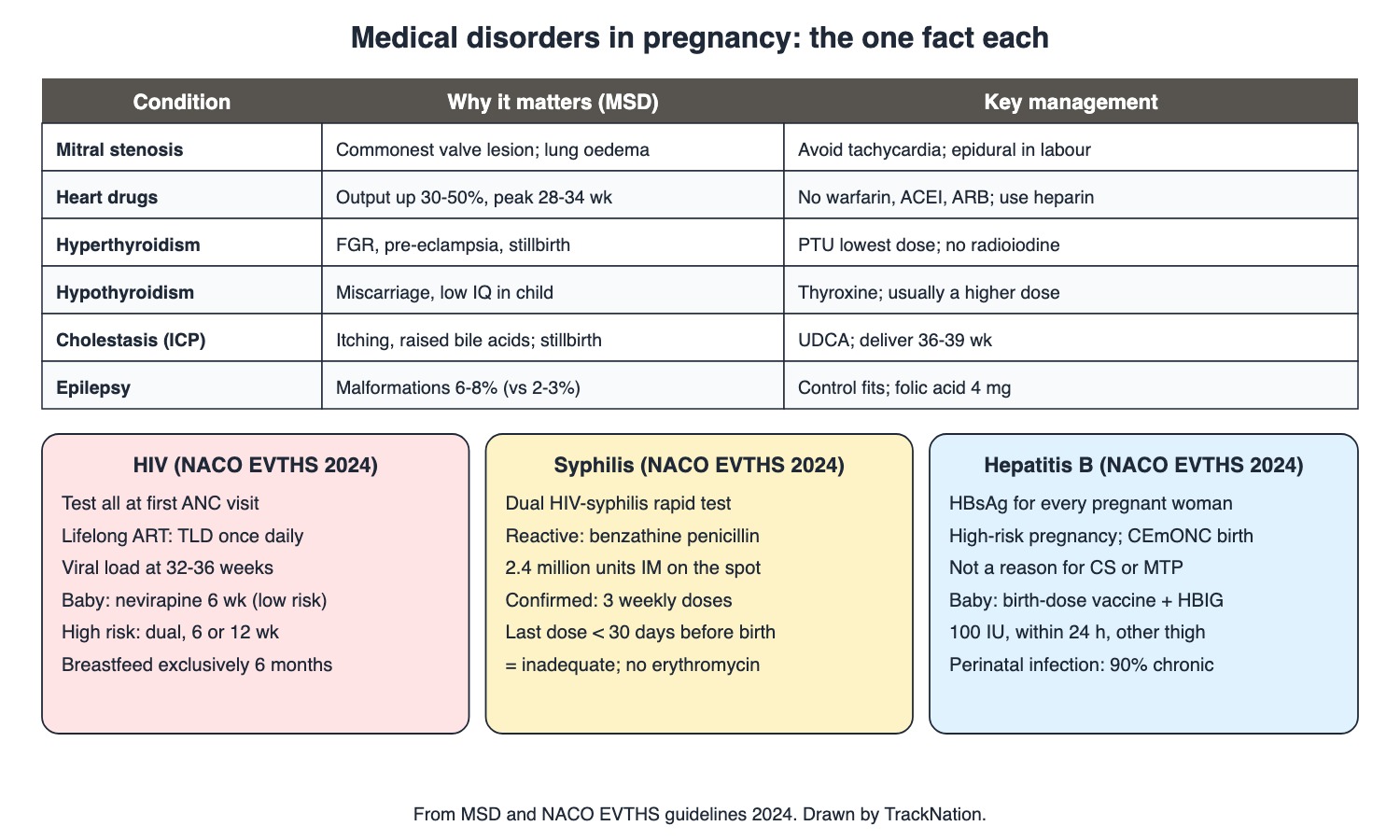
Medical disorders and the three infections tested at the first antenatal visit. Drawn by TrackNation.
Heart Disease in Pregnancy (MSD)
Cardiac output rises 30–50%, maximal at 28–34 weeks; each contraction adds about 20% in labour, and the load stays for weeks after delivery. In India, rheumatic heart disease is still common.
Normal pregnancy mimics heart disease (mild breathlessness, systolic murmur, oedema). Diastolic or presystolic murmurs point to real disease. Risk rises with NYHA class III–IV.
Pregnancy inadvisable: pulmonary hypertension/Eisenmenger, uncorrected coarctation, Marfan with aortic root >4.5 cm, severe symptomatic AS or severe MS, single ventricle with poor function, EF <30% or NYHA III–IV.
Mitral stenosis = commonest valve lesion in pregnancy; tachycardia and extra volume cause pulmonary oedema and AF. Prevent tachycardia, loop diuretics for oedema, valvotomy is relatively safe if needed, epidural in labour. Aortic stenosis: avoid conduction anaesthesia, avoid straining (operative vaginal delivery).
Avoid warfarin (crosses the placenta; fetal abnormalities, mainly in the first trimester), ACE inhibitors/ARBs (fetal kidney), spironolactone (feminises a male fetus), thiazides and amiodarone. Heparin and LMWH do not cross the placenta. Endocarditis prophylaxis is not routine for vaginal or caesarean delivery.
Thyroid, Liver and Epilepsy (MSD)
Hyperthyroidism (FGR, pre-eclampsia, stillbirth): lowest dose of propylthiouracil (50–100 mg 8-hourly) or methimazole; radioactive iodine is contraindicated. Graves often eases in the third trimester; maternal antibodies can cause fetal tachycardia >160 and goitre.
Hypothyroidism (miscarriage, intellectual deficit in the child): continue or start thyroxine — pregnancy usually needs a higher dose. Postpartum thyroid dysfunction affects 4–7% in the first 6 months.
Jaundice in pregnancy: acute viral hepatitis is the commonest cause; hepatitis E may be more severe.
Intrahepatic cholestasis: intense itching in the 2nd/3rd trimester, raised fasting bile acids; risk of preterm birth, stillbirth and meconium. UDCA eases symptoms; deliver at 36–39 weeks (36 weeks if bile acids ≥100 µmol/L). Recurs in later pregnancies and with oral contraceptives.
Acute fatty liver: rare, near term, sometimes with pre-eclampsia; nausea, vomiting, pain, jaundice → liver failure; linked to fetal LCHAD deficiency. Prompt delivery.
Epilepsy: uncontrolled fits harm more than the drugs. Malformations 6–8% vs 2–3%. Folic acid 4 mg/day, ideally before conception; vitamin K to the newborn; caesarean only if repeated fits in labour.
HIV, Syphilis and Hepatitis B (NACO EVTHS 2024)
Elimination targets: HIV transmission <5% in breastfeeding populations; new paediatric HIV and congenital syphilis ≤50 per 1,00,000 live births. Without intervention HIV passes to 30–45% of breastfed babies; with ART about 2%.
Screen every pregnant woman for HIV and syphilis in the first trimester (first ANC visit) using the dual rapid test; repeat in the third trimester and at labour for women at risk.
HIV: lifelong ART with TLD (tenofovir + lamivudine + dolutegravir, one pill a day); viral load at 32–36 weeks. Vaginal delivery unless obstetric indication; avoid routine episiotomy and instrumental delivery.
Baby: low risk (suppressed viral load) → nevirapine syrup for 6 weeks; high risk (mother not on ART, viral load not done or not suppressed after 32 weeks, mother newly identified after delivery) → nevirapine + zidovudine for 6 weeks (replacement feeding) or 12 weeks (breastfed). Exclusive breastfeeding for 6 months; cotrimoxazole from 6 weeks; first infant test (EID) at 6 weeks.
Syphilis: screen reactive → benzathine penicillin G 2.4 million units IM on the spot (over-treatment is accepted); confirmed by RPR/VDRL → three weekly doses. Last dose <30 days before delivery = inadequate. Erythromycin and azithromycin do not work; penicillin allergy → desensitise at a tertiary centre.
Hepatitis B: HBsAg for every pregnant woman; positive = high-risk pregnancy, deliver at a CEmONC centre. Not a reason for MTP or caesarean; vaccinating the infected mother is useless. Baby: HBIG 100 IU + birth-dose vaccine within 24 hours, in opposite thighs. Perinatal infection becomes chronic in 90%.
Traps the Examiner Sets
Peak cardiac load in pregnancy is at 28–34 weeks, with further surges in labour and just after delivery.
Heparin, not warfarin, is the anticoagulant that does not cross the placenta.
Syphilis: only penicillin treats the fetus.
Hepatitis B in the mother is not an indication for caesarean.
Memory Hooks & Shortcuts
Shortcuts to lock in this article's numbers and lists. Each one only re-packages facts proven above.
🧠 Heart load '30-50 at 28-34' — output rises 30–50%, peaks at 28–34 weeks — physiology
🧠 MS: 'slow the heart, dry the lungs, epidural for labour' — mitral stenosis
🧠 Anticoagulant: 'Heparin Hangs back' (does not cross); 'Warfarin Wanders in' — drugs
🧠 NACO HIV baby: 'Low risk Nevirapine 6; high risk Two drugs, 6 or 12' — HIV
🧠 Syphilis: 'Penicillin only — 2.4 on the spot, 30 days before birth or it doesn't count' — syphilis
Rapid-Revision Cards
Cardiac output peak
28–34 wk; +30–50%.
Labour
+20% per contraction.
Real heart disease
Diastolic murmur.
Commonest valve lesion
Mitral stenosis.
MS in labour
Avoid tachycardia; epidural.
Avoid pregnancy
Eisenmenger; Marfan >4.5 cm; EF <30%.
Anticoagulant
Heparin/LMWH (no placental crossing).
Spironolactone
Feminises male fetus.
Graves in pregnancy
PTU lowest dose; no RAI.
Hypothyroid
Higher thyroxine dose.
Itching + bile acids
Cholestasis; UDCA; stillbirth risk.
Fatty liver
Near term; LCHAD; deliver.
Epilepsy
Folic acid 4 mg; vit K to baby.
HIV/syphilis screen
First ANC, dual rapid test.
ART
Lifelong TLD.
Viral load
32–36 wk.
Low-risk baby
Nevirapine 6 wk.
High-risk breastfed
NVP + AZT 12 wk.
Syphilis
BPG 2.4 MU on the spot.
Inadequate
Last dose <30 days before birth.
Hep B baby
HBIG 100 IU + vaccine <24 h.
Sources
Facts in this article were checked against these documents.
National Guidelines for Elimination of Vertical Transmission of HIV and Syphilis (EVTHS) — National AIDS Control Organisation, MoHFW, 2024
MSD Manual Professional: Heart Disease, Thyroid Disorders, Hepatic Disorders and Seizure Disorders in Pregnancy — Merck & Co. (MSD Manuals), 2023–26 (link)
Competency Based Undergraduate Curriculum, Vol III: Obstetrics & Gynaecology (OG12.4–12.8) — National Medical Commission, 2024
Test Yourself: Practice Questions
Thirty questions in NEET PG style, most of them clinical vignettes.
Practice Questions (NEET PG pattern)
Original questions written in the style of the exam: +4 for a correct answer, −1 for a wrong one. Every answer was checked against the sources listed above. NEET PG papers are not published by NBEMS, so these are not past-paper questions.
Q1. Cardiac output in pregnancy reaches its maximum at about
(a) 16–20 weeks
(b) 40 weeks only
(c) 28–34 weeks
(d) 8–12 weeks
Show answer
Answer: (c) — 30–50% rise.
Q2. In labour, each uterine contraction raises cardiac output by about
(a) 2%
(b) 100%
(c) 50%
(d) 20%
Show answer
Answer: (d) — Plus straining in second stage.
Q3. Which murmur in a pregnant woman suggests real heart disease rather than normal pregnancy?
(a) diastolic murmur
(b) mammary souffle
(c) soft ejection systolic murmur
(d) venous hum
Show answer
Answer: (a) — Diastolic/presystolic.
Q4. The commonest valvular lesion complicating pregnancy is
(a) pulmonary stenosis
(b) tricuspid regurgitation
(c) mitral stenosis
(d) aortic regurgitation
Show answer
Answer: (c) — Rheumatic, in India.
Q5. A woman with mitral stenosis develops breathlessness and crackles at 30 weeks. The mechanism is
(a) pre-eclampsia always
(b) anaemia only
(c) tachycardia and volume load raising pulmonary capillary pressure
(d) pulmonary embolism always
Show answer
Answer: (c) — Pulmonary oedema.
Q6. In pregnant women with mitral stenosis, management aims to
(a) prevent tachycardia
(b) induce tachycardia to raise output
(c) give high-dose vasodilators
(d) avoid all diuretics
Show answer
Answer: (a) — Maximise diastolic filling.
Q7. Preferred analgesia in labour for a woman with mitral stenosis:
(a) pethidine only
(b) general anaesthesia always
(c) slow epidural infusion
(d) no analgesia
Show answer
Answer: (c) — Opposite in aortic stenosis.
Q8. Pregnancy is generally advised against in a woman with
(a) mitral valve prolapse
(b) mild mitral regurgitation
(c) Eisenmenger syndrome
(d) repaired ASD with normal function
Show answer
Answer: (c) — Pulmonary hypertension.
Q9. A woman with Marfan syndrome plans pregnancy. Pregnancy is inadvisable if aortic root diameter exceeds
(a) 2.5 cm
(b) 4.5 cm
(c) 6.5 cm
(d) 3.0 cm
Show answer
Answer: (b) — MSD.
Q10. A pregnant woman with AF needs anticoagulation. The drugs that do not cross the placenta are
(a) neither
(b) both warfarin and heparin
(c) warfarin
(d) unfractionated heparin and LMWH
Show answer
Answer: (d) — Warfarin is teratogenic.
Q11. Spironolactone is avoided in pregnancy because it may
(a) cause neural tube defects
(b) cause cleft lip
(c) feminise a male fetus
(d) close the ductus
Show answer
Answer: (c) — Aldosterone antagonist.
Q12. A woman with Graves disease is pregnant. Contraindicated:
(a) methimazole
(b) beta-blocker for severe symptoms
(c) radioactive iodine
(d) propylthiouracil
Show answer
Answer: (c) — Fetal thyroid.
Q13. A hypothyroid woman on thyroxine becomes pregnant. Typically her dose
(a) should be halved
(b) should be stopped
(c) needs to be higher
(d) should be switched to PTU
Show answer
Answer: (c) — Check TSH.
Q14. Untreated maternal hypothyroidism is linked to
(a) intellectual deficit in the child and miscarriage
(b) polyhydramnios only
(c) neonatal jaundice only
(d) fetal macrosomia only
Show answer
Answer: (a) — MSD.
Q15. A woman at 33 weeks has intense itching and raised fasting bile acids. Diagnosis:
(a) hepatitis E
(b) intrahepatic cholestasis of pregnancy
(c) HELLP
(d) acute fatty liver
Show answer
Answer: (b) — UDCA; plan delivery.
Q16. The main fetal danger of intrahepatic cholestasis of pregnancy is
(a) macrosomia
(b) neural tube defect
(c) hydrops from anaemia
(d) stillbirth
Show answer
Answer: (d) — Plus preterm birth, meconium.
Q17. A woman at 36 weeks develops nausea, vomiting, abdominal discomfort and jaundice, progressing to liver failure. A defect linked to this condition is
(a) G6PD deficiency
(b) alpha-thalassaemia
(c) factor V Leiden
(d) fetal LCHAD deficiency
Show answer
Answer: (d) — Acute fatty liver; deliver promptly.
Q18. The most common cause of jaundice in pregnancy is
(a) cholestasis of pregnancy
(b) fatty liver of pregnancy
(c) gallstones
(d) acute viral hepatitis
Show answer
Answer: (d) — MSD.
Q19. An epileptic woman on antiseizure drugs planning pregnancy should take folic acid
(a) none
(b) 5 mg weekly
(c) 4 mg daily, ideally before conception
(d) 0.4 mg only after the first scan
Show answer
Answer: (c) — MSD.
Q20. For a woman with epilepsy in pregnancy, the priority is to
(a) add more drugs routinely
(b) plan caesarean for all
(c) stop all drugs
(d) control seizures with the lowest effective dose
Show answer
Answer: (d) — Fits harm more.
Q21. Under NACO 2024, pregnant women are screened for HIV and syphilis
(a) in the first trimester, preferably at the first ANC visit
(b) only if high risk
(c) only in labour
(d) only at 36 weeks
Show answer
Answer: (a) — Dual rapid test.
Q22. A pregnant woman newly diagnosed with HIV is started on
(a) zidovudine alone until delivery
(b) ART only if CD4 < 350
(c) single-dose nevirapine in labour
(d) lifelong ART with TLD once daily
Show answer
Answer: (d) — Tenofovir + lamivudine + dolutegravir.
Q23. To grade the baby's risk, maternal HIV viral load is checked at
(a) 32–36 weeks
(b) 8–12 weeks
(c) 20 weeks
(d) after delivery only
Show answer
Answer: (a) — NACO.
Q24. A mother on ART has a suppressed viral load at 34 weeks. Her baby needs
(a) full three-drug ART
(b) nevirapine syrup for 6 weeks
(c) nevirapine + zidovudine for 12 weeks
(d) no prophylaxis
Show answer
Answer: (b) — Low-risk infant.
Q25. A breastfed baby of a mother whose viral load was not done after 32 weeks needs
(a) nevirapine + zidovudine for 12 weeks
(b) no drugs
(c) zidovudine for 2 weeks
(d) nevirapine for 6 weeks only
Show answer
Answer: (a) — High-risk, breastfed.
Q26. Recommended feeding for an HIV-exposed baby in India:
(a) replacement feeding always
(b) exclusive breastfeeding for 6 months
(c) mixed feeding
(d) no breast milk ever
Show answer
Answer: (b) — With maternal ART.
Q27. A pregnant woman's dual rapid test is reactive for syphilis at the sub-centre. Immediate step:
(a) oral azithromycin
(b) doxycycline
(c) wait for VDRL before treating
(d) benzathine penicillin G 2.4 million units IM on the spot
Show answer
Answer: (d) — Over-treatment accepted.
Q28. Syphilis treatment in pregnancy is considered inadequate if the last penicillin dose is given
(a) less than 30 days before delivery
(b) in the first trimester
(c) more than 30 days before delivery
(d) as three weekly doses
Show answer
Answer: (a) — Treat/evaluate the baby.
Q29. A pregnant woman with syphilis is allergic to penicillin. NACO advises
(a) ceftriaxone single dose
(b) referral for desensitisation and penicillin
(c) azithromycin
(d) erythromycin
Show answer
Answer: (b) — Macrolides fail.
Q30. The newborn of an HBsAg-positive mother should receive
(a) caesarean delivery and no vaccine
(b) vaccine only at 6 weeks
(c) HBIG only
(d) HBIG 100 IU and birth-dose hepatitis B vaccine within 24 hours, in opposite thighs
Show answer
Answer: (d) — NACO 2024.
Active Recall
From memory: describe the cardiac load of pregnancy and management of mitral stenosis, the heart conditions where pregnancy is inadvisable and drugs to avoid, thyroid, liver and epilepsy management, and the NACO 2024 approach to HIV, syphilis and hepatitis B.