Antipsychotics for NEET PG Psychiatry: FGA vs SGA, Clozapine and Agranulocytosis, EPS, Tardive Dyskinesia, NMS, Metabolic Monitoring
Start Here
🎯 Exam priority: High. Expect: high- vs low-potency drugs, which side effect fits which vignette (oculogyric crisis, restlessness, lip-smacking, rigidity with fever), the drug for each, clozapine indications and agranulocytosis monitoring, risperidone and prolactin, SGAs and metabolic syndrome, QT and dementia warnings.
CBME mapping: PS 4.1, PS 13. Receptor pharmacology is also in Pharmacology.
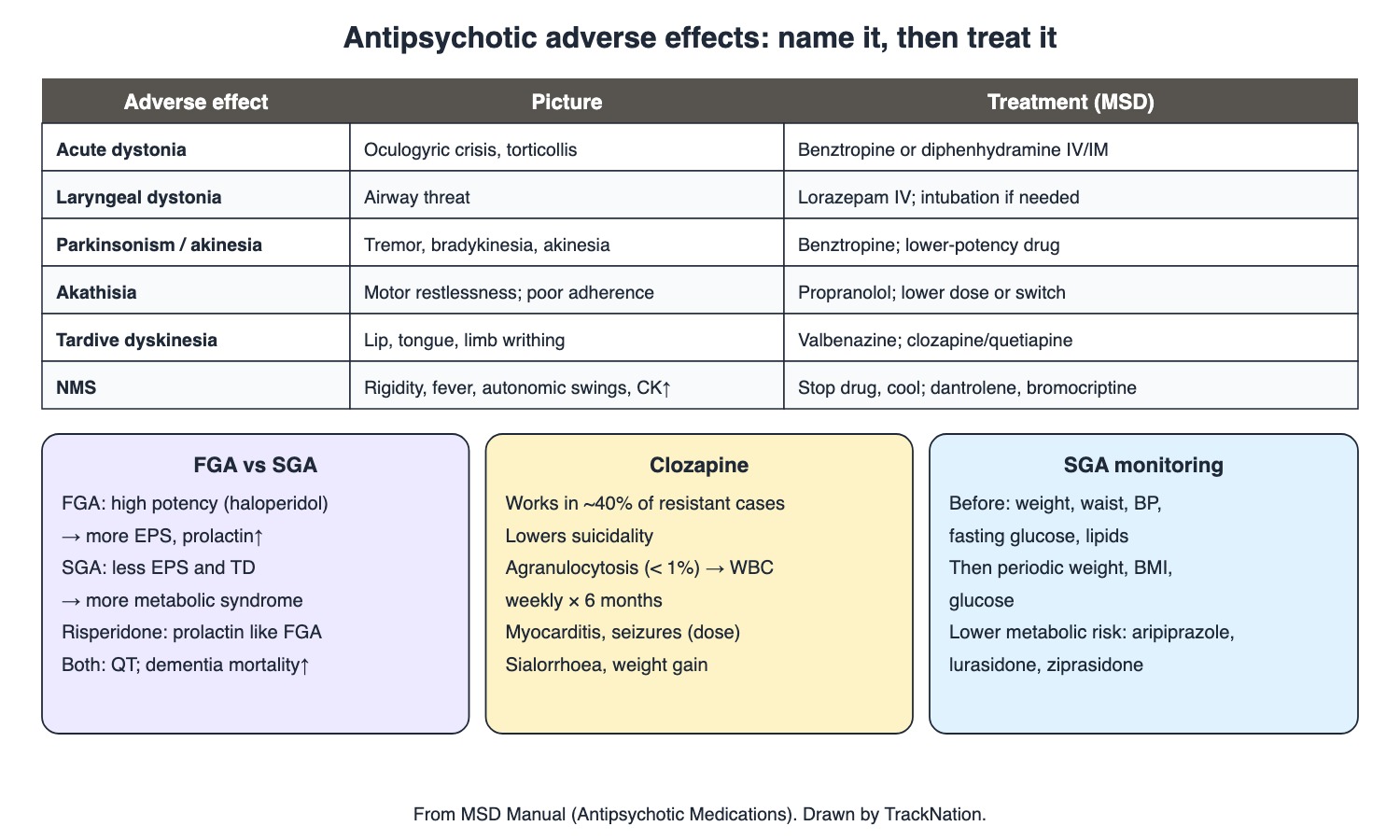
Antipsychotic adverse effects and treatment; FGA vs SGA; clozapine; SGA metabolic monitoring. Drawn by TrackNation.
Classes and Choice
First-generation (FGA): high-potency drugs such as haloperidol bind dopamine receptors strongly (more extrapyramidal effects); low-potency drugs such as chlorpromazine act more on alpha-adrenergic, muscarinic and histamine receptors. FGAs cause sedation, cognitive blunting, EPS, raised prolactin (galactorrhoea), weight gain and a lower seizure threshold, but remain useful in acute psychosis and when cost matters.
Second-generation (SGA): fewer EPS and much less tardive dyskinesia, little prolactin rise (except risperidone, which raises prolactin as much as FGAs) but more metabolic syndrome — weight gain, dyslipidaemia, type 2 diabetes. Olanzapine is sedating. Long-acting injections: aripiprazole, olanzapine, paliperidone, risperidone.
About 30% do not respond to FGAs. Clozapine works in about 40% of resistant patients, reduces suicidality and negative symptoms and hardly causes EPS or TD — but risks agranulocytosis (< 1%) needing WBC checks weekly for 6 months, then 2-weekly, then monthly after a year, plus myocarditis, dose-related seizures, sedation, hypotension, constipation, weight gain and excess salivation.
QT prolongation: thioridazine, haloperidol, olanzapine, risperidone, ziprasidone. All antipsychotics increase mortality in older adults with dementia. Xanomeline (with trospium) is the first antipsychotic with no D2 action.
Adverse Effects and Their Treatment
Acute dystonia — oculogyric crisis, torticollis: IV/IM benztropine or diphenhydramine. Laryngeal dystonia: IV lorazepam, intubation if needed.
Parkinsonism / akinesia: oral benztropine; consider a lower-potency drug. Akathisia (motor restlessness — a common reason for stopping treatment): propranolol, dose reduction or switching.
Tardive dyskinesia: lip and tongue puckering, finger movements, limb writhing; with FGAs the risk rises about 5% per year of exposure and it may persist after stopping. Track with the AIMS scale; switch to clozapine or quetiapine; valbenazine (VMAT2 inhibitor) is approved.
Neuroleptic malignant syndrome: rigidity, hyperthermia, autonomic instability, high creatine kinase; possible with all antipsychotics (more with FGAs). Stop the drug, cool rapidly, support; bromocriptine, amantadine, dantrolene.
Metabolic monitoring for SGAs: before starting, record weight, waist, BP, fasting glucose and lipids and family history of diabetes; then monitor weight, BMI and glucose. At high metabolic risk prefer aripiprazole, lurasidone, ziprasidone, cariprazine or lumateperone. ICMR also asks about weight gain, menstrual and sexual dysfunction at each review.
Traps the Examiner Sets
Restlessness after starting haloperidol = akathisia → propranolol, not more antipsychotic.
Rigidity + fever + high CK = NMS → stop the drug.
Clozapine: blood counts; risperidone: prolactin; olanzapine: weight and sedation.
Tardive dyskinesia may not go away after stopping the drug.
Memory Hooks & Shortcuts
Shortcuts to lock in this article's numbers and lists. Each one only re-packages facts proven above.
🧠 'Dystonia → Diphenhydramine or benztropine; Akathisia → A beta-blocker' — EPS treatment
🧠 NMS = 'Rigid, Hot, Unstable, CK sky-high' — NMS
🧠 Akathisia: 'restless legs? Propranolol' — akathisia
🧠 Clozapine 'CLOZ': Count the WBC, Lower suicide, Overcomes resistance, Zero EPS (almost) — clozapine
🧠 'Risperidone Raises prolactin; Olanzapine Overeats' — SGA side effects
Rapid-Revision Cards
High potency
Haloperidol: D2, more EPS.
Low potency
Chlorpromazine: sedation, anticholinergic, α-block.
SGA trade-off
Less EPS, more metabolic.
Risperidone
Prolactin like FGAs.
Olanzapine
Sedation, weight.
Non-responders
~30% to FGAs.
Clozapine
~40% of resistant; ↓ suicide.
Clozapine risk
Agranulocytosis < 1%.
WBC schedule
Weekly 6 mo → 2-weekly → monthly after 1 y.
Clozapine others
Myocarditis, seizures, salivation.
Acute dystonia
Benztropine/diphenhydramine IV/IM.
Laryngeal dystonia
IV lorazepam; airway.
Akathisia
Propranolol.
Parkinsonism
Benztropine; lower potency.
Tardive dyskinesia
~5%/year on FGAs; may persist.
TD drug
Valbenazine.
NMS
Rigidity, fever, autonomic, CK↑.
NMS treatment
Stop drug, cool, bromocriptine, dantrolene.
Metabolic baseline
Weight, waist, BP, glucose, lipids.
QT drugs
Thioridazine, haloperidol, ziprasidone.
Dementia
Antipsychotics ↑ mortality.
Sources
Facts in this article were checked against these documents.
Test Yourself: Practice Questions
Thirty questions in NEET PG style, most of them clinical vignettes.
Practice Questions (NEET PG pattern)
Original questions written in the style of the exam: +4 for a correct answer, −1 for a wrong one. Every answer was checked against the sources listed above. NEET PG papers are not published by NBEMS, so these are not past-paper questions.
Q1. High-potency first-generation antipsychotics such as haloperidol differ from low-potency ones in having
(a) higher dopamine affinity and less alpha-adrenergic/muscarinic action
(b) no extrapyramidal effects
(c) more anticholinergic effects
(d) more sedation
Show answer
Answer: (a) — So more EPS.
Q2. A low-potency first-generation antipsychotic is
(a) aripiprazole
(b) haloperidol
(c) risperidone
(d) chlorpromazine
Show answer
Answer: (d) — More adrenergic, muscarinic, histamine effects.
Q3. Compared with FGAs, second-generation antipsychotics
(a) raise prolactin more in all cases
(b) never affect weight
(c) cause more tardive dyskinesia
(d) cause fewer EPS but more metabolic syndrome
Show answer
Answer: (d) — Weight, lipids, diabetes.
Q4. A woman on an antipsychotic develops galactorrhoea and missed periods. The SGA most likely to do this, as much as FGAs, is
(a) clozapine
(b) quetiapine
(c) aripiprazole
(d) risperidone
Show answer
Answer: (d) — Prolactin elevation.
Q5. About what proportion of patients with schizophrenia do not respond to FGAs?
(a) about 70%
(b) about 1%
(c) about 30%
(d) none
Show answer
Answer: (c) — Consider clozapine.
Q6. The antipsychotic effective in about 40% of treatment-resistant patients is
(a) haloperidol
(b) risperidone
(c) clozapine
(d) chlorpromazine
Show answer
Answer: (c) — Only drug proven after FGA/SGA failure.
Q7. Weekly blood counts are required for the first 6 months of clozapine because of
(a) agranulocytosis
(b) thrombocytosis
(c) hepatitis
(d) hyperkalaemia
Show answer
Answer: (a) — < 1% of patients.
Q8. Besides agranulocytosis, a serious cardiac adverse effect of clozapine is
(a) myocarditis
(b) pericardial tamponade
(c) heart block
(d) aortic stenosis
Show answer
Answer: (a) — Also seizures, salivation.
Q9. Clozapine can cause seizures that are
(a) only in children
(b) caused by withdrawal only
(c) dose-dependent
(d) never seen
Show answer
Answer: (c) — Higher doses, higher risk.
Q10. Clozapine has a special role in patients with schizophrenia who
(a) have diabetes
(b) are at high suicide risk
(c) need sedation for sleep
(d) have mild first episodes
Show answer
Answer: (b) — It reduces suicidality.
Q11. A young man given haloperidol develops sustained upward eye deviation and neck twisting. Treatment is
(a) dantrolene
(b) propranolol
(c) IV/IM benztropine or diphenhydramine
(d) stop all drugs and wait
Show answer
Answer: (c) — Acute dystonia.
Q12. Acute dystonia affecting the larynx with stridor is treated with
(a) IV lorazepam, intubating if needed
(b) valbenazine
(c) oral benztropine next day
(d) propranolol
Show answer
Answer: (a) — Airway emergency.
Q13. A patient on an antipsychotic feels an inner urge to keep moving and cannot sit still. The drug of choice is
(a) more haloperidol
(b) dantrolene
(c) valbenazine
(d) propranolol
Show answer
Answer: (d) — Akathisia; can cause non-adherence.
Q14. After years of FGA treatment, a patient shows lip puckering, tongue movements and writhing fingers. The diagnosis is
(a) NMS
(b) akathisia
(c) acute dystonia
(d) tardive dyskinesia
Show answer
Answer: (d) — Can persist after stopping.
Q15. With FGAs, the risk of tardive dyskinesia increases by about
(a) it does not change
(b) 50% per month
(c) 1% total
(d) 5% per year of exposure
Show answer
Answer: (d) — Cumulative risk.
Q16. A scale used to track tardive dyskinesia is the
(a) Abnormal Involuntary Movement Scale (AIMS)
(b) Y-BOCS
(c) MMSE
(d) HAM-D
Show answer
Answer: (a) — Includes tongue protrusion.
Q17. A drug approved specifically for tardive dyskinesia is
(a) benztropine
(b) lithium
(c) valbenazine (VMAT2 inhibitor)
(d) haloperidol
Show answer
Answer: (c) — Also deutetrabenazine.
Q18. A patient with tardive dyskinesia who still needs an antipsychotic can be switched to
(a) clozapine or quetiapine
(b) haloperidol
(c) chlorpromazine
(d) fluphenazine
Show answer
Answer: (a) — Lower motor risk.
Q19. A patient on haloperidol develops high fever, marked muscle rigidity, fluctuating blood pressure and a very high CK. The diagnosis is
(a) malignant hyperthermia of anaesthesia
(b) neuroleptic malignant syndrome
(c) acute dystonia
(d) serotonin syndrome
Show answer
Answer: (b) — Possible with all antipsychotics.
Q20. Management of NMS includes
(a) starting lithium
(b) increasing the antipsychotic
(c) adding benztropine only
(d) stopping the antipsychotic, rapid cooling, and bromocriptine or dantrolene
Show answer
Answer: (d) — Supportive care.
Q21. NMS is more common with
(a) lithium only
(b) SSRIs
(c) first-generation antipsychotics
(d) benzodiazepines
Show answer
Answer: (c) — But any antipsychotic can cause it.
Q22. Before starting a second-generation antipsychotic, baseline checks should include
(a) nothing
(b) weight, waist, BP, fasting glucose and lipids
(c) ECG only
(d) thyroid only
Show answer
Answer: (b) — Then periodic monitoring.
Q23. For a patient with obesity and pre-diabetes, an antipsychotic with lower metabolic risk is
(a) aripiprazole
(b) clozapine
(c) chlorpromazine
(d) olanzapine
Show answer
Answer: (a) — Also lurasidone, ziprasidone.
Q24. An agitated patient with insomnia might be given an SGA with relatively high sedation, such as
(a) aripiprazole
(b) olanzapine
(c) ziprasidone
(d) lurasidone
Show answer
Answer: (b) — Choose by side-effect profile.
Q25. Which antipsychotics are available as long-acting injections?
(a) quetiapine only
(b) clozapine only
(c) aripiprazole, olanzapine, paliperidone, risperidone
(d) none
Show answer
Answer: (c) — Helps adherence.
Q26. Antipsychotics that can prolong the QT interval include
(a) none
(b) aripiprazole only
(c) lithium
(d) thioridazine, haloperidol and ziprasidone
Show answer
Answer: (d) — Risk of fatal arrhythmia.
Q27. In older adults with dementia, antipsychotics are associated with
(a) better memory
(b) improved survival
(c) increased mortality
(d) no change
Show answer
Answer: (c) — Both FGAs and SGAs.
Q28. First-generation antipsychotics still have a role mainly in
(a) dementia
(b) pregnancy only
(c) tardive dyskinesia
(d) acute psychosis and when cost matters
Show answer
Answer: (d) — SGAs widely used otherwise.
Q29. The first antipsychotic with no action at dopamine D2 receptors is
(a) xanomeline (with trospium)
(b) aripiprazole
(c) haloperidol
(d) clozapine
Show answer
Answer: (a) — Muscarinic agonist.
Q30. Tardive dyskinesia, once established, may
(a) always resolve in a week
(b) respond to more antipsychotic
(c) persist indefinitely even after stopping the drug
(d) be prevented by benztropine
Show answer
Answer: (c) — Hence prevention and monitoring.
Active Recall
From memory: compare first- and second-generation antipsychotics, describe clozapine's uses and risks, and name each extrapyramidal adverse effect, tardive dyskinesia and NMS with their treatment, plus metabolic monitoring.