Stress-Related, Somatic and Dissociative Disorders for NEET PG Psychiatry: PTSD vs Acute Stress, Adjustment, Somatic Symptom Disorder, Conversion
Start Here
🎯 Exam priority: Moderate-High. Expect: acute stress disorder (< 1 month) vs PTSD (≥ 1 month), flashbacks and hypervigilance, trauma-focused CBT and prazosin, adjustment disorder within 3 months, the somatic symptom criteria and the 6-month rule, ICMR amitriptyline, illness anxiety, conversion symptoms that break anatomical rules, factitious disorder vs malingering, fugue.
CBME mapping: PS 8.1 — diagnose stress-related disorders (acute stress and adjustment) and refer appropriately.
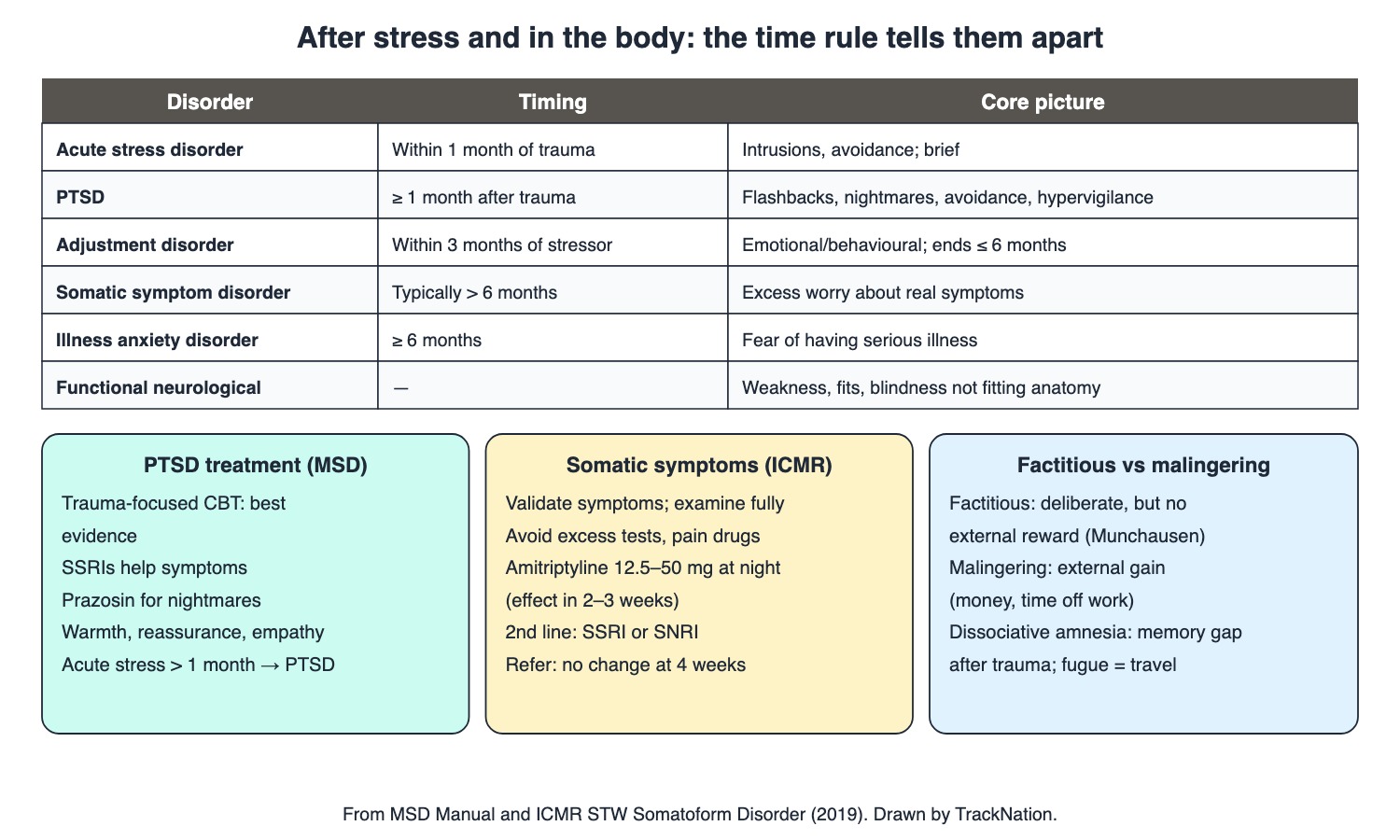
Stress-related and somatic disorders by timing; PTSD treatment; ICMR somatic symptom management; factitious vs malingering. Drawn by TrackNation.
Trauma and Stress
Acute stress disorder: intrusive recollections and related symptoms within 4 weeks of an overwhelming trauma; if significant symptoms last beyond 1 month, think PTSD.
PTSD (diagnosed ≥ 1 month after trauma): intrusive memories, nightmares and flashbacks triggered by sights, sounds or smells; avoidance of reminders; negative mood and cognitions; hypervigilance and poor sleep. Treatment: trauma-focused CBT (best evidence); SSRIs improve symptoms; prazosin for nightmares; warmth and empathy matter.
Adjustment disorder: emotional or behavioural symptoms within 3 months of an identifiable stressor (job loss, money problems, becoming a parent, caring for a disabled relative), ending within 6 months after the stressor ends; not trivial — it causes real distress and disability.
Somatic Symptom and Related Disorders
Somatic symptom disorder (ICMR): one or more distressing bodily symptoms plus excessive thoughts, anxiety or time spent on them, persisting typically more than 6 months. Severity: mild (1 of the B features), moderate (≥ 2), severe (≥ 2 plus multiple or one very severe symptom). Common: pain at many sites, GI symptoms, abnormal skin sensations, sexual and menstrual complaints. Patients request repeated tests and doctor shop. A medical illness does not exclude it; onset usually before 30.
ICMR management: full examination; treat anaemia and nutritional deficiency; validate the symptoms; avoid irrational painkillers; amitriptyline 12.5–50 mg at night (effect in 2–3 weeks); exercise and relaxation; tell the family the distress is genuine. Secondary care: SSRIs (escitalopram, sertraline, fluoxetine) or SNRIs (venlafaxine, duloxetine), brief counselling. Refer if no improvement after 4 weeks, diagnostic doubt, suicide risk or comorbidity. MSD: CBT is first line.
Illness anxiety disorder: preoccupation with having a serious illness for ≥ 6 months despite reassurance after full evaluation.
Functional neurological symptom (conversion) disorder: weakness, paralysis, sensory loss, seizures, unresponsiveness, blindness that are incompatible with known anatomy or physiology, often linked to stress or trauma; no proven drug treatment unless there is psychiatric comorbidity.
Factitious disorder (Munchausen): deliberate falsification or induction of illness without external reward; malingering is the same deception for external gain (money, time off). Approach non-confrontationally.
Dissociative amnesia: inability to recall autobiographical memories, usually after trauma or stress; fugue adds purposeful travel or wandering, sometimes with a new identity. Suicide risk can rise when memories return suddenly.
Traps the Examiner Sets
Under 1 month = acute stress disorder; 1 month or more = PTSD.
Factitious = no external gain; malingering = external gain.
Conversion signs do not follow anatomy.
Somatic symptom disorder can coexist with a real medical illness.
Memory Hooks & Shortcuts
Shortcuts to lock in this article's numbers and lists. Each one only re-packages facts proven above.
🧠 'One month line': before = Acute stress; after = PTSD — timing
🧠 Adjustment '3 in, 6 out': starts within 3 months, gone 6 months after — adjustment disorder
🧠 'Factitious = For attention (no reward); Malingering = Money' — deception
🧠 Conversion: 'the body breaks rules that nerves follow' — functional neurological disorder
🧠 Somatic symptoms in primary care: 'Validate, don't investigate endlessly, Amitriptyline' — ICMR
Rapid-Revision Cards
Acute stress disorder
Within 4 weeks of trauma.
PTSD
≥ 1 month after trauma.
PTSD features
Flashbacks, avoidance, hypervigilance.
PTSD Rx
Trauma-focused CBT; SSRIs.
Nightmares
Prazosin.
Adjustment disorder
Within 3 months; ends ≤ 6 months.
Somatic symptom disorder
Distressing symptoms + excess worry > 6 months.
SSD severity
Mild 1, moderate ≥ 2, severe ≥ 2 + many.
SSD with disease
Allowed.
ICMR drug
Amitriptyline 12.5–50 mg at night.
ICMR approach
Validate; avoid painkiller misuse.
SSD 2nd line
SSRI or SNRI.
Refer
No improvement at 4 weeks.
Illness anxiety
Fear of serious illness ≥ 6 months.
Conversion
Signs incompatible with anatomy.
Conversion drugs
No evidence without comorbidity.
Factitious
Deliberate, no external gain.
Malingering
Deliberate, external gain.
Approach
Non-confrontational.
Dissociative amnesia
Memory gap after trauma.
Fugue
Travel, new identity.
Sources
Facts in this article were checked against these documents.
Standard Treatment Workflow: Somatoform Disorder — Indian Council of Medical Research, DHR, 2019 (link)
MSD Manual Professional: PTSD; Acute Stress Disorder; Adjustment Disorders; Somatic Symptom Disorder; Illness Anxiety Disorder; Functional Neurological Symptom Disorder; Factitious Disorder; Dissociative Amnesia — Merck & Co. (MSD Manuals), reviewed 2025–26 (link)
Competency Based Undergraduate Curriculum, Psychiatry (PS 8) — National Medical Commission, 2024
Test Yourself: Practice Questions
Thirty questions in NEET PG style, most of them clinical vignettes.
Practice Questions (NEET PG pattern)
Original questions written in the style of the exam: +4 for a correct answer, −1 for a wrong one. Every answer was checked against the sources listed above. NEET PG papers are not published by NBEMS, so these are not past-paper questions.
Q1. Two weeks after a road accident, a woman has intrusive memories, avoids the road and feels on edge. The diagnosis is
(a) PTSD
(b) adjustment disorder
(c) acute stress disorder
(d) panic disorder
Show answer
Answer: (c) — Within 4 weeks of trauma.
Q2. PTSD can only be diagnosed
(a) at least 1 month after the trauma
(b) only in soldiers
(c) after 6 months
(d) within 1 week
Show answer
Answer: (a) — Acute stress disorder is within the first month.
Q3. Core features of PTSD include
(a) grandiosity and pressured speech
(b) intrusive memories, flashbacks, avoidance and hypervigilance
(c) compulsive washing
(d) hallucinations only
Show answer
Answer: (b) — Plus negative mood and poor sleep.
Q4. A soldier relives combat when he smells smoke. This is a
(a) delusion
(b) obsession
(c) flashback
(d) hallucination due to psychosis
Show answer
Answer: (c) — Triggered by sensory cues.
Q5. The treatment with the strongest evidence for PTSD is
(a) ECT
(b) trauma-focused cognitive behavioural therapy
(c) benzodiazepines
(d) antipsychotics
Show answer
Answer: (b) — Drugs are less robust.
Q6. A drug that helps trauma-related nightmares in PTSD is
(a) prazosin
(b) methylphenidate
(c) haloperidol
(d) lithium
Show answer
Answer: (a) — Alpha-1 blocker.
Q7. Which drug class improves PTSD symptoms?
(a) opioids
(b) SSRIs
(c) stimulants
(d) anticholinergics
Show answer
Answer: (b) — Adjunct to psychotherapy.
Q8. Two months after losing his job, a man is persistently low and irritable and not coping, without meeting criteria for depression. The likely diagnosis is
(a) dysthymia
(b) schizophrenia
(c) PTSD
(d) adjustment disorder
Show answer
Answer: (d) — Within 3 months of a stressor.
Q9. Adjustment disorder symptoms should not continue for more than
(a) 6 months after the stressor and its consequences end
(b) they are lifelong
(c) 1 week
(d) 2 years
Show answer
Answer: (a) — Per DSM-5-TR via MSD.
Q10. Somatic symptom disorder is characterised by
(a) delusions only
(b) distressing bodily symptoms with excessive thoughts, anxiety or time devoted to them
(c) deliberate faking for money
(d) loss of memory
Show answer
Answer: (b) — ICMR criteria A and B.
Q11. In somatic symptom disorder, the symptomatic state is typically persistent for more than
(a) 1 month
(b) 1 week
(c) 5 years
(d) 6 months
Show answer
Answer: (d) — ICMR criterion C.
Q12. A patient with somatic symptom disorder meets only one of the excessive thought/feeling/behaviour criteria. ICMR grades this as
(a) mild
(b) severe
(c) moderate
(d) not diagnosable
Show answer
Answer: (a) — ≥ 2 = moderate.
Q13. A known diabetic has excessive, persistent worry and spends most of her time on mild symptoms. Can somatic symptom disorder still be diagnosed?
(a) only if diabetes is cured
(b) only in men
(c) yes — a medical illness does not exclude it
(d) no — medical illness excludes it
Show answer
Answer: (c) — Changed criteria.
Q14. The ICMR primary-care drug for somatic symptom disorder is
(a) low-dose amitriptyline 12.5–50 mg at night
(b) high-dose opioids
(c) lithium
(d) haloperidol
Show answer
Answer: (a) — Effect in 2–3 weeks.
Q15. Which is part of ICMR primary care for somatic symptoms?
(a) start morphine
(b) tell the patient it is imaginary
(c) order every test requested
(d) validate the symptoms and avoid irrational pain medication
Show answer
Answer: (d) — Also treat anaemia, exercise, relaxation.
Q16. Referral to secondary care in somatic symptom disorder is advised when there is
(a) first visit
(b) no improvement after 4 weeks of first-line treatment
(c) normal tests
(d) any pain
Show answer
Answer: (b) — Also suicide risk, comorbidity.
Q17. Second-line drugs for somatic symptom disorder at secondary care include
(a) clozapine
(b) SSRIs or SNRIs such as duloxetine
(c) benzodiazepines long term
(d) steroids
Show answer
Answer: (b) — Per ICMR.
Q18. Per MSD, the first-line treatment for somatic symptom disorder is
(a) surgery
(b) antipsychotics
(c) psychotherapy, particularly CBT
(d) ECT
Show answer
Answer: (c) — Antidepressants also help.
Q19. A man has feared having cancer for a year despite normal evaluations and reassurance, with few physical symptoms. This is
(a) OCD
(b) delusional disorder
(c) illness anxiety disorder
(d) somatic symptom disorder
Show answer
Answer: (c) — ≥ 6 months of preoccupation.
Q20. After a family conflict, a woman cannot move her right arm; examination findings do not fit any nerve or brain lesion. The diagnosis is
(a) functional neurological symptom (conversion) disorder
(b) stroke
(c) factitious disorder
(d) malingering
Show answer
Answer: (a) — Incompatible with anatomy.
Q21. Drug treatment for functional neurological symptom disorder without psychiatric comorbidity is
(a) antiepileptics
(b) first-line SSRIs
(c) antipsychotics
(d) not supported by evidence
Show answer
Answer: (d) — Treat comorbid depression or anxiety if present.
Q22. A woman repeatedly induces symptoms in herself to get admitted, with no financial or other external gain. The diagnosis is
(a) conversion disorder
(b) somatic symptom disorder
(c) malingering
(d) factitious disorder imposed on self
Show answer
Answer: (d) — Formerly Munchausen syndrome.
Q23. Factitious disorder differs from malingering because in factitious disorder
(a) there is financial gain
(b) the symptoms are unconscious
(c) there is no obvious external incentive
(d) there is a real disease
Show answer
Answer: (c) — Both are conscious deception.
Q24. A man fakes back pain to get paid time off work. This is
(a) conversion disorder
(b) factitious disorder
(c) malingering
(d) illness anxiety
Show answer
Answer: (c) — External gain.
Q25. When presenting a diagnosis of factitious disorder, the recommended approach is
(a) confrontation in front of family
(b) non-aggressive, non-punitive and non-confrontational
(c) police report
(d) discharge without explanation
Show answer
Answer: (b) — Per MSD.
Q26. After an assault, a woman cannot recall what happened over a few hours, though other memory is normal. This is
(a) delirium
(b) Korsakoff psychosis
(c) dementia
(d) localised dissociative amnesia
Show answer
Answer: (d) — Usually after trauma or stress.
Q27. A man disappears from home, travels to another city and starts work under a new name, with no memory of his past. This is
(a) dissociative fugue
(b) delirium
(c) schizophrenia
(d) malingering
Show answer
Answer: (a) — Type of dissociative amnesia.
Q28. Suicide risk in dissociative amnesia may rise when
(a) the patient travels
(b) amnesia persists
(c) the patient sleeps
(d) memories return suddenly and overwhelm the patient
Show answer
Answer: (d) — Recover memories gently.
Q29. Somatic symptom disorder typically begins
(a) before age 30
(b) after menopause
(c) only in childhood
(d) after 60
Show answer
Answer: (a) — Sometimes in childhood.
Q30. A common challenge ICMR lists in somatic symptom disorder is
(a) repeated requests for investigations and doctor shopping despite reassurance
(b) memory loss
(c) hallucinations
(d) violence
Show answer
Answer: (a) — Focus on symptom relief.
Active Recall
From memory: separate acute stress disorder, PTSD and adjustment disorder by timing and give PTSD treatment, describe somatic symptom disorder with ICMR management, and contrast illness anxiety, conversion, factitious disorder, malingering and dissociative amnesia.